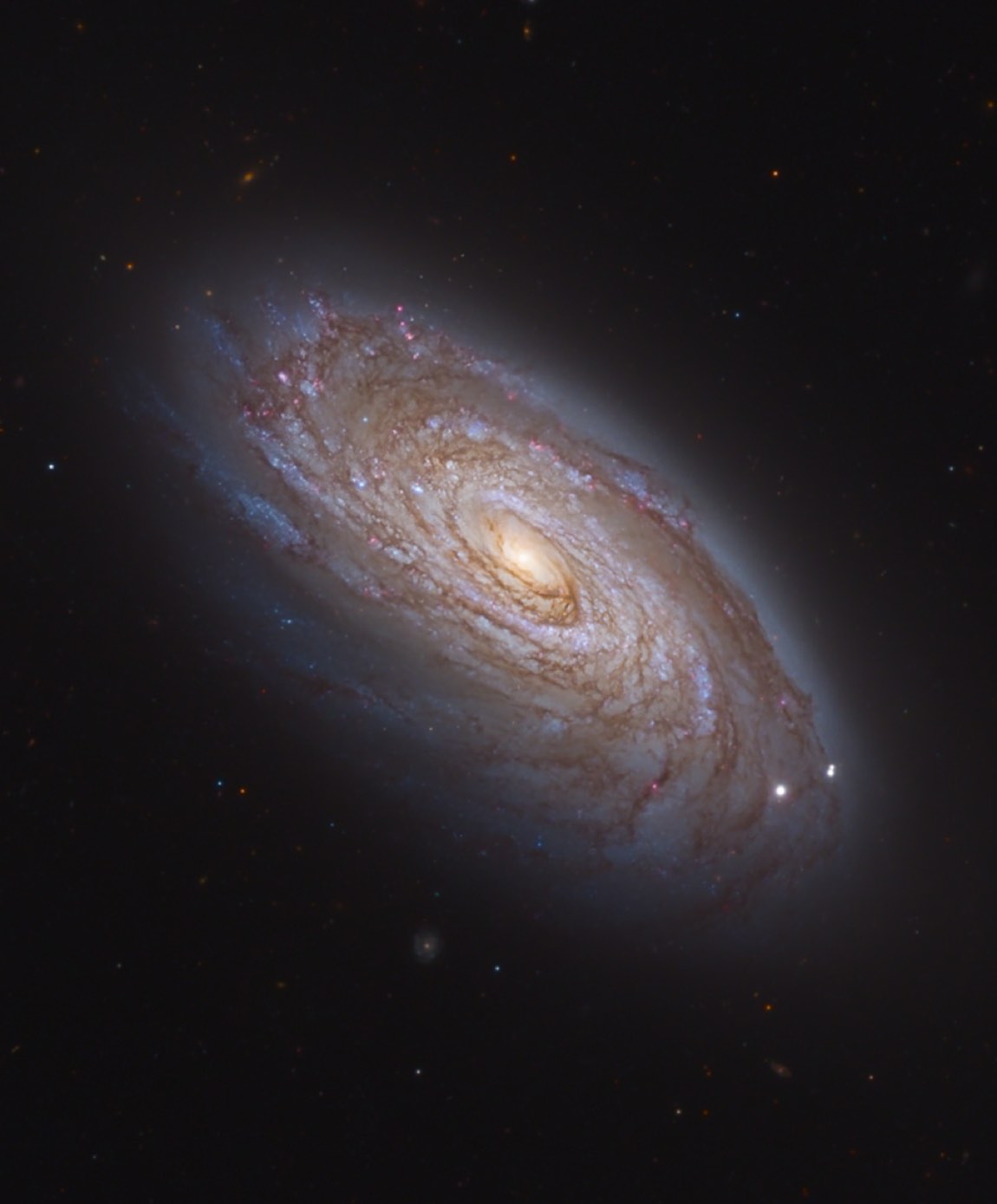
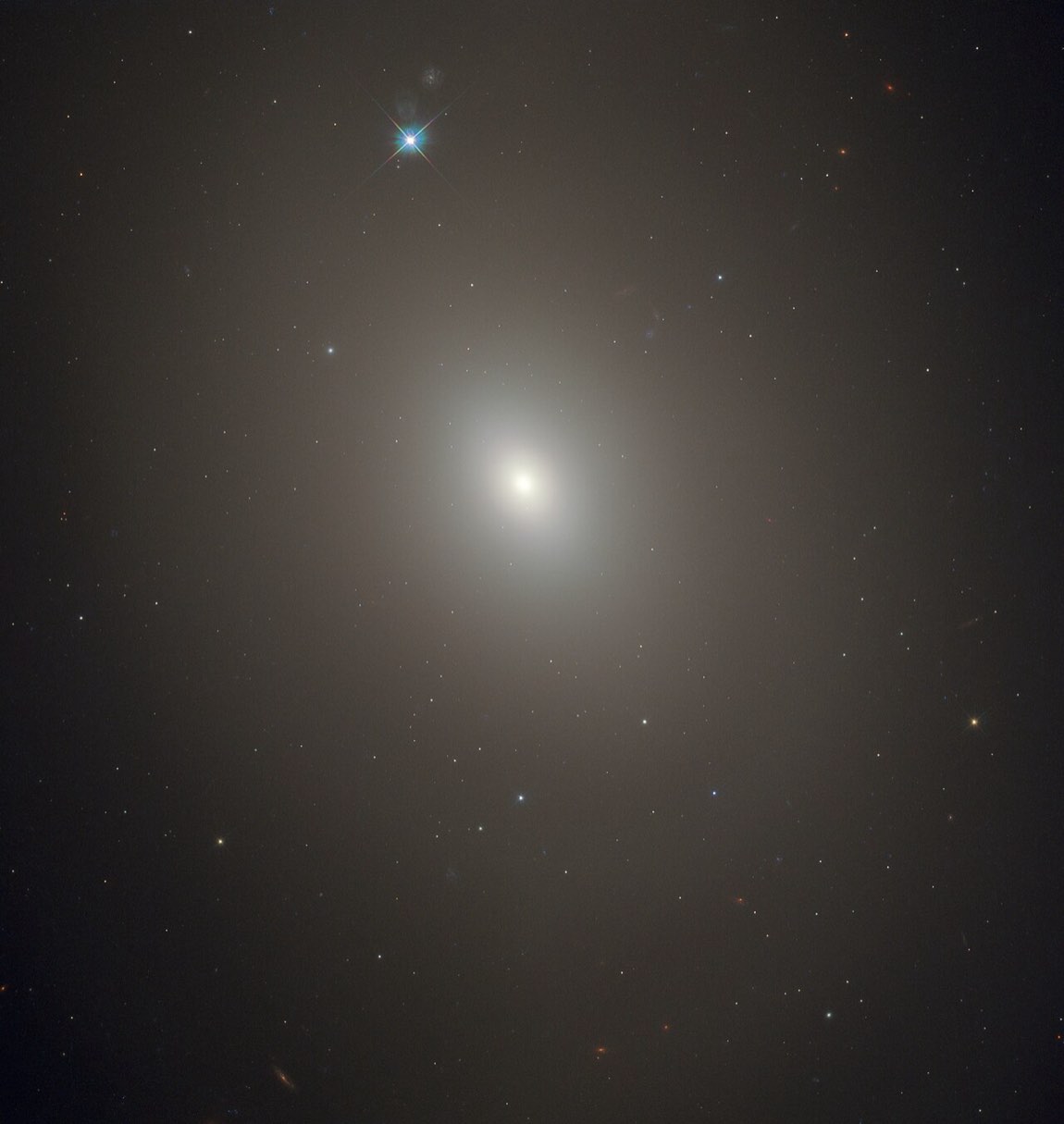
 Photograph · Credit: ESA/Hubble & NASA, R. O'Connell · CC BY 4.0
Galaxy · Deep guide
Messier 85
Also called: M85 · NGC 4382 · UGC 7508 · PGC 40515
A lens-shaped galaxy still showing the ripples of a merger billions of years ago.
What is it?
Messier 85 is a lenticular galaxy (some astronomers classify it as elliptical) in Coma Berenices, about 60 million light-years away. Pierre Méchain discovered it in 1781. It lies on the outskirts of the Virgo Cluster. Its outer regions show shells and ripples, thought to be left over from a merger with another galaxy 4 to 7 billion years ago. Its centre contains a relatively young population of stars, possibly from a later burst of star formation. It appears to be slowly turning from a lenticular into an elliptical galaxy.
The deep dive
Researched for the Atlas from Wikipedia — Messier 85 (2,160 characters read) · updated Nov 15, 2026
01 A galaxy caught changing its identity
Most galaxies wear their type like a permanent label, but Messier 85 appears to be in the middle of a slow transformation. Astronomers currently classify it as a lenticular galaxy — a flattened, disk-shaped system with little ongoing star formation — yet some researchers argue it is better described as an elliptical. The debate is not merely semantic. M85 is thought to be actively transitioning from one category into the other, gradually losing whatever disk structure it once had and evolving toward the featureless, rounded form of a true elliptical. This kind of mid-transition state is rarely caught so clearly, making M85 a valuable test case for understanding how galaxies change over cosmic time. Its ambiguous classification reflects genuine physical uncertainty, not sloppy bookkeeping, and the tension between the two camps in the literature is itself a sign that something genuinely interesting is happening inside this galaxy right now.
02 Shells, ripples, and a galactic collision
Look closely at the outer regions of M85 and you find something unsettling: faint shells and ripples wrapped around the galaxy like the aftershocks of a slow-motion explosion. These structures are not random. They are the gravitational fingerprints of a merger with another galaxy that took place somewhere between 4 and 7 billion years ago — roughly when Earth's oceans were still young. When two galaxies collide and merge, stars get flung into arcing streams that fold back on themselves, creating the layered shell pattern astronomers observe today. M85 is also extremely poor in neutral hydrogen gas, which is consistent with a post-merger state: the violent encounter would have used up or dispersed much of the raw gaseous fuel that star-forming galaxies normally carry. The complex outer structure makes M85 one of the more visually striking examples of galactic archaeology in the nearby universe.
03 A surprise burst of young stars at the core Deeper
Despite being an early-type galaxy — a category usually associated with old, red, quietly aging stellar populations — M85 harbors a relatively young stellar population less than 3 billion years old concentrated in its centermost region. Some of these young stars are arranged in a ring, a geometry that often signals a specific triggering event rather than steady, gradual star formation. Astronomers suspect this central starburst was sparked by a late-stage interaction, possibly related to the same merger that created the outer shells, or perhaps a more recent gravitational encounter with one of its neighboring galaxies. Early-type galaxies are not supposed to be making many new stars, so finding a ring of comparatively fresh stars at the heart of M85 challenges the simple picture and suggests the galaxy's history is more complicated and more recent than its placid appearance might suggest.
04 The black hole that might not be there Deeper
Nearly every large galaxy is believed to harbor a supermassive black hole at its center, and Messier 85 is no exception — at least in theory. Indirect methods, which use the galaxy's overall mass and properties to predict what its central black hole should weigh, suggest it ought to contain one of around 100 million solar masses. That is roughly 25 times the mass of the black hole in the Milky Way. Yet when astronomers measure the actual motions of stars near the center of M85 using velocity dispersion observations — a more direct technique — the data imply the galaxy may entirely lack a central massive black hole. The contradiction is striking and unresolved. Either the indirect scaling relations break down for a galaxy like M85, or the velocity dispersion measurements are missing something, or the black hole genuinely is absent. Any of those outcomes would be scientifically important, and the question remains open.
05 Four flavors of globular clusters Deeper
Massive galaxies typically carry two populations of globular clusters: a "blue" population of older, metal-poor clusters and a "red" population of younger, metal-rich ones, the two groups reflecting different epochs of star formation in the galaxy's history. M85 goes further. In addition to those standard red and blue groupings, it hosts a population with intermediate colors and an even redder population beyond that. Four distinct flavors of globular clusters is unusual and suggests a more complicated assembly history than a simple two-phase formation model can explain. Globular clusters are remarkably long-lived and preserve a chemical record of the conditions when they formed, so reading the color distribution of M85's cluster system is essentially reading a compressed biography of the galaxy — one that hints at multiple mergers or star-formation episodes spread across billions of years.
06 Three neighbors and an unusual location
M85 sits within the outskirts of the Virgo Cluster, the massive collection of more than a thousand galaxies that dominates the local universe roughly 65 million light-years away. Despite living on the edge of one of the grandest structures in the nearby cosmos, M85 is described as relatively isolated — it is not tightly packed among close neighbors the way galaxies near the cluster's center are. It is, however, actively interacting with two specific companions: the nearby spiral galaxy NGC 4394 and a small elliptical called MCG 3-32-38. These gravitational interactions are ongoing and may be contributing to some of the structural and stellar features seen in M85 today, including possibly the disturbed outer regions and the ring of young central stars. Its edge-of-cluster position gives it a quieter environment than many Virgo members while still providing the occasional gravitational nudge.
07 Why M85 glows faintly in X-rays Deeper
Hot gas trapped in the gravitational wells of large elliptical and lenticular galaxies normally glows in X-rays, and studying that emission tells astronomers about the temperature and distribution of the gas. M85 does emit X-rays, but compared to other early-type galaxies of similar mass and type, it emits a relatively smaller proportion. The reason for this X-ray deficit is not definitively established, but it fits into the broader picture of a galaxy that has been through significant disruption. Mergers can redistribute and heat gas, potentially allowing some of it to escape the galaxy's gravity entirely, reducing the reservoir available to radiate in X-rays. The low X-ray output is therefore another clue pointing toward M85's turbulent past and adds to the portrait of a galaxy that, despite its calm outward appearance at optical wavelengths, carries the structural scars of a complicated history.
08 Two supernovae and a mysterious red flash
M85 has hosted three notable transient events that have kept astronomers busy for decades. The first was SN 1960R, a Type Ia supernova discovered on 20 December 1960 by Howard S. Gates and independently confirmed by Leonida Rosino on 18 January 1961; it reached a peak apparent magnitude of 13.5. Then in January 2006, the Lick Observatory Supernova Search detected an object on the galaxy's outskirts called M85 OT2006-1, which turned out to be historically significant: it was classified as a luminous red nova, the first event of that type to be formally identified as such. Luminous red novae are now understood as a distinct class of stellar explosion, thought to arise when two stars merge rather than when a single star dies. Most recently, the ATLAS telescope in Hawaii caught SN 2020nlb, another Type Ia supernova, on 25 June 2020; though discovered at magnitude 17.436, it eventually brightened to magnitude 12, making it visible in modest amateur telescopes.
09 Discovering M85: Méchain and the catalog
Pierre Méchain, a French astronomer and close collaborator of Charles Messier, discovered this galaxy in 1781. The discovery came during the period when Messier and Méchain were actively sweeping the sky to catalog fuzzy objects that might be confused with comets — the practical goal of Messier's famous list. M85 earned its place as the 85th entry in that catalog, and it also carries the designations NGC 4382 and PGC 40515. The NGC number comes from John Dreyer's New General Catalogue compiled more than a century later, while the PGC number is part of the modern Principal Galaxies Catalogue. All three identifiers refer to the same object, and the existence of multiple catalog names simply reflects how many generations of astronomers have independently classified and reclassified the sky's contents. That M85 was noticed in the eighteenth century with relatively modest instruments speaks to how intrinsically luminous it is at 60 million light-years distance.
10 How big is M85, really?
Messier 85 spans a diameter of about 36.99 kiloparsecs, which works out to roughly 120,600 light-years across. For comparison, the Milky Way is generally estimated at around 100,000 light-years in diameter, so M85 is modestly larger than our own galaxy. At a distance of 60 million light-years, its apparent size on the sky is entirely the result of intrinsic scale — there is nothing close about it. Light leaving M85 when the first complex animals were evolving on Earth is only now reaching our telescopes. The galaxy's large physical extent, combined with its complex outer shell structure, means that even its outermost observable features lie tens of thousands of light-years from the central core, underscoring just how vast the debris field left by its ancient merger really is.
11 Observing M85 from your backyard
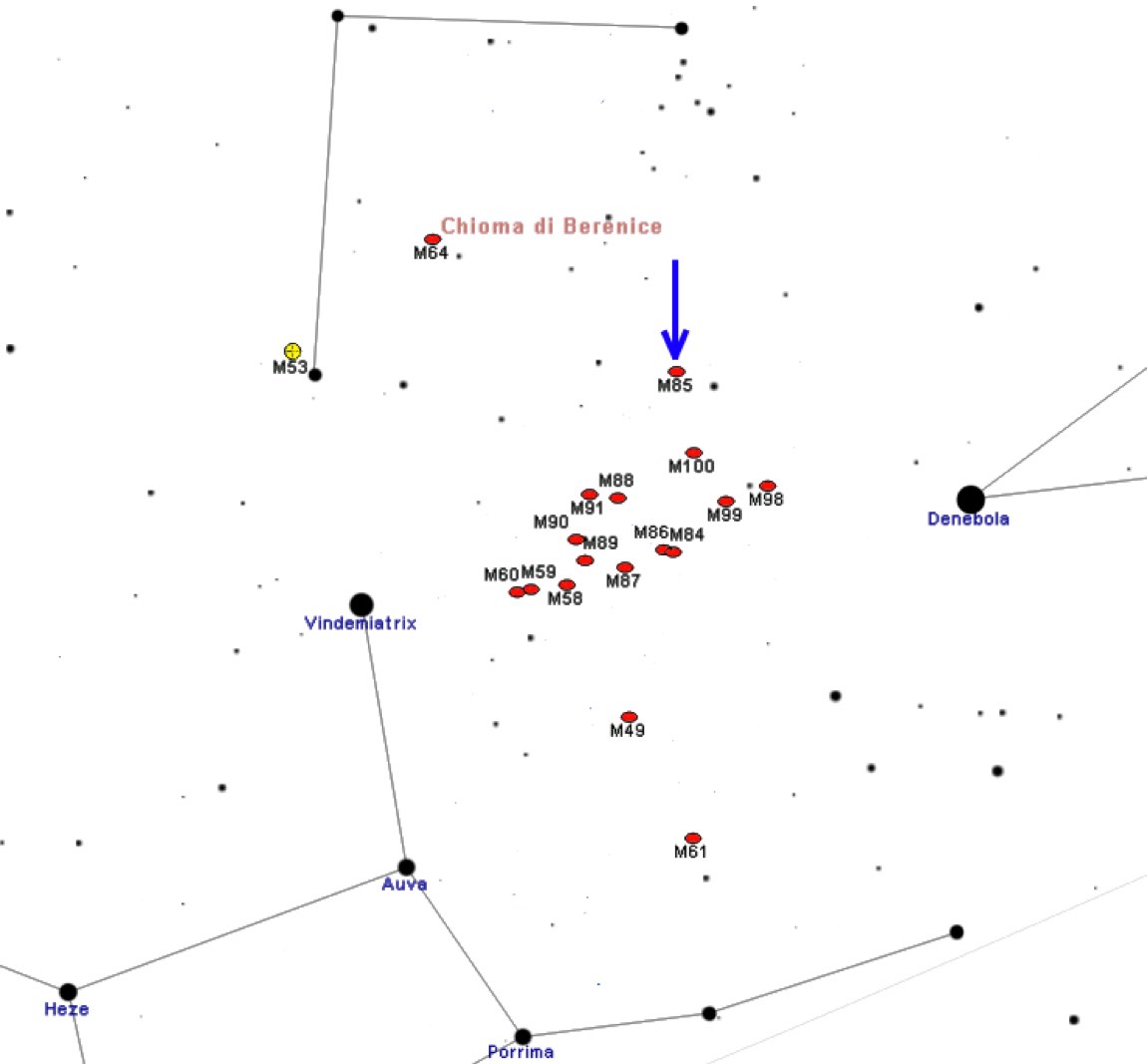
M85 is located in the constellation Coma Berenices, a faint but rewarding star field that climbs high in northern hemisphere spring skies. With an apparent magnitude bright enough to have been cataloged by eighteenth-century observers using basic refractors, it is accessible to modern amateur astronomers with small to moderate telescopes under reasonably dark skies. It appears as a softly glowing elliptical smudge, brighter toward the center, without sharp edges. The faint shells and ripples in its outer regions that fascinate professional astronomers require much larger aperture and careful image processing to reveal — visual observers will see the bright core rather than the structural complexity. When SN 2020nlb brightened to magnitude 12 in 2020, it temporarily became a point-like interloper visible even in modest instruments, offering a rare chance to watch a stellar death happening in a galaxy 60 million light-years away.
 ⤢