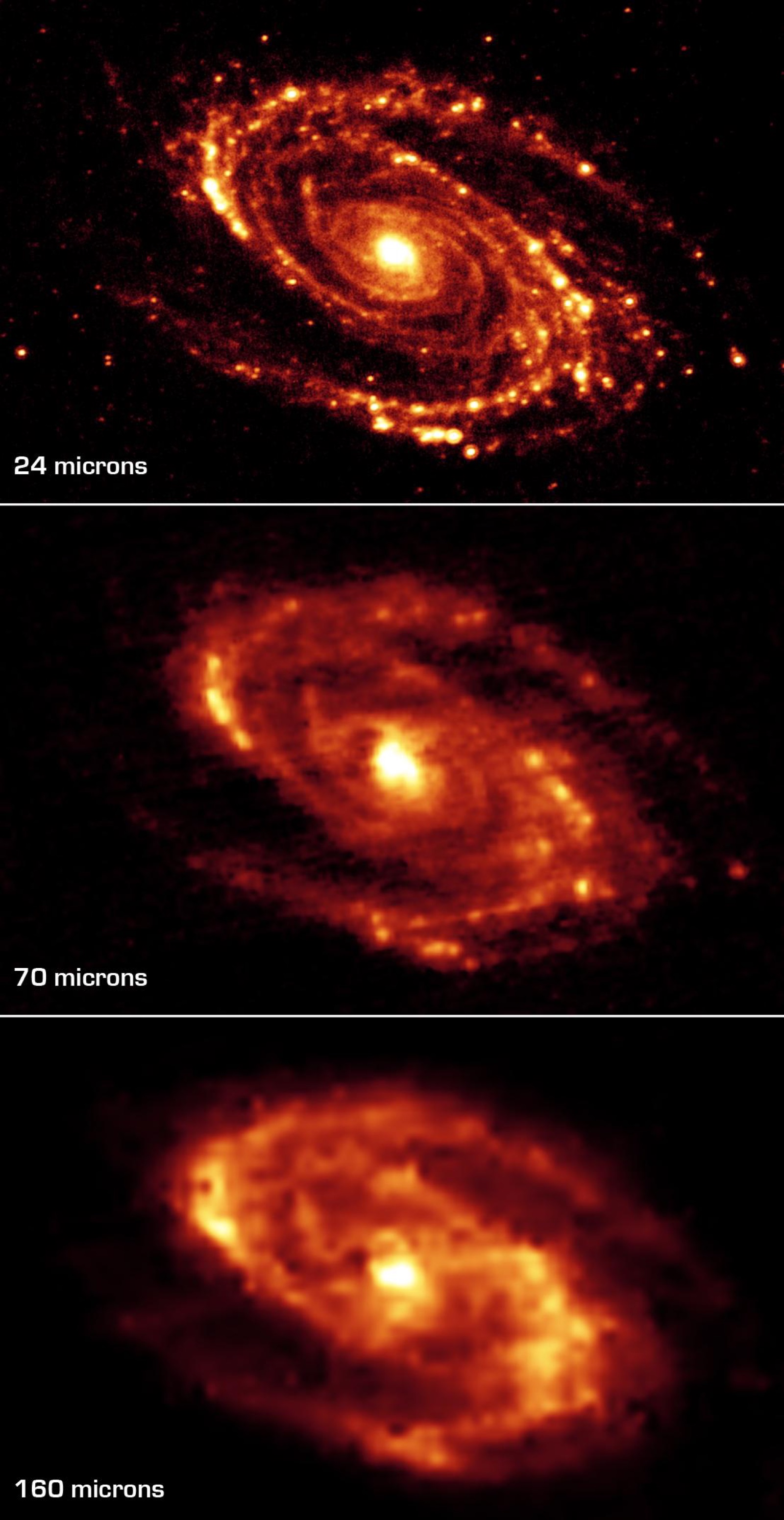
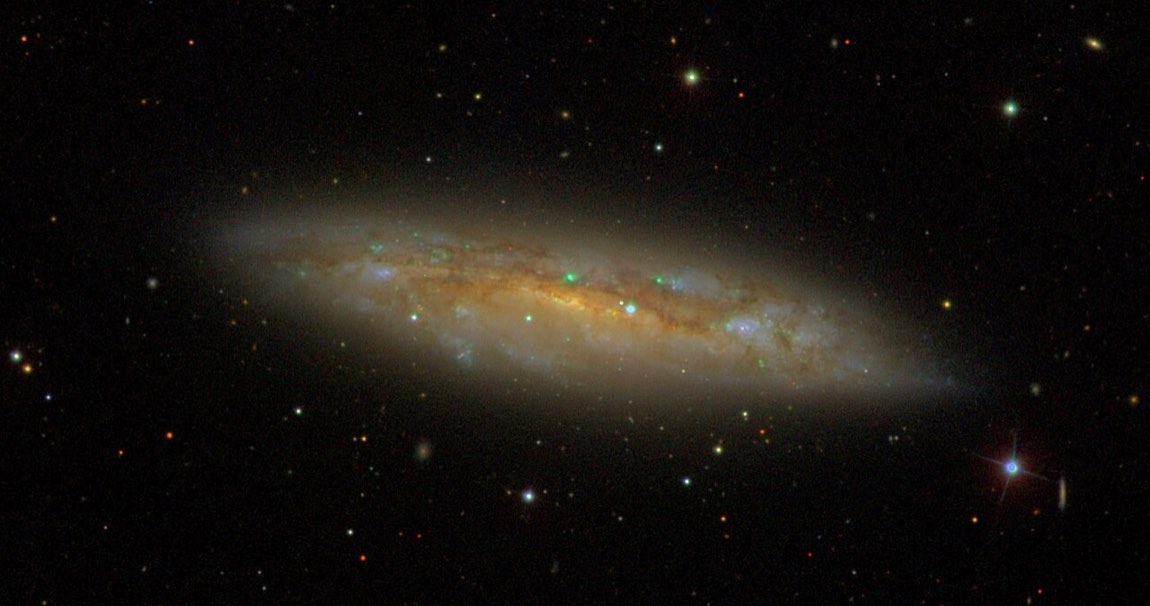
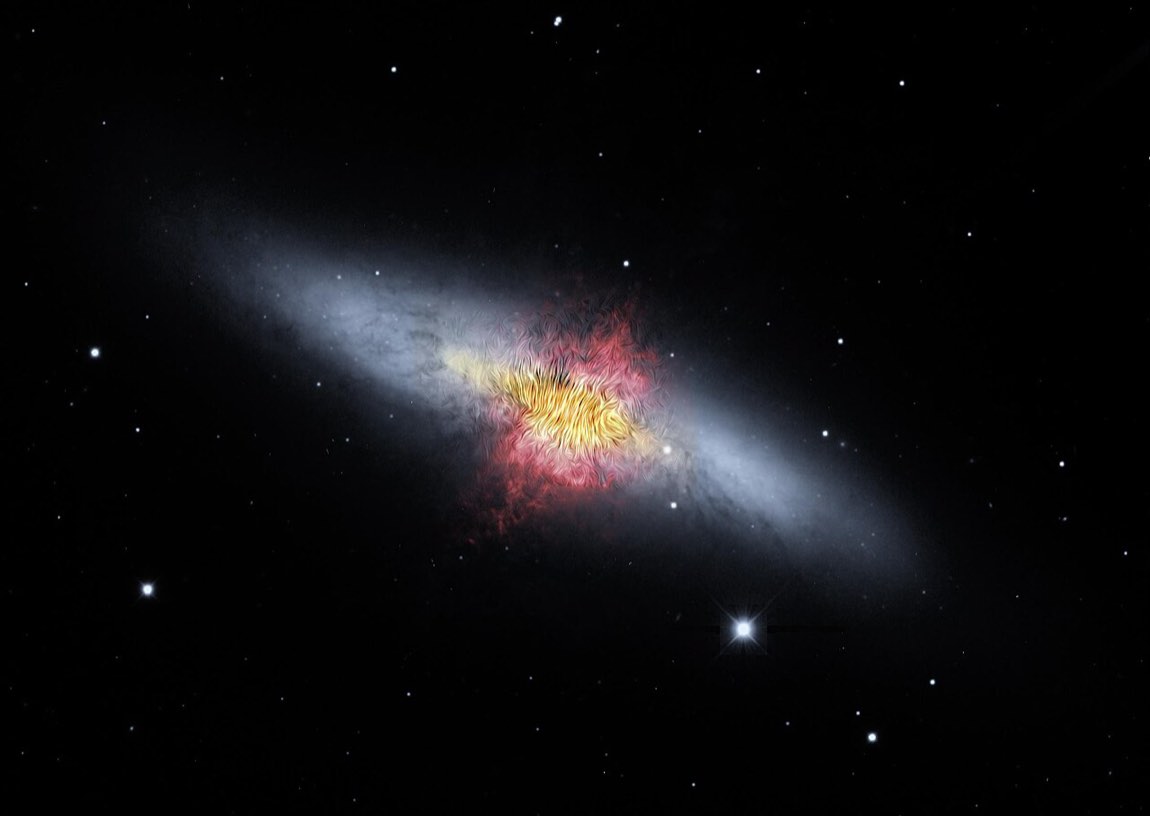
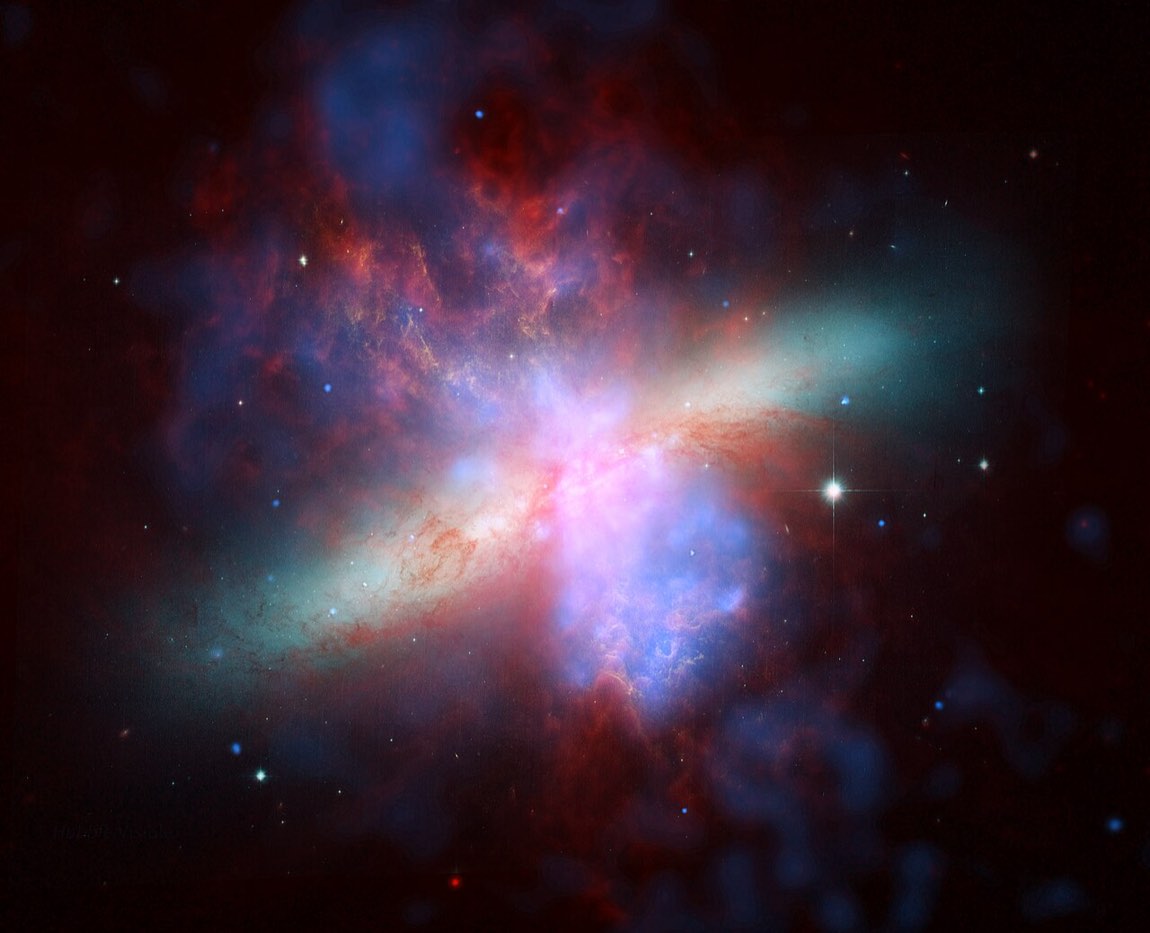
 Photograph · NASA/SOFIA/E. Lopez-Rodiguez; NASA/Spitzer/J. Moustakas et al. · Public domain
Galaxy · Deep guide
Messier 82 (Cigar Galaxy)
Also called: M82 · NGC 3034 · Cigar Galaxy · UGC 5322 · 3C 231
A galaxy in overdrive: its core makes stars so fast it blasts out plumes of gas.
What is it?
Messier 82, the Cigar Galaxy, is a starburst galaxy in Ursa Major about 12 million light-years away. Johann Bode found it, together with its neighbour M81, in 1774. A close pass by M81 is thought to have triggered a burst of star formation that makes M82 about five times brighter than the Milky Way overall, and its centre about a hundred times brighter. It is the classic example of a starburst galaxy. A Type Ia supernova, SN 2014J, appeared in it in January 2014.
The deep dive
Researched for the Atlas from Wikipedia — Messier 82 (8,804 characters read) · updated Nov 15, 2026
01 Spiral Arms Hidden in Plain Sight
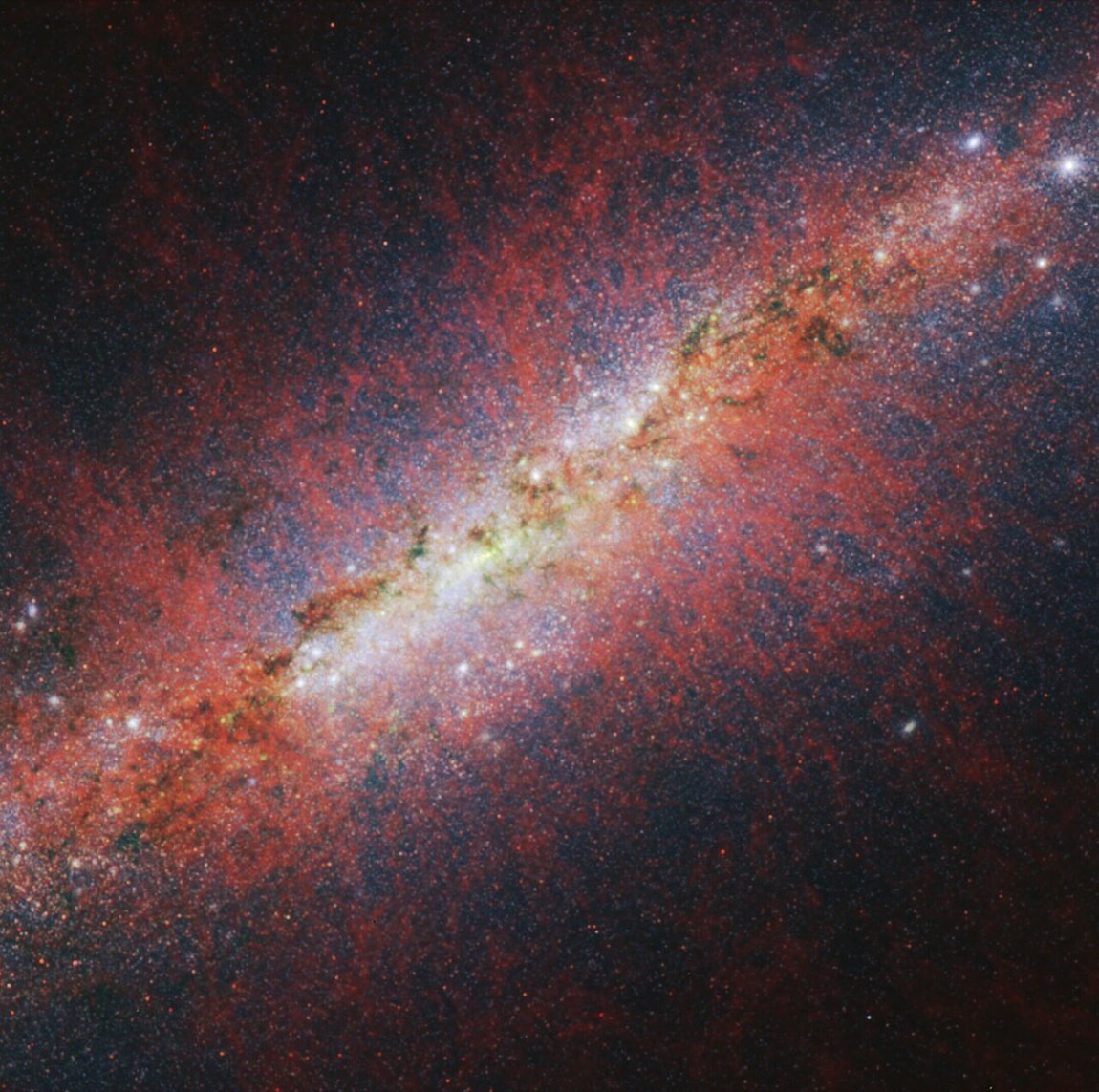
For decades astronomers classified M82 as an irregular galaxy, a chaotic smear of light with no obvious ordered structure. That picture changed dramatically in 2005, when two symmetric spiral arms were finally revealed in near-infrared images. Detecting them required a clever technique: researchers subtracted a smooth, axisymmetric exponential disk model from the infrared data, exposing the faint arms underneath. Three factors had conspired to hide them. First, M82's disk is extraordinarily bright, washing out subtler features. Second, we see the galaxy nearly edge-on, at roughly 80 degrees of inclination, compressing the spiral pattern into a thin sliver on the sky. Third, a complex web of dusty filaments obscures the view at optical wavelengths. The arms themselves are bluer than the surrounding disk, and they extend outward from the ends of an infrared bar for a length of three disk scale lengths. The sense of winding, assuming the northern side of M82 is closest to us as most researchers do, indicates they are trailing arms, the same handedness seen in the Milky Way.
02 The Superwind Blowing M82 Apart
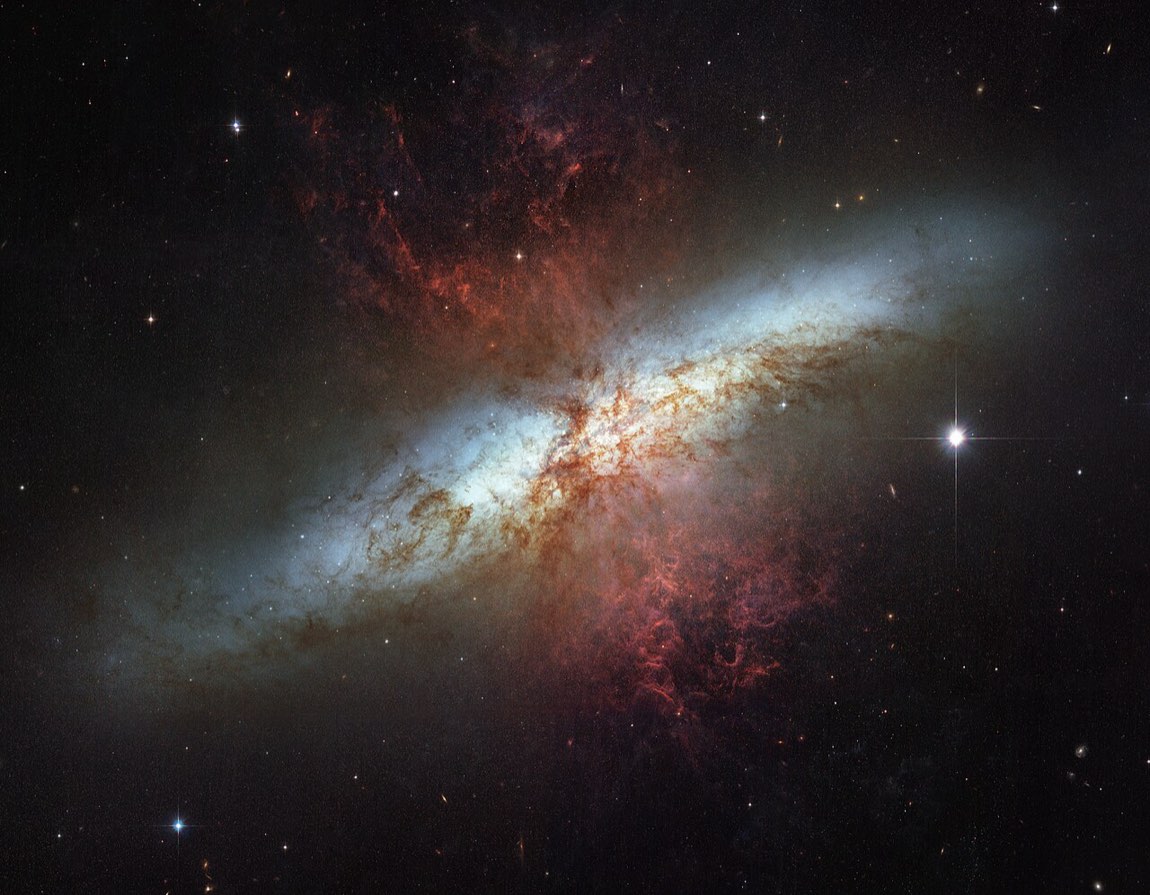
M82 is not quietly holding itself together. A dramatic bipolar outflow — astronomers call it a superwind — blasts material above and below the galaxy's disk in a structure that photographs as vivid red filaments stretching thousands of light-years into space. This superwind is concentrated on two of the four brightest starburst clumps in the galaxy's core, designated A and C. The energy driving it comes from supernovae detonating inside those clumps at the remarkable rate of roughly one explosion every ten years. That is an extraordinary cadence: our own Milky Way produces perhaps one or two supernovae per century. Each explosion pumps energy into the surrounding gas, and the cumulative pressure of hundreds of supernovae over millions of years sustains the outflow. The active starburst region powering all of this spans only about 500 parsecs in diameter, yet within it young stars are forming ten times faster than star formation proceeds across the entire Milky Way. It is a small furnace producing an outsized blast.
03 A Star-Forming Frenzy Triggered by a Neighbor
M82 did not ignite its furious starburst on its own. The culprit is the larger spiral galaxy M81, whose gravitational tidal forces began deforming M82 roughly 100 million years ago. Over the past 200 million years, at least one close encounter between the two galaxies funneled enormous quantities of gas into M82's core. The most recent such close pass is thought to have occurred somewhere between 200 and 500 million years ago. That encounter triggered a concentrated burst of star formation that ran for up to 50 million years at a rate of approximately 10 solar masses of new stars per year — enough material to build ten stars the mass of the Sun every single year. Two subsequent starbursts followed, with the most recent one occurring roughly 4 to 6 million years ago and likely responsible for forming the dense core clusters visible today. Looking at the broader disk, stars there appear to have formed in an earlier burst about 500 million years ago, with that disk-wide activity shutting off around 100 million years ago. One hypothesis holds that M82 was once a quiet, low surface brightness galaxy before its neighbor woke it up.
04 Hundreds of Young Massive Star Clusters Deeper
When the Hubble Space Telescope trained its cameras on M82's starburst core in 2005, it resolved 197 distinct young massive star clusters packed into that turbulent region. These are not ordinary open clusters like the Pleiades. Each one carries an average mass of around 200,000 solar masses, comparable to the most massive globular clusters orbiting the Milky Way, yet they are far younger. The core environment that produced them is described as very energetic and high-density, conditions that allow giant molecular clouds to collapse and fragment into stars at an accelerated rate. Beyond the core, M82's disk is littered with hundreds of additional clusters with properties similar to globular clusters but younger, relics of the disk-wide starburst that peaked about 500 million years ago. This population gives M82 a layered archaeological record: an older disk generation, a quiescent period, and then renewed core activity driven by tidal interactions with M81. Reading that record lets astronomers reconstruct the interaction history between the two galaxies with surprising precision.
 ⤢
05 Two Black Holes and a Mystery Object Deeper
M82 hosts at least two confirmed black holes of very different scales, plus one deeply puzzling radio source. At the galaxy's center sits a supermassive black hole with a mass of approximately 3 × 10⁷ solar masses, measured through stellar dynamics. Roughly 600 light-years from that center, the Chandra X-ray Observatory detected fluctuating X-ray emissions that astronomers interpret as evidence for an intermediate-mass black hole — a class of object between stellar-mass and supermassive — with an estimated mass somewhere between 200 and 5,000 solar masses. If confirmed, it would be among the first known examples of this long-sought intermediate category. Then there is the unidentified radio source reported in April 2010 by astronomers at the University of Manchester's Jodrell Bank Observatory. It appeared suddenly, emitting radio waves unlike anything previously observed. It sits several arcseconds from M82's center, appears stable, and shows an apparent superluminal motion of four times the speed of light relative to the galaxy — an effect consistent with relativistic jets and not actual faster-than-light travel. No existing theory fully accounts for all of its observed properties.
06 The Brightest Pulsar Ever Found
In 2014, while studying M82, scientists made a record-breaking discovery tucked inside the galaxy's chaotic core: a pulsar, designated M82 X-2, that outshines every other known pulsar. Pulsars are the ultra-dense, rapidly spinning remnants left behind when massive stars explode as supernovae, and they emit beams of radiation that sweep across space like cosmic lighthouses. What made M82 X-2 so astonishing was simply its luminosity — it claimed the title of the brightest pulsar yet known at the time of discovery. Finding it inside a starburst galaxy makes a certain intuitive sense, since M82's elevated supernova rate produces fresh pulsar-forming explosions roughly once per decade, giving the galaxy an unusually large supply of young, energetic neutron stars. The discovery added another superlative to M82's growing list and reinforced the galaxy's status as a natural laboratory for studying extreme astrophysical objects that are rare or absent in quieter environments like our own Milky Way neighborhood.
07 A Magnetar Burst from Beyond the Milky Way
In November 2023 M82 delivered yet another first. Astronomers detected a gamma-ray burst originating from the galaxy and traced it back to a magnetar — a neutron star with an extraordinarily powerful magnetic field capable of releasing sudden, intense bursts of energy. The significance went beyond M82 itself: this was the first magnetar-sourced gamma-ray burst ever detected outside the Milky Way, and only the fourth such event detected anywhere. Magnetars are already among the most extreme objects known to physics, with magnetic fields trillions of times stronger than Earth's. Catching one flare up at a distance of 12 million light-years and still registering a detectable signal underscores just how violent these outbursts are. The event also demonstrates that M82's dense, supernova-rich environment continues to produce exotic neutron star remnants at a pace that makes it one of the most productive laboratories in the nearby universe for studying the endpoint of massive stellar evolution.
08 A Century of Supernovae, Mostly Hidden Deeper
Because M82 forms massive stars so rapidly, it also destroys them rapidly — massive stars live short lives and die as supernovae. Yet most of M82's supernovae go visually undetected, smothered by the thick dust and gas clouds that also fuel star formation. The radio-detected supernova SN 2008iz is a clear example: it was identified as a probable supernova only through its radio emission, invisible at optical wavelengths. A similar undesignated transient appeared in 2009. Studies of supernova remnants by the European VLBI Network in the 1980s and 1990s found evidence for even earlier events, including one remnant that showed measurable expansion between 1986 and 1997, implying the original explosion happened in the early 1960s. Two additional remnants suggested ages nearly as young. All of this points to a substantial backlog of unrecorded events. The first supernova candidate, SN 1986D, turned out not to be a supernova at all — a variable infrared source masquerading as one — while the first confirmed supernova, SN 2004am, was identified from archival images taken months before its official discovery.
 ⤢
09 SN 2014J: The Closest Type Ia in Decades
On 21 January 2014, astrophysics lecturer Steve Fossey and four of his students at the University of London Observatory spotted a new point of light in M82 glowing at apparent magnitude +11.7. Two days later it had brightened to magnitude +10.9. Tracing back through archival images showed it had been brightening since at least 15 January, starting at magnitude +14.4. Early speculation suggested it might reach magnitude +8.5, putting it within reach of large binoculars, but it peaked at magnitude +10.5 at the end of January — still visible in modest backyard telescopes. Classified as a young, reddened Type Ia supernova and officially designated SN 2014J by the International Astronomical Union, it holds the distinction of being the closest Type Ia supernova observed since SN 1972E, more than four decades earlier. Type Ia supernovae are cosmologically important because their consistent peak brightness makes them standard candles for measuring distances across the universe, so having one so nearby allowed unusually detailed study of the explosion mechanism and its interaction with surrounding dust.
10 How and When M82 Was First Recorded
M82 entered the historical record in 1774, when German astronomer Johann Elert Bode observed it alongside its companion M81. His description was characteristically spare but evocative: he noted it as a nebulous patch located about three-quarters of a degree from the other object, describing it as "very pale and of elongated shape" — an apt description of what we now recognize as an edge-on galaxy seen through its own dusty disk. Five years later, in 1779, French astronomer Pierre Méchain independently rediscovered both objects and reported his findings to Charles Messier, who incorporated them into his famous catalog of nebulae and star clusters. Messier's catalog was originally designed as a practical tool to help comet hunters avoid confusing fuzzy, non-moving objects with actual comets. The fact that M82 made the list reflects how genuinely nebula-like it appears through a small telescope — an elongated smudge that could easily be mistaken for a comet on a first glance.
11 M82's Place in Its Local Galaxy Group
M82 is not isolated. It is the second-largest member of the M81 Group, a collection of galaxies bound together by gravity at a distance of roughly 12 million light-years from Earth in the constellation Ursa Major. The dominant member is M81, a well-ordered spiral galaxy that visually appears only about 130,000 light-years from M82 when projected on the sky — though accounting for each galaxy's uncertain position along the line of sight, their actual three-dimensional separation is estimated at 300,000 light-years, with an uncertainty of plus 300,000 or minus 200,000 light-years. That proximity is what makes the interaction between them so consequential for M82. Despite being the smaller partner, M82 punches well above its weight in terms of energy output: it is about five times more luminous than the entire Milky Way, and its central region alone is roughly one hundred times more luminous, a concentration of energy made possible by the tidal stirring its larger neighbor has provided over hundreds of millions of years.
12 Observing the Cigar Galaxy from Earth
M82 is one of the most rewarding targets in the northern sky for amateur astronomers. Its apparent magnitude and location in Ursa Major place it well above the horizon for observers throughout the northern hemisphere for much of the year. Through even a modest telescope, its elongated, cigar-like profile — the feature that gave it its popular name — is immediately apparent, and the edge-on disk crossed by dark dust lanes becomes clearer with larger apertures. The galaxy is best found by star-hopping from the bright stars of the Big Dipper, and it rewards wider-field views because M81 fits in the same eyepiece at low magnification, offering a striking paired comparison between a classic face-on spiral and an edge-on starburst galaxy. SN 2014J's peak brightness of magnitude +10.5 demonstrated that supernovae in M82 can reach visibility in backyard instruments, so the galaxy is worth monitoring during any active survey period. Narrowband hydrogen-alpha imaging reveals the spectacular red filaments of the superwind that standard color photographs only hint at.
 ⤢