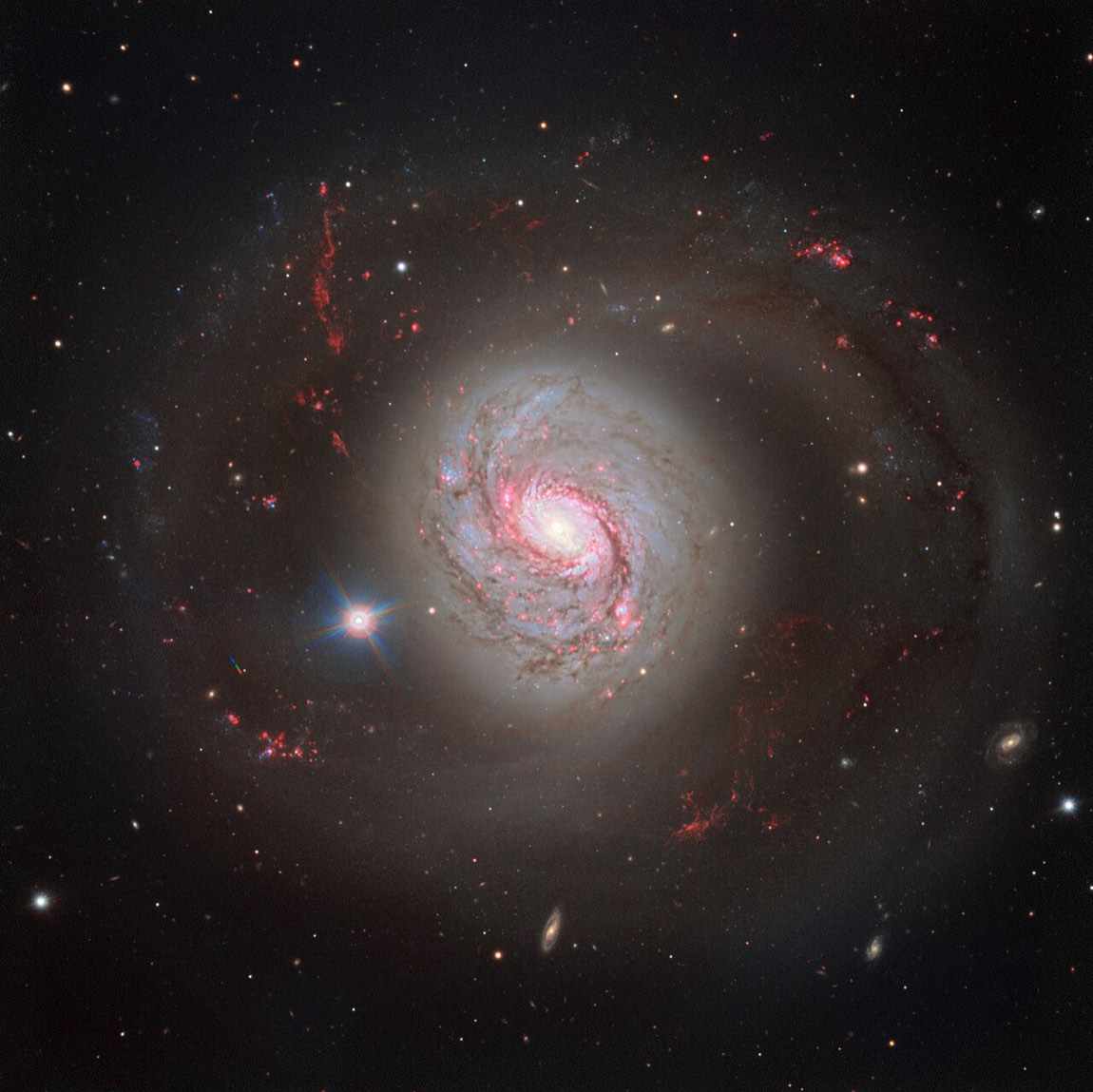
 Photograph · ESO · CC BY 4.0
Galaxy · Deep guide
Messier 77 (Squid Galaxy)
Also called: M77 · NGC 1068 · Squid Galaxy · Cetus A · 3C 71 · Arp 37
One of the brightest active galaxies in our sky, its core lit by a feeding black hole.
What is it?
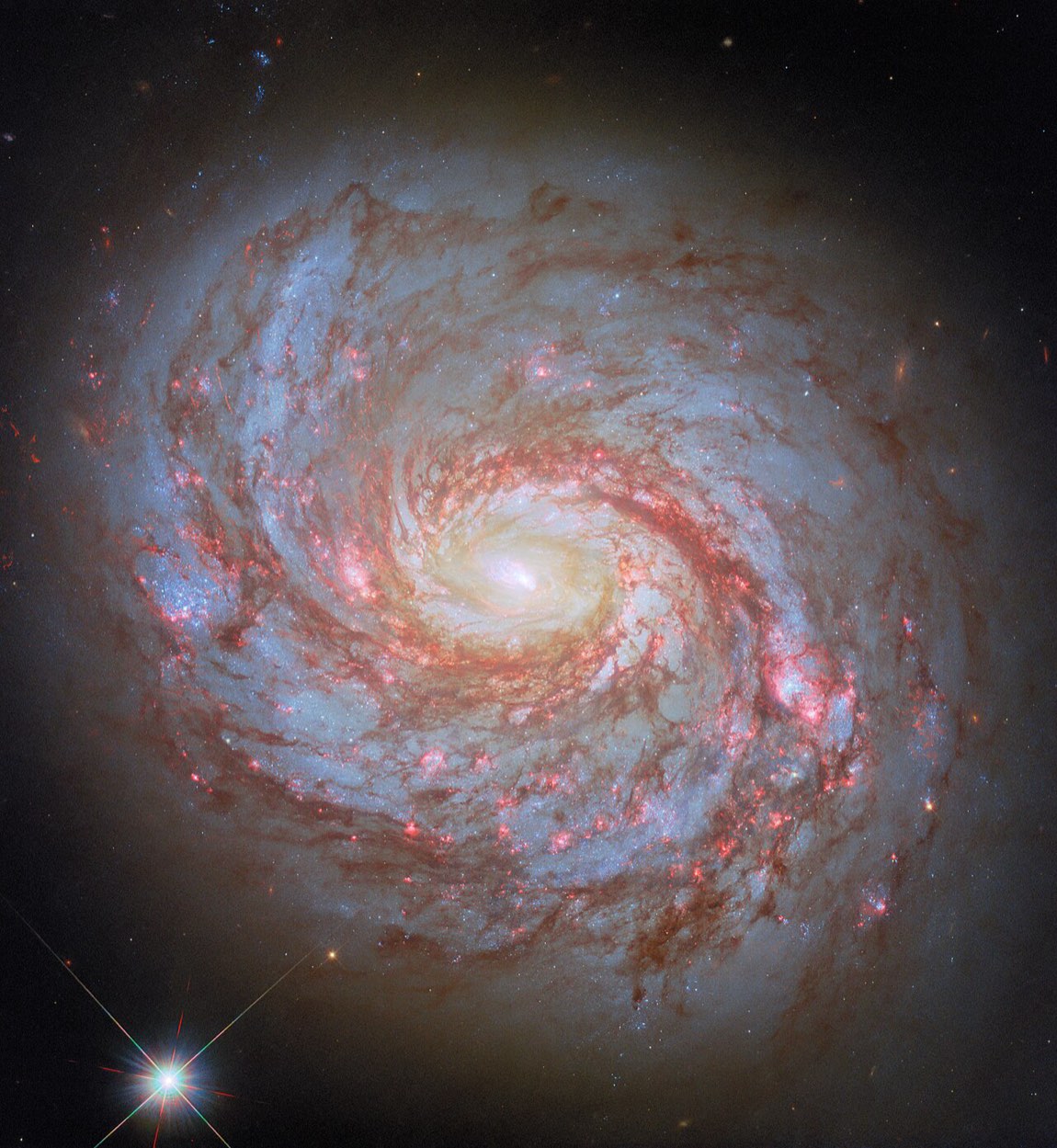
Messier 77, also called the Squid Galaxy, is a spiral galaxy in Cetus about 35 million light-years away. Pierre Méchain found it in 1780, and both Messier and William Herschel thought it was a star cluster. It is one of the brightest Seyfert galaxies seen from Earth, meaning its centre glows intensely as material falls toward a supermassive black hole. Visible-light images show a ringed spiral, but infrared images reveal a bar through its middle. It is the largest galaxy in a small group of at least seven.
The deep dive
Researched for the Atlas from Wikipedia — Messier 77 (4,402 characters read) · updated Nov 15, 2026
01 A Case of Mistaken Identity Through the Ages
When Pierre Méchain spotted Messier 77 in 1780, he logged it as a nebula — a diffuse cloud of gas, not a star system in its own right. He passed the find along to Charles Messier, who added it to his now-famous catalog. Yet even Messier himself, along with the great observer William Herschel, described the object as a star cluster rather than a galaxy. This was not carelessness on their part; the technology of the era simply could not resolve the true nature of what they were seeing. It took more than a century of advancing telescope design and spectroscopic technique before astronomers recognized Messier 77 for what it actually is: a vast barred spiral galaxy lying 35 million light-years away. The progression from "nebula" to "star cluster" to "galaxy" tracks the entire arc of modern astronomical understanding, making M77 a small but vivid chapter in the history of how humanity learned to read the sky.
02 The Hidden Bar and Its Winding Arms Deeper
Classifying the shape of Messier 77 has proven surprisingly tricky. In the De Vaucouleurs morphological system the galaxy carries the designation (R)SA(rs)b, which unpacks into a layered description: an outer ring-like structure, a non-barred spiral core, a transitional inner ring-spiral region, and moderately wound arms. Ann et al. in 2015 assigned an even tighter SAa classification, implying arms wound closer to the nucleus. The twist comes from infrared imaging. At visible wavelengths the central regions look unbarred, but switch to infrared and a prominent bar emerges from behind the obscuring dust. Because infrared light penetrates dust far more effectively than optical light, astronomers now classify M77 as a barred spiral, overriding the optical impression. This example illustrates a broader lesson in astronomy: the wavelength you choose to observe at can fundamentally change what a galaxy appears to be, making multi-wavelength surveys essential for accurate morphology.
03 An Active Nucleus Behind a Dusty Veil
At the heart of Messier 77 sits an active galactic nucleus — a supermassive black hole furiously consuming surrounding material and flooding space with energy. What makes M77 particularly important is that this nucleus is hidden from ordinary optical telescopes by a thick shroud of astronomical dust. In February 2022, astronomers reported that infrared interferometry had detected a cloud of cosmic dust at the galaxy's center, confirming it is sheltering that supermassive black hole from direct view. Earlier work using the MIDI instrument at the Very Large Telescope measured the hot dust in mid-infrared light, while the VLBA and VLA radio arrays first pinned down the diameter of the molecular disk and hot plasma that make up the obscuring material. Because the nucleus is blocked yet the galaxy is relatively close at 35 million light-years, M77 has become a kind of natural laboratory — giving astronomers a way to study the machinery of an AGN without being blinded by its full glare.
04 Why M77 Is the Prototype Seyfert 2 Galaxy Deeper
Seyfert galaxies are active galaxies whose nuclei shine with exceptional brightness, and they come in two observational flavors. Type 1 Seyferts show broad emission lines in their spectra, produced by gas moving at thousands of kilometers per second close to the central black hole. Type 2 Seyferts, like Messier 77, lack those broad lines. The leading explanation, known as the unified model of AGN, proposes that type 1 and type 2 Seyferts are actually the same class of object seen from different viewing angles — when a thick ring or torus of gas and dust surrounds the nucleus and the observer's line of sight passes through it, the broad-line region is hidden, producing what looks like a type 2. Tacconi et al. in 1994 gave direct support to this idea by analyzing M77's spectra with interferometry, finding that a thick molecular cloud region was obscuring a type 1 core. Because M77 is one of the brightest, closest, and most thoroughly examined type 2 Seyferts, it has earned recognition as the prototype of this class — the benchmark against which others are compared.
 ⤢
05 Jets, Bow Shocks, and Molecular Outflows Deeper
Messier 77 drives a radio jet that extends in two directions: a northeast region and a southwest region. These jets are not propagating through empty space; they plow into the interstellar medium of the galaxy, and those collisions create bow shocks — curved shock fronts similar in concept to the wave a boat pushes ahead of its bow. In M77 the bow shocks in the northeast region spatially overlap with the edges of a molecular outflow, a stream of gas being expelled from the galactic center. The overlap is not coincidental: it strongly suggests that the jet itself is the engine responsible for driving the outflow, transferring energy and momentum from the AGN deep into the surrounding gas. This jet-driven feedback is thought to be one of the key ways that active galactic nuclei regulate star formation in their host galaxies, making M77's well-resolved jet system a valuable case study in galactic-scale physics.
06 A Galaxy That Emits Cosmic Neutrinos
In November 2022, the IceCube Neutrino Observatory collaboration announced a remarkable finding: high-energy neutrinos were being emitted by the active galactic nucleus of Messier 77. Neutrinos are ghostly subatomic particles that barely interact with matter, making their sources extremely difficult to pin down. This detection made M77 only the second extragalactic neutrino source IceCube has identified, after TXS 0506+056, and only the fourth known neutrino source of any kind, alongside SN1987A and the Sun. Scientists proposed that the magnetic corona surrounding the AGN could accelerate particles powerfully enough to produce the neutrinos. To explain why M77 is a strong neutrino emitter but a surprisingly weak gamma-ray source — the two are normally linked — researchers suggested a specific chain reaction: helium nuclei collide with ultraviolet photons in the galaxy's central region, break apart, release neutrons, and those neutrons eventually decay into neutrinos without generating gamma rays. The finding positions M77 as a cornerstone object in the emerging field of multi-messenger astronomy.
07 Identifying M77 Across the Electromagnetic Spectrum Deeper
Long before its deeper nature was understood, Messier 77 showed up in X-ray surveys under the catalog designation 1H 0244+001, an X-ray source listed in the constellation Cetus. In 1984 that X-ray source was formally identified as M77, adding a high-energy window to the galaxy's observational record and reinforcing its status as an energetic active nucleus. This cross-identification is a good example of how survey astronomy works: objects discovered independently at different wavelengths are eventually matched by their sky coordinates, revealing that one physical source is radiating across a vast range of energies simultaneously. For M77, the full electromagnetic portrait now spans radio waves — where the VLBA and VLA mapped the central disk — through infrared, optical, X-ray, and beyond. Each wavelength band peels back a different layer of the galaxy's structure, and together they construct a coherent picture of one of the most intensively studied galaxies in the sky.
08 M77's Galactic Neighborhood: The LGG 73 Group
Messier 77 does not travel through the cosmos alone. It is the dominant member of a galaxy group designated LGG 73, which contains at least seven galaxies: NGC 1055, NGC 1073, UGCA 44, UGC 2302, UGC 2275, and UGC 2162. As the largest member of this group, M77 exerts considerable gravitational influence over its companions. The most visible consequence involves NGC 1055, an edge-on spiral galaxy whose disk appears to have been twisted or warped, likely by gravitational interactions with M77. The remaining members are small irregular galaxies, the kind of dwarf systems that often populate the outskirts of groups dominated by a large spiral. Galaxy groups like LGG 73 are the most common environment for galaxies in the universe — the Milky Way itself belongs to the Local Group — and studying the interactions within LGG 73 offers insights into how close encounters shape galactic structure over billions of years.
 ⤢
09 The Only Known Supernova in M77
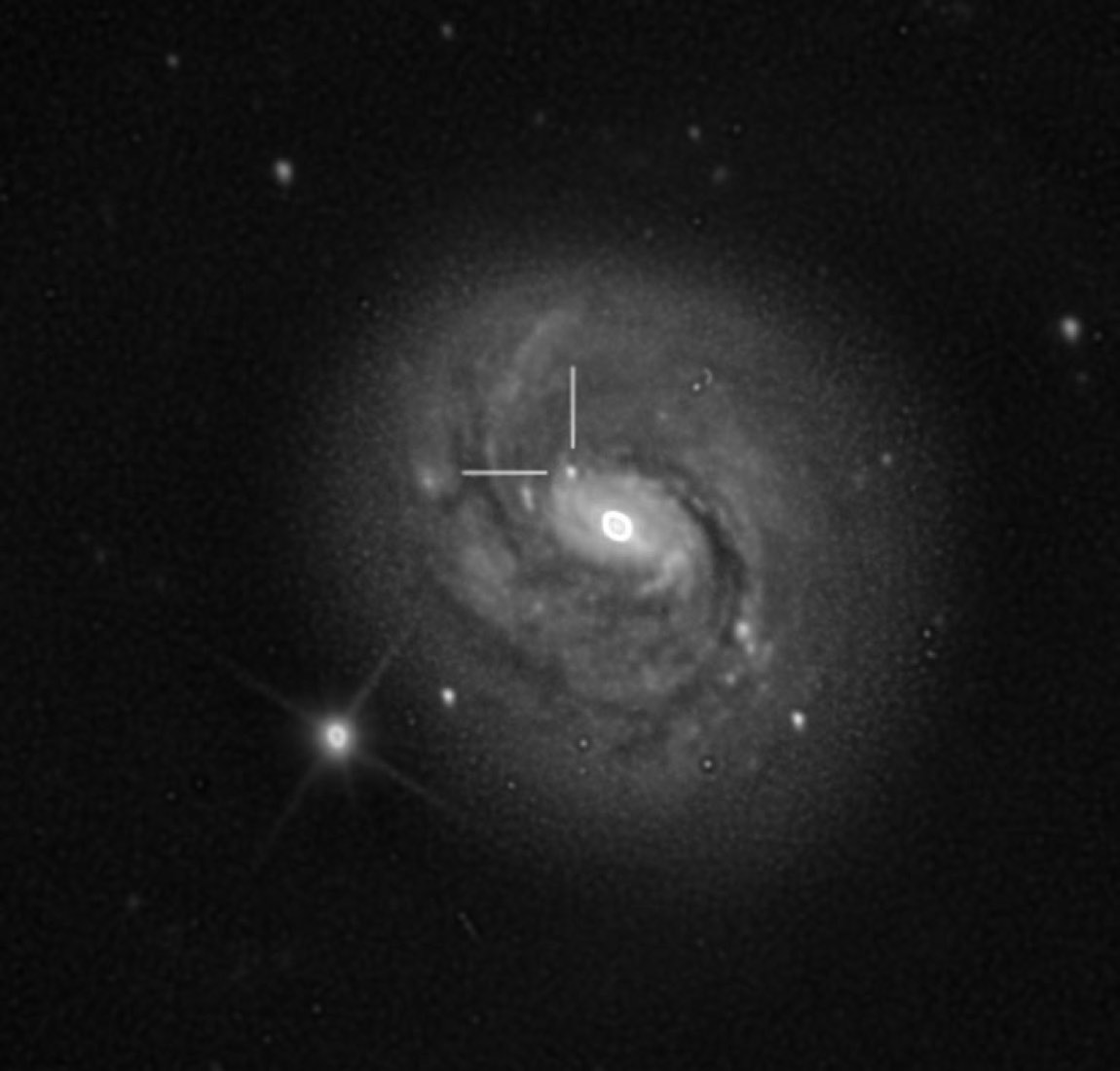
On 24 November 2018, the DLT40 Survey detected a supernova inside Messier 77, cataloged as SN 2018ivc. It was classified as a Type II supernova, the kind produced when a massive star exhausts its nuclear fuel, collapses under gravity, and explodes. At peak the supernova reached an apparent magnitude of 14.6523 — far too faint for the naked eye but within reach of a moderate amateur telescope under dark skies. As of the information available, SN 2018ivc remains the only supernova ever observed in Messier 77. Supernovae in nearby well-studied galaxies like M77 are scientifically prized because the host galaxy's distance is already well established at 35 million light-years, allowing the explosion's true luminosity and energy output to be calculated with unusual confidence. They also serve as tracers of where massive star formation has recently occurred within the galaxy's disk.
10 Size, Brightness, and How to Find It
Messier 77 spans a D25 isophotal diameter of about 27.70 kiloparsecs, which works out to roughly 90,000 light-years — almost as wide as the Milky Way. Despite lying 35 million light-years away, it is one of the brightest Seyfert galaxies visible from Earth, making it a rewarding target for observers. The galaxy sits in the constellation Cetus, the Sea Monster, a large but relatively faint constellation straddling the celestial equator and best placed for observation in the northern autumn and early winter months. Its Seyfert nucleus gives the core a star-like, concentrated appearance that can fool observers into underestimating what they are seeing. Even a modest telescope will reveal a bright, compact central region surrounded by a fainter haze — the broader disk of the galaxy. Under good conditions the outer ring structure hinted at in its morphological classification may become detectable with larger apertures or long-exposure imaging.
11 Open Questions Surrounding This Busy Nucleus Deeper
For all that is known about Messier 77, significant questions remain. The neutrino detection of 2022 has raised fresh puzzles: the precise mechanism by which the AGN's magnetic corona accelerates particles, and why the gamma-ray emission is weaker than standard models predict, are still subjects of active debate. The helium-photon collision scenario proposed to explain the gamma-ray deficit is a candidate, not a confirmed answer. More broadly, the unified AGN model — which predicts that M77's type 1 core is simply hidden by orientation — has been supported by spectroscopic evidence, yet fully disentangling the geometry of the obscuring torus from the emission properties of the nucleus remains an ongoing effort. The relationship between the radio jet and the molecular outflow also invites further study: while the spatial overlap is suggestive of jet-driven feedback, quantifying exactly how much energy the jet deposits into the surrounding interstellar medium requires higher resolution observations. M77's proximity and brightness ensure it will stay near the top of observational target lists for years to come.
 ⤢