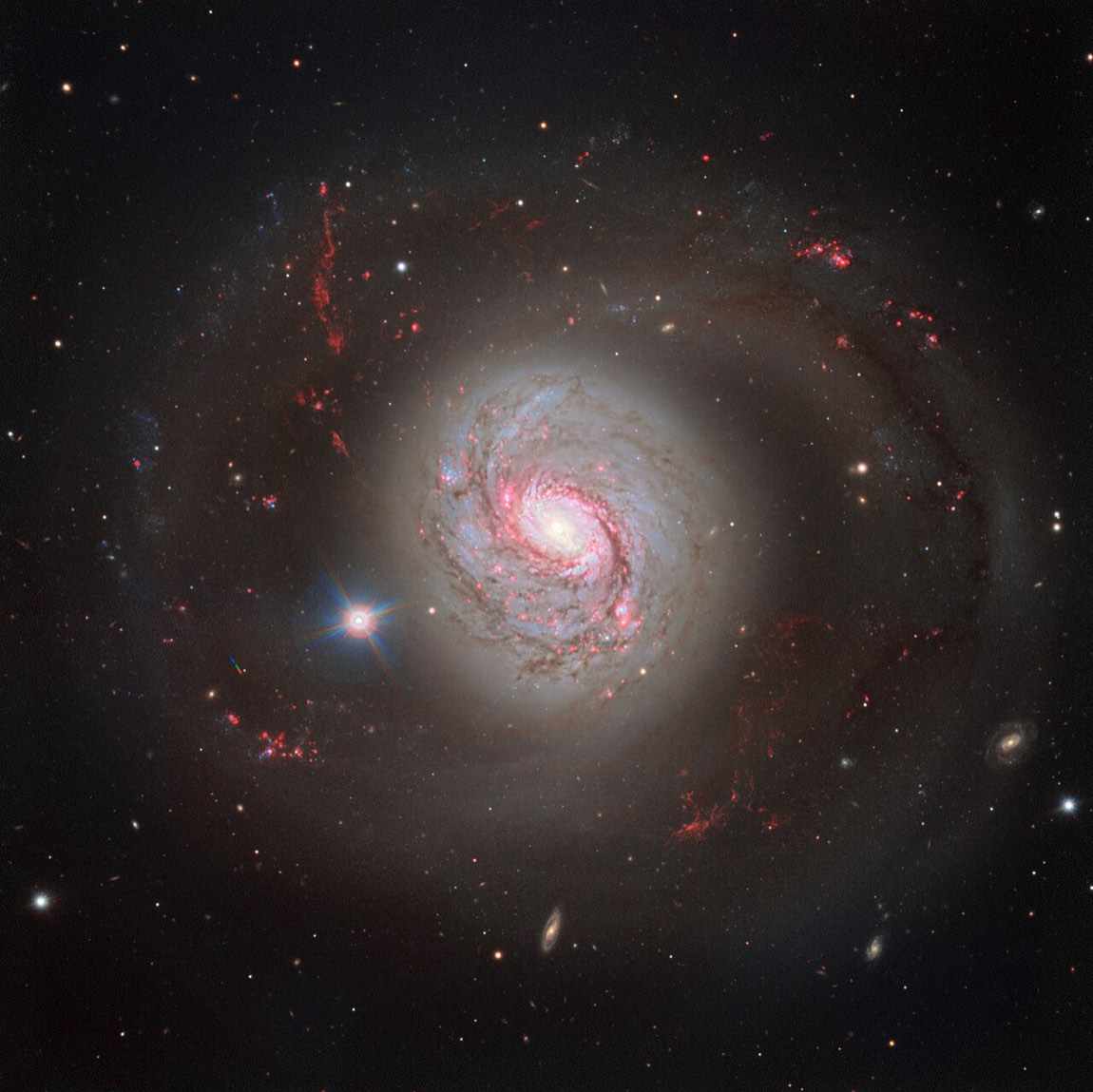
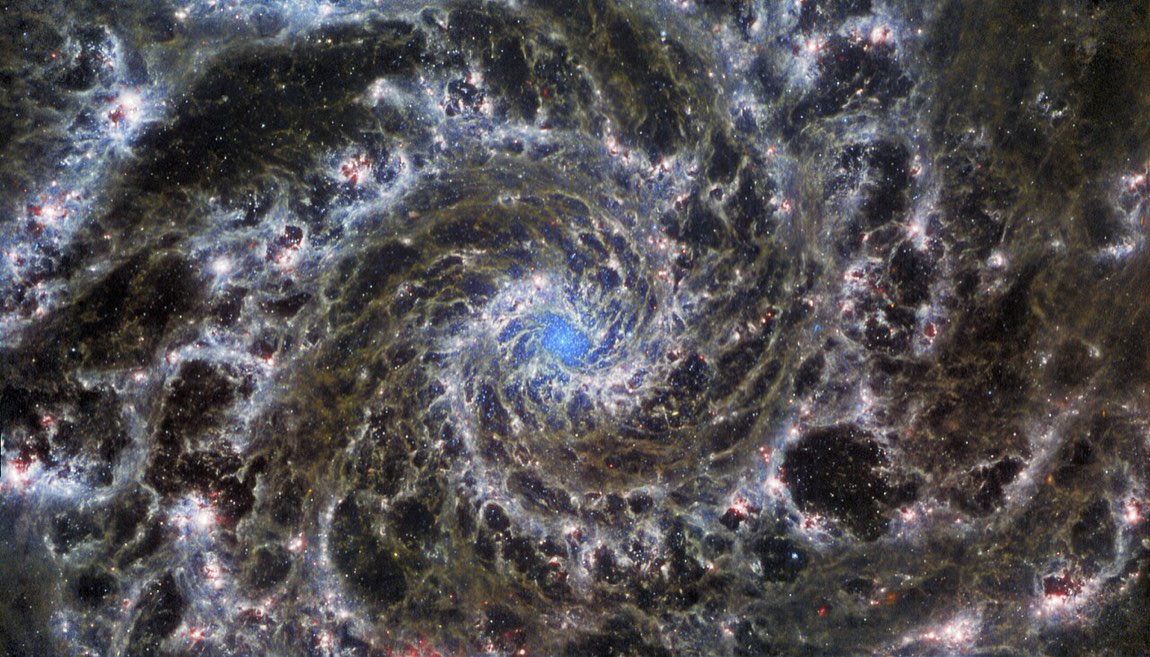
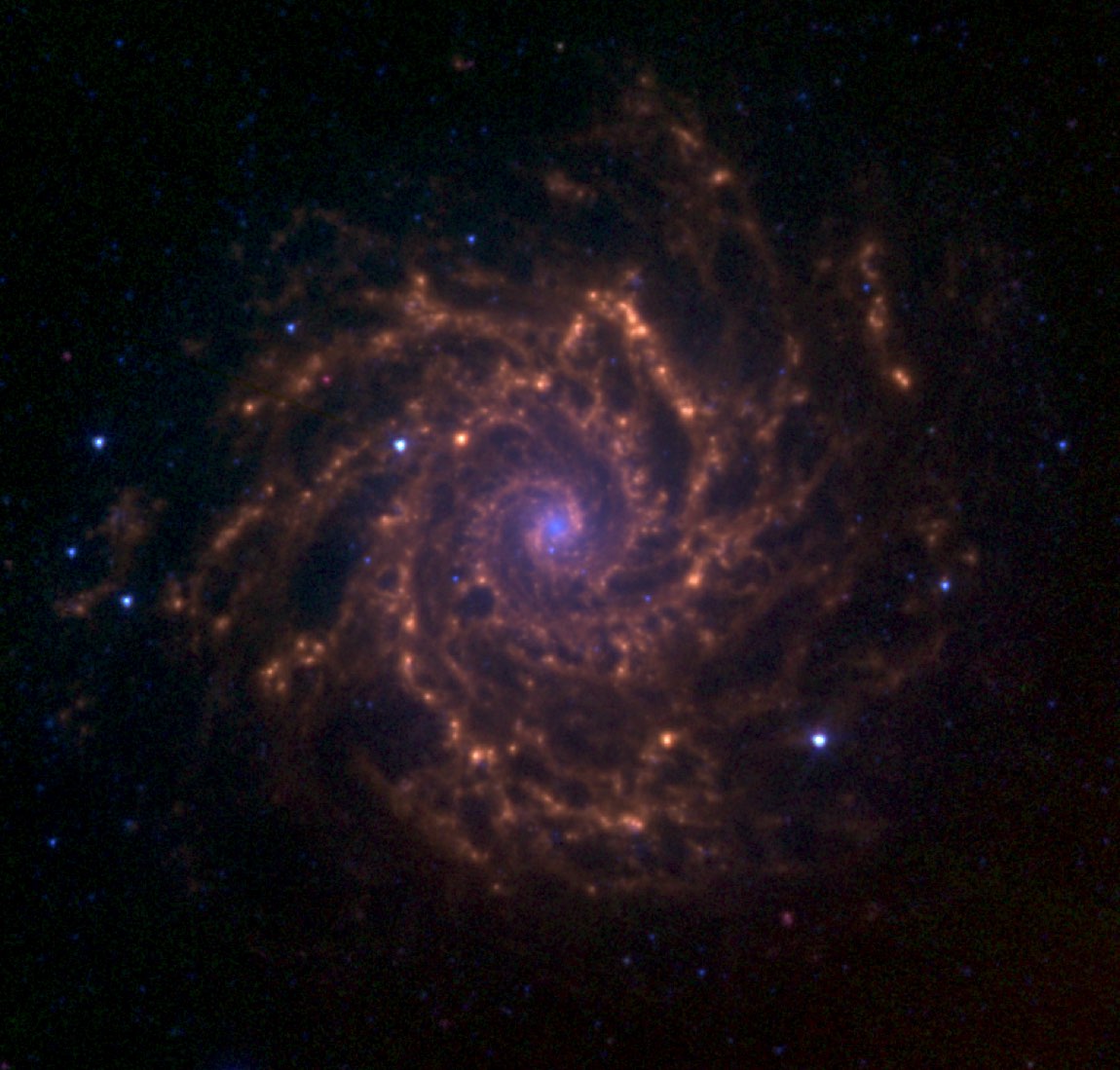
 Photograph · NASA's James Webb Space Telescope. · Public domain
Galaxy · Deep guide
Messier 74 (Phantom Galaxy)
Also called: M74 · NGC 628 · Phantom Galaxy · UGC 1149 · PGC 5974
A perfect face-on spiral, and the hardest Messier object for backyard observers to see.
What is it?
Messier 74, sometimes called the Phantom Galaxy, is a spiral galaxy in Pisces about 32 million light-years away. Pierre Méchain discovered it in 1780. We see it face-on, with two clean, well-defined arms, so it is a textbook example of a grand-design spiral. Its light is spread thinly across a large patch of sky, which makes it the most difficult Messier object for amateur astronomers. The James Webb Space Telescope observed it in July 2022. It is thought to hold about 100 billion stars.
The deep dive
Researched for the Atlas from Wikipedia — Messier 74 (4,598 characters read) · updated Nov 15, 2026
01 Why M74 Is a Grand Design Showpiece
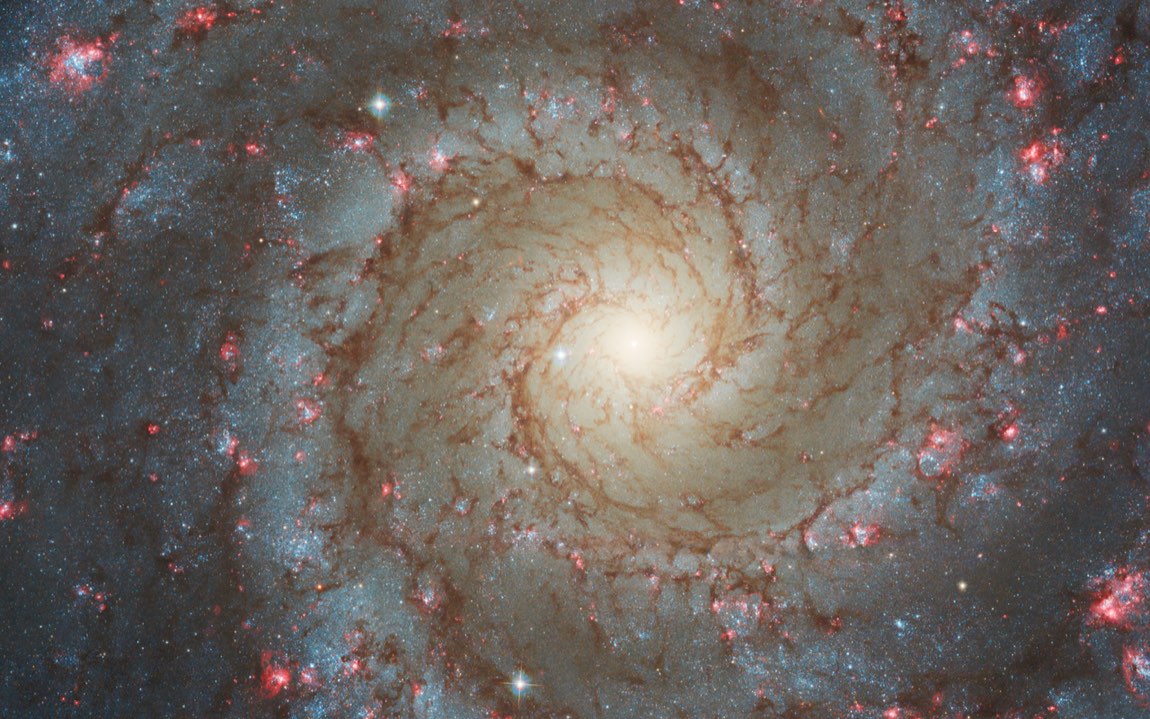
Most spiral galaxies wear their structure loosely, with patchy, fragmentary arms that trail off into vagueness. Messier 74 is different. Its two spiral arms wind counterclockwise from the galaxy's center in a sweeping, continuous curve, making it what astronomers call a grand design spiral — a galaxy whose architecture is clean and unmistakable enough to serve as a textbook example of how spiral structure works. The arms are not perfectly uniform: they widen as they extend outward from the core, though one arm actually narrows again at its far end. They also deviate slightly from a constant winding angle, a subtle asymmetry that hints at the complex gravitational dynamics shaping them. Because M74 happens to face us almost directly — what astronomers call a face-on orientation — none of that detail is hidden by a tilted perspective. This combination of clarity and geometry makes it an ideal laboratory for studying spiral density waves, the theoretical ripples in a galaxy's mass distribution that are thought to drive and sustain spiral arm patterns over billions of years.
02 Pierre Méchain's 1780 Discovery
The story of M74's entry into the astronomical record begins with Pierre Méchain, who spotted the galaxy in 1780. Méchain was a skilled French astronomer and a close collaborator of Charles Messier, the comet hunter whose famous catalog was built precisely to prevent astronomers from mistaking fuzzy permanent objects for new comets. After Méchain made his observation, he communicated the finding to Messier, who added it to the catalog as object number 74. The irony embedded in that history is that M74 — cataloged to save people from confusion — turned out to be one of the hardest objects in the entire list to actually see. Its surface brightness is so low that it has earned the reputation as the most difficult Messier object for amateur astronomers to observe, an unglamorous distinction for a galaxy that is scientifically one of the most elegant in the catalog. More than two centuries after Méchain's discovery, in July 2022, M74 was revisited by the James Webb Space Telescope, an observation that added an entirely new dimension to what we know about its structure.
03 Three Supernovae in One Galaxy Deeper
M74 has hosted three confirmed supernovae in roughly a decade, an unusually eventful run for a single galaxy. The first, SN 2002ap, was a Type Ic supernova — the class sometimes called a hypernova — discovered by Yoji Hirose on 29 January 2002. It reached a peak brightness of magnitude 12.3, making it the brightest supernova of 2002, and it belongs to a rare category: fewer Type Ic supernovae than that have been recorded within 10 megaparsecs per century. Its explosion has been used to test theories about gamma-ray burst emission and to understand more distant supernovae by analogy. The second, SN 2003gd, was a Type II-P event discovered by Robert Evans on 12 June 2003. Because Type II supernovae have known intrinsic luminosities, they function as standard candles for distance measurement; SN 2003gd placed M74 at 9.6 ± 2.8 Mpc, or 31 ± 9 million light-years. Researcher Ben Sugerman also detected a light echo associated with SN 2003gd — a delayed reflection of the explosion off a sheet-like dust cloud lying in front of the supernova — one of only a handful ever found, and a tool for probing interstellar dust composition. The third supernova, SN 2013ej, was discovered by the Lick Observatory Supernova Search on 25 July 2013 and reached magnitude 10, bright enough to be visible in almost any modern telescope under good skies.
04 A Light Echo Frozen in Dust Deeper
Among the many things SN 2003gd left behind, one of the most scientifically valuable was not the explosion itself but its afterglow bouncing off dust. Ben Sugerman identified a light echo associated with the supernova — essentially a later reflection of the original blast, arriving at Earth after taking a longer path by scattering off interstellar material. This phenomenon is rare enough that only a small number of supernovae in history have been associated with confirmed light echoes. In the case of SN 2003gd, the reflection appears to come from dust arranged in a sheet-like cloud positioned in front of the supernova along the line of sight. That geometry matters enormously: by analyzing how the echo spreads and brightens over time, astronomers can infer the three-dimensional structure and composition of the interstellar dust doing the reflecting. Dust in galaxies is fundamental to star formation and the interstellar medium's chemistry, yet it is notoriously difficult to study directly. A light echo offers a rare, well-defined beam of light to illuminate it. This particular echo, produced by an explosion 32 million light-years away, thus became an unexpected window into the microscopic grain structure of M74's interstellar environment.
 ⤢
05 An Intermediate Black Hole Hiding in Plain Sight Deeper
In 2005, the Chandra X-ray Observatory announced the detection of an ultraluminous X-ray source inside M74, cataloged as CXOU J013651.1+154547. What made the finding striking was not just the intensity of the radiation — which exceeded what a neutron star can produce — but its behavior: the X-ray emission pulsed in periodic intervals of around two hours. The source carries an estimated mass of 10,000 solar masses. That figure places it squarely in the category of intermediate-mass black holes, a class that sits between stellar-mass black holes, which form from individual dying stars, and the supermassive black holes, millions to billions of times the Sun's mass, that are thought to lurk at the centers of most large galaxies. Intermediate-mass black holes are poorly understood and relatively rarely confirmed. The leading hypothesis for how objects like CXOU J013651.1+154547 form involves the gradual merging of smaller stellar black holes within a dense star cluster, a bottom-up construction process that remains an active area of theoretical debate. M74's example offers one of the cleaner observational cases for this elusive middle tier of black hole demographics.
06 The Galaxy Group M74 Anchors
Messier 74 does not travel through the universe alone. It is the brightest member of a small galaxy group bearing its name — the M74 Group — which contains between 5 and 7 galaxies depending on which membership criteria astronomers apply. The group includes NGC 660, described as a peculiar spiral galaxy, along with several irregular galaxies. What counts as a group member turns out to be a genuinely complicated question. Different identification methods — ranging from those requiring a clear gravitational connection, to those accepting a likely or even historically suggested tie — agree on a core set of members but disagree on several objects whose status within the group remains uncertain. This kind of ambiguity is common in galaxy group astronomy, where the boundaries between bound systems and chance alignments can be difficult to establish definitively. Within this modest collection, M74 stands out not just for its brightness but for its structural elegance, making it a compelling anchor for a group that is otherwise dominated by less symmetrical and more visually chaotic companions.
07 The Transient That Defied Easy Classification Deeper
Beyond its three confirmed supernovae, M74 produced another enigmatic event: the astronomical transient AT 2019krl, discovered by astronomer Anna Ho on 6 July 2019. Classifying it proved difficult from the outset. Initial analysis placed it in one of two very different categories — either a Type IIn supernova, characterized by narrow emission lines indicating interaction with surrounding material, or an outburst from a luminous blue variable, one of the most massive and unstable types of stars known. These are not minor distinctions; a supernova represents the death of a star, while an LBV outburst is a dramatic but survivable eruption. Later analysis shifted the interpretation further, suggesting that AT 2019krl is consistent with known examples of giant LBV eruptions and with a subclass of events similar to SN 2008S — a poorly understood family of transients that occupy a gray zone between true supernovae and non-terminal stellar tantrums. The event highlights how M74, despite being a relatively nearby and intensively studied galaxy, still harbors phenomena that resist neat categorization.
08 Why Surface Brightness Is the Real Enemy
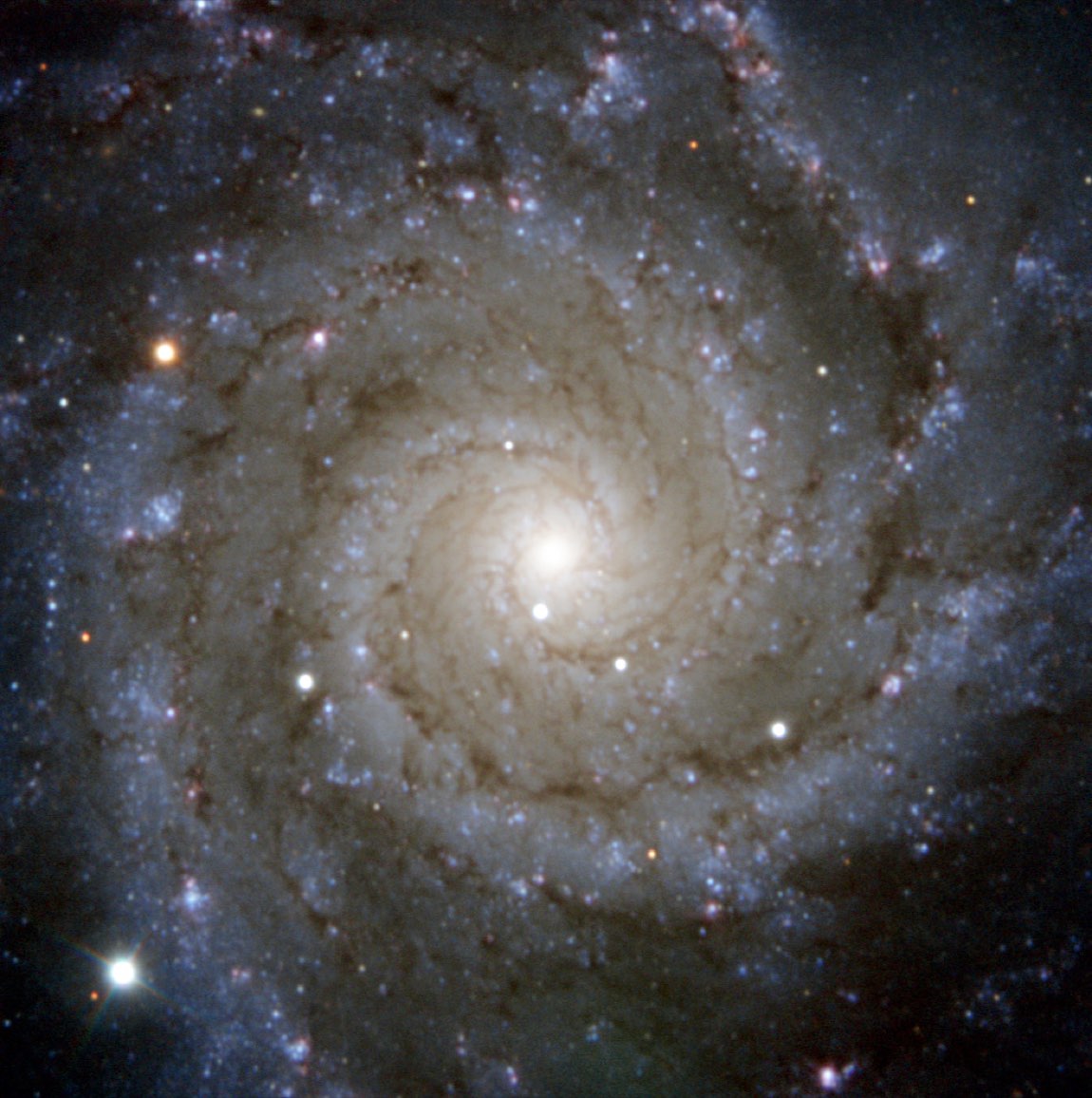
Messier 74 presents a paradox for observers. At 32 million light-years away it is hardly the most distant object in the Messier catalog, it spans a generous apparent size on the sky, and its face-on orientation means none of its disk is foreshortened. And yet it holds the reputation as the hardest Messier object to actually see, carrying the second-lowest surface brightness of any object in the catalog — only M101 ranks lower. The problem is that apparent size works against a diffuse object: the same total light spread across a larger area on the sky means lower brightness per square arc-minute reaching your eye. High magnification makes matters worse rather than better, stretching the already faint glow thinner until it disappears below the threshold of human perception. Amateur astronomers who want any chance of spotting it are advised to use low magnification, to allow their eyes to become fully dark adapted, and to employ averted vision — the technique of looking slightly to the side of a target so that the more light-sensitive rod cells at the edge of the retina do the detecting rather than the color-focused cone cells at the center.
 ⤢
09 Finding M74 in the Sky
Messier 74 lives in the equatorial constellation Pisces, a part of the sky reachable from most of Earth's surface at appropriate times of year. The practical starting point for locating it is Eta Piscium, one of the constellation's brighter stars: M74 lies 1.5 degrees east-northeast of that star. A degree and a half is about three times the apparent diameter of a full Moon, a distance easily covered in a low-power eyepiece field. The challenge after that is not pointing — it is seeing. Even under genuinely dark skies, M74's diffuse glow can elude observers who are not patient or who push their magnification too high. The face-on orientation that makes the galaxy scientifically invaluable — exposing its full spiral structure to professional instruments — is part of what makes it so elusive visually, because that same geometry distributes the galaxy's light across a broad, low-contrast disk rather than concentrating it into a bright, condensed patch. Experienced observers consistently emphasize dark adaptation and patience as the two most important tools for a successful sighting.
10 What the James Webb Telescope Revealed
In July 2022, Messier 74 became one of the early targets of the James Webb Space Telescope. The article notes the observation took place, situating it as a significant new chapter in the galaxy's scientific history. Webb's instruments operate primarily in infrared wavelengths, which cut through the dust that obscures features in visible light and reveal the cooler stellar populations and interstellar medium in far greater detail than previous observatories could manage. For a galaxy like M74 — already valued for the clarity of its spiral arm structure — an infrared view from Webb offered the prospect of tracing those arms through regions of active star formation and dust emission that are effectively invisible in optical images. The observation arrived more than 240 years after Pierre Méchain first noted the galaxy's existence, underscoring how a single object can remain a productive scientific subject across wildly different technological eras. Webb's visit to M74 is part of a broader pattern in which nearby grand design spirals serve as key benchmarks for testing new instruments, since their well-understood structure provides a reliable reference point.
11 How Supernovae Became M74's Measuring Sticks Deeper
Measuring the distance to a galaxy sitting 32 million light-years away is not straightforward, and M74 illustrates how astronomers triangulate using multiple independent methods. The Type II-P supernova SN 2003gd provided one of the cleaner recent measurements: because this class of supernova has a known intrinsic luminosity, comparing that expected brightness to the observed apparent brightness yields a distance. For M74, that method gave 9.6 ± 2.8 Mpc, equivalent to 31 ± 9 million light-years. Astronomers have also estimated the distance using the brightest supergiant stars in the galaxy as standard candles, arriving at values of 7.7 ± 1.7 Mpc and 9.6 ± 2.2 Mpc by that separate approach. The fact that different methods converge near 9–10 Mpc gives astronomers confidence in the general range, even though the individual uncertainties remain substantial. The agreement between a supernova-based method and a stellar-brightness method is itself scientifically important: each method depends on different physical assumptions, so agreement suggests neither is wildly off. M74's well-studied supernovae have thus contributed not just to knowledge of this one galaxy but to the broader toolkit of extragalactic distance measurement.
 ⤢