 Photograph · Joxean Koret · CC BY-SA 4.0
Galaxy · Deep guide
Messier 66
Also called: M66 · NGC 3627 · Arp 16 · UGC 6346 · PGC 34695
The showiest member of the Leo Triplet, stretched and stirred by a near miss with a neighbour.
What is it?
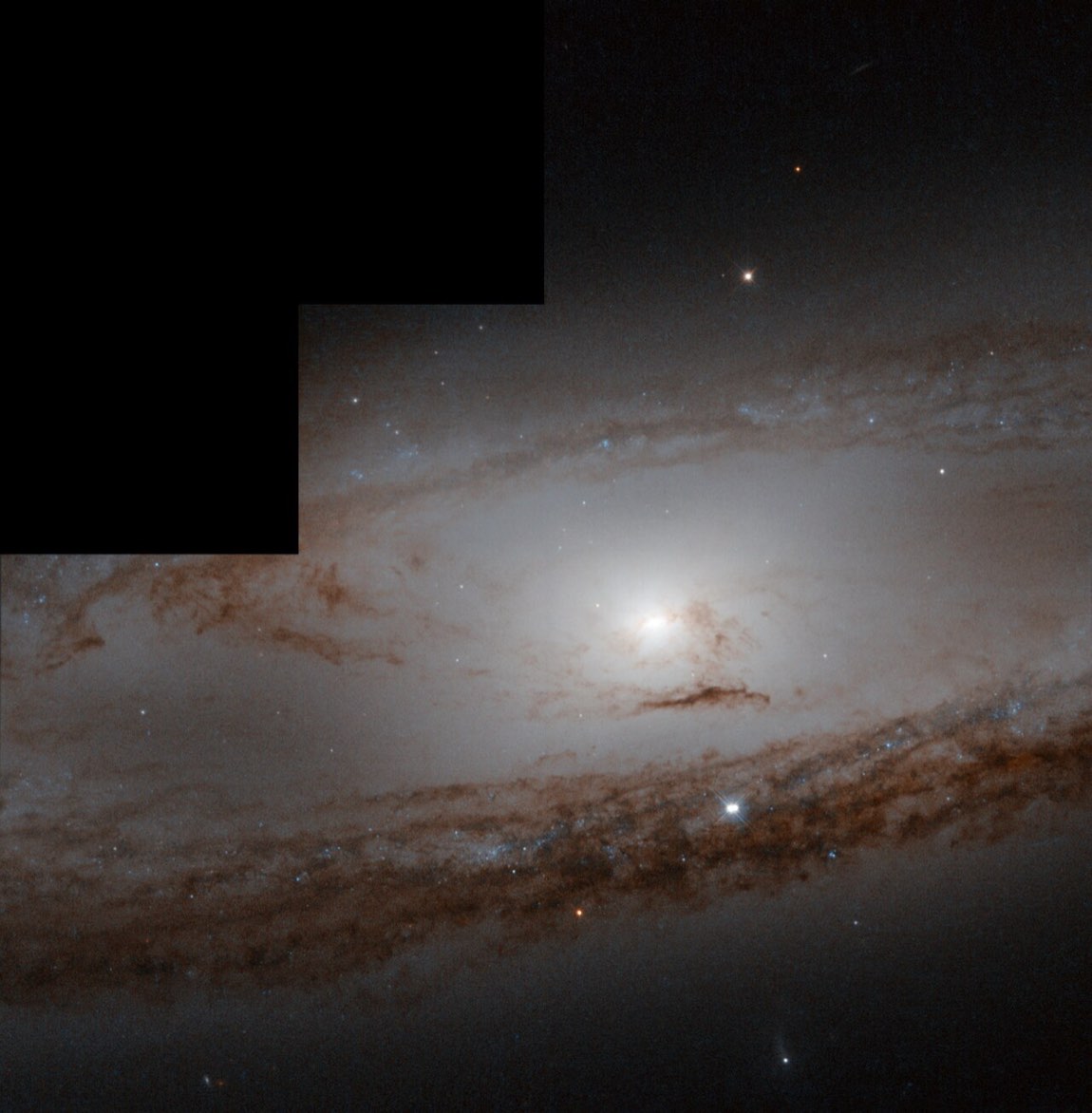
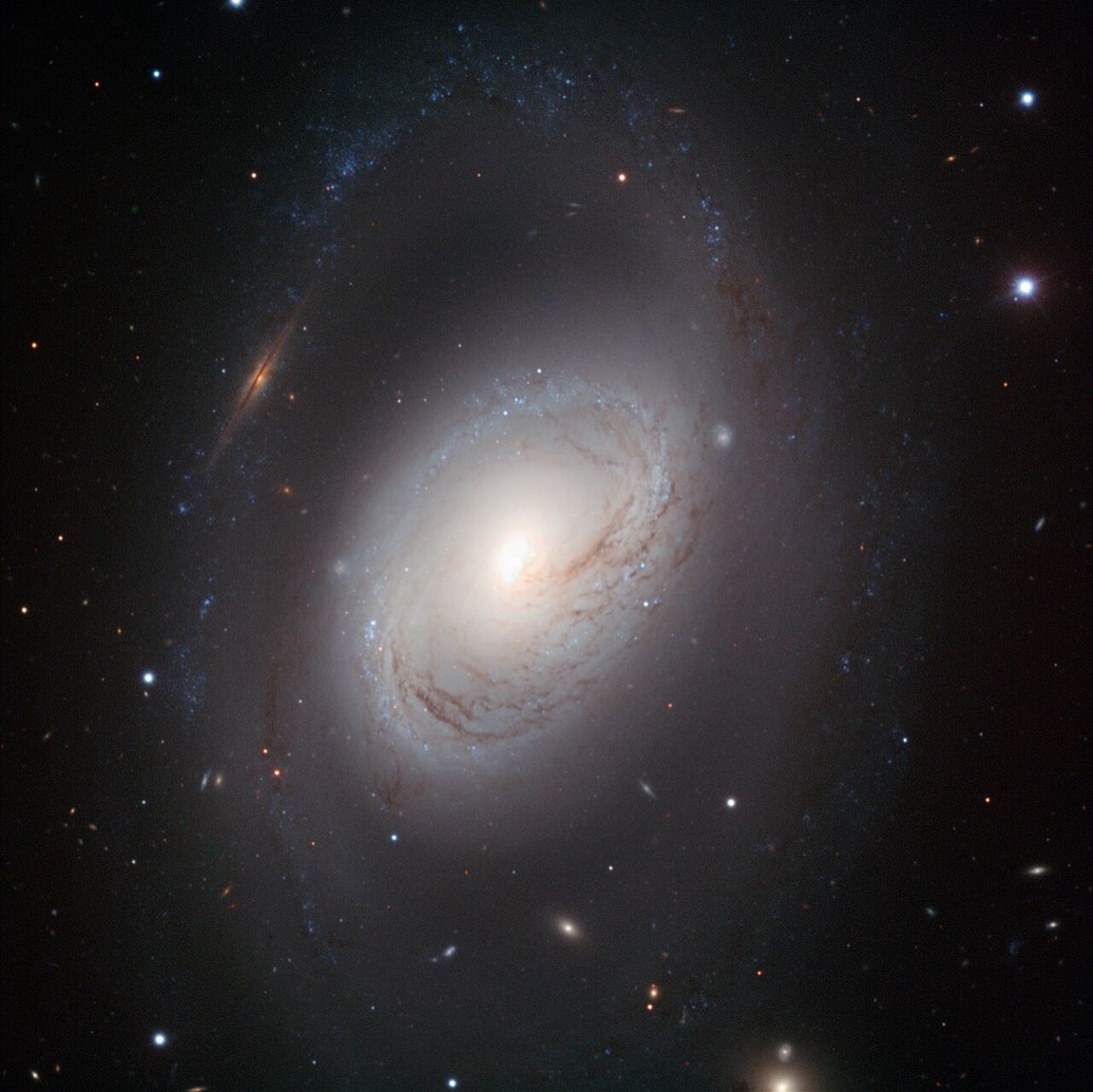
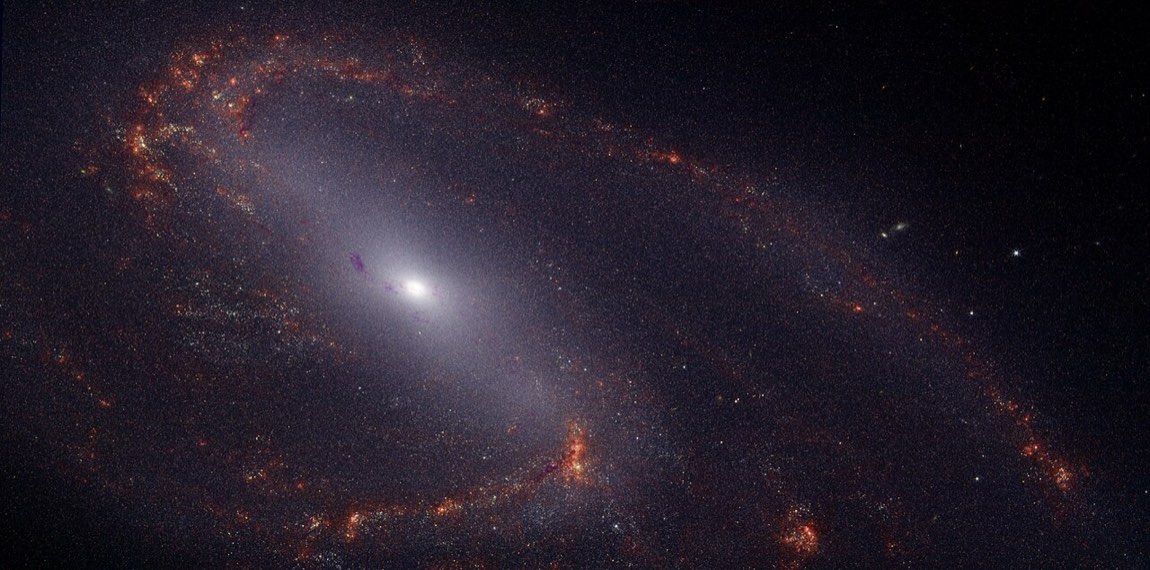
Messier 66 is a spiral galaxy in Leo, found by Messier on 1 March 1780. It belongs to the Leo Triplet with M65 and NGC 3628, and sits only about 20 arcminutes from M65 on the sky, which makes the pair a popular target for backyard telescopes. A past close encounter with NGC 3628 has packed gas toward its centre and distorted its arms. M66 shows strong dust lanes and bright clusters of young stars along its spiral arms, and it is about 95,000 light-years across.
The deep dive
Researched for the Atlas from Wikipedia — Messier 66 (2,446 characters read) · updated Nov 15, 2026
01 A Galaxy Knocked Slightly Out of Shape
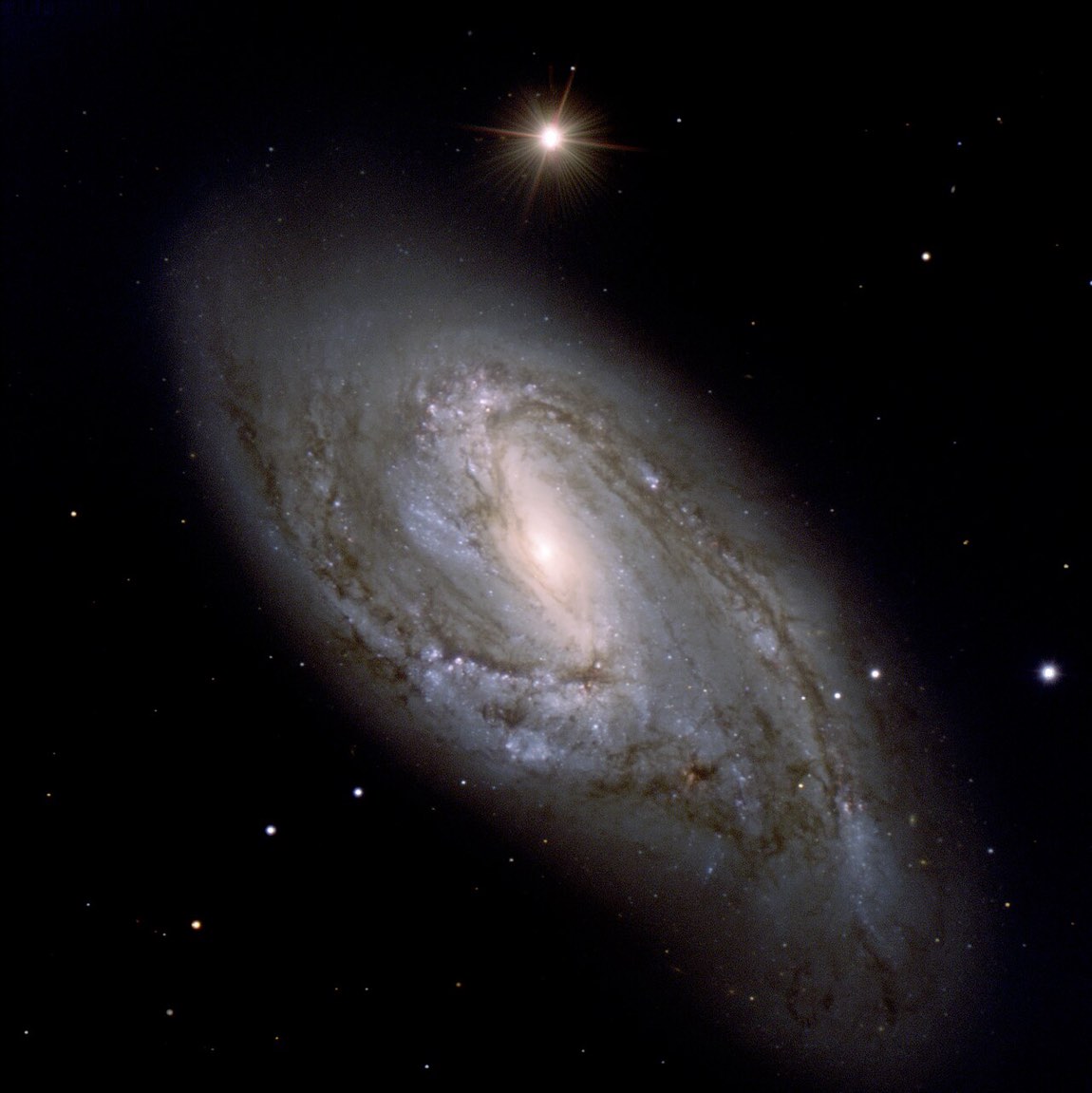
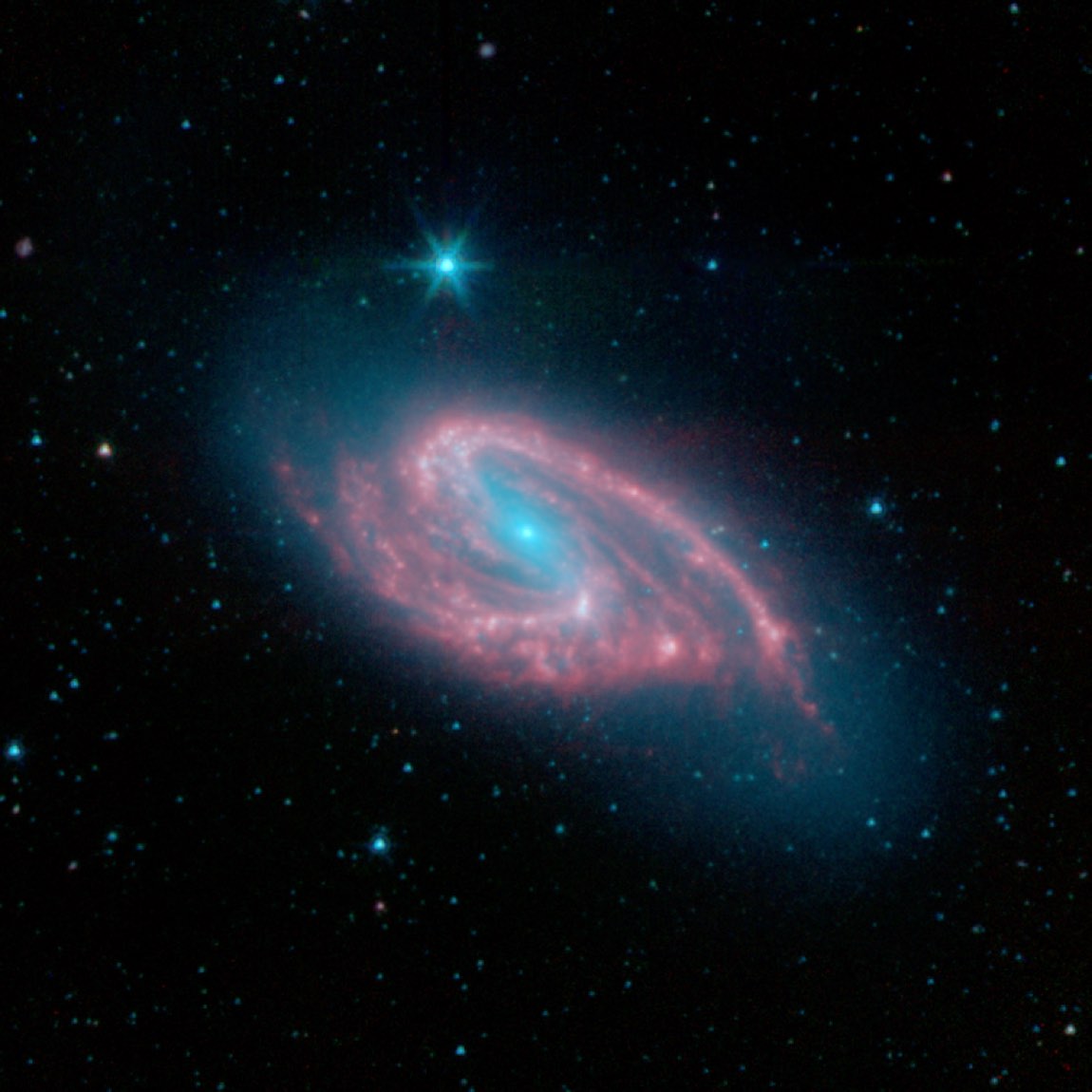
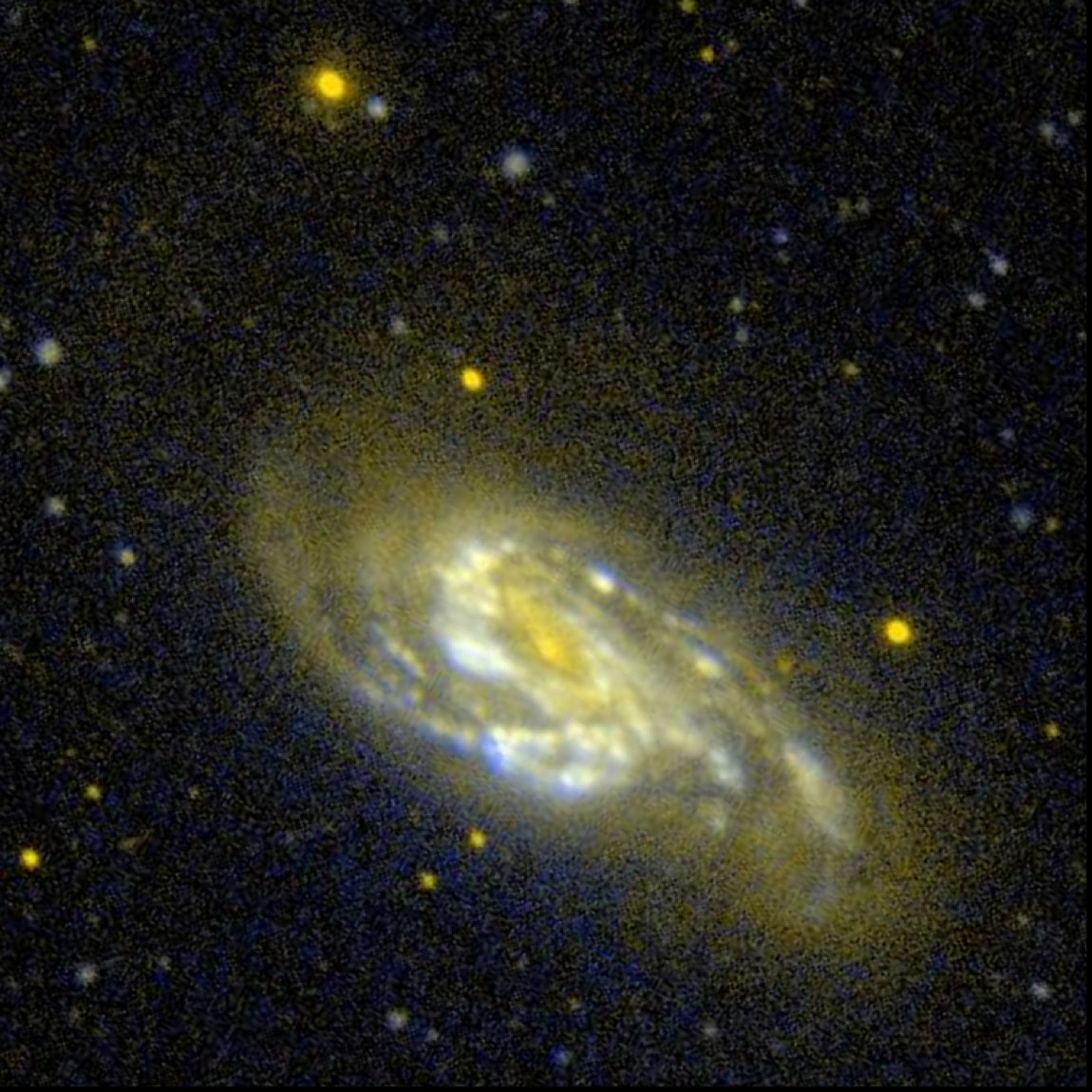
M66 is not a textbook-perfect spiral. Its isophotal axis ratio of 0.32 tells astronomers that we are viewing it at a pronounced angle rather than face-on, but the real source of its visual drama is gravitational harassment. A past encounter with its neighbor NGC 3628 left lasting scars: an unusually high concentration of mass in the central region, a lopsided ratio of molecular to atomic gas, and — most strikingly — a clump of neutral hydrogen gas that appears to have been physically torn away from one of the spiral arms. That displaced clump produces the galaxy's famously peculiar, asymmetric arm structure, prominent enough that M66 earned a place in the Atlas of Peculiar Galaxies, a catalog dedicated to galaxies whose shapes defy simple classification. Even casual telescope views reveal striking dust lanes and bright star clusters tracing the warped arms, making M66 one of the most visually rewarding examples of galaxy-on-galaxy interaction in the northern sky.
02 Size, Structure, and What Lives Inside
Stretch a ruler across M66 and it would measure roughly 95 thousand light-years — slightly smaller than the Milky Way's estimated diameter but still a substantial city of stars. Its morphological classification, SABb, encodes three key facts in four characters: 'S' for spiral, 'AB' for an intermediate or weak bar running through the nucleus (not as prominent as a strongly barred galaxy, not entirely absent either), and 'b' for loosely wound arms that sweep outward with relatively open spacing. At the center sits a well-developed bulge, a dense, roughly spherical concentration of older stars that dominates the inner light of the galaxy. Beyond the bulge, the spiral arms carry a different population: young, hot stars recently born from interstellar gas, whose ultraviolet radiation ionizes the surrounding hydrogen and lights it up as glowing nebulae. The weak bar likely funnels gas inward, feeding both the central bulge and ongoing star formation.
03 Star Birth at a Measured Pace Deeper
Despite its turbulent interaction history, M66 is not forming stars at a runaway rate. Its measured star-formation rate sits at approximately 0.05 solar masses per year — meaning that every year the galaxy converts the equivalent of one-twentieth of a Sun's worth of gas into new stars. That is a relatively modest pace compared to starburst galaxies, which can exceed tens of solar masses per year. The activity is concentrated in the spiral arms rather than spread uniformly across the disk, consistent with the picture of spiral density waves compressing interstellar gas until it collapses under gravity. The gravitational interaction with NGC 3628 has driven an unusually high molecular-to-atomic mass ratio at the center, meaning more of the available gas exists in the cold, dense molecular form that is the direct raw material for star formation. This elevated molecular fraction in the core hints that future star-formation episodes could be triggered there if conditions change — a slow fuse set by an ancient gravitational encounter.
 ⤢
04 The Leo Triplet: M66's Cosmic Neighborhood
M66 is not a lone wanderer. It belongs to the Leo Triplet, a compact little group of three galaxies that also includes M65 and NGC 3628, all residing at roughly similar distances from Earth in the constellation Leo. The group is formally catalogued as the M66 Group. Within this trio, gravitational ties are real and consequential: the past close passage of NGC 3628 is directly responsible for the displaced hydrogen clump and the warped arm structure that makes M66 so visually distinctive. M65 and M66 themselves lie only about 20 arcminutes apart on the sky — less than two-thirds the apparent width of the full Moon — making them a classic paired target for amateur observers who can capture both in a single wide-field eyepiece or camera frame. That physical proximity is not an illusion of perspective; the two galaxies are genuine neighbors in space, though they appear less disturbed than NGC 3628, whose prominent tidal tail is one of the showpieces of deep-sky astrophotography.
05 Charles Messier Finds Something "Very Faint"
On the night of 1 March 1780, French astronomer Charles Messier swept his telescope across Leo and logged a smudge he described, in characteristically sparse language, as "very long and very faint." He added it to his famous catalog as number 66, alongside M65 which he found the same night. Messier's catalog was not intended as a celebration of these objects — it was a practical nuisance list of things that could be mistaken for comets, which were the prestige discoveries of his era. By his standards, M66 was an obstacle, not a destination. Yet that brief notation secured its place in the historical record and gave it the name astronomers still use today. The irony is complete: Messier spent his career hunting comets, most of which are long forgotten, while his catalog of "false alarms" became one of the most-observed collections of objects in all of amateur astronomy, with M66 among its most studied members.
06 Five Stellar Explosions and Counting
M66 has hosted five observed supernovae, an unusually rich record for a single galaxy and a testament both to its ongoing stellar activity and to the increasing power of automated sky surveys. The first, SN 1973R, was a Type II explosion discovered by Leonida Rosino on 19 December 1973, reaching magnitude 14.5. Next came SN 1989B on 30 January 1989, found by prolific supernova hunter Robert Evans; it was a Type Ia event and brightened to magnitude 13, making it briefly visible in modest amateur telescopes. SN 2009hd followed on 2 July 2009, discovered by Berto Monard at magnitude 15.8, also a Type II. The most recent confirmed supernova, SN 2016cok — a Type II-P, the plateau subtype produced by red supergiant stars — was detected on 28 May 2016 by the All Sky Automated Survey for Supernovae at magnitude 16.6. Each event destroys a massive star in seconds while briefly outshining billions of ordinary ones.
 ⤢
07 The Puzzling Case of SN 1997bs Deeper
The fifth transient event detected in M66, SN 1997bs, discovered by the Lick Observatory Supernova Search on 15 April 1997, has proven far more confusing than a straightforward stellar explosion. Initially classified as a Type IIn supernova — a category defined by narrow emission lines indicating interaction between ejecta and dense surrounding gas — later analysis cast serious doubt on that verdict. Researchers subsequently proposed three competing alternatives: that the source was a luminous blue variable (an extremely massive, unstable star undergoing a giant eruption rather than a true death), a so-called "gap" transient (an event whose energy falls in the poorly understood territory between classical novae and supernovae), or a luminous red nova (thought to result from the merger of two stars). The uncertainty around SN 1997bs illustrates a broader challenge in modern transient astronomy: the boundary between a true supernova and a dramatic-but-survivable stellar outburst can be genuinely difficult to establish, especially for events observed at the distance of M66.
08 How to Find M66 in Your Telescope
M66 sits in Leo, one of the most recognizable spring constellations in the northern hemisphere, making it accessible to observers across a wide range of latitudes. With an apparent magnitude that places it among the brighter Messier objects, it is reachable with binoculars under dark skies, though a telescope of 15 centimeters or more begins to reveal the dust lanes and the asymmetric arm structure that make it scientifically interesting. Its celestial address puts it in the equatorial half of Leo, convenient for observers in both hemispheres. The practical observing shortcut is simply to point at M65: because M65 and M66 are separated by only 20 arcminutes, they share a low-power telescope field of view, and star-hopping to one delivers the other automatically. Spring evenings, when Leo rides high around midnight, offer the best window. Dark skies dramatically improve the view; from a light-polluted suburb, the galaxy appears as a soft oval, while from a rural site its structure begins to emerge.
09 What the Hydrogen Gas Clump Reveals Deeper
Among the structural curiosities of M66, the displaced clump of neutral hydrogen — referred to in radio astronomy as H I material — deserves particular attention. Radio telescopes sensitive to the 21-centimeter emission line of hydrogen reveal gas that has apparently been stripped from one of the spiral arms and now sits in a "non-rotating" clump, decoupled from the general spin of the galaxy's disk. This is a direct fingerprint of the gravitational interaction with NGC 3628: tidal forces during the galaxies' past close approach were strong enough to physically displace cold gas from its orbit. Because hydrogen gas traces the outer, more loosely bound regions of a galaxy, it is particularly vulnerable to tidal stripping. The clump is not simply a visual curiosity — it represents a reservoir of raw star-forming material that has been relocated, potentially seeding future star formation in an unexpected location. The same interaction also drove an extremely high central mass concentration, suggesting that inward-funneled gas settled into the core rather than escaping the system entirely.
 ⤢
10 An Intermediate Bar and What It Means Deeper
The 'AB' designation in M66's classification of SABb is more than taxonomic bookkeeping — it points to a physical structure with real consequences for the galaxy's internal dynamics. A galactic bar is an elongated, relatively straight concentration of stars and gas cutting through the nucleus, rotating as a rigid pattern. Strongly barred galaxies (classified SB) have prominent bars that efficiently channel gas inward; unbarred spirals (S) rely on other mechanisms. M66 sits between these extremes, with a weak or partial bar. Theory and simulation both suggest that bars are efficient drivers of gas toward galactic centers, potentially fueling both star formation in the bulge and, in some cases, active galactic nuclei. M66's well-developed central bulge is consistent with a history of bar-driven inflow. Whether the bar itself was strengthened or disrupted by the interaction with NGC 3628 is not settled by the article's information, but the combination of a weak bar, an elevated central molecular gas fraction, and a high central mass concentration paints a coherent picture of a galaxy whose core has been repeatedly fed.