 Photograph · ESA/Hubble & NASA · Public domain
Galaxy · Deep guide
Messier 65
Also called: M65 · NGC 3623 · UGC 6328 · PGC 34612
A quiet, tilted spiral in Leo and one third of the famous Leo Triplet.
What is it?
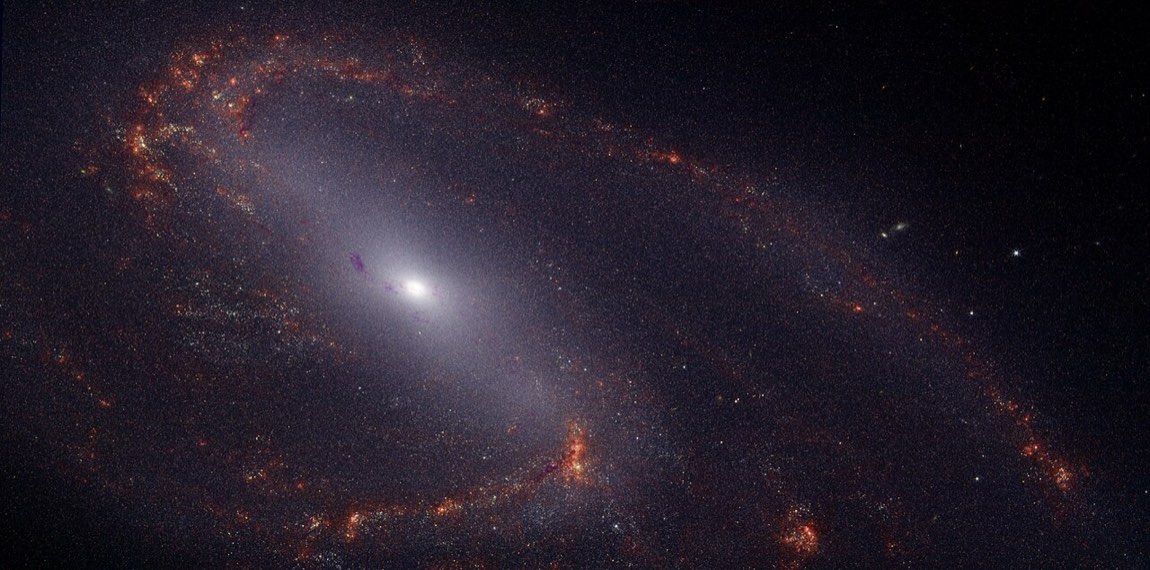
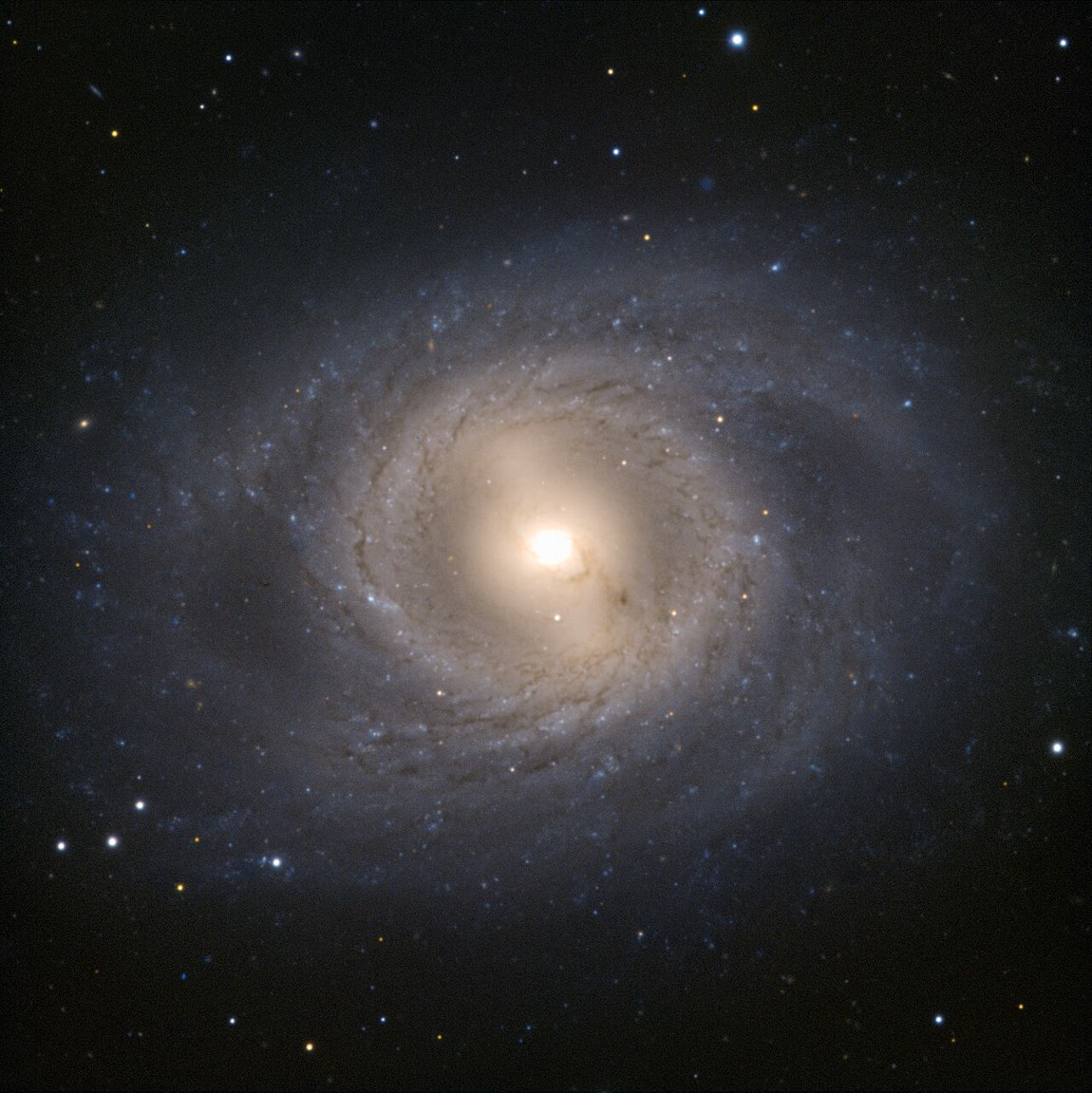
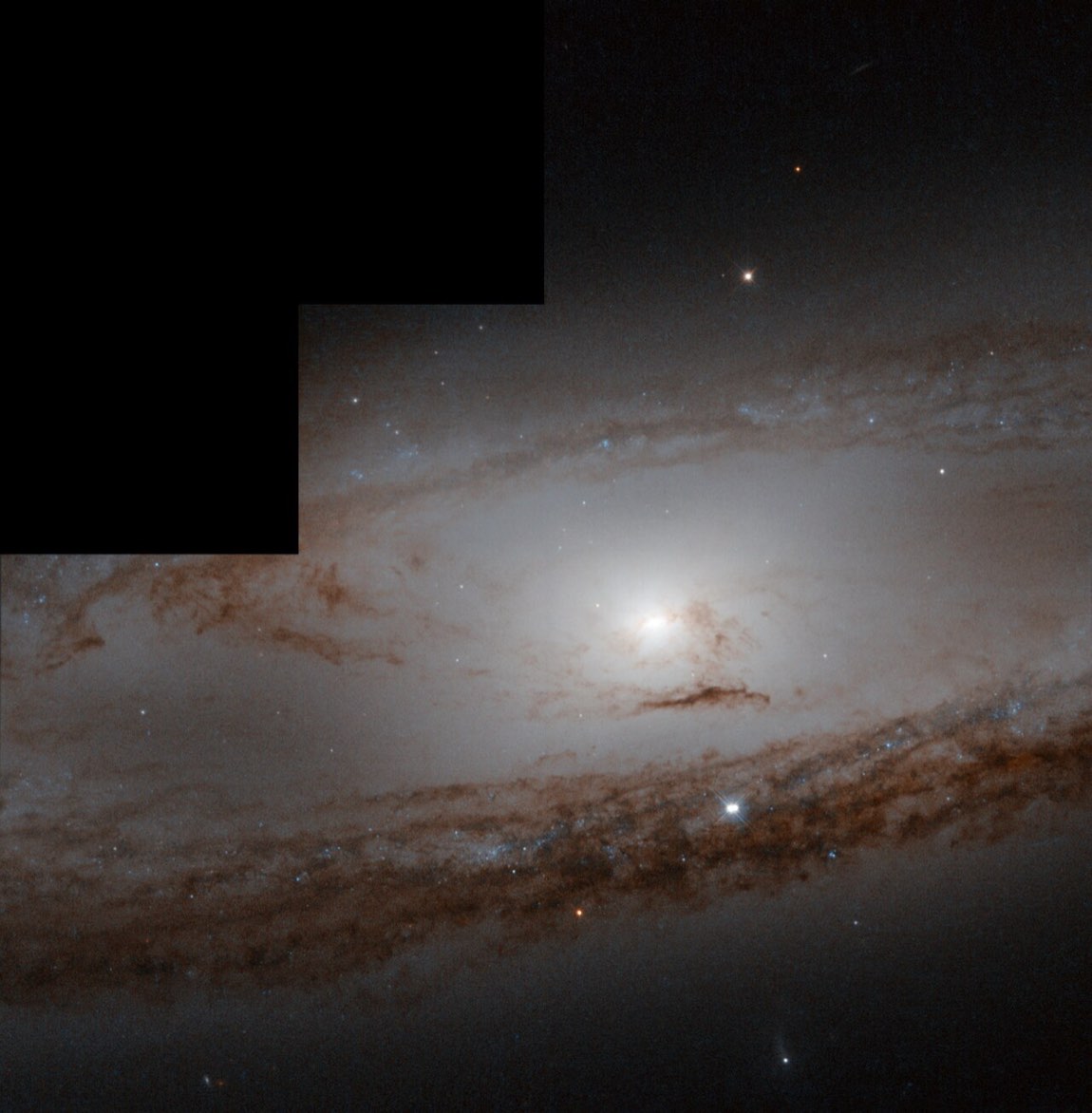
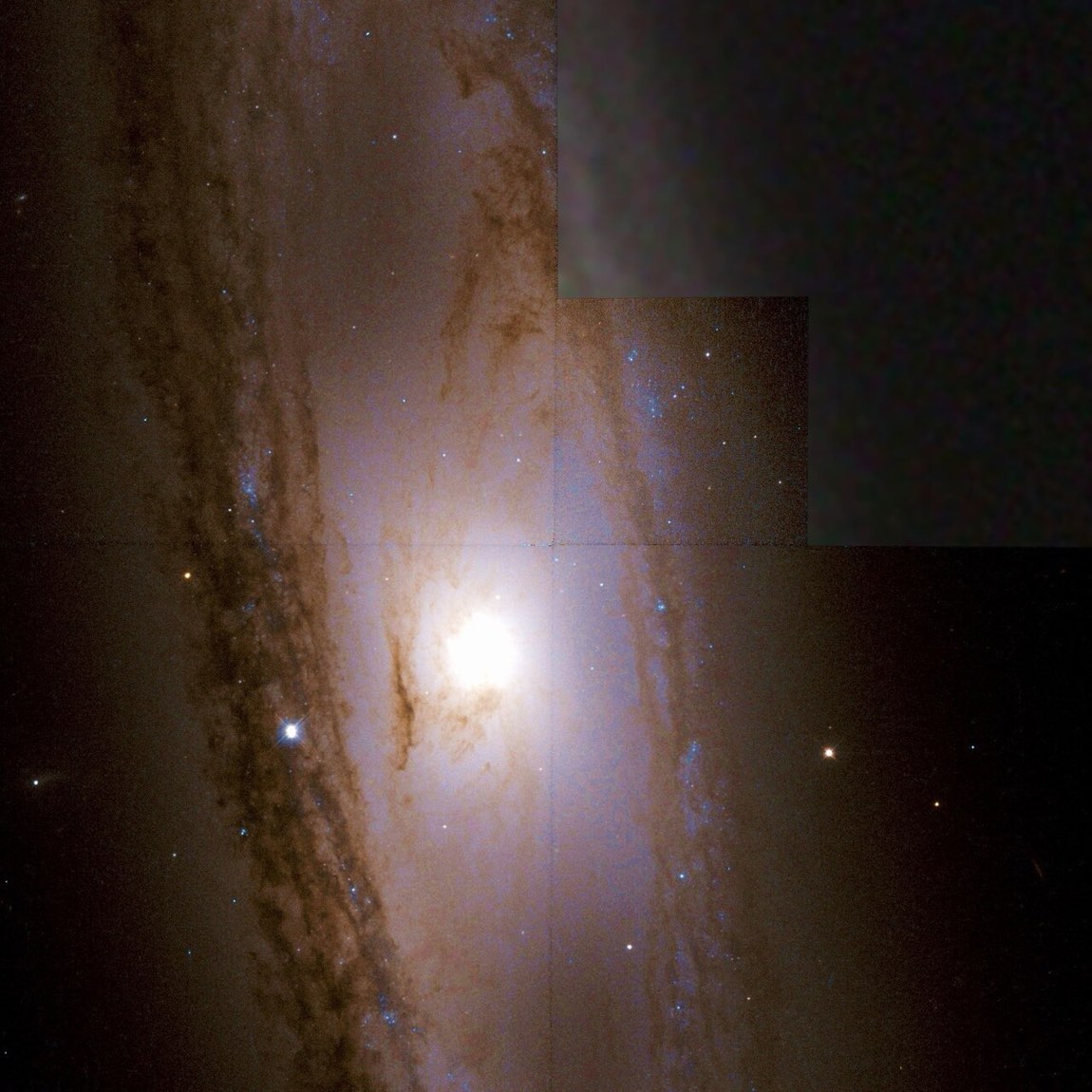
Messier 65 is a spiral galaxy in Leo, discovered by Charles Messier in 1780. Together with M66 and NGC 3628 it forms the Leo Triplet, a small group that fits in one telescope view. M65 holds little gas and dust and forms few new stars, so its light comes mostly from older stars. Its disk looks slightly warped, and a burst of fairly recent star formation in its arms hints that it has been disturbed, possibly by its neighbours' gravity.
The deep dive
Researched for the Atlas from Wikipedia — Messier 65 (2,062 characters read) · updated Nov 15, 2026
01 A Galaxy Running Low on Fuel
Messier 65 is remarkably quiet for a spiral galaxy. It holds very little dust and gas — the raw ingredients stars need to form — which means the engine of stellar birth has largely wound down. The ratio of old stars to new stars is correspondingly quite high, giving the galaxy a mature, settled appearance dominated by aging yellow and red stars rather than the brilliant blue ones that mark active star-forming regions. In most wavelengths of light, astronomers find M65 almost unremarkable, a galaxy that has largely used up its natal material and is coasting through the universe on what it already built. This stands in sharp contrast to its Leo Triplet neighbor NGC 3628, which shows far more turbulent features. The quietness of M65 makes it a useful reference point for studying how spiral galaxies age and exhaust their star-forming potential over cosmic time.
02 Recent Star Birth in the Arms Deeper
Despite its generally low level of activity, M65 has not gone completely quiet. Astronomers have detected some star formation occurring relatively recently within the galaxy's spiral arms, even as the rest of the disk remains placid. This localized burst of new stars is scientifically interesting precisely because it seems out of character for such a gas-poor system. The leading explanation connects this activity to external influences rather than any internal reservoir of material. Researchers suspect that gravitational interactions with neighboring galaxies in the Leo Triplet may have compressed existing gas enough to trigger star formation in isolated pockets. The arms, being the outermost and most dynamically sensitive regions, would be the first places to respond to any tidal pushing and pulling from outside. This makes the star-forming patches in M65's arms a kind of forensic record of past gravitational encounters.
03 The Mysterious Offset Radio Source Deeper
Among the few genuinely puzzling features of M65 is a radio source detected in the NVSS — the NRAO VLA Sky Survey — that sits roughly two arc-minutes offset from the galaxy's core. Two arc-minutes is a small angle to the eye, but at a distance of about 35 million light-years it corresponds to a meaningful physical separation from the galactic center. What makes this source intriguing is how little is known about it. It has not been identified visually, meaning no corresponding optical object has been pinned down, and as of the available record it has not been formally studied in any published scientific paper. Its nature remains genuinely uncertain. It could be a background object seen in projection, an unusual feature within M65 itself, or something else entirely. The absence of follow-up study means this small radio anomaly represents one of the more concrete open questions attached to an otherwise well-catalogued galaxy.
04 A Warped Disk and Tidal Fingerprints
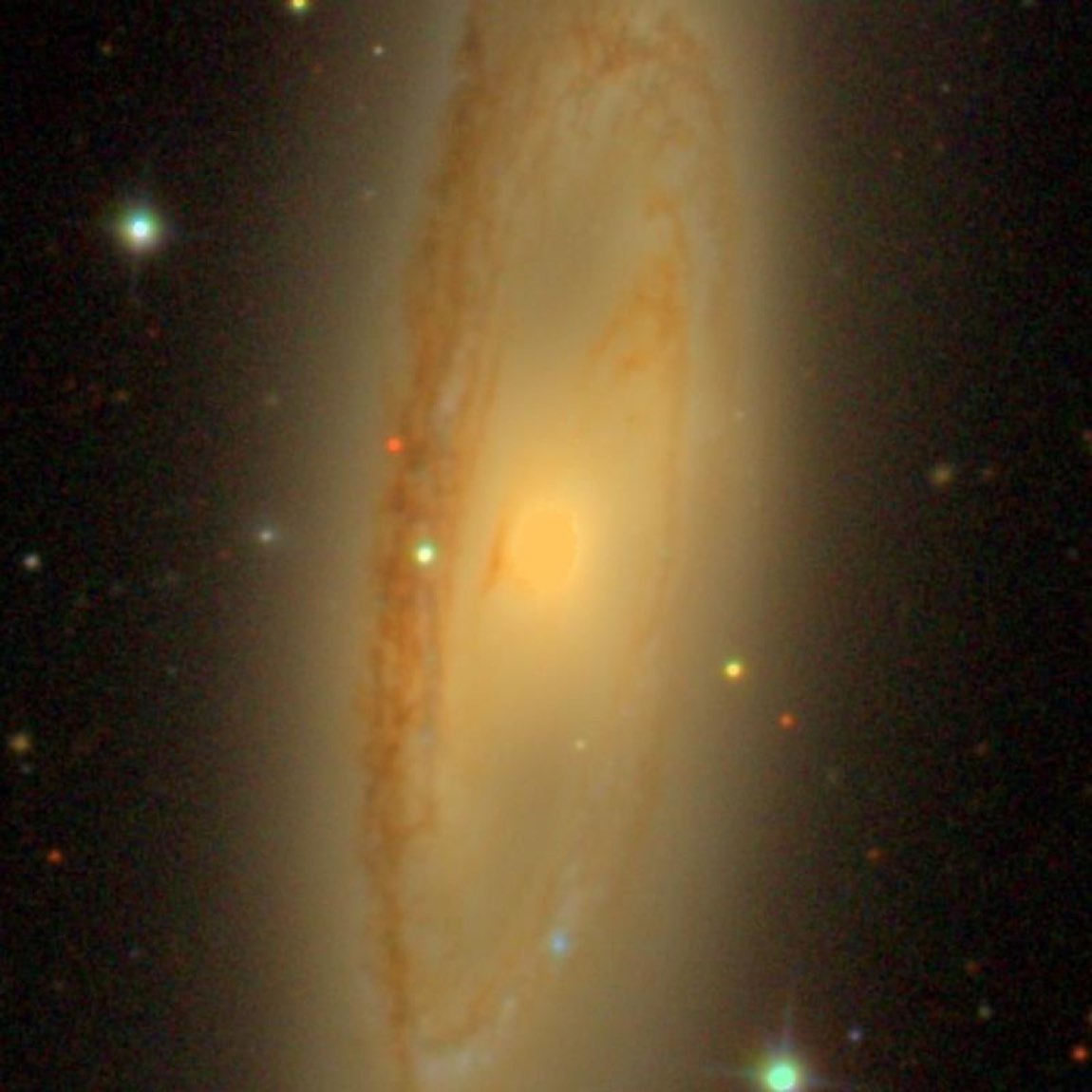
Look carefully at M65 and something subtle stands out: its disk is not perfectly flat. The slight warp visible to observers is considered a telltale sign that the galaxy has experienced gravitational tugging from an outside source. Warps in galactic disks are commonly produced when neighboring galaxies pull unevenly on different parts of a disk, bending it like a vinyl record left in the sun. Combined with the localized burst of star formation in its arms, the picture that emerges is of a galaxy that has not been entirely isolated. Researcher Zhiyu Duan concluded that M65 did interact with the other members of the Leo Triplet, though much less strongly than the interaction believed to have occurred between M66 and NGC 3628. M65 appears to have been the quieter participant in whatever gravitational drama played out among the three galaxies hundreds of millions of years ago.
05 800 Million Years Ago: A Close Encounter
The Leo Triplet is not just a pretty grouping of three galaxies sitting near each other by coincidence — its members have a shared gravitational history. Research by Rots in 1978 put a specific timescale on the event: the galaxies in the Leo Triplet are thought to have interacted with each other approximately 800 million years ago. To put that in perspective, 800 million years ago on Earth, multicellular life was only just beginning to diversify. The gravitational encounter would not have been a collision in any everyday sense — galaxies are mostly empty space — but rather a slow, sweeping mutual distortion as the galaxies passed close enough to feel each other's gravity strongly. The effects of that ancient encounter are still being read in the warped disk of M65 and the pockets of star formation scattered through its arms today, making the galaxy a kind of long-playing record of a cosmic event that happened before complex life existed on our planet.
 ⤢
06 Does M65 Hide a Central Bar? Deeper
One structural question about M65 remains genuinely unresolved: whether or not it possesses a central bar — a linear, elongated concentration of stars running through the nucleus that is a common feature in many spiral galaxies, including our own Milky Way. Researcher Zhiyu Duan noted that M65 may have such a bar, but pinning this down with certainty is complicated by geometry. M65 is observed from an oblique angle, meaning we do not see it face-on but instead tilted toward us in a way that compresses and blurs features along certain axes. A bar hidden within that inclination would be difficult to disentangle from other structure. The significance of a bar extends beyond mere classification: bars are associated with tidal disruption and can be triggered or enhanced by gravitational interactions with other galaxies. If M65 does have a bar, it would add one more piece of evidence pointing to a past disturbance from its Leo Triplet companions.
07 A Supernova Briefly Lit M65 in 2013
On 21 March 2013, amateur astronomer Matsuo Sugano discovered a supernova within M65, designated SN 2013am. It was classified as a Type II supernova — the kind that results from the core collapse of a massive star that has exhausted its nuclear fuel — and it reached an apparent magnitude of 15.6 at its brightest. That is far too faint to see with the naked eye but within reach of moderately sized amateur telescopes. Type II supernovae are among the most energetic events in the universe, briefly outshining entire galaxies, and they are also responsible for seeding space with heavy elements forged in stellar cores. For a galaxy as quiet and dust-poor as M65, the appearance of a supernova was a reminder that even sedentary-looking systems still contain massive stars capable of spectacular endings. SN 2013am stands as the only supernova recorded in M65 so far.
08 How Messier Got Credit — and Almost Lost It
Charles Messier discovered M65 in 1780 and included it in his famous catalog, yet for generations many astronomers believed the credit belonged to Pierre Méchain. The confusion originated with William Henry Smyth, a 19th-century astronomer whose popular book A Cycle of Celestial Objects stated that M65 and M66 were "pointed out by Méchain to Messier in 1780." This was an error on Smyth's part, but because his book was widely read and respected, the mistake propagated. Kenneth Glyn Jones then repeated it in his own influential work, Messier's Nebulae and Star Clusters, and from there it branched into numerous other publications. The story is a vivid illustration of how errors can become entrenched in scientific literature through the authority of secondary sources, amplifying rather than correcting a simple original mistake. Modern scholarship has restored the discovery to Messier himself.
09 Finding M65 in the Night Sky
Messier 65 sits in Leo, specifically within the constellation's southern, more equatorial half. At an apparent magnitude that places it within range of modest amateur telescopes under dark skies, it is a rewarding target precisely because it appears together with M66 and NGC 3628 in the same wide field of view, forming the Leo Triplet. Seeing three galaxies simultaneously in a single eyepiece field gives an immediate and visceral sense of galactic clustering and cosmic scale. M65 tends to appear as an elongated smudge of light, its disk tilted relative to our line of sight — the same inclination that makes pinning down structural details like a central bar so difficult for professional astronomers. The galaxy's relatively low surface brightness rewards observers who seek genuinely dark skies away from city lights, where the delicate extent of its disk becomes more apparent.
10 M65's Place in the Leo Triplet
Messier 65 is one of three galaxies that make up the Leo Triplet, a compact and physically associated group that also includes M66 and NGC 3628. The three galaxies are close enough to one another in space — not merely in the direction we happen to look — to have exerted real gravitational influence on each other over cosmic history. Among the three, M65 appears to have experienced the most gentle interaction, showing subtler signs of disturbance than its companions. M66, by contrast, shows more pronounced structural irregularities, and NGC 3628 is famous for its dramatic tidal tail, a stream of stars pulled away by gravitational forces. Studying the three together gives astronomers a natural laboratory for understanding how galaxy interactions of different intensities leave different imprints, with M65 representing the mild end of the disturbance spectrum within the same small group.
 ⤢