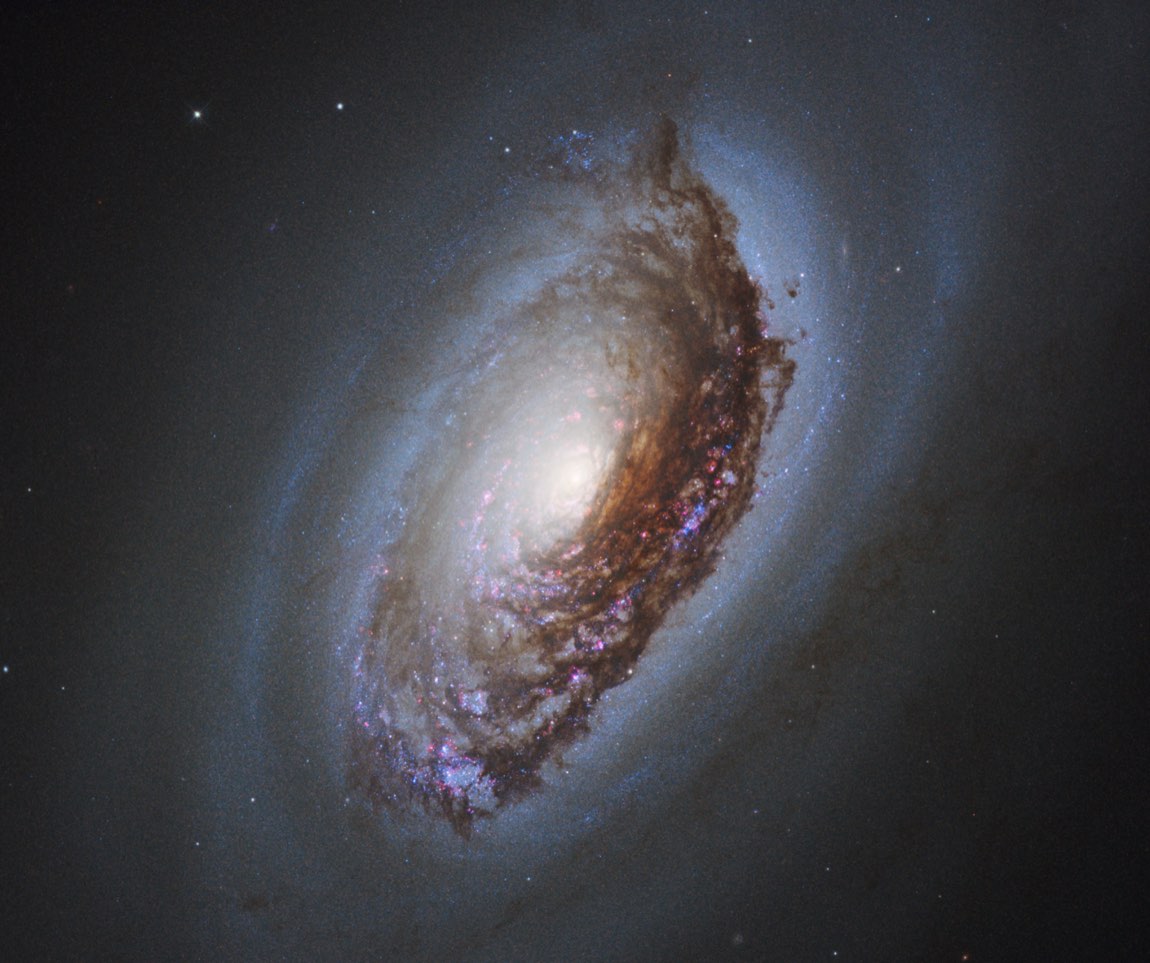
 Photograph · Judy Schmidt from USA · CC BY 2.0
Galaxy · Deep guide
Messier 64 (Black Eye Galaxy)
Also called: M64 · NGC 4826 · Black Eye Galaxy · Evil Eye Galaxy · Sleeping Beauty Galaxy
A spiral galaxy with a dark band of dust across its bright core, like a black eye.
What is it?
Messier 64, the Black Eye Galaxy, is a spiral galaxy in Coma Berenices about 17 million light-years away. Edward Pigott discovered it in March 1779, Johann Bode found it again a month later, and Messier logged it the following year. A dark lane of dust in front of its bright centre gives it the nicknames Black Eye, Evil Eye and Sleeping Beauty. It is a favourite of amateur astronomers because that dark band can be seen even in small telescopes. The galaxy is fairly isolated, with no large neighbours nearby.
The deep dive
Researched for the Atlas from Wikipedia — Black Eye Galaxy (2,487 characters read) · updated Nov 15, 2026
01 The Famous Dark Band Up Close
The feature that gives M64 all three of its nicknames — Black Eye, Evil Eye, and Sleeping Beauty — is a sweeping dark band of absorbing dust that sits partially in front of the galaxy's bright nucleus. This is not a gap or a hole in the galaxy; it is a dense lane of interstellar dust that blocks the light coming from the glowing central region behind it. The contrast between the brilliant nucleus and the shadowing dust lane is dramatic enough to be visible in small amateur telescopes, which is exactly why M64 has been a favourite target since the era of its discovery. What makes the dust lane scientifically interesting is its location: it lies within the inner disk of the galaxy, a region packed with molecular gas that is simultaneously one of the most actively star-forming areas in the entire system. The dust is not a passive decoration — it is raw material being consumed and transformed into new stars at a vigorous rate, making the most visually striking part of M64 also one of its most physically active.
02 Three Discoverers, One Galaxy
Messier 64 has the distinction of being independently discovered three times in quick succession, a testament to how conspicuous it appears even through modest instruments. Edward Pigott was the first, spotting it in March 1779. The following month, Johann Elert Bode observed it independently, and then Charles Messier — whose name the object now formally carries — recorded it the following year. Messier's catalogue was intended as a practical list of objects that could be confused with comets, which were the prized targets of observers of his era. The fact that M64 made the cut tells us it was bright and fuzzy enough to be a genuine nuisance for comet hunters. Pigott's earlier priority is historically notable, since the galaxy is primarily remembered today under the Messier number rather than under any designation honouring its true first observer. The NGC catalogue later gave it the additional designation NGC 4826, and it now appears under all three names depending on the context.
03 A Galaxy Spinning Against Itself Deeper
Perhaps the most remarkable structural fact about M64 is that its interstellar medium consists of two counter-rotating disks that are approximately equal in mass. In plain terms, the gas in the outer disk is rotating in the opposite direction to the gas in the inner disk — like two interlocked gears turning against each other. Despite this dramatic conflict in the gas, the stellar population of the galaxy shows no measurable counter-rotation; the stars all rotate in the same direction. This creates a genuinely unusual situation: the stars and the inner gas agree on direction, but a large reservoir of outer gas is flowing the wrong way. At the boundary between the two counter-rotating systems, gas from each side collides, and those collisions are thought to drive the vigorous star formation observed in the inner disk. The situation is not in equilibrium, and astronomers expect the counter-rotating outer gas will gradually be consumed or assimilated over time, eventually leaving a more conventional-looking galaxy.
04 How Did M64 End Up This Way? Deeper
Two formation scenarios have been proposed to explain the counter-rotating gas disks, and astronomers have not definitively settled on one. The first scenario is a merger: M64 may have consumed a smaller, gas-rich satellite galaxy that happened to be orbiting in a retrograde direction — that is, moving opposite to M64's own rotation. As the satellite was torn apart and its gas incorporated, that counter-rotating material settled into what is now the outer disk. The second scenario involves the continued accretion of gas clouds drifting in from the intergalactic medium, again arriving along trajectories that brought them in with the wrong spin. In either case, the evidence of a recent large inflow of mass supports the idea that M64 has been actively cannibalising material from its surroundings. The fact that the stellar population shows no counter-rotation is an important clue: stars from any accreted satellite have either been fully mixed in or were not transferred in significant numbers, leaving only the gas as a witness to the event.
05 The Inner Molecular Disk and Star Factory Deeper
Inside M64 there is a well-defined inner disk of molecular gas that extends outward to a radius of 2,300 light-years (700 parsecs) before it is truncated. This disk is the seat of the galaxy's vigorous star formation activity, and it is also where the prominent dust lanes reside. Despite sitting so close to the central supermassive black hole, the non-rotational motions of this disk — the inward and outward flows that could feed the core — do not significantly channel material onto the nucleus at present. So the star formation is proceeding intensely, but the black hole is not being efficiently fuelled by this disk right now. The disk is also associated with the outer ring-like structure indicated in M64's morphological classification, and the whole arrangement is consistent with a galaxy that has recently received a large injection of gas. With approximately 100 billion stars already inside the galaxy, the new generations being born in this molecular disk will add to that population over cosmic time.
06 The Black Eye's Sleeping Supermassive Black Hole
At the heart of M64 sits a supermassive black hole calculated to have a mass of about 8.4 million times the mass of the Sun. For context, that is a few times less massive than the black hole at the centre of the Milky Way, which weighs in around 4 million solar masses, so they are in a broadly similar weight class despite M64 being a more distant and more visually striking galaxy. M64 is classified as a type 2 Seyfert galaxy with an HII/LINER nucleus, meaning its core shows signs of activity but the central engine itself is not blazing brightly. The central region is only a weak source of radio emission, and while a soft X-ray source has been detected at the nucleus, astronomers believe this X-ray emission most likely originates from the circumnuclear region — the zone of gas and dust surrounding the black hole — rather than directly from an active galactic nucleus. In other words, the black hole is present and detected, but it is currently relatively quiet.
07 Shape, Tilt, and What You Are Really Seeing
When you look at M64, you are not seeing it face-on. The galaxy is inclined 60 degrees to the line of sight, meaning it is tipped significantly away from a perfect top-down view, though not so steeply that it appears edge-on. It has a position angle of 112 degrees, describing the orientation of its major axis on the sky. Its morphological classification in the De Vaucouleurs system is (R)SA(rs)ab — a notation that packs considerable information into a short code. The (R) indicates an outer ring-like structure; SA denotes a non-barred spiral; (rs) means there is a transitional structure between an inner ring and a pure spiral; and ab says the spiral arms are fairly tightly wound rather than sweeping and open. A separate classification by Ann et al. in 2015 called it SABa, suggesting a weakly barred structure may also be present. At M64's distance, every arcsecond of angular size on the sky corresponds to a physical scale of 65 light-years (20 parsecs), giving astronomers a useful ruler for translating what the telescope shows into real dimensions.
08 Size, Place, and Cosmic Neighbourhood
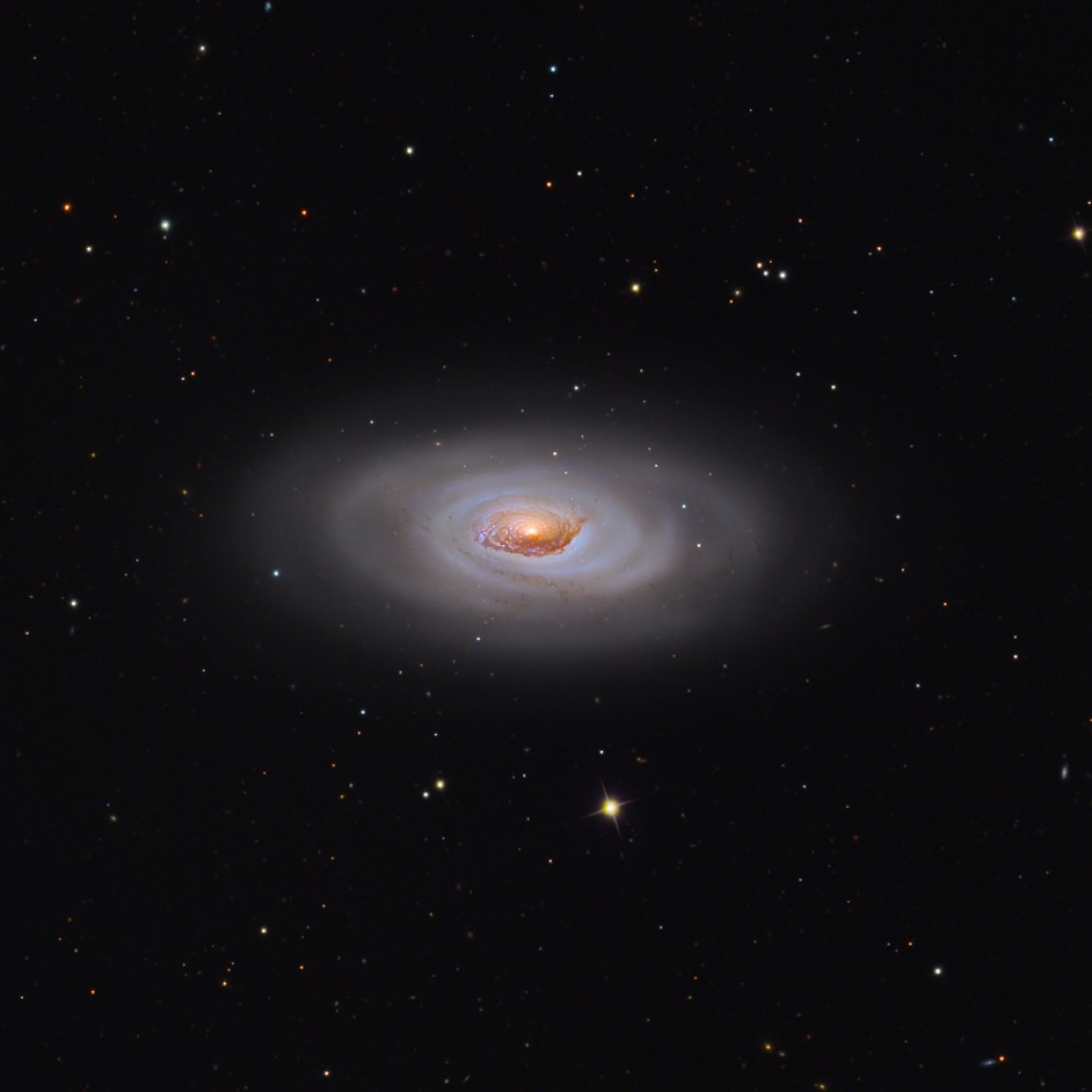
M64 spans a diameter of 16.51 kiloparsecs, which works out to approximately 53,800 light-years — making it somewhat smaller than the Milky Way, which extends roughly 100,000 light-years across. It sits 17 million light-years away in the constellation Coma Berenices, a relatively modest cosmological distance that puts it among the nearer spiral galaxies observable from Earth. Despite this relative proximity, M64 is described as a relatively isolated spiral galaxy, meaning it does not belong to a rich group or cluster of galaxies in its immediate vicinity. At the larger scale, however, it is gravitationally bound to the Virgo Supercluster, the enormous structure of galaxy groups and clusters that also includes the Local Group containing the Milky Way. The Virgo Supercluster spans hundreds of millions of light-years, so membership in it describes M64's position in the cosmic web rather than its local social environment. Its isolation on smaller scales may help explain why a merger with a small satellite, rather than a major galactic collision, is the leading explanation for its unusual counter-rotating gas structure.
09 Observing the Black Eye Galaxy Yourself
M64 is genuinely accessible to amateur astronomers with modest equipment. Its apparent magnitude makes it visible in small telescopes, and its striking dark dust lane becomes increasingly obvious as aperture grows. The galaxy is well known in the amateur community precisely because it rewards observers across a wide range of telescope sizes — even compact instruments show the galaxy's bright core set against the softer outer glow, while larger backyard telescopes begin to resolve the dark absorbing lane that inspired all three of its nicknames. Its location in Coma Berenices is favourable for observers across inhabited latitudes in both the northern and southern hemispheres, giving a large fraction of the world's amateur astronomers seasonal access to it. Because M64 is relatively isolated, it typically sits in an uncluttered star field, which helps it stand out visually. For anyone building a Messier marathon — an attempt to observe all 110 Messier objects in a single night — M64 is a standard inclusion that consistently delivers a satisfying view.
10 The Outer Ring and Spiral Architecture Deeper
The De Vaucouleurs classification of M64 as (R)SA(rs)ab specifically flags the presence of an outer ring-like structure, labelled by the (R) at the start of the code. This kind of outer ring is thought to form when material accumulates at the outer resonance zones of a galaxy's gravitational potential, often associated with the long-term evolution of spiral structure or the aftermath of interactions. Within that outer ring, the galaxy has a transitional (rs) structure — not a clean inner ring and not a pure spiral leading into the core, but something in between. The spiral arms themselves are described as tightly wound, indicated by the ab classification, which places M64 between the grand-design open spirals and the most tightly coiled Sa types. The alternative classification by Ann et al. in 2015 as SABa adds a nuance: it suggests a weakly barred component may be present, something the standard De Vaucouleurs classification did not emphasise. Whether M64 has a true bar or only an incipient one remains part of the ongoing discussion about how to best characterise this structurally complex galaxy.
 ⤢