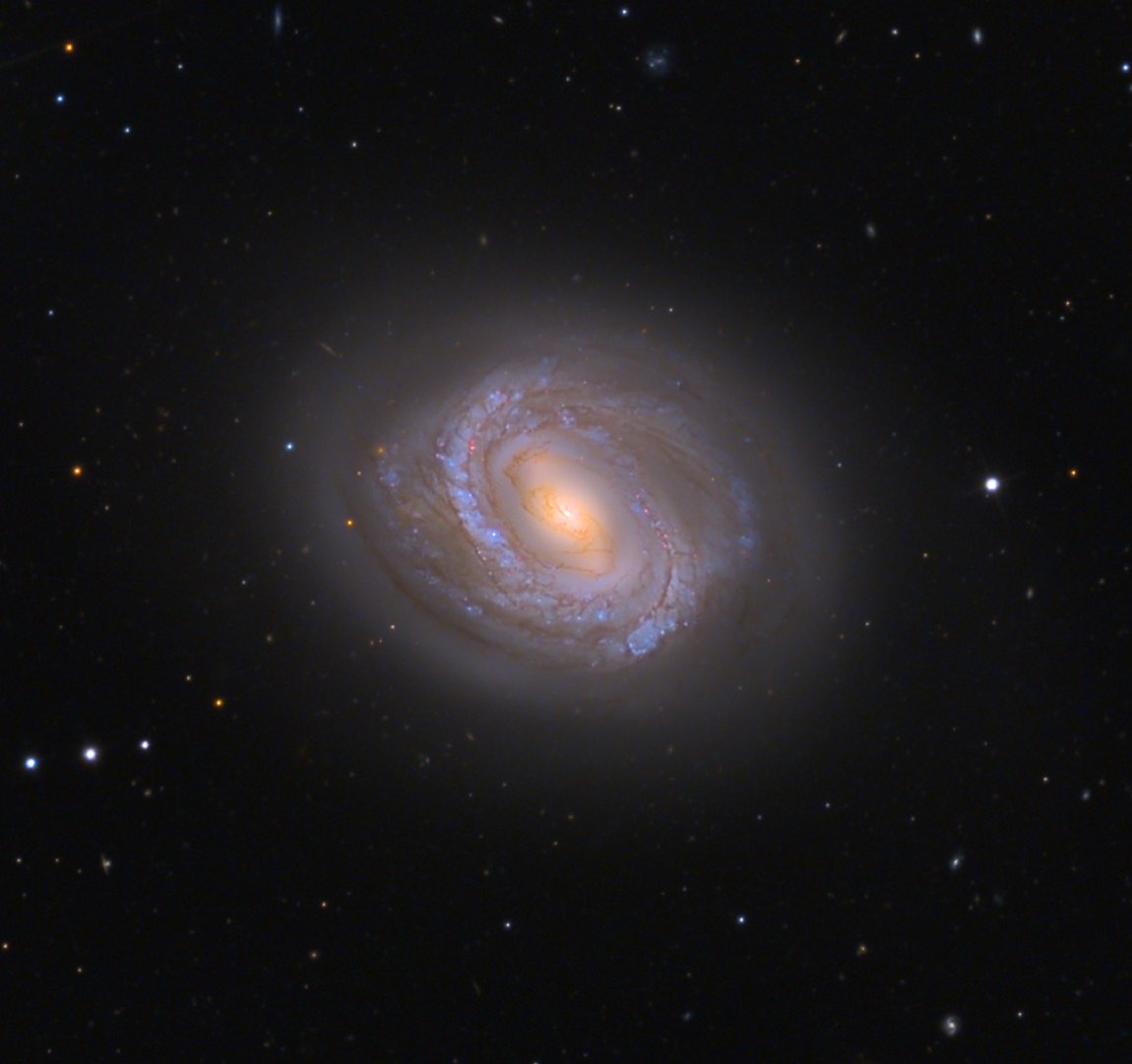
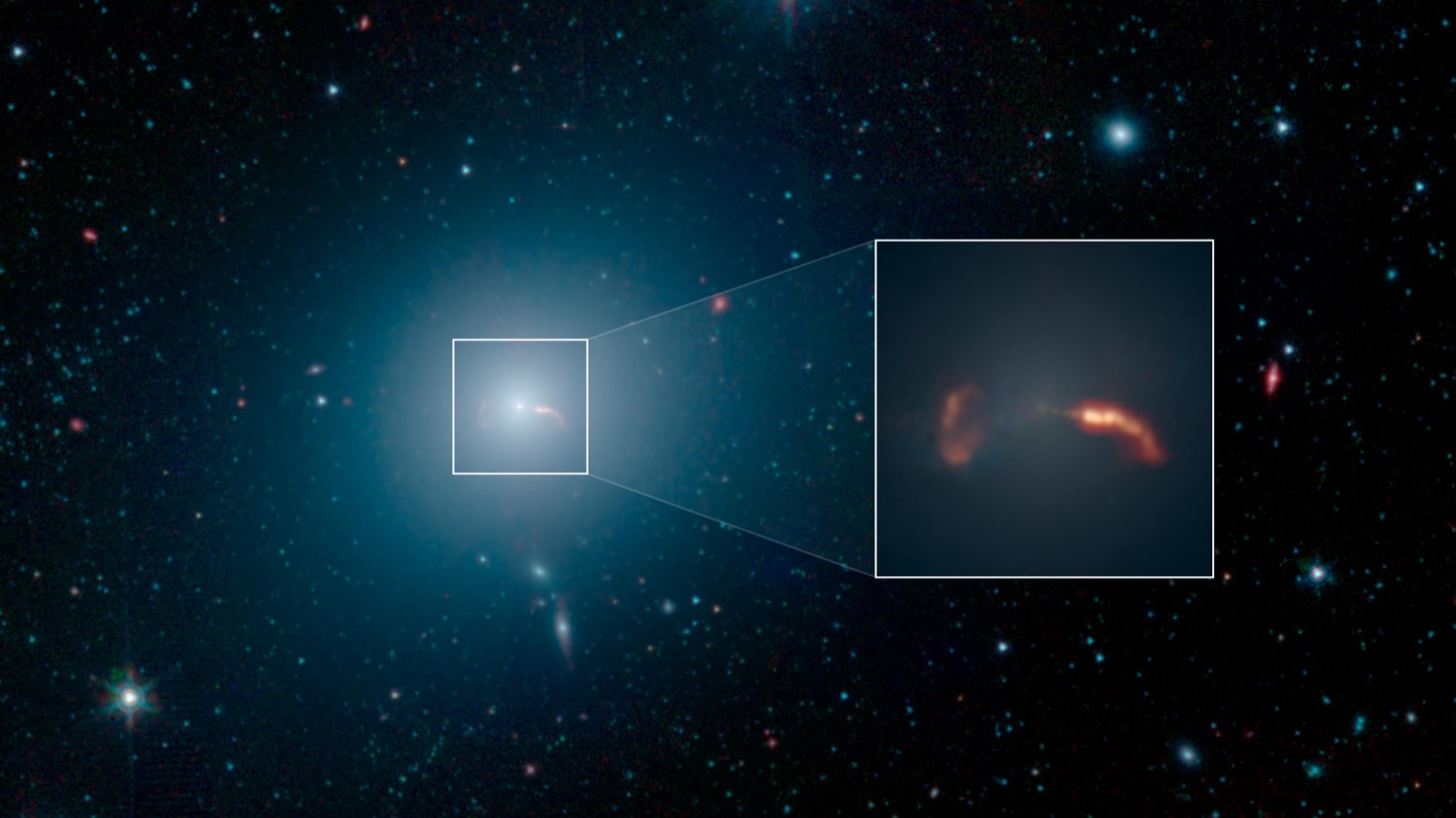
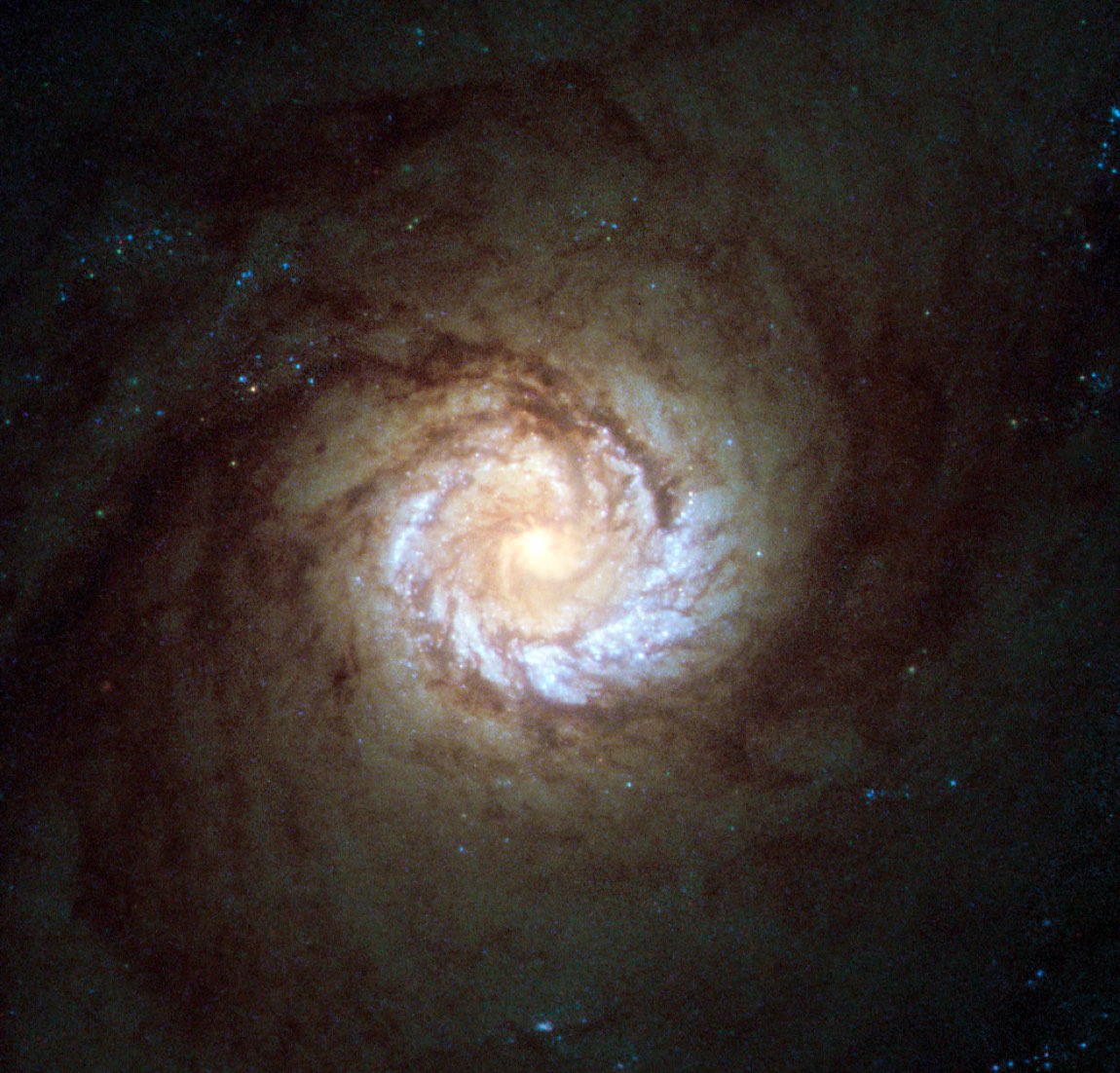
 Photograph · ESA/Hubble & NASA Acknowledgement: Det58 · CC BY 4.0
Galaxy · Deep guide
Messier 61
Also called: M61 · NGC 4303 · UGC 7420 · PGC 40001 · Swelling Spiral Galaxy
The Swelling Spiral: a busy, star-forming galaxy on the southern edge of the Virgo Cluster.
What is it?
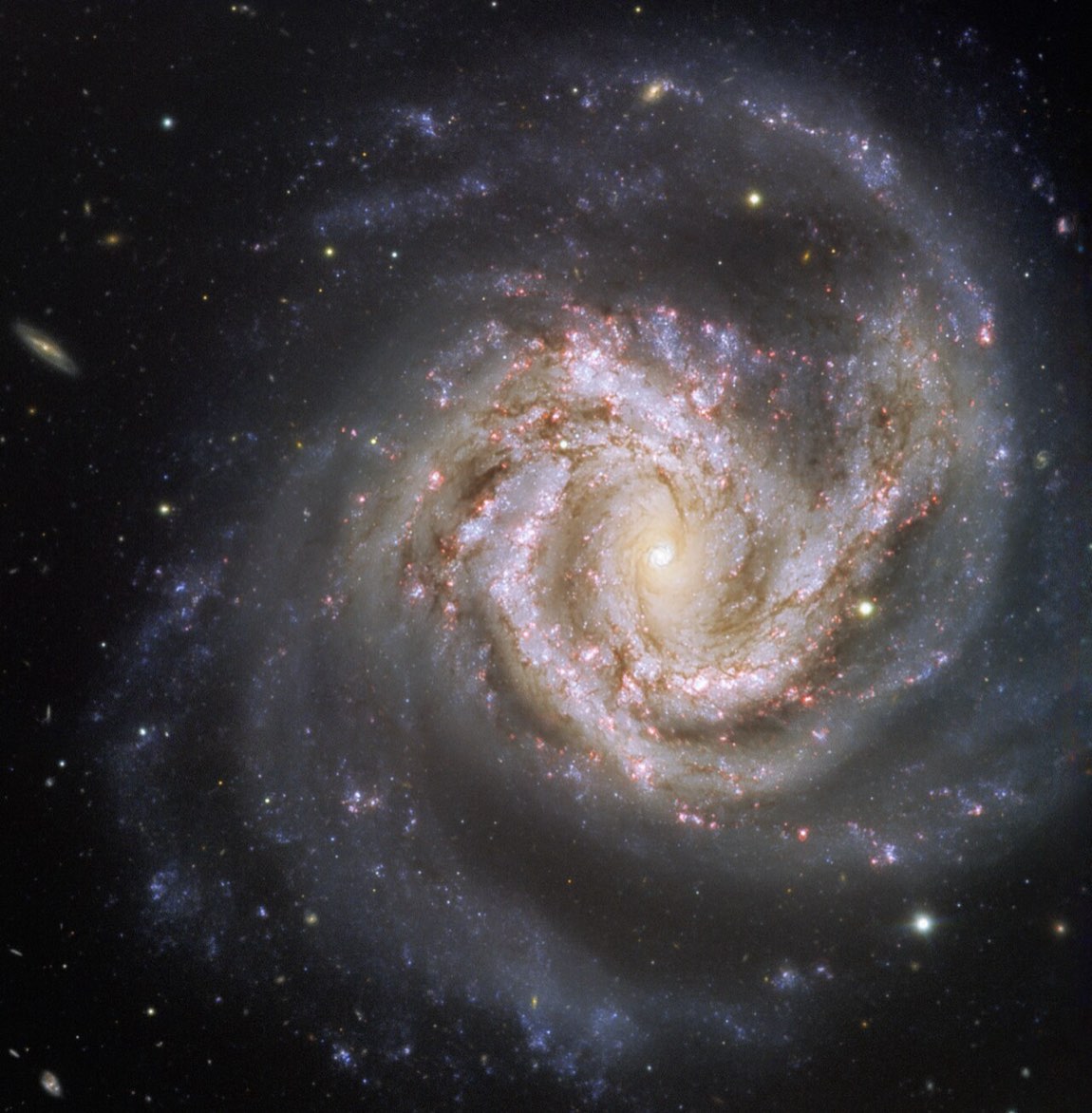
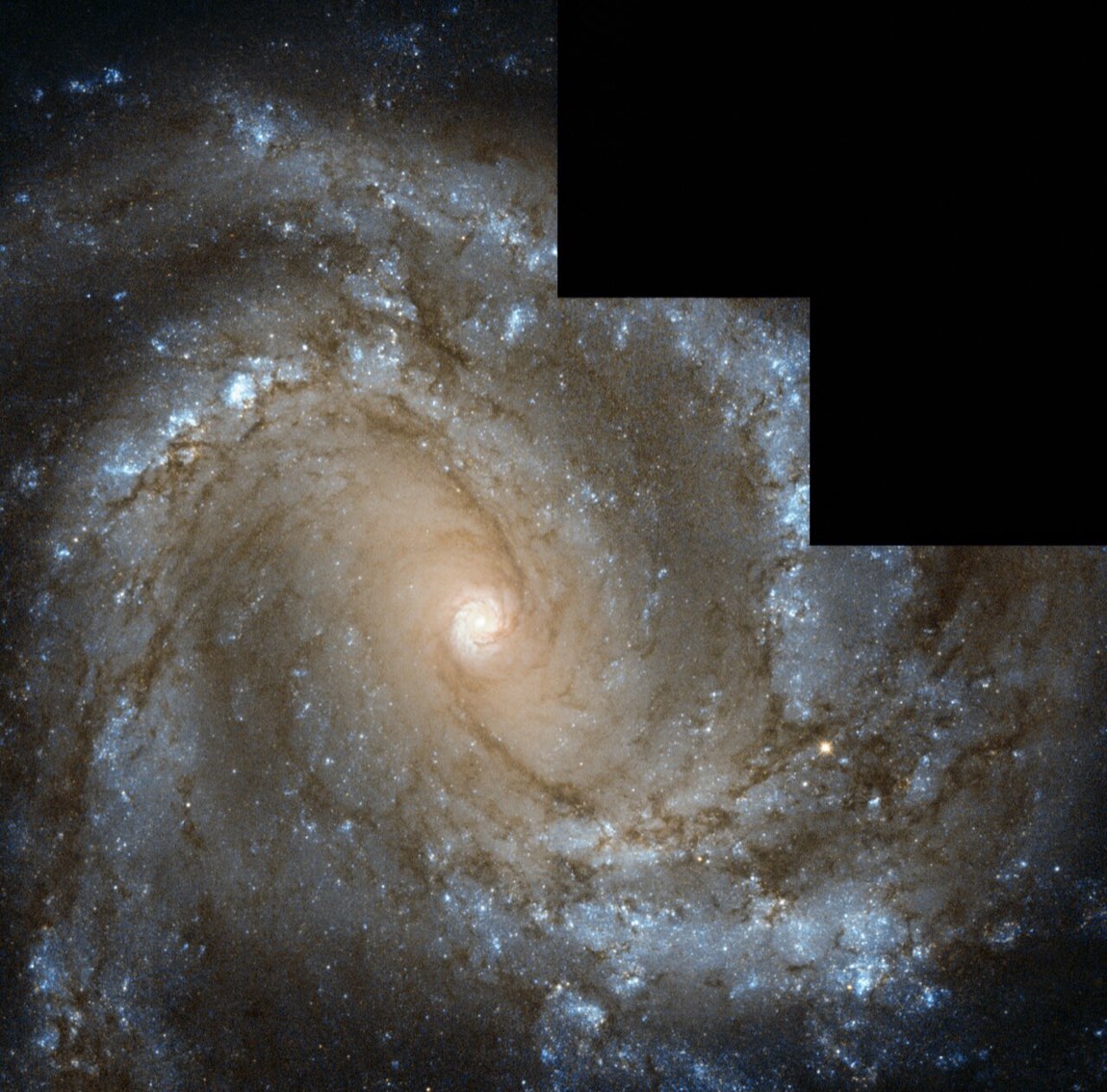
Messier 61 is a weakly barred spiral galaxy and one of the largest members of the Virgo Cluster. Barnaba Oriani found it on 5 May 1779; Messier saw it the same night but at first mistook it for a comet. M61 is a starburst galaxy: its disk is full of glowing gas clouds and new stars, and its centre holds a young, massive star cluster and an active nucleus. Unusually for a Virgo spiral, it still holds a lot of neutral hydrogen gas, the raw material for future stars.
The deep dive
Researched for the Atlas from Wikipedia — Messier 61 (2,475 characters read) · updated Nov 15, 2026
01 A Case of Mistaken Identity at First Light
The story of M61's discovery is a small comedy of astronomical errors. On the night of May 5, 1779, Italian astronomer Barnaba Oriani spotted the galaxy and correctly identified it as a fixed nebula. That same night, the great Charles Messier also trained his telescope on the same patch of sky — but convinced himself he was looking at a comet. Six days later Messier returned, realized his mistake, and logged the object properly into his famous catalog. The irony is rich: the catalog that bears Messier's name includes an object that Oriani unambiguously identified first. It is a reminder that even meticulous observers can be fooled, and that priority in astronomy often belongs not to the most famous name but to whoever paused longest to look carefully.
02 Where M61 Sits in the Cosmic Web
M61 is not a loner. It belongs to the Virgo Cluster, one of the nearest large galaxy clusters to the Milky Way, sitting at an estimated distance of 45.61 million light-years from us. Within that sprawling cluster it is part of a smaller concentration called the S Cloud, and it anchors its own named grouping — the M61 Group. That group, in turn, is a member of the Virgo II Groups, a chain of galaxies and clusters strung along the southern edge of the larger Virgo Supercluster. Think of it as a town inside a county inside a state inside a country: M61 occupies a well-defined address within a layered hierarchy of gravitational structures that extends across hundreds of millions of light-years.
03 Reading the Code in M61's Galaxy Type Deeper
Astronomers classify M61 with the morphological designation SAB(rs)bc, and each letter or symbol in that string carries precise meaning. SAB tells us the galaxy has a bar across its center, but only a weak one — not the strong, rigid bar of a fully barred spiral. The parenthetical rs indicates a partial ring structure, a suggestion rather than a complete ring encircling the nucleus. The lowercase bc at the end describes the spiral arms as moderately to loosely wound, meaning they sweep outward in broad, open curves rather than tight pinwheels. Together, the classification paints a portrait of a galaxy caught somewhere between structural extremes: not a clean grand-design spiral, not a strongly barred one, but a hybrid caught mid-expression — which may help explain why it hosts such vigorous ongoing activity.
04 A Starburst Engine at the Galaxy's Heart
At M61's center, star formation is running at a furious pace. The galaxy is classified as a starburst galaxy, meaning it is producing new stars far faster than a typical spiral. Nestled at its nucleus is a massive nuclear star cluster estimated to contain about 1 million solar masses of material and thought to be only around 4 million years old — an infant by cosmic standards. For comparison, 4 million years ago on Earth, our earliest human ancestors were just beginning to walk upright. This young cluster coexists with an older massive star cluster and evidence of an earlier starburst episode, suggesting M61 has experienced more than one intense burst of star-making activity. Bright active nebulae — the glowing gas clouds that signal energetic star formation — are visible across much of the galaxy's disk.
 ⤢
05 The Supermassive Black Hole Lurking Inside Deeper
Beyond the nuclear star cluster, M61 harbors a central candidate supermassive black hole with an estimated mass of around 5 million solar masses. That figure puts it in the same rough weight class as the black hole at the center of our own Milky Way, Sagittarius A*, which checks in at about 4 million solar masses — though the article designates M61's black hole as a "candidate," reflecting some remaining uncertainty in its confirmation. The galaxy is also classified as having an active galactic nucleus, meaning material falling toward this black hole is likely releasing significant energy. The coexistence of a fresh nuclear star cluster, residual older stellar populations, and an actively fed black hole makes M61's core one of the more complex and layered environments known in nearby galaxies.
06 The Unusual Wealth of Neutral Hydrogen Deeper
One of M61's most scientifically interesting quirks is how much neutral hydrogen gas it holds. Most late-type spiral galaxies inside the Virgo Cluster have been stripped of significant amounts of their gas through a process called ram-pressure stripping — essentially, the hot intracluster medium blows the galaxy's gas away as it moves through the cluster environment. M61 bucks that trend, displaying an unusual abundance of neutral hydrogen for a galaxy of its type and location. This excess gas reservoir almost certainly helps feed the ongoing starburst activity at its center. It raises an open question: why has M61 retained so much of its raw star-forming fuel when its neighbors have lost theirs? The answer likely involves its particular orbit within the cluster and how recently it may have passed through the cluster's denser regions.
07 Eight Supernovae: A Record Explosion Rate
M61 holds an extraordinary distinction among nearby galaxies: eight supernovae have been observed within it, making it one of the most prolific supernova factories known. The parade began with SN 1926A, discovered by Max Wolf and Karl Wilhelm Reinmuth on May 9, 1926, and continued through SN 2020jfo, detected by the Zwicky Transient Facility on May 6, 2020. Seven of the eight were classified as Type II supernovae — the violent deaths of massive stars that have exhausted their nuclear fuel — while SN 2014dt was a Type Ia-peculiar event, an unusual variant of the thermonuclear explosions that occur in white dwarf systems. The brightest of the recorded events reached apparent magnitude 13, easily visible in a moderate amateur telescope. This high supernova rate is almost certainly connected to M61's intense ongoing star formation: more massive stars being born means more massive stars dying.
08 A Century of Supernova Discoveries Deeper
The roster of people who have discovered supernovae in M61 reads like a who's who of observational astronomy across nearly a century. Max Wolf — famous for asteroid discoveries — and Karl Reinmuth found the first in 1926. Milton Humason, a former mule driver turned renowned astronomer who worked alongside Edwin Hubble establishing the expansion of the universe, spotted the second in 1961. Italian astronomer Leonida Rosino added the third in 1964. Decades later, the prolific Japanese amateur Kōichi Itagaki discovered three separate events: SN 2006ov, SN 2008in, and SN 2014dt, the last being the peculiar Type Ia. The most recent detection, SN 2020jfo, came from the automated Zwicky Transient Facility, illustrating how the field has shifted from lone observers at eyepieces to wide-field robotic survey telescopes that sweep the sky every few nights looking for exactly these kinds of transient brightening events.
 ⤢
09 A Stellar Stream Found with Rubin's Eye
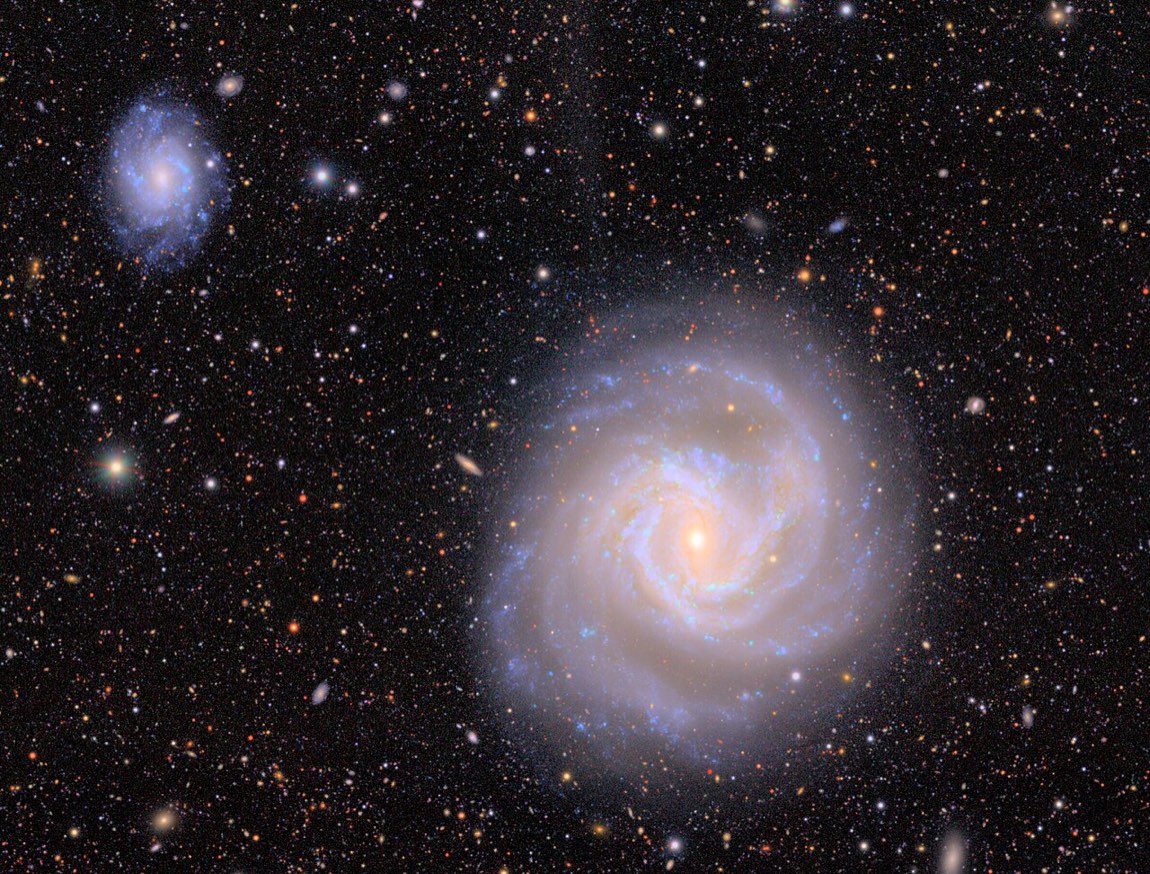
In 2026, astronomers announced a fresh discovery surrounding M61: a stellar stream was detected north of the galaxy using the Vera C. Rubin Observatory. Stellar streams are faint, elongated arcs of stars — the shredded remnants of a smaller galaxy or star cluster that was pulled apart by the gravitational tides of a larger galaxy over billions of years. Finding one around M61 is significant because it offers direct evidence of past galactic cannibalism: at some point in its history, M61 swallowed a smaller companion, leaving behind this gossamer trail of stars. The Rubin Observatory, designed precisely to find these kinds of extremely faint structures through its combination of a wide field of view and deep imaging capability, is expected to reveal many more such streams in the coming years as its survey of the southern sky accumulates data.
10 How to Find and Observe M61
M61 lies in the constellation Virgo, embedded within the Virgo Cluster, which makes spring evenings the ideal time to hunt for it from northern hemisphere locations. With an apparent magnitude that brought its brightest historical supernova down to magnitude 13 in telescopes, the galaxy itself is accessible to amateur astronomers with moderate equipment under dark skies. Its classification as one of the largest members of the Virgo Cluster means it subtends enough angular size to show structure in larger backyard telescopes, where observers may glimpse hints of its spiral arms. The region of sky around M61 is rich with other Virgo Cluster members, so a session spent sweeping the area can turn into an extended tour of multiple galaxies in a single evening. The discovery of a faint stellar stream in 2026 also points toward what future deep-imaging amateurs with sensitive cameras might eventually attempt to capture.
11 Open Questions M61 Still Poses Deeper
Despite being relatively close at 45.61 million light-years and well-studied, M61 leaves several questions unresolved. The central black hole is still labeled a "candidate," meaning its existence is strongly inferred but not definitively confirmed by direct dynamical measurements. The reason M61 has held onto so much neutral hydrogen while other late-type spirals in the Virgo Cluster have been stripped is not fully explained — its orbit and accretion history within the cluster remain subjects of investigation. The galaxy also shows evidence of multiple distinct starburst episodes separated by time, and the triggers for each remain unclear. The newly discovered stellar stream adds another layer: identifying the progenitor — what kind of object was consumed and when — will require additional observations. M61 is in many ways a galaxy that rewards continued attention, offering a compact laboratory where star formation, black hole activity, galaxy merging, and cluster environment all interact simultaneously.
 ⤢