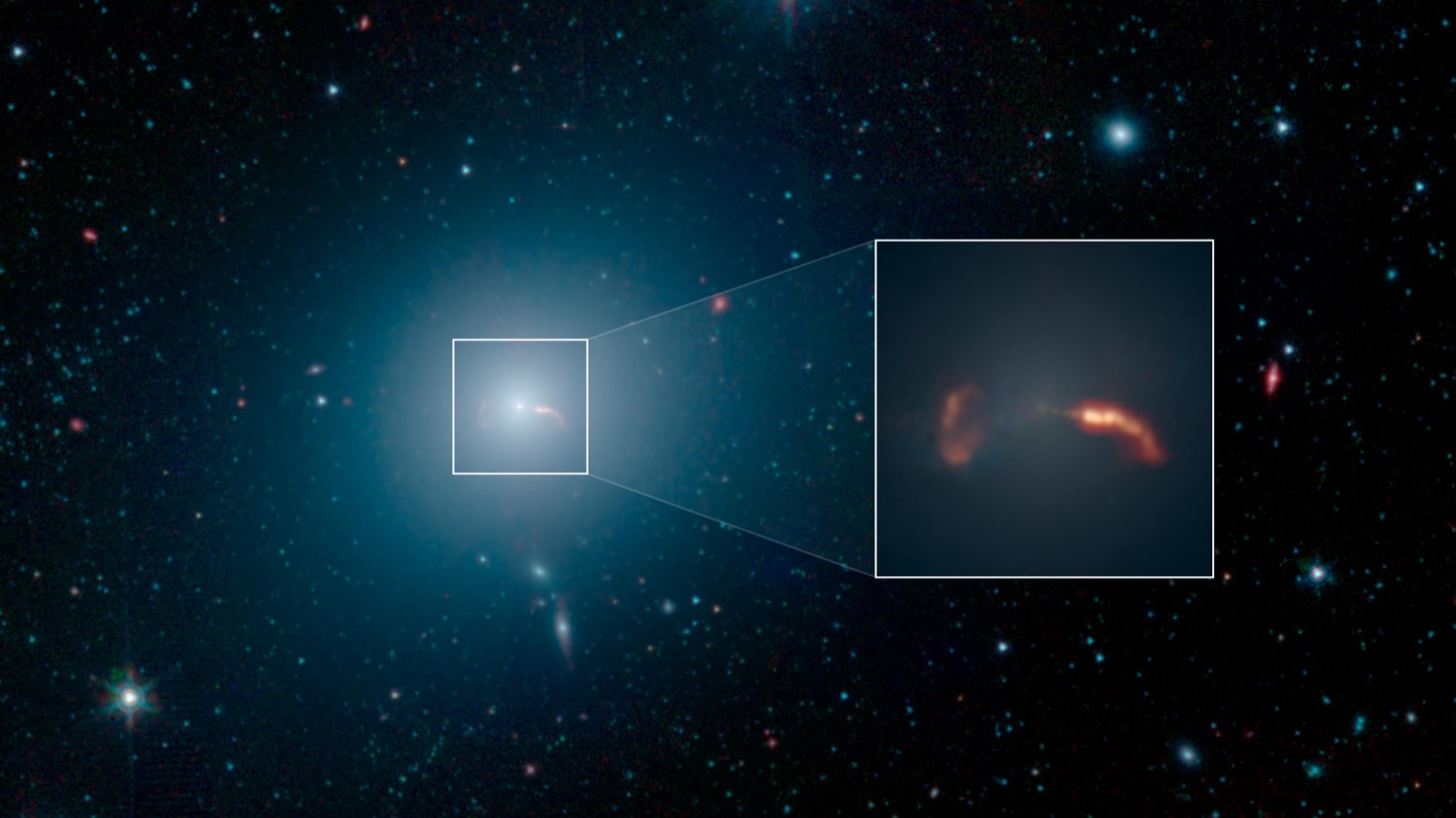
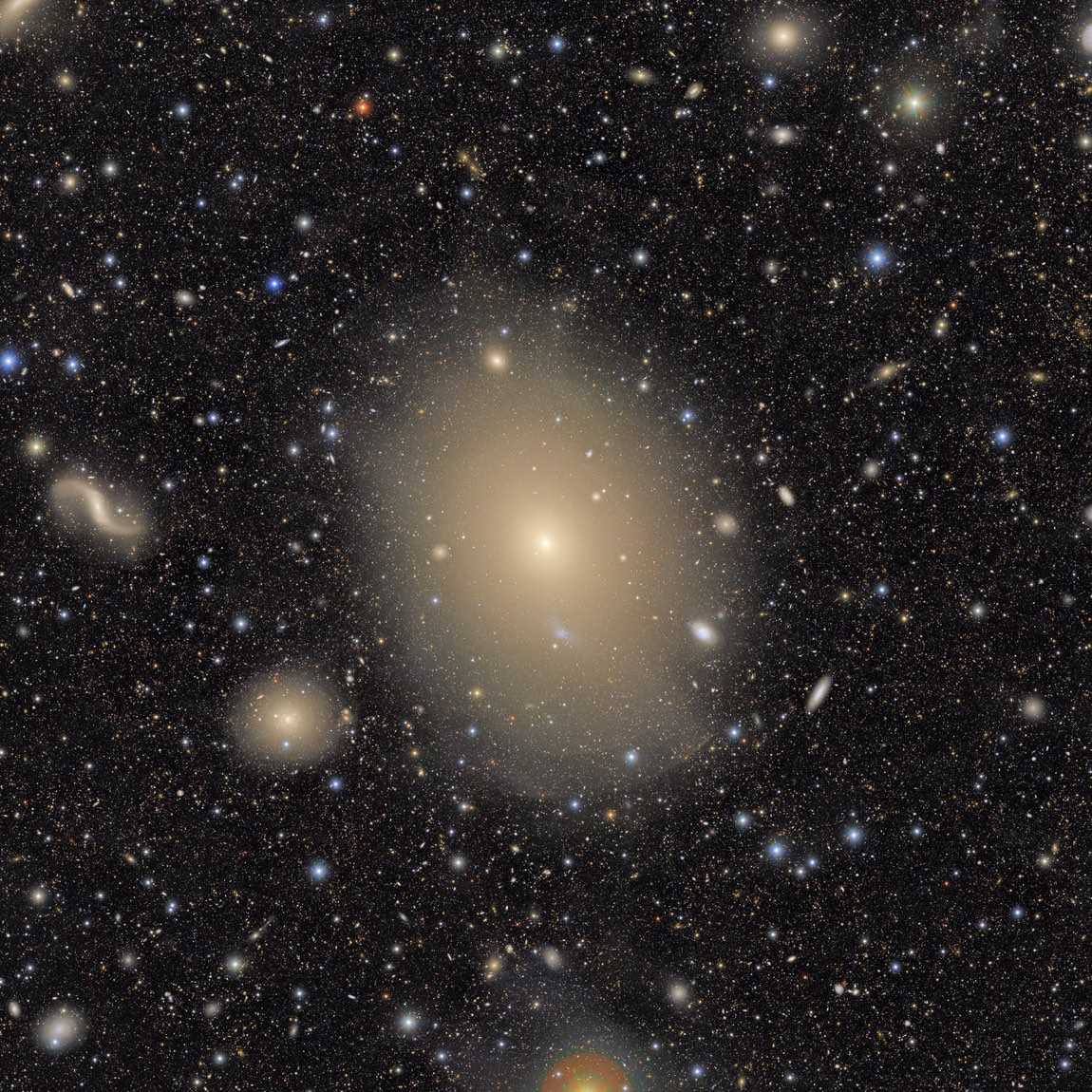
 Photograph · RubinObs/NOIRLab/SLAC/NSF/DOE/AURA · CC BY 4.0
Galaxy · Deep guide
Messier 49
Also called: M49 · NGC 4472 · Arp 134
The brightest galaxy in the Virgo Cluster, guarding thousands of globular clusters and a giant black hole.
What is it?
Messier 49 is a giant elliptical galaxy in Virgo, about 56 million light-years away. Discovered by Charles Messier in 1777, it was the first member of the Virgo Cluster of galaxies ever found, and it is the cluster's most luminous galaxy. X-rays from its centre suggest a supermassive black hole of about 565 million Suns. It is surrounded by an estimated 5,900 globular clusters, far more than the Milky Way's roughly 200 but fewer than giant Messier 87 has.
The deep dive
Researched for the Atlas from Wikipedia — Messier 49 (2,371 characters read) · updated Nov 15, 2026
01 The First Virgo Cluster Galaxy Ever Found
When Charles Messier catalogued this galaxy in 1777, he had no idea he was logging the very first confirmed member of what we now call the Virgo Cluster — a vast gravitational city of thousands of galaxies. That distinction makes M49 historically remarkable. The Virgo Cluster has a dynamic center dominated by the giant galaxy Messier 87, but M49 sits in a distinct smaller grouping called the Virgo B subcluster, positioned about 4.5 degrees away from that center on the sky. Despite lying slightly off to the side of the cluster's heart, M49 is the most luminous member of the entire Virgo Cluster, outshining every other galaxy in that enormous collection. It is also more luminous than any galaxy closer to Earth. So the first Virgo cluster galaxy Messier ever recorded turned out to be, in terms of raw brightness, the heavyweight champion of the whole group — a satisfying historical coincidence that astronomers still appreciate today.
02 A Radio-Quiet Giant With a Violent Core Deeper
Elliptical galaxies of M49's size often power loud radio sources, blasting jets of charged particles far into intergalactic space. M49 has the physical shape and mass of a radio galaxy, but it radiates at radio wavelengths like an ordinary, quiet galaxy — a puzzling underachievement given its scale. What energy it does release through synchrotron radiation in its core region amounts to roughly 10 to the power of 53 ergs, or about 10 to the power of 46 joules. Meanwhile, the nucleus is a steady source of X-rays, which is one of the clearest signatures astronomers have that a supermassive black hole is actively accreting material at the center. That black hole has an estimated mass of 5.65 times 10 to the power of 8 solar masses — 565 million times the mass of our Sun. Even more striking, X-ray observations reveal a bow-shock structure to the north of the galaxy, the kind of feature created when a massive object plows through a medium at high speed, hinting at complex gas dynamics around M49.
03 An Enormous Family of Ancient Star Clusters
Surrounding M49 is a vast swarm of approximately 5,900 globular clusters — tight, ancient balls of stars that orbit the galaxy like a glittering halo. To put that in perspective, our own Milky Way hosts only about 200 such clusters. So M49 has nearly 30 times as many. On average, these clusters are about 10 billion years old, meaning they formed when the universe was only a few billion years old and have been faithfully orbiting ever since. M49's collection is impressive, but it still falls well short of the record-holder: the supergiant elliptical Messier 87 is surrounded by an estimated 13,450 globular clusters. The difference likely reflects the fact that M87 sits at the gravitational center of the Virgo Cluster and has had more opportunity to strip clusters from infalling galaxies over cosmic time. M49's globular cluster population is itself a fossil record of ancient mergers and star formation episodes stretching back nearly to the beginning of the universe.
04 Black Holes Hiding Inside Star Clusters Deeper
Beyond the supermassive black hole lurking at the galaxy's nucleus, M49's globular clusters appear to be hiding black holes of their own — far smaller but equally fascinating. Between 2000 and 2009, astronomers gathered strong evidence for a stellar-mass black hole residing inside one of M49's globular clusters. This kind of object forms when a massive star collapses at the end of its life, leaving behind a compact remnant tens of times the mass of the Sun. Then in 2011, a second candidate stellar-mass black hole was announced in another of the galaxy's globular clusters. The detection of these objects inside ancient star clusters is scientifically significant because it informs models of how black holes form, migrate, and survive within the dense stellar environments of globular clusters, where gravitational interactions are extreme. M49 has thus become a useful laboratory for studying not just the supermassive variety at galactic centers, but the smaller stellar-mass population embedded in the relics of the galaxy's earliest star-forming episodes.
05 Cannibalizing a Smaller Neighbor
M49 is not simply floating alone in its corner of the Virgo Cluster. It is actively gravitationally interacting with a much smaller companion called UGC 7636, a dwarf irregular galaxy. The gravitational pull of M49 is tearing material away from UGC 7636, and the evidence is visible as a trail of stellar debris. This debris stream spans roughly 1 by 5 arcminutes on the sky, which corresponds to a physical size of about 6 by 30 kiloparsecs — a structure tens of thousands of light-years long. This kind of interaction, where a giant elliptical slowly devours a smaller galaxy, is thought to be one of the key mechanisms by which large ellipticals grow over time. Each small galaxy that falls in contributes stars, gas, and potentially globular clusters to the larger system. M49's encounter with UGC 7636 gives astronomers a live, observable example of this galaxy-building process unfolding on a human-relevant timescale.
06 How Far Does M49 Actually Extend? Deeper
Elliptical galaxies do not have sharp edges — they fade gradually into the surrounding darkness, making it genuinely difficult to define where the galaxy ends. For M49, astronomers have traced the luminous outline of the galaxy out to a distance of 260 kiloparsecs from its core, working in the direction to the southwest. One kiloparsec is roughly 3,260 light-years, so 260 kiloparsecs corresponds to a staggering reach of about 848,000 light-years — more than eight times the diameter of the Milky Way. That 260 kpc figure represents the furthest extent at which the galaxy's faint light could still be reliably detected and traced. The true boundary of M49's gravitational influence extends even further, since the dark matter halo surrounding the galaxy is invisible to optical telescopes. What this tells us is that M49 is not just large at its bright central core — its stellar envelope spreads across an enormous volume of intergalactic space.
07 Two Supernovae and What They Tell Us
M49 has hosted two observed supernovae — stellar explosions so bright they can briefly outshine the entire galaxy. The first, designated SN 1969Q, was discovered by Evans on 12 June 1969 and reached an apparent magnitude of 13, bright enough to be relatively straightforward to detect. Its type was not conclusively identified. The second, SN 2024kce, is far more scientifically interesting. Discovered by the Zwicky Transient Facility on 2 June 2024, it is classified as a peculiar Type Ia supernova — a category of explosion normally used as a standard candle for measuring cosmic distances, but with unusual properties. It sits 12.8 arcminutes from M49's center, corresponding to a projected distance of 203,000 light-years, or 62.2 kiloparsecs. High calcium content in its spectra suggests it may be a calcium-rich supernova, a rare subtype. Remarkably, SN 2024kce along with five other transients in the area were still visible when the Vera C. Rubin Observatory imaged the region in June 2025.
08 The Zwicky Facility and Rubin Observatory on Watch
The discovery of SN 2024kce highlights how modern survey telescopes have transformed our ability to catch fleeting cosmic events. The Zwicky Transient Facility, designed specifically to scan large areas of sky rapidly and repeatedly, flagged the new supernova on 2 June 2024. These kinds of automated, wide-field surveys can detect transient events — things that appear, change, or fade over days to weeks — that older observing methods would easily miss. The story did not end at discovery. When the Vera C. Rubin Observatory turned to the same patch of sky in June 2025, SN 2024kce and five additional transients were still detectable. The Rubin Observatory, designed to conduct the Legacy Survey of Space and Time, represents the next generation of this kind of continuous sky monitoring. Together, these two facilities illustrate how the field has shifted from astronomers hunting for individual events to automated systems providing an ongoing, living census of the dynamic universe.
09 Observing M49 From Your Backyard
M49 sits in the equatorial constellation of Virgo, which makes it accessible to observers across most of the inhabited world at some point during the year. At an apparent magnitude of around 8 to 9 — the article gives the supernova SN 1969Q a comparison magnitude of 13, suggesting M49 itself is significantly brighter — it falls within reach of binoculars under good dark-sky conditions and is a straightforward target for small telescopes. As an elliptical galaxy, it appears as a smooth, oval glow without the dramatic spiral arms or dust lanes that make some galaxies visually striking. The challenge for a visual observer is not finding it but appreciating it: nothing in its appearance hints at the 5,900 globular clusters swarming around it, the bow shock to its north, or the debris trail it is pulling from UGC 7636. Those details emerge only through the analysis of professional instruments — but knowing they are there transforms even a modest telescopic view into something genuinely profound.
10 Synchrotron Energy and What It Reveals Deeper
The radio emission detected from M49's core is synchrotron radiation — light produced when electrons traveling at near-light speeds spiral through magnetic fields. By measuring this emission, astronomers can estimate the energy stored in the process, and for M49's core region that figure comes to roughly 10 to the power of 53 ergs, equivalent to about 10 to the power of 46 joules. For context, the Sun releases around 3.8 times 10 to the power of 33 ergs per second, so this represents the Sun's total energy output over trillions of years, all concentrated in a galactic core. The fact that M49 produces this synchrotron energy without the powerful radio jets seen in classic radio galaxies is what makes its classification interesting. It has the physical credentials of a radio galaxy — the mass, the elliptical form, the supermassive black hole — but its actual radio output is ordinary. Understanding what suppresses or channels that energy differently in M49 compared to louder radio galaxies remains an open question in the study of active galactic nuclei.
11 The Bow Shock: A Clue to M49's Motion Deeper
Among the more unusual features of M49 is a structure detected in X-ray observations to the north of the galaxy that resembles a bow shock. A bow shock forms when an object moves supersonically through a medium — the same physics that creates a sonic boom around a supersonic aircraft, or the curved wave ahead of a ship's prow. In M49's case, the medium is the hot, diffuse gas that fills the Virgo Cluster, known as the intracluster medium. The bow-shock structure suggests that M49 is moving through this gas at a significant velocity relative to the cluster environment. This kind of observation gives astronomers a way to probe both the motion of the galaxy and the density and temperature of the intracluster medium itself. It also adds texture to M49's status as a member of the Virgo B subcluster — the galaxy is not simply sitting still in its cosmic neighborhood but actively plowing through it, shaping the gas around it as it goes.