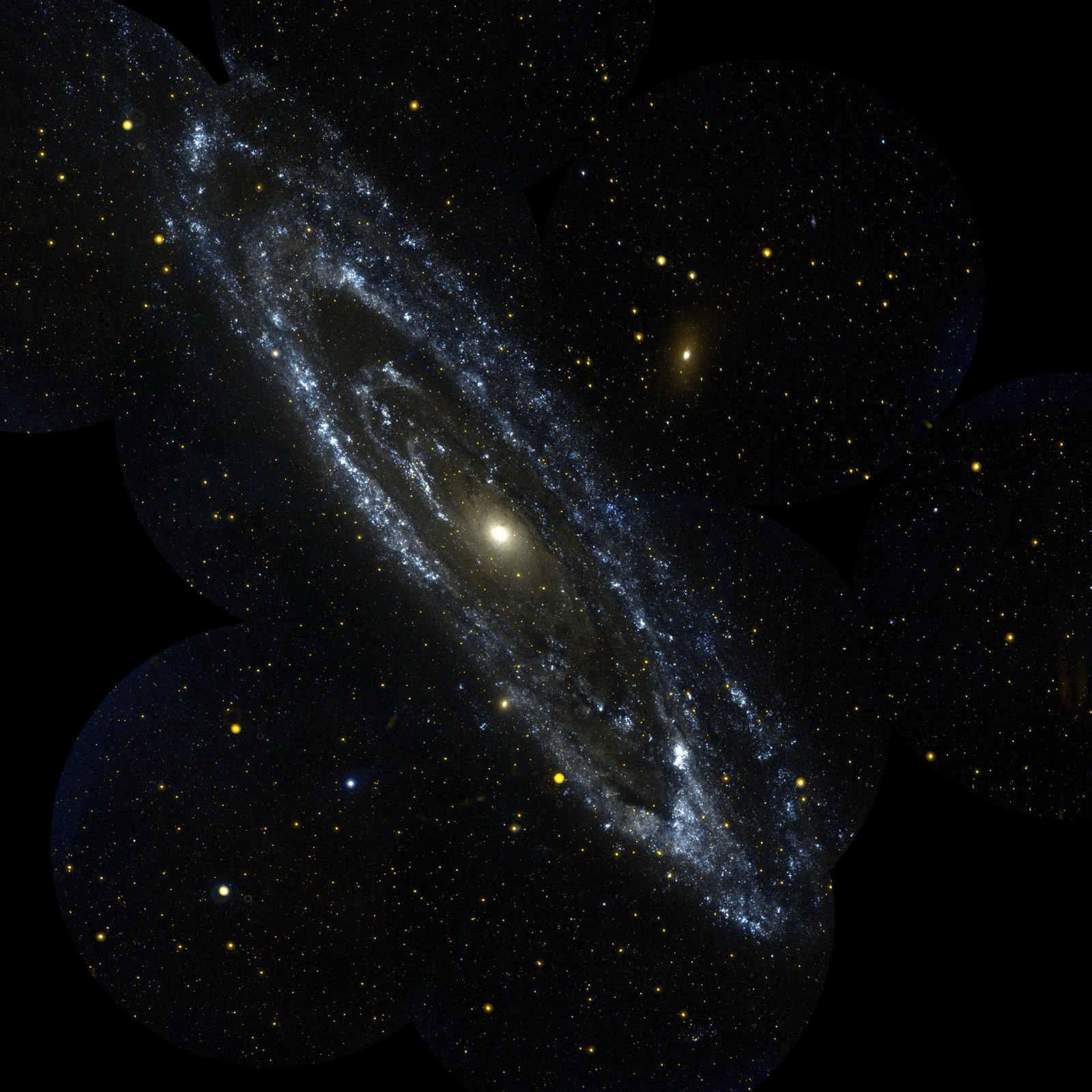
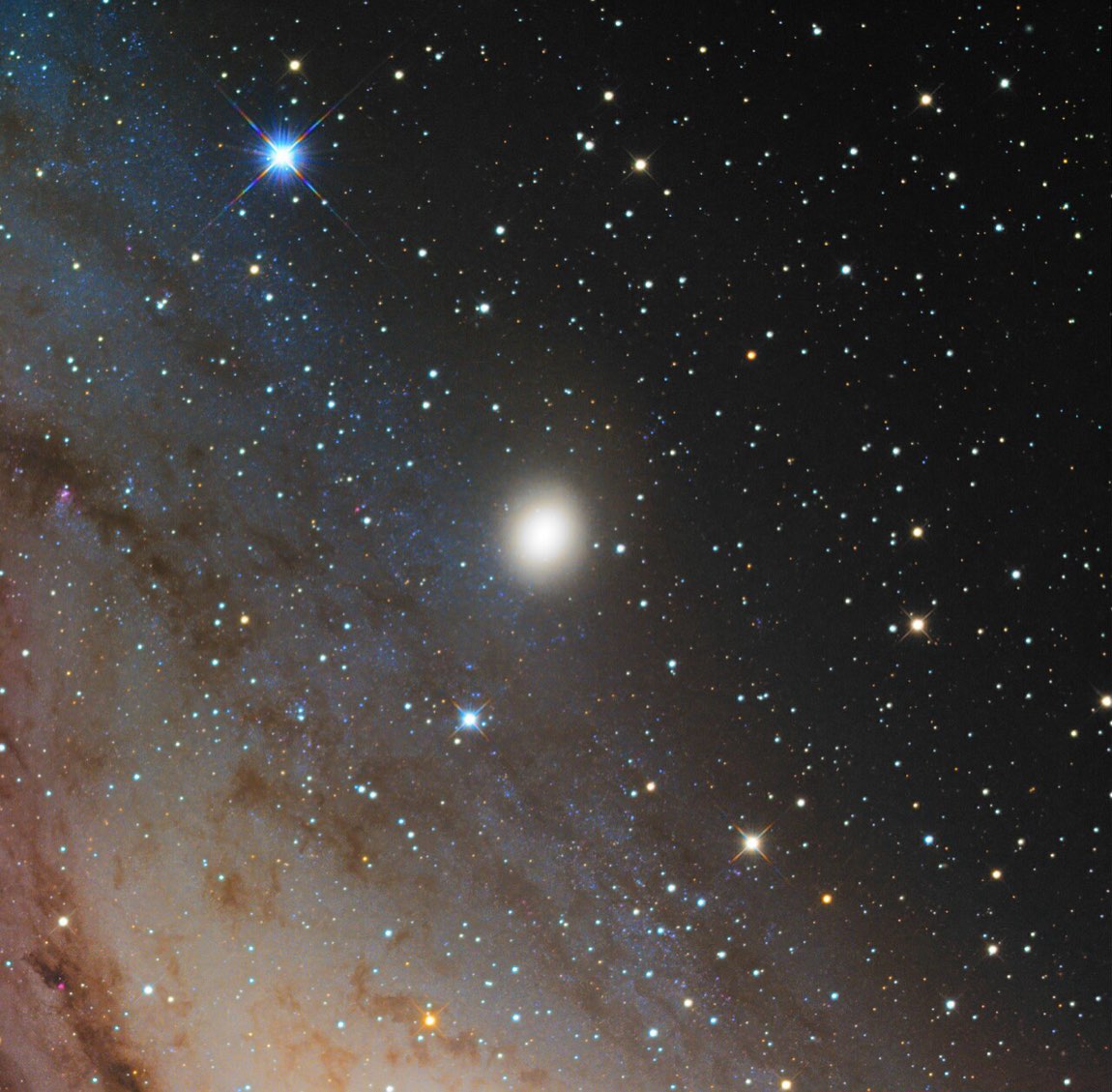
 Photograph · Fabrizio Francione · CC BY-SA 4.0
Galaxy · Deep guide
Messier 32
Also called: M32 · NGC 221 · Arp 168
A compact little galaxy orbiting the Andromeda Galaxy, the prototype of its rare kind.
What is it?
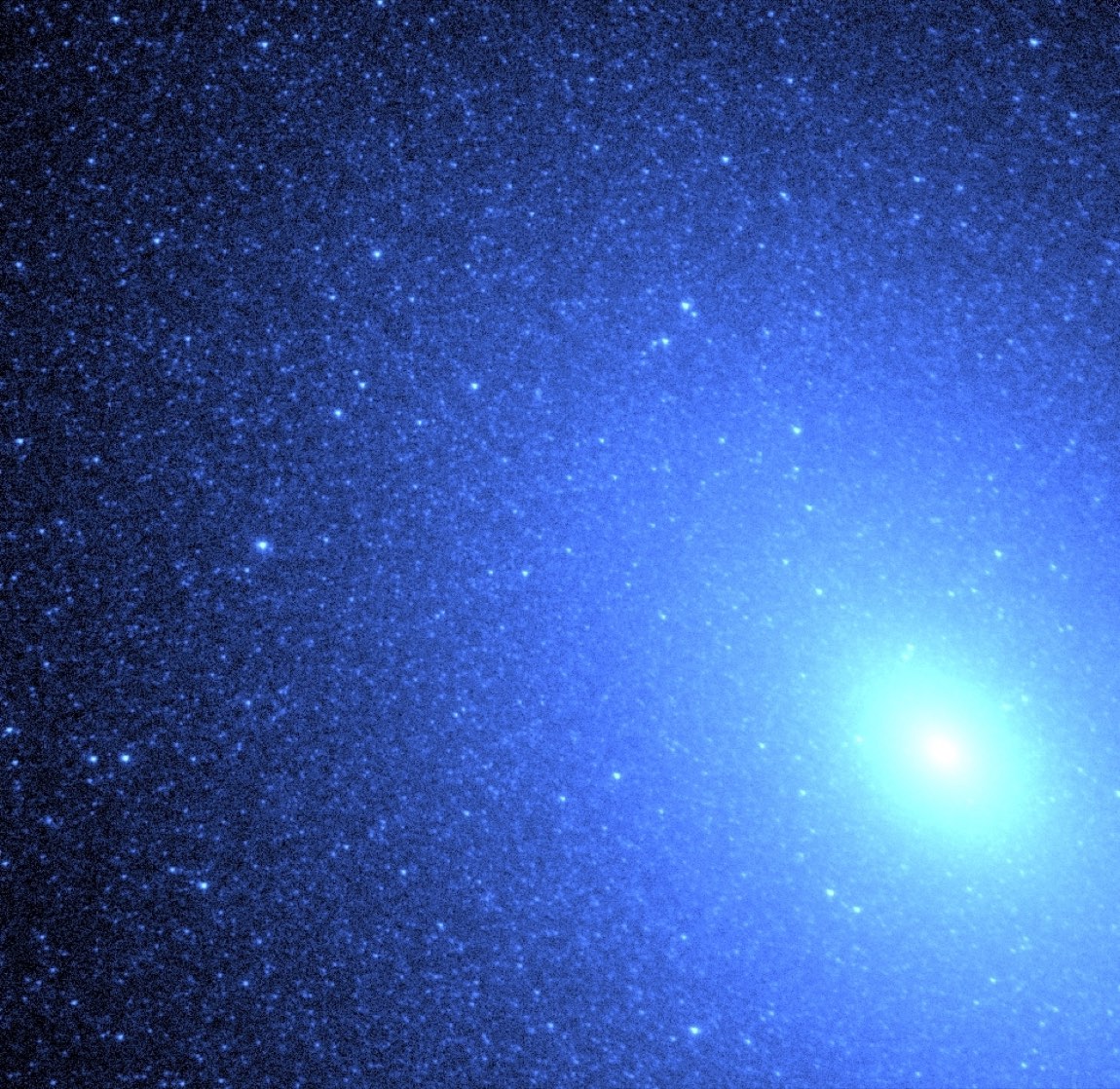
Messier 32 is a small satellite galaxy of the Andromeda Galaxy, about 2.5 million light-years away. Guillaume Le Gentil discovered it in 1749. It is the prototype of the rare compact elliptical class, with half its stars crowded into a core only about 330 light-years across. Like larger elliptical galaxies, it is made mostly of old red and yellow stars and holds almost no gas or dust, so few new stars are forming there today.
The deep dive
Researched for the Atlas from Wikipedia — Messier 32 (4,003 characters read) · updated Nov 15, 2026
01 A galaxy that defies easy categories
M32 is classified as a compact elliptical galaxy, abbreviated cE, and it serves as the defining prototype of that rare class. Compact ellipticals are peculiar objects sitting between ordinary dwarf ellipticals and the dense central bulges of large spirals — small in total size yet extraordinarily concentrated. Like garden-variety elliptical galaxies, M32 hosts mostly old, faint red and yellow stars and carries practically no dust or gas. That absence means star formation has effectively shut down, leaving a population of aging stellar residents with little prospect of new arrivals. Even so, the galaxy does show hints that star formation occurred in the relatively recent past, so it has not always been entirely quiet. There is also evidence of a faint outer disk, which is decidedly un-elliptical and complicates any tidy categorization. M32 sits close enough to its massive neighbor, the Andromeda Galaxy, to be gravitationally bound as a satellite, yet its stellar populations and colors at its outskirts do not match M31's surrounding stellar halo — a clue that the two systems have kept surprisingly distinct identities despite billions of years of proximity.
02 Discovered by accident in 1749
Guillaume Le Gentil discovered M32 in 1749, making it one of the earliest catalogued companion galaxies to Andromeda. Charles Messier later added it to his famous catalog, giving it the designation M32 — a name that has stuck for nearly three centuries. The galaxy's proximity to the brilliant core of M31 means it appears in the constellation Andromeda as a small, almost stellar smudge close to its enormous neighbor on the sky. Because it contains no ongoing star formation and no luminous blue stars, M32 has a relatively smooth, featureless appearance that made it easy to overlook as anything more than a foreground star until telescopes and spectroscopy matured enough to reveal its true nature. Its apparent magnitude and angular size are modest, yet from a dark site it is detectable with binoculars, nestled just south of M31's core. Despite centuries of observation, many of the most revealing measurements about M32 have come only recently, from space-based instruments sensitive enough to resolve individual stars near its center.
03 An impossibly dense stellar core Deeper
The interior of M32 is startling even by galaxy standards. Half of all the galaxy's stars are packed within an effective radius of just 330 light-years — roughly 100 parsecs — in the inner core. Moving inward toward the center, stellar densities climb steeply in what astronomers call a central stellar cusp. At the smallest sub-radii that the Hubble Space Telescope can resolve, densities exceed 3×10⁷ solar masses per cubic parsec, meaning more than 30 million solar masses are squeezed into each cubic parsec of space. For comparison, the solar neighborhood contains roughly one solar mass per cubic parsec, so M32's core is about 30 million times denser in stellar material. The half-light radius of this central star cluster is approximately 6 parsecs, or about 20 light-years — a tiny volume for such an enormous concentration of stars. These extreme densities make M32 an important laboratory for understanding how stars behave when they are packed together so tightly that collisions and gravitational interactions become far more frequent than anywhere in our own Milky Way.
04 The supermassive black hole at the center
Tucked inside M32's dense core is a supermassive black hole whose mass has been estimated to lie between 1.5 and 5 million solar masses. That range reflects genuine measurement uncertainty — pinning down a black hole's mass in a galaxy as compact and crowded as M32 is technically demanding work. The black hole has been assigned the name M32*, drawing a deliberate parallel to Sgr A*, the supermassive black hole at the center of our own Milky Way. A faint radio source and a faint X-ray source, both located at the galaxy's center, are attributed to gas slowly falling onto the black hole in a process called accretion. That infalling gas releases energy detectable across multiple wavelengths, providing indirect but concrete evidence for the black hole's presence. Because M32 is relatively nearby at about 2.49 million light-years, it offers one of the closest opportunities outside the Local Group's two dominant spirals to study a supermassive black hole in a dense stellar environment, making it a valuable comparison case for black hole research.
05 How tidal forces may have sculpted M32 Deeper
One of the leading theories for M32's unusual compactness invokes the powerful gravitational tidal field of its giant neighbor, M31. In this scenario, M32 began as a larger disk galaxy — either a spiral or a lenticular — that fell into the inner regions of M31. As it plunged inward, tidal forces stripped away the galaxy's outer layers, leaving only the dense central bulge largely intact. Simulations also suggest that tidal effects could funnel gas toward the center, potentially triggering a burst of star formation that would drive up the core's density. This picture is appealing, but it runs into timing problems. Newer simulations show that an off-center impact by M32 on M31 approximately 800 million years ago neatly explains the present-day warp observed in M31's disk. However, that warp only forms during the first orbital passage, while transforming a normal dwarf galaxy into something as compact as M32 would require many orbits. The two timescales are difficult to reconcile, leaving the tidal-stripping explanation incomplete and actively debated.
06 Did M32 begin compact — or was it always like this? Deeper
Because the stellar populations at M32's outskirts do not match the surrounding stellar halo of M31, tidal stripping from M32 is unlikely to be the source of that halo material. This is a significant observation: if M31's tides had been vigorously peeling stars away from M32 for billions of years, some chemical and color fingerprint of M32's stars should appear in M31's halo — and it does not. That absence has led some researchers to argue that M32 may have started out compact, retaining most of its own stars rather than being whittled down from something larger. Supporting this view, at least one similar compact elliptical galaxy has been found in complete isolation, far from any massive companion that could have stripped it. If a cE galaxy can exist without a massive host to shape it, then perhaps tidal harassment is not a necessary ingredient. The question remains genuinely open in current astronomy: M32 may be a relic of a rare compact formation process, or it may be a stripped remnant — and distinguishing between those histories is an active area of research.
 ⤢
07 The lost spiral galaxy hypothesis
A striking alternative hypothesis proposes that M32 is actually the surviving core of a much larger former spiral galaxy, now designated M32p in theoretical models. Under this scenario, M32p would have been the third-largest member of the entire Local Group at its peak — larger than the Triangulum Galaxy (M33) and second only to M31 and the Milky Way. Simulations suggest that M31 and M32p collided and merged roughly two billion years ago. That ancient merger could simultaneously explain two puzzling features: the unusual stellar makeup of M31's present-day stellar halo, and the peculiar structure and stellar content of today's compact M32. In this picture, what we see as M32 is essentially the indestructible kernel of a once-grand spiral that survived an enormous galactic collision, while the rest of M32p was absorbed into Andromeda's outer reaches. If correct, the merger would rank among the most consequential events in the Local Group's history, reshaping the region's dominant galaxy while leaving behind a small but dense calling card.
08 Two ways astronomers measure its distance Deeper
Because M32 is close enough for detailed study, astronomers have been able to apply two independent distance-measurement techniques and compare their results. The infrared surface brightness fluctuations method works by analyzing the apparent graininess in the light from a galaxy's stellar population — a smoother appearance implies greater distance. Applied to M32, this technique yields a distance of 2.46 ± 0.09 million light-years (755 ± 28 kiloparsecs). The second approach, the tip of the red giant branch method, exploits the fact that the brightest red giant stars reach a predictable maximum luminosity before shedding their outer layers. By identifying that luminosity cutoff in M32's resolved stellar population, astronomers estimate a distance of 2.51 ± 0.13 million light-years (770 ± 40 kiloparsecs). The two measurements overlap comfortably within their uncertainties, lending confidence to a distance near 2.49 million light-years. Additional evidence — particularly the fact that M32's stars and planetary nebulae show no reddening or obscuration by intervening gas and dust — supports the conclusion that M32 lies slightly in the foreground of M31 rather than behind it.
09 A rare gravitational microlensing event Deeper
In late November 2000, astronomers recorded a remarkable event: a star inside M32 briefly and measurably brightened the light from a background star in M31 through gravitational microlensing. The brightening peaked on 2 December 2000. Microlensing occurs when a massive object — in this case a star in M32 — passes close to the line of sight between an observer and a more distant light source. The foreground star's gravity bends and amplifies the background light in a characteristic, symmetric brightening curve. This single recorded event carries multiple layers of significance. It confirms the foreground position of M32 relative to M31 by demonstrating that M32's stars can act as lenses for M31's background stars. It also illustrates how even a small, dense satellite galaxy can contribute to microlensing surveys originally designed to probe M31's dark matter content. Such events are fleeting and rare, making the December 2000 detection a notable observational achievement in the study of this galaxy pair.
10 How to find and observe M32
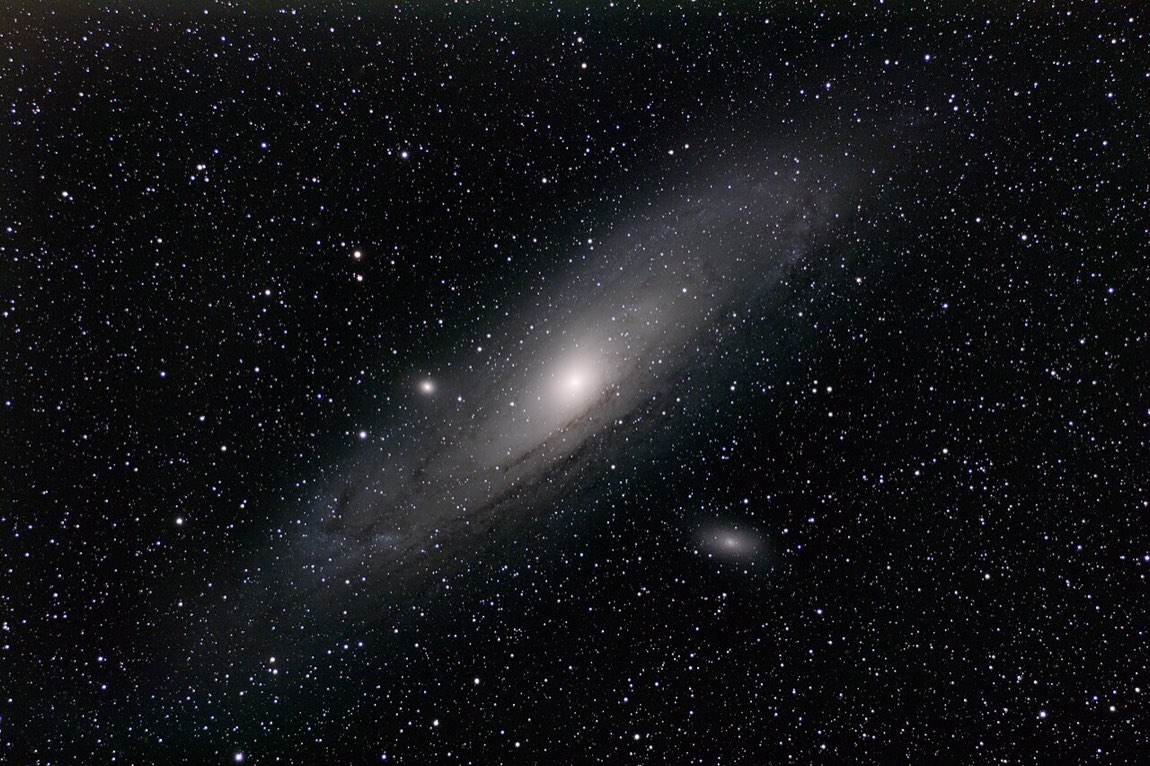
M32 appears in the constellation Andromeda, positioned close to the southern edge of M31's bright central region, making the two objects easy to locate together. Because M32 sits so near its massive neighbor on the sky, the most straightforward strategy for finding it is to locate M31 first and then look for the small, condensed glow just to M31's south. M32 has a higher surface brightness than many dwarf galaxies, which helps it stand out against the sky background despite its modest angular size. Binoculars can reveal it from a dark site as a nearly stellar point of light distinct from M31's extended glow. Through a small telescope under good conditions, its compact, oval shape becomes apparent. Because M32 contains no bright emission nebulae or star-forming regions, it shows no color variation across its disk — just a smooth, slightly yellowish gradient that reflects its old stellar population. Autumn evenings in the Northern Hemisphere offer the best viewing window, when Andromeda climbs high in the sky and atmospheric blurring is minimized at greater altitudes above the horizon.
11 Open questions that keep researchers busy Deeper
Despite more than two and a half centuries of observation, M32 leaves several fundamental questions unanswered. The most pressing is its origin: did tidal stripping by M31 compress a formerly larger galaxy into M32's current compact form, or did M32 always exist in something close to its present state? The timing mismatch between M31's disk warp and the many orbits needed for tidal transformation makes the stripping scenario difficult to defend cleanly, yet no formation model fully accounts for all of M32's properties. The former spiral galaxy hypothesis — that M32 is the remnant core of M32p after a merger two billion years ago — is consistent with some observations but remains a simulation-based inference rather than a confirmed history. The black hole mass estimate, ranging from 1.5 to 5 million solar masses, still carries large uncertainty and would benefit from higher-resolution dynamical measurements. The hints of relatively recent star formation have not been fully characterized in timing or extent. And M32's faint outer disk, if real, needs deeper imaging to establish whether it is a genuine structural feature or a projection artifact — each answer would point toward a different formation story.
 ⤢