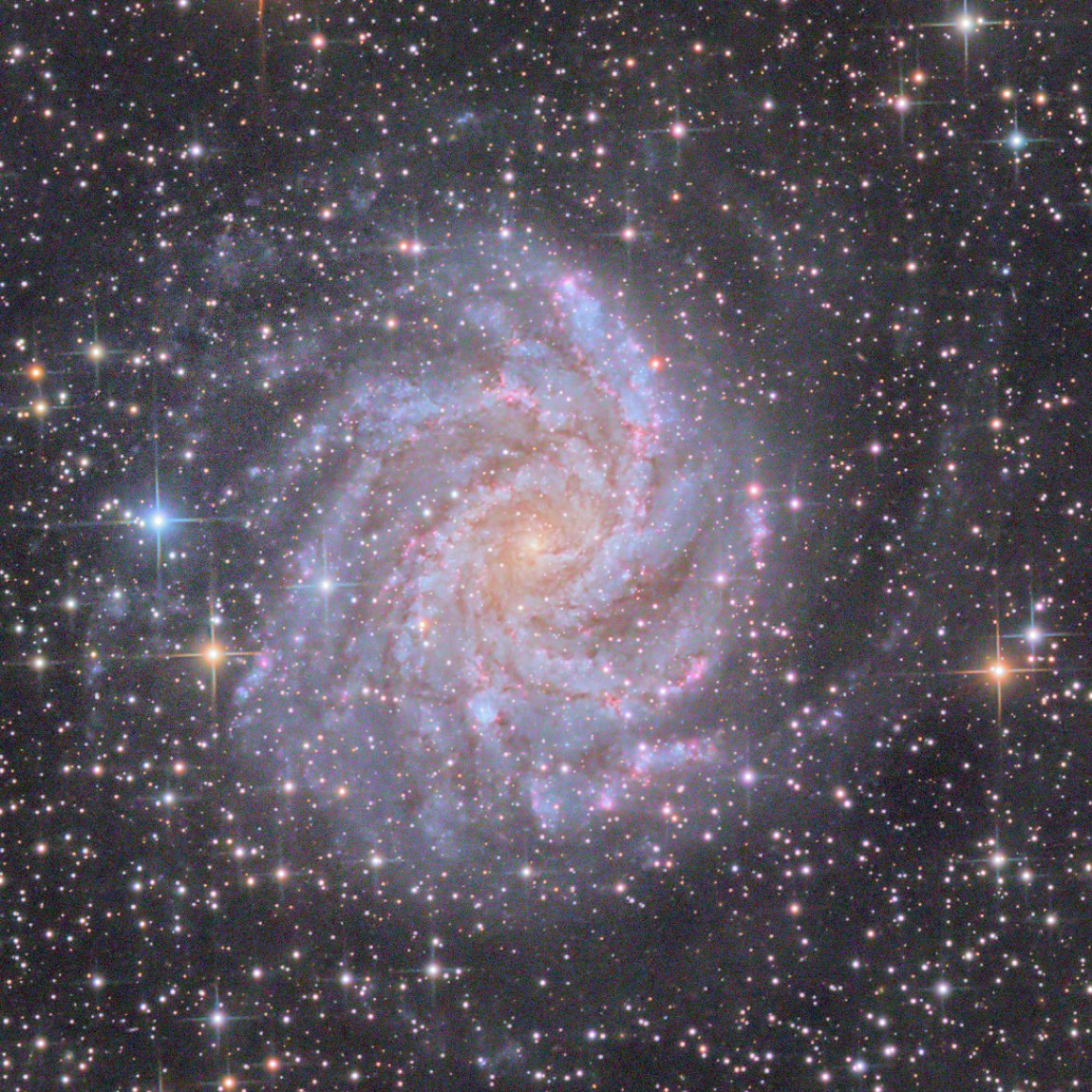
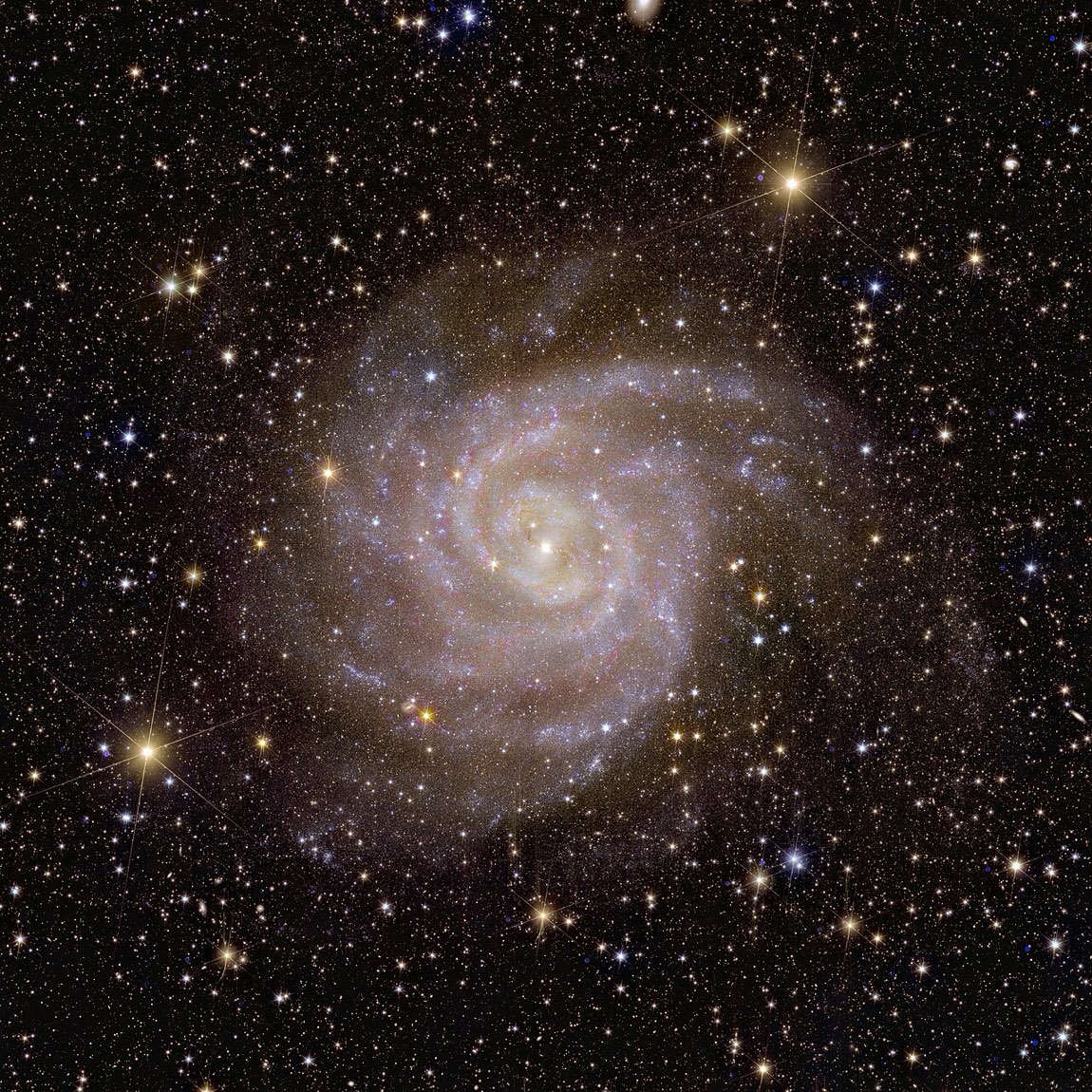
 Photograph · ESA/Euclid/Euclid Consortium/NASA image processing by J.-C. Cuillandre (CEA Pari · CC BY-SA 3.0 igo
Galaxy · Deep guide
IC 342 (Hidden Galaxy)
Also called: Caldwell 5 · C5 · Hidden Galaxy · UGC 2847 · PGC 13826
A big, bright spiral that would be a naked-eye sight if the Milky Way's dust weren't in the way.
What is it?
IC 342 is a large spiral galaxy in Camelopardalis, nicknamed the Hidden Galaxy because it lies behind the thick dust near the plane of our own galaxy. Without that veil it would be visible to the naked eye; even so, binoculars can pick it up. The dust also makes its distance hard to pin down, with modern estimates ranging from about 7 to 11 million light-years. It is one of the brightest members of the IC 342/Maffei Group, one of the nearest galaxy groups beyond our own Local Group. William Frederick Denning discovered it in 1892.
The deep dive
Researched for the Atlas from Wikipedia — IC 342 (1,646 characters read) · updated Nov 15, 2026
01 Why dust hides a giant next door
IC 342 sits frustratingly close to the plane of the Milky Way, and that positioning is its curse. Our own galaxy's disk is laced with vast clouds of gas and dust, and IC 342 must be seen right through them. The dust scatters and absorbs starlight, dramatically dimming and reddening everything behind it. The result is that a galaxy genuinely large enough and bright enough to be spotted with the naked eye is instead reduced to a faint smudge requiring at least binoculars — and even then, most of its detail is stolen by the intervening haze. Astronomers call this obscuration, and IC 342 is one of the most dramatic examples of a nearby object being hidden in plain sight by our own galaxy's murk rather than by any true faintness or remoteness. The same dust that conceals it also complicates distance measurements, which is why modern estimates for how far away it actually lies still span a wide range — anywhere from about 7 million light-years to about 11 million light-years — an uncertainty that matters enormously when trying to understand its true role among nearby galaxies.
02 Pinning down the distance problem Deeper
Because interstellar dust absorbs light preferentially at shorter wavelengths, it distorts the apparent brightness and color of everything behind it, making standard distance-measuring techniques less reliable. For IC 342, this has produced a genuinely wide spread in published distance estimates: modern values range from roughly 7 million light-years to roughly 11 million light-years. That gap — 4 million light-years — is not trivial. At the near end of the range, IC 342 would be firmly among the Milky Way's closest large galactic neighbors; at the far end, it recedes into a more distant tier. The uncertainty directly affected early interpretations of its membership: Edwin Hubble, working without today's tools, initially concluded that IC 342 belonged to our own Local Group of galaxies. Subsequent analysis showed it does not qualify as a Local Group member, but the fact that a figure of Hubble's caliber was misled illustrates just how profoundly the obscuring dust can skew conclusions. Nailing down the true distance remains an active challenge, dependent on finding distance indicators — such as Cepheid variable stars or the tip of the red giant branch — that can be measured reliably through the dust.
03 Shapley's surprising size measurement
In 1935, the astronomer Harlow Shapley made a striking announcement: IC 342 appeared on the sky wider than the full moon. That is an astonishing statement for a galaxy lying millions of light-years away. At the time, Shapley ranked it as the third-largest spiral galaxy known by angular size, surpassed only by the Andromeda Galaxy and the Triangulum Galaxy. This finding helped cement IC 342's reputation as an unusually large and important nearby system. Modern measurements have revised that figure downward considerably — current estimates give its apparent diameter as roughly one-half to two-thirds the diameter of the full moon — but even that more conservative figure is remarkable for a galaxy so heavily obscured. The revision likely reflects improved techniques that can better separate genuine galaxy light from the glow of foreground stars and dust, rather than any change in the galaxy itself. Still, Shapley's 1935 measurement was a landmark moment in recognizing that a significant galaxy had been lurking, largely ignored, behind the dust of our own Milky Way.
04 A galaxy group hiding near our own
IC 342 is not an isolated system — it is one of the brightest members of the IC 342/Maffei Group, which stands as one of the closest galaxy groups to our own Local Group. The Local Group contains the Milky Way, Andromeda, and their retinue of smaller companions, and the IC 342/Maffei Group is a comparable gathering in the nearby cosmic neighborhood. The proximity of this group to our own makes it scientifically valuable: studying how galaxies interact, form stars, and evolve in a nearby group gives astronomers a relatively close-up laboratory for processes that are harder to examine in distant clusters. IC 342's prominence within that group — it is among the brightest members — means it anchors much of our understanding of how the group as a whole is structured. The dust obscuration that hides IC 342 from casual observation also complicated the discovery and characterization of the group itself, since several of its members are similarly veiled.
05 The discovery that almost went unnoticed
IC 342 was discovered in 1892 by William Frederick Denning, a British amateur astronomer who was primarily known for his meticulous work cataloguing meteor showers. The galaxy subsequently entered the Index Catalogue — the IC in its designation — a supplement to the more famous New General Catalogue assembled by John Louis Emil Dreyer. Despite being catalogued, IC 342 did not attract widespread attention for decades, in large part because its obscured appearance made it easy to underestimate. It was Edwin Hubble who brought it into sharper focus, though even he initially misidentified it as a Local Group member. The galaxy is also designated Caldwell 5, placing it fifth on the Caldwell Catalogue compiled by Patrick Moore as a list of showpiece objects not included in the more famous Messier Catalogue. The Caldwell designation reflects the galaxy's status as a rewarding, if challenging, observational target despite its obscuration.
06 What lives at the center Deeper
At the heart of IC 342 lies what astronomers classify as an H II nucleus — a core region characterized by ionized hydrogen gas. H II regions are zones where energetic ultraviolet radiation from hot, young, massive stars has stripped electrons from hydrogen atoms, producing a glowing plasma. Finding such a nucleus at a galaxy's center points to vigorous ongoing star formation in the innermost regions, driven by gas being funneled toward the core. This distinguishes IC 342 from galaxies that host active galactic nuclei powered primarily by accreting supermassive black holes. Instead, the central energy output of IC 342 appears dominated by the collective brilliance of freshly minted stars. This kind of starburst activity in a galaxy's nucleus is of broad interest to astronomers because it links large-scale gas dynamics — how material flows inward through the spiral disk — to the conditions that ignite star formation at the very center. The H II nucleus makes IC 342 a useful comparison object for understanding how star-forming regions scale from the outskirts of a galaxy all the way to its core.
07 Spiral structure and galaxy classification
IC 342 is classified as an intermediate spiral galaxy and is further described as a late-type spiral galaxy. In the scheme astronomers use to organize spiral galaxies, "late-type" means the spiral arms are loosely wound, the central bulge is relatively modest, and star formation tends to be spread broadly across the disk rather than concentrated at the center. This stands in noticeable contrast to "early-type" spirals, which have prominent central bulges and tightly wrapped arms. IC 342's intermediate spiral designation also distinguishes it from strongly barred spirals, suggesting its central structure is somewhere between a pure spiral and one dominated by a linear bar of stars running through its core. Together, these classifications paint a picture of a large, relatively open, actively star-forming disk galaxy — a system in many ways structurally similar to our own Milky Way, though the precise comparison depends on distance estimates that remain uncertain.
08 A sparse family of satellite galaxies Deeper
Compared with galaxies that have large central bulges — the Andromeda Galaxy being the prime example — IC 342 has relatively few dwarf satellite galaxies orbiting it. This scarcity of satellites is itself scientifically interesting: the number and character of a large galaxy's satellites carry clues about the dark matter halo surrounding it and about the history of mergers and tidal stripping the system has experienced. For IC 342, the satellite population received a notable addition in 2020, when the galaxy KKH 32 was identified as the first confirmed satellite of IC 342 classified as a dwarf spheroidal galaxy. Dwarf spheroidals are small, ancient, and nearly devoid of gas, representing some of the oldest stellar populations in the universe. KKH 32 lies about 10.2 million light-years away — equivalently, 3.12 megaparsecs — and measures roughly 4,300 light-years across. For comparison, the Milky Way's own disk spans around 100,000 light-years, so KKH 32 is a very small companion indeed. Its discovery opened the door to a more systematic search for other satellites that may still be hiding behind the same dust curtain that obscures IC 342 itself.
09 How to find the Hidden Galaxy yourself
IC 342 sits in the constellation Camelopardalis, the giraffe, a large but faint constellation sprawling across the northern polar sky with no stars brighter than fourth magnitude. Despite its obscured nature, the galaxy can be detected with binoculars under dark skies — a remarkable achievement for an object lying millions of light-years away. The key challenge is not the instrument but the sky conditions: light pollution and the natural airglow of the sky can easily overwhelm the already-dimmed light of IC 342. From a dark site, binoculars will show a faint, round glow, while a small telescope begins to hint at structure. Larger amateur telescopes can reveal the broad, low-surface-brightness disk more clearly, though the spiral arms remain subtle because the dust robs so much contrast. Its Caldwell 5 designation marks it as a recognized showpiece target, and observers who put in the effort to find a genuinely dark location often report success in spotting what is, in physical terms, a galaxy rivaling some of the most celebrated spirals in the sky.
10 Hubble's misidentification and what it tells us Deeper
Edwin Hubble, one of the twentieth century's most consequential astronomers, initially placed IC 342 within the Local Group — the small gravitational family that includes the Milky Way, Andromeda, and a few dozen smaller companions. This was not careless work; Hubble was operating with the best evidence available to him, and the obscuring dust made reliable distance estimation genuinely difficult. When later analysis showed IC 342 was not a Local Group member, it underscored an important lesson about observational astronomy: the dust of the Milky Way's plane does not just dim objects, it systematically misleads. Dust makes distant objects look fainter than they are — which makes them seem farther — but it also makes bright objects harder to characterize precisely, blurring the boundary between what is nearby and what is not. Hubble's error with IC 342 is therefore remembered not as a failure but as an illustration of how even extraordinary observational skill cannot fully overcome the problem of an obscured line of sight. The eventual correction refined both the census of the Local Group and the understanding of which nearby galaxy groups truly neighbor our own.
11 The naked-eye galaxy we cannot see
One of the most striking facts about IC 342 is the contrast between what it is and how we experience it. In terms of intrinsic brightness and physical size, IC 342 is a major galaxy — large enough and luminous enough that if it were not hidden behind the dust of our own Milky Way, it would be visible to the unaided human eye. That would make it one of only a handful of external galaxies ever seen without any optical aid, joining the Andromeda Galaxy, the Magellanic Clouds, and a small number of others. Instead, it demands binoculars at minimum and genuinely dark skies for even that. The idea that a galaxy of this stature is effectively concealed by cosmic dust sitting within our own galaxy is a vivid reminder that our view of the universe is not neutral or complete — the Milky Way actively obscures a significant swath of the sky, and an unknown number of interesting objects may be lurking behind it, waiting for better infrared or radio observations to reveal them fully.