 Photograph · Andreigusan · CC0
Galaxy · Deep guide
The Fireworks Galaxy (NGC 6946)
Also called: Caldwell 12 · C12 · NGC 6946 · UGC 11597 · PGC 65001 · Arp 29
A face-on spiral that has shown about ten supernovae since 1917.
What is it?
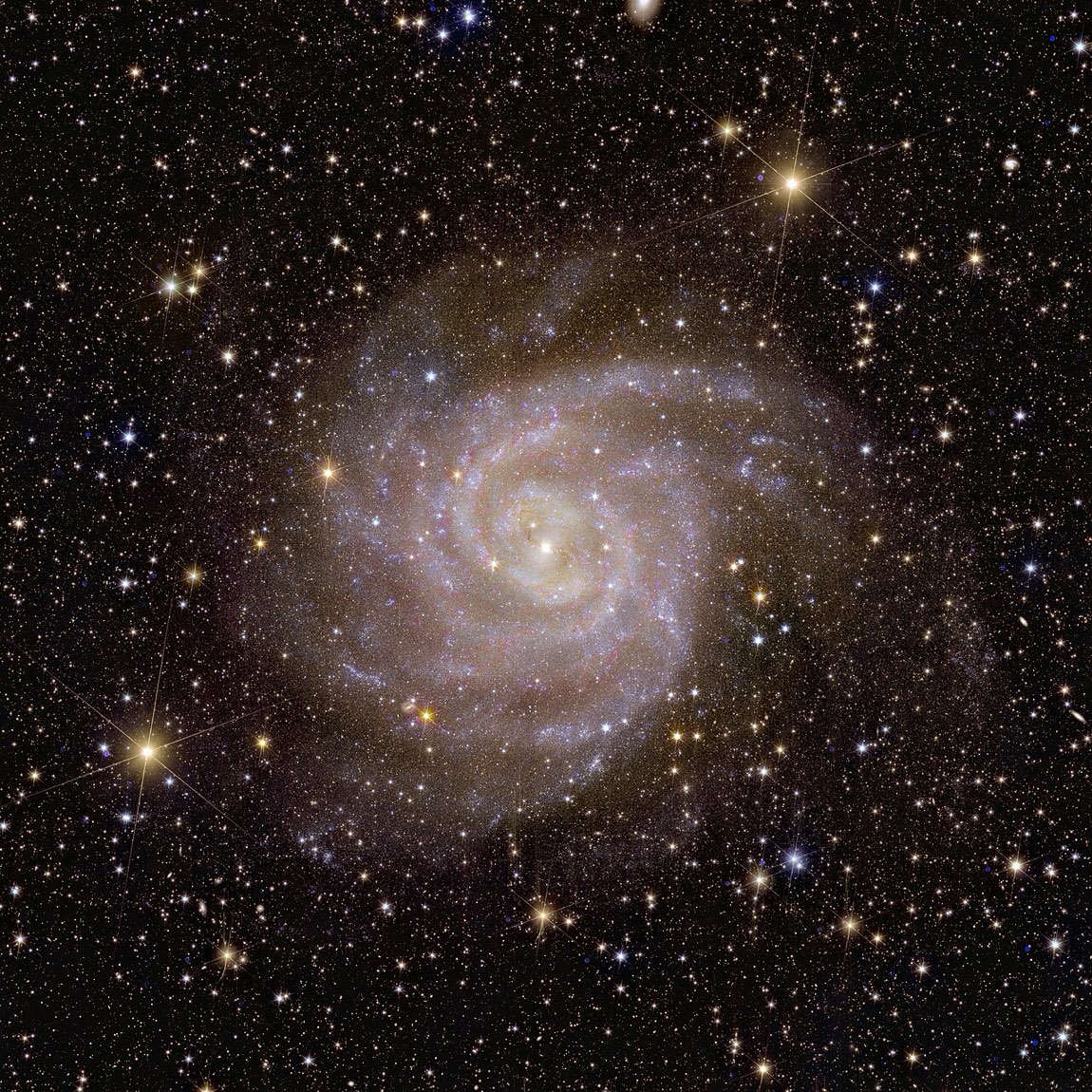
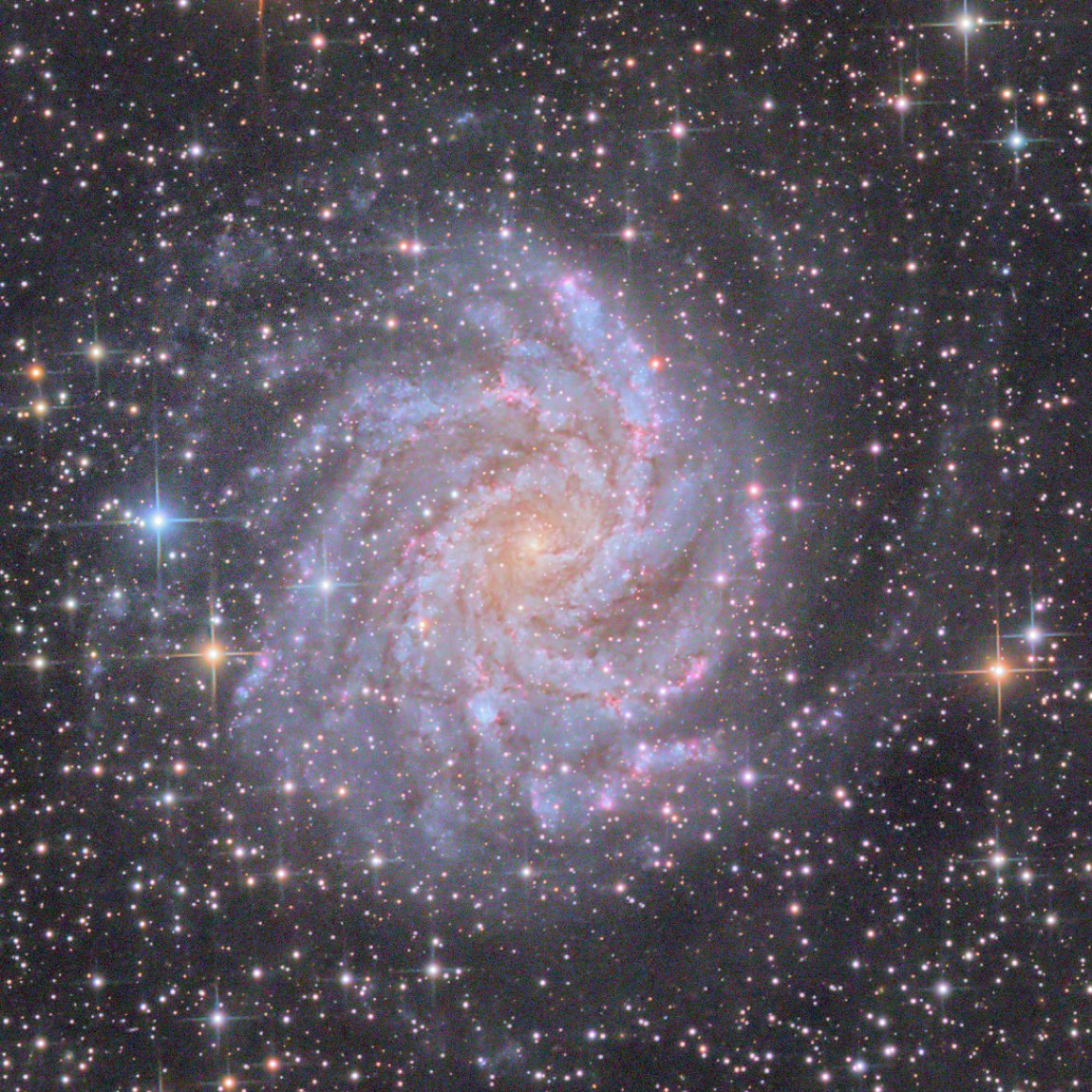
NGC 6946 is a face-on spiral galaxy on the border between Cepheus and Cygnus. It earned the name Fireworks Galaxy because ten supernovae have been seen in it since 1917, about ten times the rate in our own galaxy, even though the Milky Way has twice as many stars. It is a starburst galaxy, forming new stars at a furious pace, and may have a small inner bar feeding gas to its centre. Because it lies near the plane of the Milky Way, much of its light is dimmed by our galaxy's dust. William Herschel discovered it on 9 September 1798.
The deep dive
Researched for the Atlas from Wikipedia — NGC 6946 (4,605 characters read) · updated Nov 15, 2026
01 Why NGC 6946 Explodes So Often
Ten supernovae have been recorded in NGC 6946 since 1917 — roughly one every eleven years — giving it a supernova rate about ten times higher than our own Milky Way. What makes this doubly striking is that the Milky Way actually contains twice as many stars as NGC 6946. The difference comes down to star formation: NGC 6946 is classified as an active starburst galaxy, meaning it is manufacturing new stars at an unusually vigorous pace. Massive stars burn through their fuel quickly and die in violent explosions, so a galaxy that keeps making them will keep detonating them. The double-barred spiral structure of NGC 6946 is thought to play a role here, with the inner bar funneling gas toward the galaxy's center and feeding the cycle of star birth and death. This prolific fireworks display gave the galaxy its popular nickname, though as of 2017 that record for most observed supernovae in a single galaxy has since been surpassed by NGC 3690.
02 A Century of Stellar Deaths, Catalogued
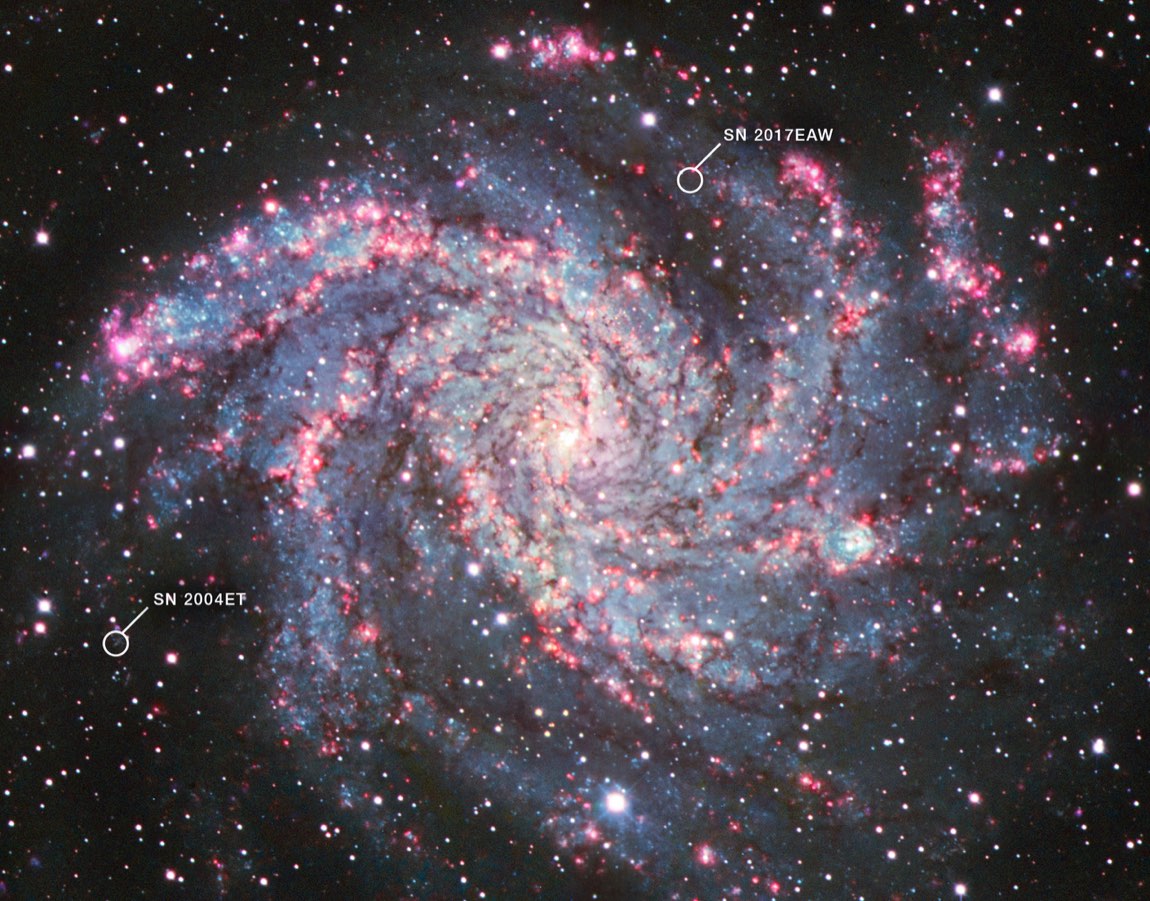
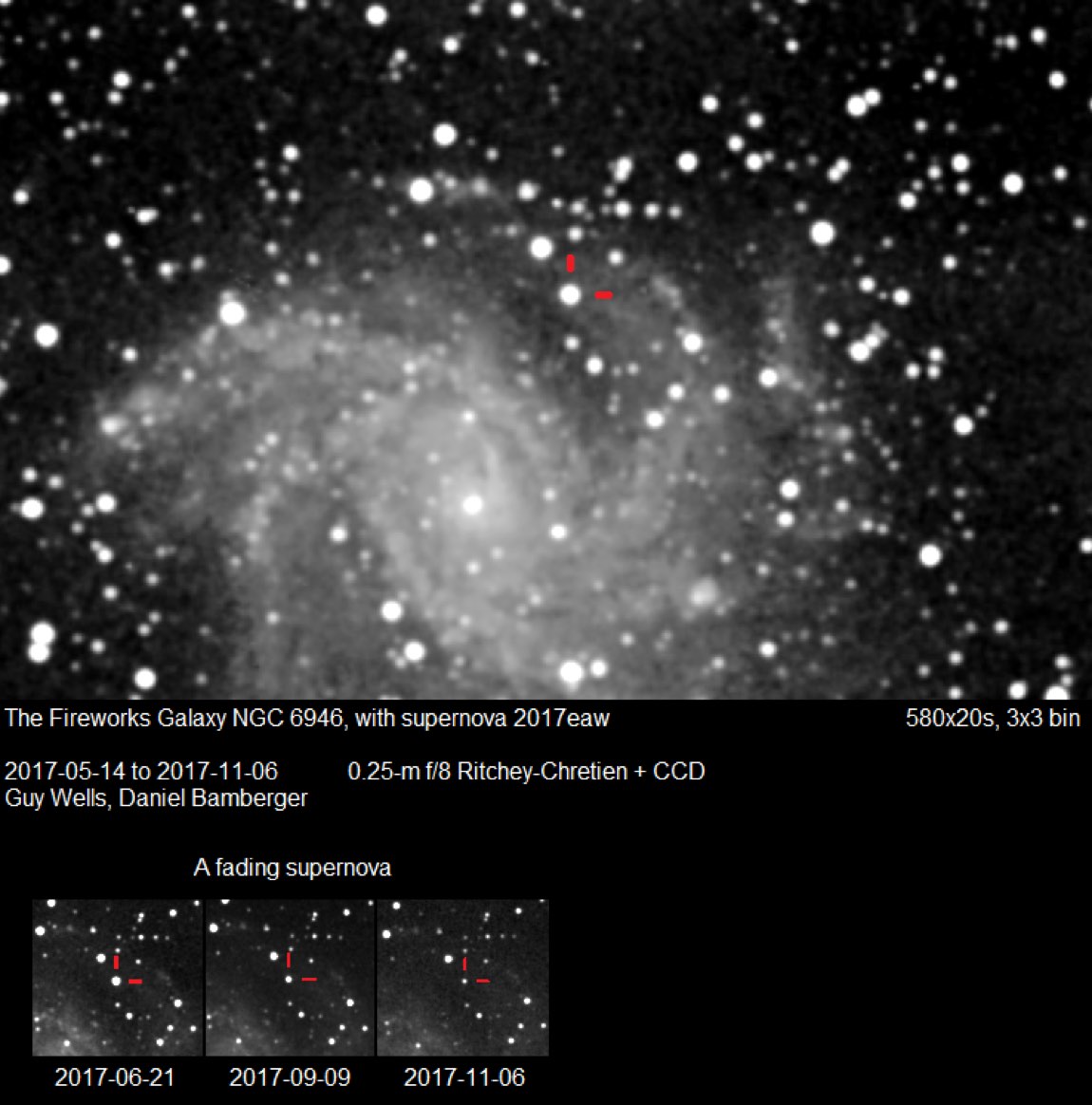
The parade of supernovae in NGC 6946 reads almost like a historical timeline of modern astronomy. The first, SN 1917A, was spotted by American optician George Willis Ritchey on 19 July 1917 — the same era as the First World War. Fritz Zwicky, one of the founding figures of supernova science, bagged SN 1939C on 17 July 1939. Nicholas U. Mayall found SN 1948B, while Paul Wild discovered both SN 1968D and SN 1980K. SN 1980K reached a bright magnitude of 13, easily within range of a modest amateur telescope under good skies. The most recently discovered entry, SN 2017eaw, was found by Patrick Wiggins on 14 May 2017 and reached the same peak brightness of magnitude 12.8 as SN 2004et — making it one of the brighter supernovae of recent decades. Light curves tracked over the following 600 days confirmed it as a Type II-P event, the kind caused by a red supergiant star collapsing under its own gravity.
03 When a Progenitor Star Is Caught Beforehand Deeper
Among the hardest feats in observational astronomy is identifying the actual star that exploded in a supernova before the explosion happened. For SN 2004et, discovered by S. Moretti on 27 September 2004, researchers were able to do exactly that by examining archival images of NGC 6946 taken before the event. The explosion itself was later pinned to 22 September 2004 through pre-discovery photographs. Finding the progenitor made SN 2004et only the seventh supernova at the time for which this identification had been directly achieved. The star turned out to be a red supergiant with an initial mass of about 15 solar masses, orbiting in an interacting binary system alongside a blue supergiant companion. SN 2017eaw's progenitor was similarly identified as a red supergiant with a mass of around 15 solar masses, suggesting that stars near this mass threshold are particularly prone to the kind of core collapse that produces Type II-P supernovae.
04 The Star That Vanished Into a Black Hole
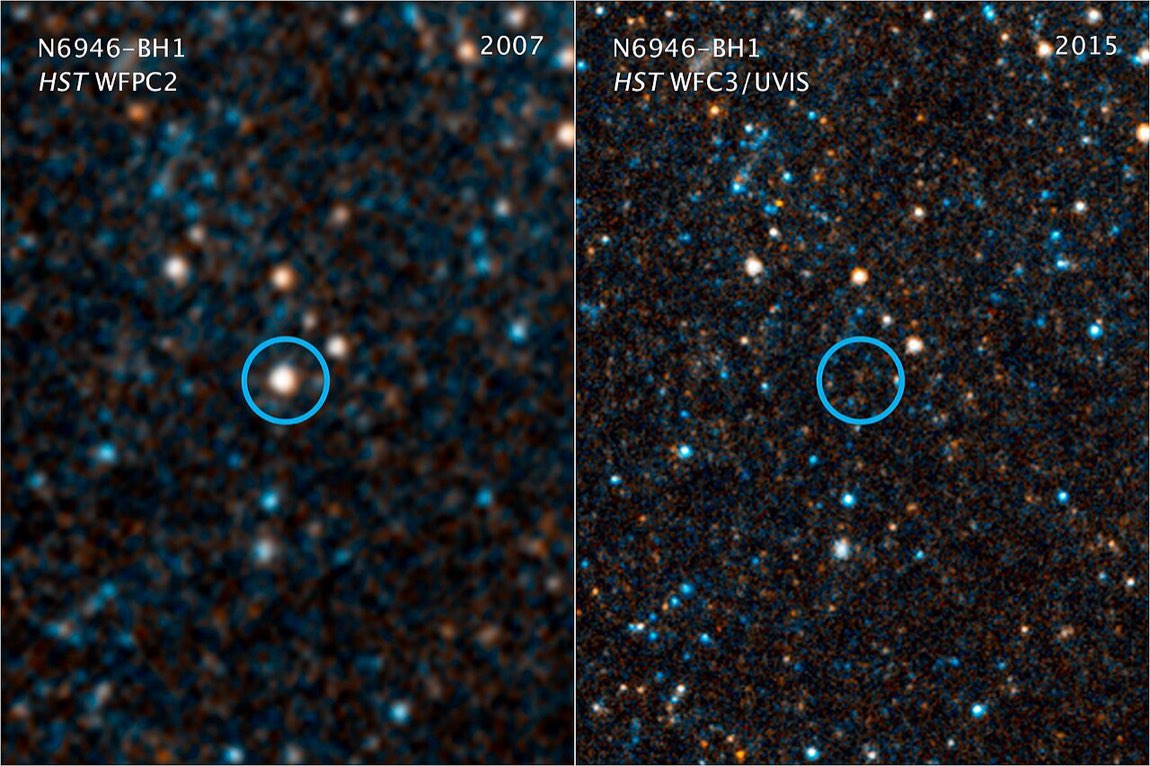
In 2009, astronomers watched something in NGC 6946 behave in a way that defied the usual supernova script. A bright star flared over several months until it shone more than one million times as brightly as the Sun — and then, instead of maintaining a glowing remnant, it simply faded away. Follow-up observations with the Hubble Space Telescope suggested the star had not survived in any conventional sense. Some infrared emission persists at its position, but the leading interpretation is that this glow comes from debris falling onto a newly formed black hole rather than from a surviving stellar remnant. The object is now designated N6946-BH1, and the star that apparently gave birth to it is believed to have been a yellow hypergiant. If the interpretation holds, this would represent a rare direct observation of a massive star collapsing straight into a black hole without producing the bright supernova explosion astronomers would normally expect.
 ⤢
05 The Red Ellipse and Other Strange Features Deeper
Beyond its supernovae, NGC 6946 hosts several peculiar structures that astronomers are still working to fully explain. One of the most eye-catching is called the Red Ellipse, found along one of the galaxy's northern spiral arms. Its appearance resembles either a super-bubble — an enormous cavity carved by stellar winds and multiple supernova blasts — or a very large supernova remnant. It may have been created by an open cluster packed with massive stars whose collective energy output sculpted the surrounding gas. Elsewhere in the galaxy, two regions show unusual dark lanes of nebulosity that cut across the starlight. Additionally, several zones within the spiral arms appear strangely empty, stripped of both stars and gaseous hydrogen, with some of these voids stretching up to two kiloparsecs across — a span of roughly 6,500 light-years, comparable to the distance from Earth to the center of the Orion Arm of our own galaxy.
06 Hodge's Complex: Cluster or Dwarf Galaxy? Deeper
In 1967 astronomers identified a peculiar object within NGC 6946 that became known as Hodge's Complex. For decades it was categorized as a young supergiant star cluster — an unusually large and luminous grouping of newly formed stars embedded in one of the galaxy's arms. That interpretation held for fifty years. Then in 2017, researchers proposed a fundamentally different explanation: that Hodge's Complex is not part of NGC 6946 at all, but rather an interacting dwarf galaxy that happens to lie along the same line of sight, superimposed on the larger galaxy's disk. If confirmed, this would mean that what looked like a single exotic object is actually a gravitational encounter between two separate galaxies at very different scales. The question remains open, illustrating how even well-studied objects in well-studied galaxies can conceal their true nature for half a century.
07 A Galaxy Hiding Behind the Milky Way's Dust
One reason NGC 6946 took so long to characterize precisely is that it sits very close to the galactic plane of our own Milky Way. From Earth's perspective, we look at it through a thick curtain of interstellar dust and gas belonging to our own galaxy, which absorbs and reddens the light coming from NGC 6946. This heavy obscuration makes it harder to measure accurate brightness values, distances, and the properties of individual objects within the galaxy. It is part of why the galaxy's distance estimate — about 25.2 million light-years, or 7.72 megaparsecs — carries some uncertainty, and why the galaxy's true appearance in certain wavelengths of light is difficult to disentangle from foreground contamination. Astronomers working with infrared and radio telescopes, which can pierce through dust more easily than optical instruments, have been particularly valuable in mapping its structure.
08 Its Architecture: Bars, Arms, and Nucleus Deeper
NGC 6946 is classified as a grand design spiral galaxy, meaning its spiral arms are prominent, well-defined, and symmetrical rather than patchy or fragmented. It is also a face-on galaxy as seen from Earth, which means we look almost straight down onto its disk rather than at an edge — a geometry that makes its full structure visible and aids detailed study. The galaxy carries the further classification of intermediate spiral, placing it between the tightly wound and loosely wound extremes of the spiral family. Its most structurally distinctive feature is that it has not one but two bars: a double-barred configuration in which an inner, smaller bar is thought to channel gas inward toward the bright, compact nucleus, potentially sustaining its starburst activity. The D25 isophotal diameter — the size measured at a standard faint brightness threshold — was estimated by the Third Reference Catalogue of Bright Galaxies in 1991 at 26.77 kiloparsecs, equivalent to about 87,300 light-years.
 ⤢
09 William Herschel's Discovery in 1798
NGC 6946 was discovered by the German-British astronomer William Herschel on 9 September 1798. Herschel was already one of the most prolific observers in history by that point, having discovered the planet Uranus in 1781 and catalogued thousands of nebulae and star clusters with his handmade reflecting telescopes. Spotting NGC 6946 would have been a challenge even for his powerful instruments, given the galaxy's obscuration by Milky Way dust and its relatively faint surface brightness spread across a wide area of sky. The galaxy straddles the boundary between the constellations Cepheus and Cygnus, a region of the northern sky densely packed with the star clouds and dark lanes of our own galaxy. That position near the galactic equator is precisely what makes the galaxy so hard to study at optical wavelengths, though Herschel of course would not have understood the dust obscuration problem in the same terms modern astronomers do.
10 NGC 6946's Neighborhood in Space
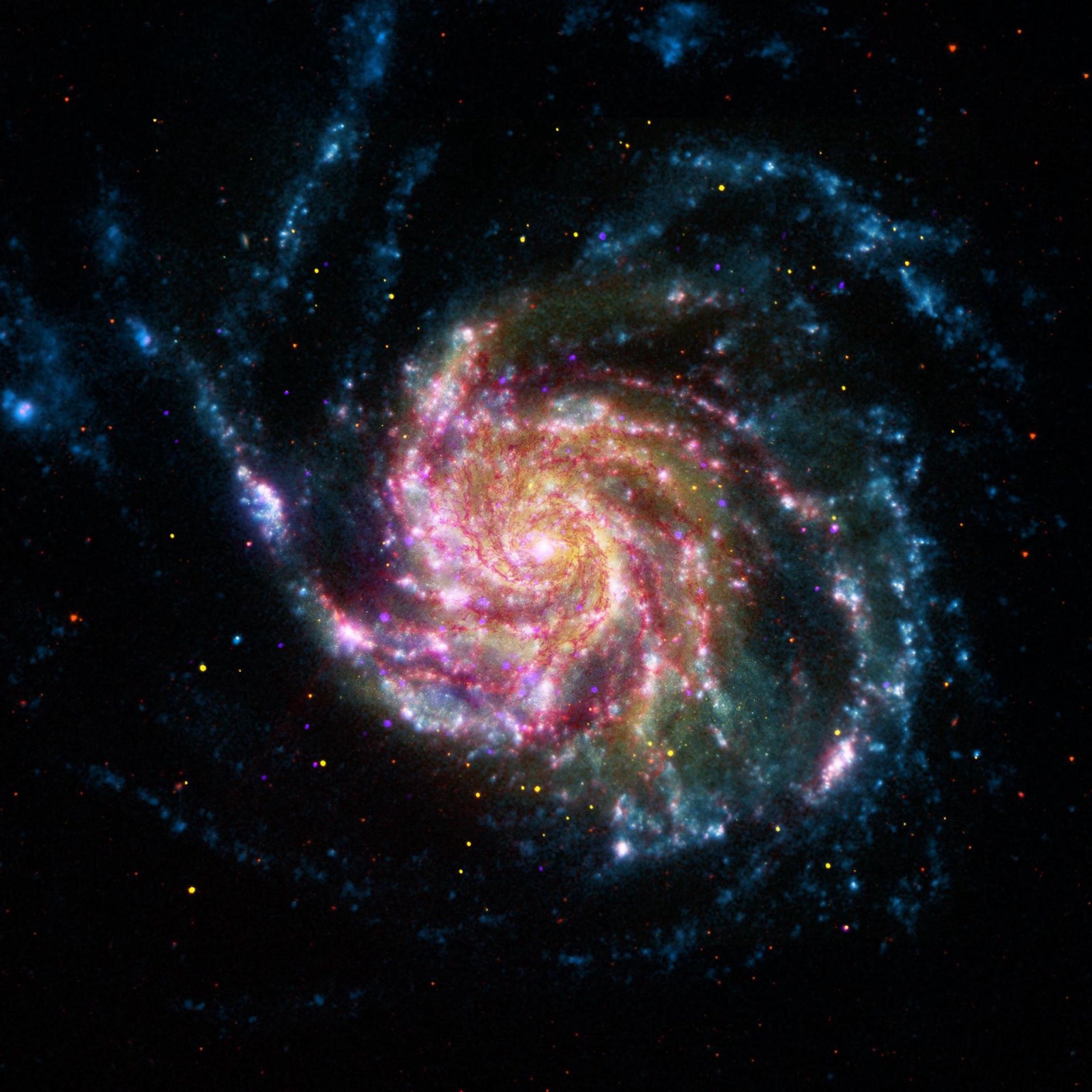
Although NGC 6946 looks like it ought to belong to our Local Group of galaxies — the small cluster that contains the Milky Way, Andromeda, and their satellites — it does not. It and the similarly distant Pinwheel Galaxy, M101 (NGC 5457) in Ursa Major, were both once considered Local Group members but are now known to lie well beyond its boundary at comparable distances of around 25 million light-years. Instead, NGC 6946 is one of roughly a dozen bright spiral galaxies that sit near the Milky Way without being gravitationally bound to our Local Group. On a larger scale, it falls within the Virgo Supercluster, the vast cosmic structure that contains the Local Group, the Virgo Cluster, and many smaller galaxy groups spread across a region hundreds of millions of light-years wide. Its distance from Earth is about 25.2 million light-years, or 7.72 megaparsecs — far enough that light leaving it today will not arrive here until long after human civilization has had time to change enormously.
11 How to Observe the Fireworks Galaxy
NGC 6946 is best found by star-hopping from the bright stars of Cygnus or the distinctive house-shape of Cepheus, since it lies on the boundary between those two northern constellations. Its apparent magnitude means it is accessible with a modest amateur telescope, but its diffuse, face-on disk and heavy foreground dust mean it rarely shows sharp detail under typical suburban skies. Dark, transparent skies well away from city light pollution make an enormous difference: under such conditions the broad glow of the disk becomes easier to hold in view, and hints of the spiral structure may emerge through larger apertures. Observers in the Northern Hemisphere have a reasonable window to view it during summer and autumn evenings when Cygnus rides high. The galaxy's reputation as a supernova factory also gives patient amateur astronomers a genuine scientific motivation to monitor it regularly — the history of its supernovae shows they can reach magnitudes well within amateur reach, with SN 2004et and SN 2017eaw both touching magnitude 12.8.
 ⤢