 Photograph · ESO · CC BY 4.0
Galaxy · Deep guide
IC 1613
Also called: Caldwell 51 · C51 · UGC 668 · DDO 8 · PGC 3844
A clear, dust-free dwarf galaxy on the Local Group's edge, prized for measuring cosmic distances.
What is it?
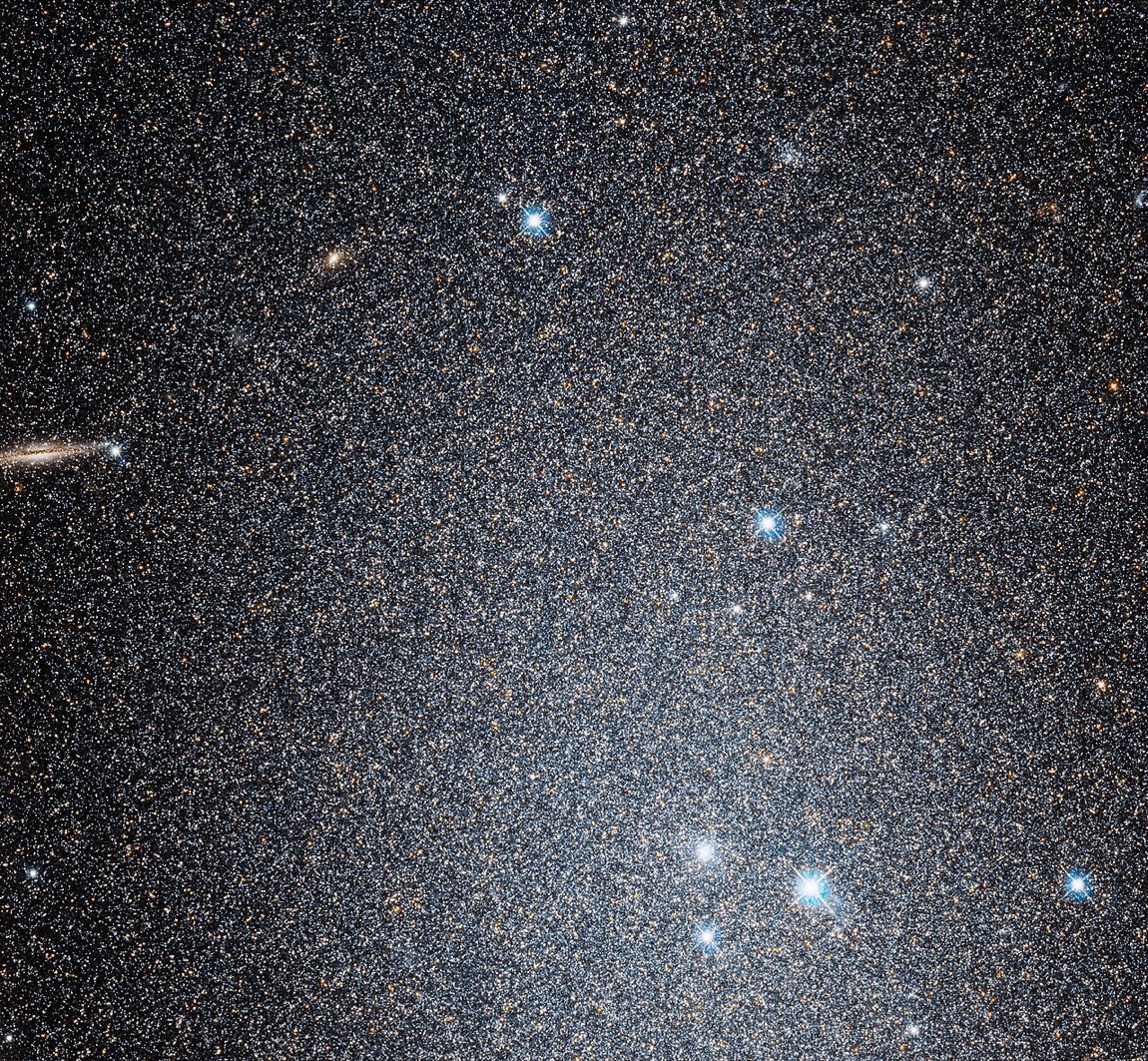
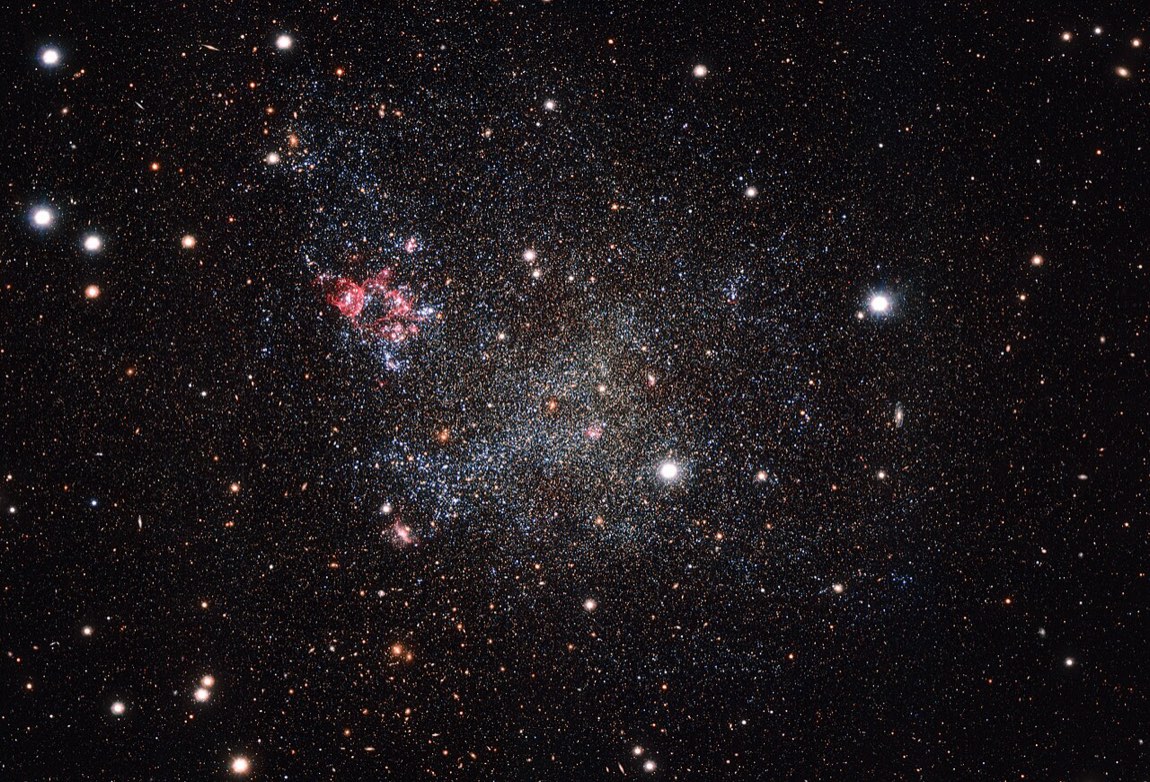
IC 1613 is an irregular dwarf galaxy in Cetus, on the outskirts of our Local Group about 2.4 million light-years away. It contains very little dust, and so does the line of sight toward it, which lets astronomers measure its variable stars, including Cepheids and RR Lyrae stars, very accurately. That has made it important for calibrating the Cepheid period–luminosity relation used to measure distances across the universe. Hubble observations show most of its stars are about 7 billion years old. Max Wolf discovered it in 1906.
The deep dive
Researched for the Atlas from Wikipedia — IC 1613 (2,844 characters read) · updated Nov 15, 2026
01 Discovered by Max Wolf in 1906
IC 1613 was discovered in 1906 by the German astronomer Max Wolf, whose tireless photographic surveys of the sky turned up vast numbers of faint objects that visual observers had missed entirely. The galaxy sits in the constellation Cetus, close on the sky to the star 26 Ceti, and its irregular, low-surface-brightness glow made it a challenging catch even on photographic plates. It later received the designation Caldwell 51 in Patrick Caldwell-Moore's popular observing catalogue, which helped bring it to the attention of amateur astronomers. Despite being known for over a century, IC 1613 remained something of a specialist's object until modern telescopes revealed the extraordinary scientific leverage it offers for measuring cosmic distances. Its position near the outskirts of the Local Group, roughly 730 kiloparsecs from Earth — about 2.4 million light-years — places it just at the edge of our gravitational neighbourhood, making it a valuable reference point for understanding how dwarf galaxies are distributed around the larger members of the group.
02 A galaxy almost free of dust
One of IC 1613's most scientifically precious qualities is its unusually low abundance of interstellar dust — both inside the galaxy itself and along the line of sight between it and Earth. Dust is the great enemy of precise distance measurement because it absorbs and reddens starlight in ways that can mimic or disguise a star's true brightness. When dust levels are uncertain, every distance estimate carries an extra layer of error. IC 1613's near-absence of this obscuring material means astronomers can observe its stars with far less correction and far more confidence than in dustier systems. Combined with its relatively face-on orientation and its position away from the crowded Milky Way plane, this cleanliness makes IC 1613 almost a laboratory-grade target. The result is that distance estimates to IC 1613 are regarded as especially accurate, and the galaxy has served as a critical anchor point for calibrating the wider cosmic distance ladder.
03 The Cepheid yardstick and IC 1613 Deeper
Among the various tools astronomers use to measure distances across the universe, the Cepheid variable period–luminosity relation is one of the most powerful. Cepheid stars pulsate with a clockwork rhythm: the longer the period of their brightness cycle, the more intrinsically luminous they are. By comparing intrinsic luminosity to observed brightness, distances can be derived. IC 1613 has played an important role in calibrating this relation, partly because its low dust content means the measured brightnesses of its Cepheids are not significantly distorted. In 1999, Antonello and colleagues pushed this further by identifying five Cepheids of Population II in IC 1613. Population II Cepheids, also called W Virginis stars, are older and chemically different from the classical Population I Cepheids, and finding them here provided direct, self-evident support for the existence of a very old stellar population within the galaxy. This layering of different types of pulsating stars in one well-studied system makes IC 1613 unusually rich as a calibration target.
04 RR Lyrae stars and what they reveal Deeper
Beyond Cepheids, IC 1613 belongs to an exclusive club: it is one of the very few Local Group dwarf irregular galaxies where RR Lyrae-type variable stars have been detected. The others with confirmed RR Lyrae populations are the Magellanic Clouds. RR Lyrae variables are old, low-mass, horizontal-branch stars that pulsate with periods typically less than a day. Because they have a well-defined absolute luminosity, they serve as independent distance indicators and, crucially, as tracers of ancient stellar populations. Their presence in IC 1613 tells astronomers that the galaxy built up at least some of its stars very early in cosmic history. This is consistent with the 1999 finding by Cole and colleagues, who used the Hubble Space Telescope to show that the dominant stellar population has an age of approximately 7 billion years. The combination of RR Lyrae stars, Population II Cepheids, and that HST age estimate paints a coherent picture of a galaxy with deep roots in the early universe.
 ⤢
05 A stellar history written in diagrams Deeper
To reconstruct IC 1613's past, Cole and colleagues in 1999 analysed its Hess diagram — a type of colour-magnitude plot that shows how many stars of each brightness and colour are present. The pattern of points in a Hess diagram encodes the entire star-formation history of a galaxy, because stars of different ages and masses occupy predictable regions of the diagram as they evolve. The analysis suggested that IC 1613's evolutionary history may be similar to that of the Pegasus Dwarf Irregular Galaxy. Both galaxies share the same classification in the DDO morphological system: Ir V. This parallel history is intriguing because it implies that some dwarf irregulars in the Local Group followed broadly similar paths of star formation and chemical enrichment despite being physically separate systems. Whether this reflects shared environmental influences — such as proximity to the Milky Way or Andromeda — or simply reflects generic processes common to low-mass dwarf galaxies remains an open question that continues to motivate detailed comparative studies.
06 Rare and extreme stars in IC 1613 Deeper
Despite its modest total mass of around 100 million solar masses — roughly one-thousandth that of the Milky Way — IC 1613 hosts some remarkably exotic individual stars. It contains a WO star designated DR1, which may be the only Wolf–Rayet star in the entire galaxy. Wolf–Rayet stars are extreme evolved massive stars shedding their outer layers at ferocious rates, exposing hot nuclear-processed material; WO subtype stars are particularly rare and show strong oxygen emission lines. A candidate WC+O binary system called SPIRITS14bqe has also been identified, though the WO designation for DR1 makes it stand out. Additionally, a luminous blue variable candidate was proposed, but revised spectral classification placed it as a B2.5 III type star rather than a true LBV. IC 1613 also contains a rich population of OB-type stars and OB associations — compact groupings of young, hot, massive stars — which confirm that star formation has continued into relatively recent cosmic times alongside the galaxy's ancient stellar backbone.
07 GHV-62024: a star with an identity crisis
Among IC 1613's catalogued stars, GHV-62024 is a particularly puzzling object. It is classified as an O6-type star — meaning it is extremely hot and massive — yet it displays spectral characteristics normally associated with cooler F-type stars, which are more similar to our own Sun in surface temperature. The likely explanation lies in the star's rapid rotation. Spinning fast enough can induce powerful internal mixing processes driven by the carbon-nitrogen-oxygen nuclear cycle, known as CNO mixing. This mixing drags the chemical products of nuclear burning from deep inside the star up to its surface, contaminating the photosphere with material that alters its apparent spectral signature in ways that do not match what you would expect from its temperature alone. GHV-62024 is therefore a valuable natural laboratory for studying how rotation affects the observable properties of massive stars — a topic with broad implications for understanding stellar evolution throughout the universe.
08 The supernova remnant S8
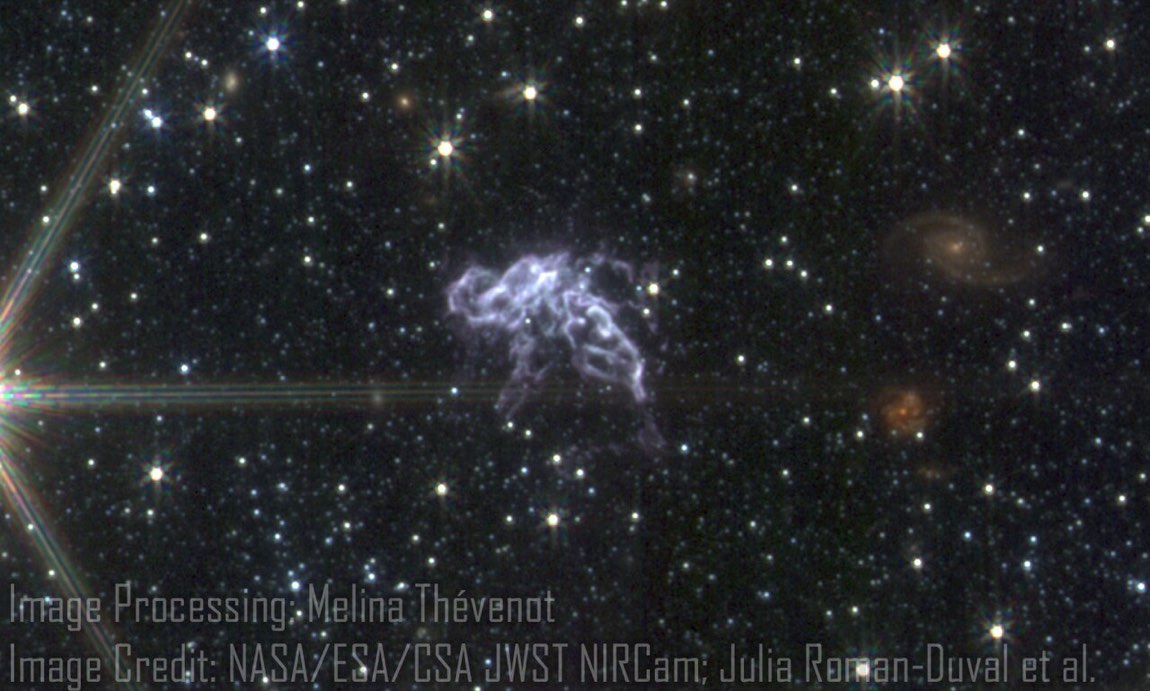
IC 1613 hosts at least one confirmed supernova remnant, designated S8. It was first identified in 1971 by the legendary astronomer Allan Sandage, who catalogued it simply as emission nebula number 8 using the 200-inch Hale reflector at Palomar Observatory — one of the most powerful telescopes of its era. Sandage's original classification as an emission nebula understated its true nature; subsequent work using data from the MDM Observatory revealed that S8 is in fact a very young supernova remnant. Its estimated age falls between 2,700 and 4,400 years, meaning the stellar explosion that produced it occurred when ancient Egyptian civilisation was flourishing on Earth. The nebula has an estimated mass of 119 ± 34 solar masses. A second possible remnant has also been identified by its shell-like structure, which spans a diameter of 55 parsecs — roughly 180 light-years — but its status as a true supernova remnant has not yet been firmly confirmed.
 ⤢
09 A background galaxy cluster hides nearby
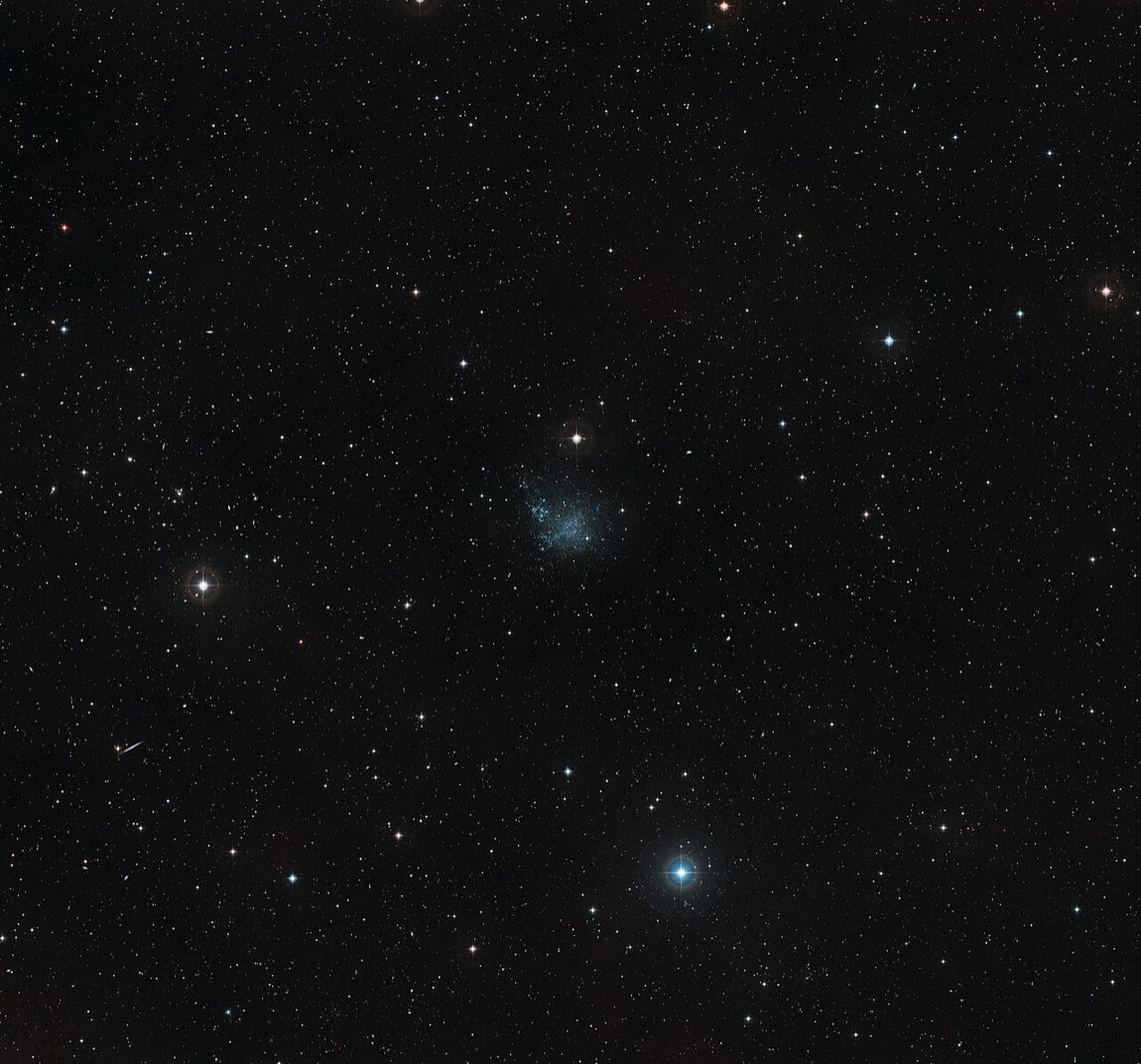
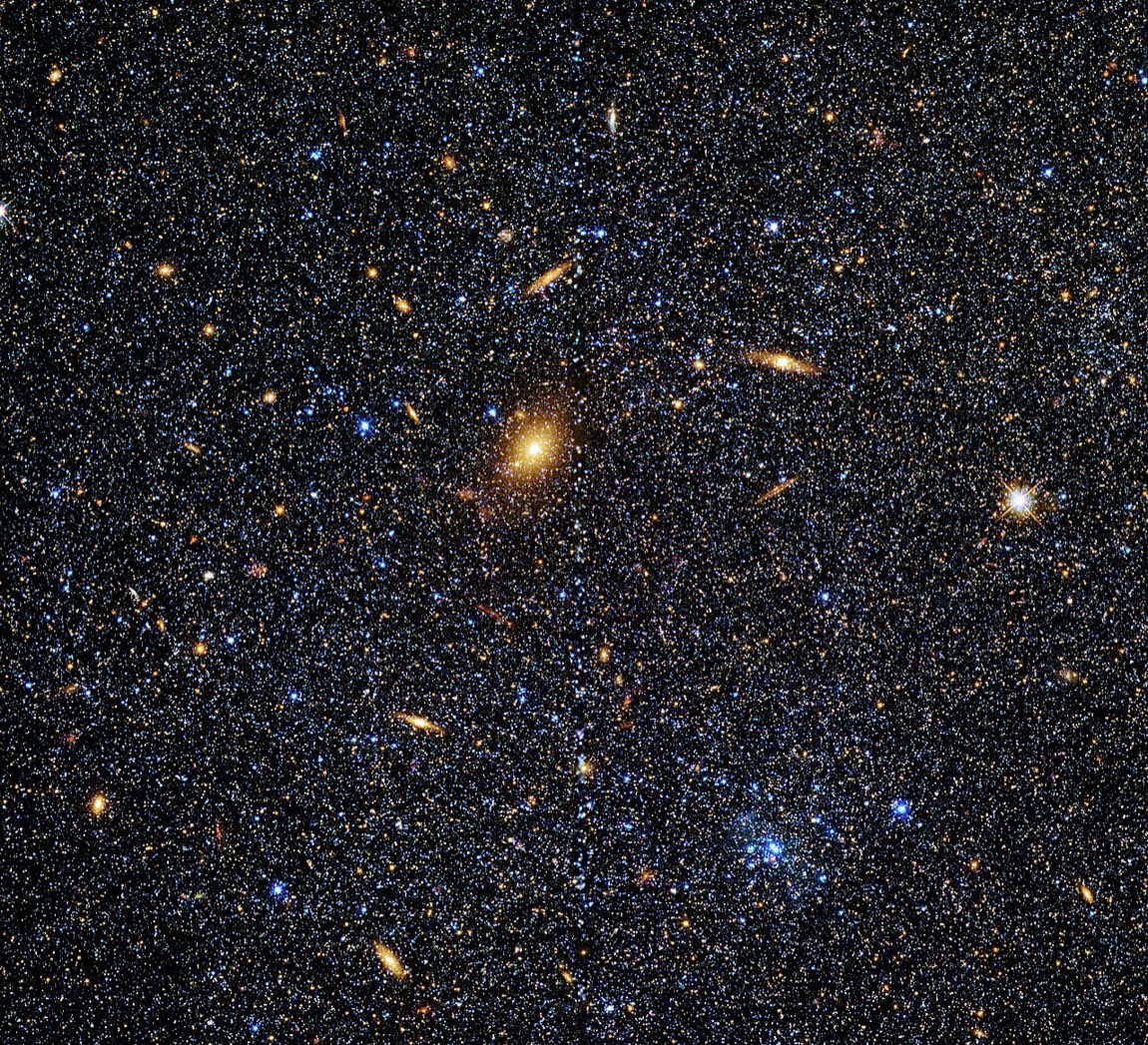
Although IC 1613 appears alone in the sky near the star 26 Ceti, astronomers examining the field around it have identified 14 faint galaxies that appear close to it in projection. These galaxies are not physical neighbours of IC 1613: they form a background galaxy cluster located at a redshift of approximately z ≈ 0.20, which corresponds to a distance many times greater than IC 1613 itself. At that redshift, the cluster's galaxies are receding from us as the universe expands and are simply seen behind IC 1613 by chance alignment. The cluster has not yet been given a formal name. Its accidental discovery in the field of IC 1613 is a reminder that deep observations of nearby galaxies almost always uncover a rich landscape of background structure — a universe teeming with clusters and superclusters that happen to lie along the same line of sight as whatever local object drew the telescope's attention.
10 The first nova ever caught in IC 1613
In 1999, astronomers King, Modjaz, and Li achieved a notable first: they detected the first nova ever observed in IC 1613. A nova occurs when a white dwarf in a binary system accretes enough hydrogen-rich material from its companion star that the accumulated layer ignites in a thermonuclear runaway on the white dwarf's surface, producing a sudden, dramatic brightening that can outshine an entire galaxy's worth of normal stars for days to weeks. Detecting a nova in a galaxy 730 kiloparsecs away requires precise, repeated monitoring, and this discovery demonstrated that IC 1613's stellar population includes the kind of evolved binary systems capable of producing such events. The detection added another data point confirming the galaxy's older stellar component, since white dwarfs represent the end-states of intermediate-mass stars that need billions of years to evolve off the main sequence.
11 How to observe IC 1613 from Earth
IC 1613 sits in the constellation Cetus and can be located by its proximity to the naked-eye star 26 Ceti. Its apparent magnitude places it firmly in the realm of telescopic objects, and its very low surface brightness — a consequence of its diffuse, irregular structure and the fact that its stars are spread across a large angular area — makes it a challenging target even for experienced observers. Light pollution severely hampers any attempt to pick it out, so a dark-sky site is essentially mandatory. Under excellent conditions with a large-aperture amateur telescope, it can be glimpsed as a faint, structureless glow. The same quality that makes it hard to observe visually — its low dust content and its relatively unobstructed view from outside the Milky Way plane — is precisely what makes it so scientifically valuable, since professional observatories can study its individual stars with high photometric accuracy unavailable in dustier, more crowded fields.
 ⤢