Confirmed exoplanet · Database record + computed analysis
WASP-76 b
A confirmed world orbiting WASP-76, 634.2 light-years away.
A gas giant
20.78 Earth radii, Jupiter-class (Jupiter is 11.2). At only 284.1 Earth masses for that size, it must be substantially gas or volatile ices: puffy, not rocky. Orbiting this close, it is a classic 'hot Jupiter', a giant that migrated inward from where it formed.
The orbit
Its year, one full orbit, takes just 1.8 Earth days.
Temperature and starlight
Its equilibrium temperature (the airless-world estimate) is about 1,955 °C. Hot enough to melt copper; any surface would glow. It receives 4,104.0 times the starlight Earth gets.
Its sun
Its star is hotter than the Sun (6,329 K, F7), burning brighter and faster. The system holds 2 stars, so its skies have more than one sun.
How far is that, really?
At 634 light-years, tonight's light from this system left it around the year 1391. A Voyager-speed probe would need roughly 11,221,357 years to get there.
How we found it
It was found by the transit method: the planet crosses its star's face on schedule, dimming it by a tiny, repeating fraction. The dip's depth gives the planet's size. The discovery was announced in 2016 from SuperWASP.
Everything above is computed from the archive’s measured values for this planet. Where a quantity is missing, the statement is omitted rather than guessed.
The deep dive
Researched for the Atlas from Wikipedia — WASP-76b (3,279 characters read) · updated Sep 20, 2026
01 A World Closer Than Mercury Ever Gets
WASP-76 b orbits its host star at roughly 0.033 AU — about 4.9 million kilometres, a distance so small that Mercury at its closest to the Sun is still more than ten times farther away. That extreme proximity drives an orbital period of approximately 1.8 days, meaning a year on WASP-76 b is shorter than a typical human weekend. The consequence for the planet is ferocious. Its equilibrium temperature — the theoretical balance point between incoming stellar radiation and outgoing heat — is estimated at around 2,190 K (1,920 °C). Yet the actual measured daytime temperature climbs even higher, reaching approximately 2,500 ± 200 K (2,227 ± 200 °C). That 200 K uncertainty reminds us how difficult it is to take the temperature of a world dozens of light-years away, and the gap between equilibrium and measured values tells astronomers that simple models of heat distribution are not the whole story for this planet.
02 Hot Jupiter: What That Classification Really Means
WASP-76 b belongs to the class of exoplanets called Hot Jupiters — gas giants that orbit their stars at a fraction of the distance Mercury orbits the Sun. Its mass is approximately 0.92 times that of Jupiter, making it almost a near-perfect Jupiter twin in bulk, yet its environment could hardly be more different from our solar system's largest planet. Hot Jupiters are thought to have formed far from their stars in cooler regions of their protoplanetary disks, where ices and gases could accumulate efficiently, and then migrated inward over millions of years through gravitational interactions with the disk or with other bodies. WASP-76 b sits in the constellation Pisces, and as of 2022 it is the only known planet in the WASP-76 system, though the presence of a companion star — relevant later for its effect on spectroscopic measurements — makes the system more complex than a simple single-star arrangement.
03 Discovery and the Companion Star Complication
WASP-76 b was discovered on October 21, 2013, as part of the Wide Angle Search for Planets survey. What followed was a lesson in how easily astronomical data can be misread. In March 2020, spectroscopic analysis appeared to reveal neutral iron vapor in the planet's atmosphere. Just two months later, in May 2020, the Hubble Space Telescope showed that the earlier spectrum had been distorted by light leaking in from a companion star in the WASP-76 system. This contamination had skewed the signal, making features appear that were either absent or significantly overstated. Astronomers responded by building an updated atmospheric model using the corrected spectrum. The revised picture differed substantially from the original: it pointed to a cloudy hydrogen-helium envelope and cast serious doubt on the presence of neutral iron and the dramatic "iron rain" narrative that had captured public attention. The episode illustrates why multi-instrument cross-checking is essential in exoplanet science.
04 Atmosphere Packed With Exotic Elements Deeper
Beyond hydrogen and helium, the atmosphere of WASP-76 b hosts a remarkable roster of detected species. Observations from the Hubble and Spitzer Space Telescopes provided early evidence for titanium oxide and small amounts of water. Higher-resolution spectroscopy later uncovered ionized forms of lithium, sodium, magnesium, calcium, manganese, potassium, and iron. The detection of calcium was confirmed specifically by the Gemini North Observatory in 2021, adding institutional credibility to that particular identification. Then in 2022, barium was detected — one of the heaviest elements ever found in an exoplanet atmosphere. The atmosphere is described as cloudy, predominantly grey, and shows significant thermal incandescence, meaning it glows visibly from its own heat. Planetary atmospheric circulation models suggest that dense cloud layers may form, composed of aluminum oxide, neutral iron, or magnesium orthosilicate, depending on local temperature and pressure conditions across the globe.
05 The Iron Rain Debate, Explained Fairly Deeper
The idea of iron rain on WASP-76 b became one of the most widely shared exoplanet stories of 2020. The original March 2020 spectroscopic analysis detected neutral iron and calculated that temperatures of around 2,400 °C (2,700 K) would vaporize iron on the dayside, while the cooler nightside — around 1,400 °C (1,700 K) — would cause it to condense and fall as liquid droplets. The image was vivid and scientifically plausible for a tidally influenced planet with extreme temperature contrasts. However, after Hubble revealed companion-star contamination in the original spectrum, the updated model found no clear evidence for neutral iron rain. By 2021, further analysis showed that the observed spectroscopic signal could alternatively be explained by temperature variations between different regions of the planet rather than iron condensation specifically. Crucially, existing data remain insufficient to definitively distinguish between these two scenarios, and significant iron condensation on the nightside is not supported by current available data.
 ⤢
⤢
06 Clouds That Would Dissolve Any Metal Craft
The cloud layers proposed for WASP-76 b are nothing like the water-ice clouds of Earth or even the ammonia clouds of Jupiter. Atmospheric circulation models point to possible dense clouds composed of aluminum oxide — the same mineral as corundum, the base of rubies and sapphires — as well as neutral iron droplets or magnesium orthosilicate, a material related to the mineral forsterite found in Earth's mantle. These cloud compositions reflect the planet's extraordinary temperatures, where rocky and metallic materials are not solids or even liquids sitting on a surface but instead vapors cycling through a high-altitude global atmosphere. The overall character of the atmosphere is described as cloudy and predominantly grey, with significant thermal incandescence adding a glow from within. The greyness likely reflects how these high-temperature mineral particles scatter light across many wavelengths without the strong color selectivity seen in cooler planetary atmospheres.
07 A Possible Glory Effect: First Beyond Our Solar System Deeper
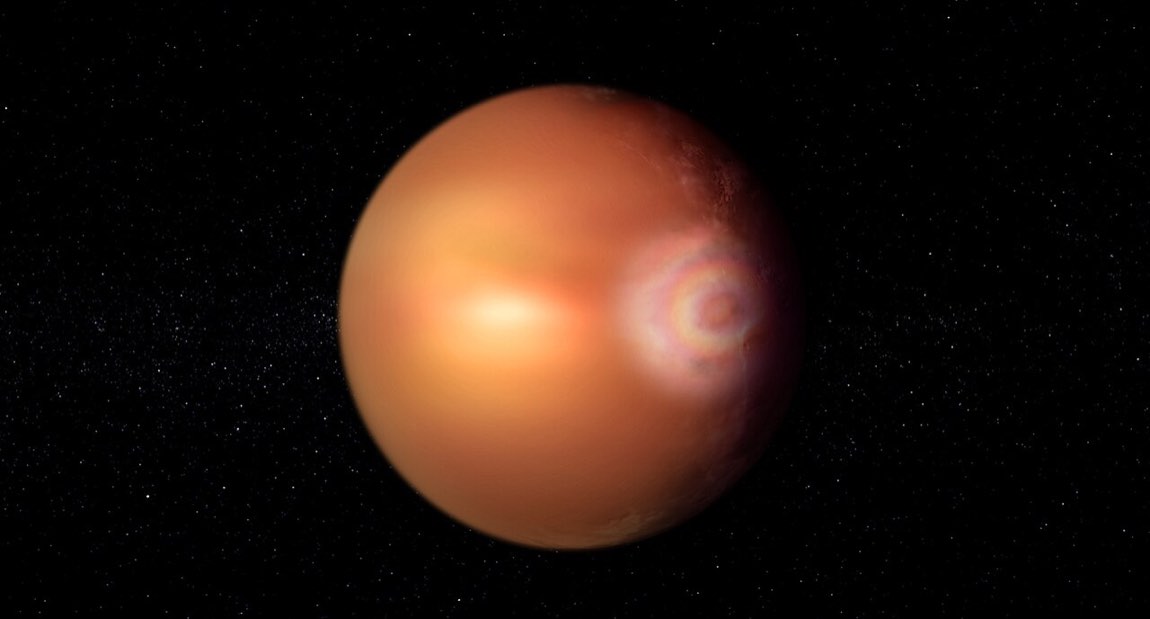
In April 2024, researchers proposed a striking interpretation for a puzzling brightness increase observed at the eastern terminator zone of WASP-76 b — the boundary region between the planet's dayside and nightside as seen from Earth. The suggestion was that this brightening might be caused by a glory effect, the same optical phenomenon that produces the colorful circular halos sometimes seen around the shadow of an aircraft on clouds below it. On Earth, glories require spherical or near-spherical droplets of uniform size. If the glory interpretation for WASP-76 b is confirmed, it would mark the first detection of an extrasolar glory-like phenomenon ever recorded. That would carry significant implications, because glories are sensitive to droplet size and composition, potentially offering a new diagnostic tool for characterizing cloud particles in exoplanet atmospheres. However, the article is careful to note that confirmation has not yet been achieved as of the time of reporting.
08 The Evaporating Exomoon Hypothesis Deeper
Among the more speculative ideas surrounding WASP-76 b is the possibility that a hot, evaporating exomoon orbits the planet. The hypothesis was raised because such an object could be consistent with observations of what has been described as an extrasolar toroidal atmosphere — a doughnut-shaped envelope of gas that might encircle the planet beyond its own atmosphere. On a world this close to its star, any moon would be bombarded by intense radiation and gravitational forces, which could drive rapid evaporation of its surface and upper layers, releasing gas that then fills a torus-shaped volume around WASP-76 b's orbit. This is an explicitly speculative idea: the article describes it as something that "has been speculated" rather than confirmed or even strongly evidenced. Still, it reflects a broader scientific interest in understanding whether moons — which are common throughout our own solar system — can survive and be detected in the extreme environments around Hot Jupiters.
09 The Telescopes That Built This Picture
Building even our current incomplete picture of WASP-76 b has required a fleet of space- and ground-based observatories working in different wavelength ranges and with different capabilities. The Hubble Space Telescope contributed critically on two fronts: early detections of titanium oxide and water in the atmosphere, and the later revelation that a companion star had contaminated the 2020 spectroscopic data, forcing a revision of the atmospheric model. The Spitzer Space Telescope, which operated in the infrared, also contributed to those early atmospheric detections. Gemini North Observatory on Mauna Kea in Hawaii provided the 2021 confirmation of calcium in the atmosphere. For the iron detection controversy, high-resolution spectrographs were central tools, able to resolve individual absorption lines of specific elements against the stellar background. Each instrument added a piece, but also sometimes a complication, underscoring that exoplanet characterization is an iterative and self-correcting process rather than a single definitive measurement.
10 What the Temperature Gap Tells Scientists Deeper
The difference between WASP-76 b's equilibrium temperature of roughly 2,190 K and its measured daytime temperature of approximately 2,500 ± 200 K is scientifically informative. An equilibrium temperature assumes the planet radiates heat evenly in all directions and reflects a fixed fraction of starlight. When the measured dayside temperature exceeds this value, it indicates that heat redistribution from day to night is inefficient — the dayside is absorbing more energy than it radiates locally and is not effectively sharing it with the nightside through atmospheric circulation. This in turn affects predictions about atmospheric dynamics, wind speeds, cloud formation locations, and the kinds of chemical reactions that can occur. The ±200 K uncertainty on the daytime measurement is also a reminder of the real observational challenges involved: measuring temperatures remotely using spectral emission and secondary eclipse depths leaves meaningful room for error, and different observational campaigns or modeling assumptions can shift the result within that window.
11 Open Questions That Still Haunt This Planet
WASP-76 b is one of the most-studied exoplanets, yet fundamental questions remain unresolved. The iron rain scenario — arguably the most famous claim about this world — cannot yet be definitively confirmed or ruled out with existing data; both iron condensation and temperature-variation explanations remain viable. The possible glory effect observed in 2024 awaits confirmation that could make it a landmark discovery or dissolve into an alternative explanation. The speculative evaporating exomoon and toroidal atmosphere remain unconfirmed. Even the basic atmospheric composition carries uncertainty: the revised post-Hubble model found only upper limits on titanium oxide and vanadium oxide, not firm detections. Barium has been found, but understanding why such a heavy element appears at high altitudes in an atmosphere pushes against current models of atmospheric dynamics. This planet is a reminder that the most dramatic-sounding science stories are often the ones still being actively debated and revised.
About this record
The measured values come from the NASA Exoplanet Archive, and any missing value has not been determined yet; the Atlas never fills gaps with guesses. More standout worlds: Proxima b, TRAPPIST-1e, K2-18 b, 55 Cancri e, and the detection methods that found them all.