Confirmed exoplanet · Database record + computed analysis
K2-18 b
A confirmed world orbiting K2-18, 124.0 light-years away.
A sub-Neptune
2.37 Earth radii, likely a rocky core under a thick gas or steam envelope rather than a walkable surface.
The orbit
Its year, one full orbit, takes just 32.9 Earth days.
Temperature and starlight
Its equilibrium temperature (the airless-world estimate) is about 11 °C. In the range where, with the right atmosphere, liquid water is conceivable; a real atmosphere could shift the true surface figure a lot (Earth's equilibrium value is −18 °C, yet we average +15 °C). It receives 1.00 times Earth's starlight, the same order as our own world.
Its sun
Its star is a red dwarf (3,457 K surface), type M2.5 V: small, dim, flare-prone, and destined to outlive the Sun many times over. It shares the system with 1 other known planet.
How far is that, really?
At 124 light-years, tonight's light from this system left it around the year 1901. A Voyager-speed probe would need roughly 2,194,345 years to get there.
How we found it
It was found by the transit method: the planet crosses its star's face on schedule, dimming it by a tiny, repeating fraction. The dip's depth gives the planet's size. The discovery was announced in 2015 from K2.
Everything above is computed from the archive’s measured values for this planet. Where a quantity is missing, the statement is omitted rather than guessed.
The deep dive
Researched for the Atlas from Wikipedia — K2-18b (16,815 characters read) · updated Sep 20, 2026
01 A Red Dwarf Host and What That Means
K2-18b orbits K2-18, a spectral class M3V red dwarf sitting 124.02 ± 0.26 light-years away in the constellation Leo. The star is considerably smaller and cooler than the Sun, with a surface temperature of just 3,457 K and a radius only 45% of the Sun's — meaning it shines far more feebly. Because the star is so dim, K2-18b's 33-day orbit still lands it squarely inside the habitable zone, receiving about 1,368 W/m² of stellar radiation — remarkably close to the roughly 1,361 W/m² Earth receives from the Sun. The star is estimated to be 2.4 ± 0.6 billion years old and shows moderate stellar activity. Whether it hosts starspots — dark, cooler patches — is not yet settled, and that uncertainty matters enormously: a planet crossing a starspot during a transit can create spectral signals that mimic the chemistry of an atmosphere, so disentangling real atmospheric signatures from stellar noise is an ongoing challenge for every observation of K2-18b.
02 Size, Mass, and the Radius Valley Puzzle
With a radius of 2.610 ± 0.087 times Earth's and a mass of 8.63 ± 1.35 Earth masses, K2-18b falls into the category astronomers call a sub-Neptune. Its bulk density works out to about 2.67 g/cm³ — denser than Neptune (roughly 1.64 g/cm³) but far less dense than Earth (5.51 g/cm³), pointing firmly toward a substantial hydrogen-rich envelope rather than a purely rocky interior. The planet's size places it just above the so-called radius valley, a conspicuous gap in the size distribution of known exoplanets centered around 1.5–2 Earth radii. Planets in that range are rarer than expected, apparently because they struggle to hold their atmospheres against the combined pressure of their own thermal energy and ultraviolet bombardment from their stars. K2-18b, at 2.610 Earth radii, sits above this gap as a sub-Neptune, but understanding exactly how thick and how persistent its envelope is remains a central open question about this world.
03 Interior Structure: Ice, Rock, or Something Else Deeper
Pinning down what lies beneath K2-18b's atmosphere requires interpreting its density, which at 2.67 g/cm³ is intermediate between Earth and Neptune — consistent with several very different internal architectures. One plausible picture has the planet as essentially rocky at its heart, draped in a thick hydrogen envelope. Another scenario gives it a Neptune-like layered interior. A pure liquid-water planet with only a thin atmospheric veneer is considered less likely based on current mass and radius data alone. If a liquid-water ocean does exist at intermediate depths, models suggest it would sit atop a layer of high-pressure ice, which in turn rests on a rocky core. That icy boundary layer is scientifically important because it could prevent material from cycling between the rocky core and the ocean — potentially destabilizing climate over geological timescales. The atmosphere contributes at most 6.2% of the planet's total mass, and its composition is thought to broadly resemble that of the ice giants Uranus and Neptune rather than Earth or Jupiter.
04 Tidal Locking and the Question of Rotation
Because K2-18b orbits so close to its relatively cool star — completing one circuit every 33 days — gravity has almost certainly synchronized its rotation with its orbit, a state called tidal locking where one hemisphere permanently faces the star and the other sits in endless night. However, K2-18b's orbital eccentricity leaves open a second possibility: a spin-orbit resonance similar to Mercury's, where the planet rotates three times for every two orbits, giving it a slow but real day-night cycle. Climate simulations by Charnay et al. (2021) found that assuming tidal locking produces an atmosphere with surprisingly weak temperature gradients between the day and night sides, with air descending on the night side and rising on the day side. When the same model was run with a spin-orbit resonance instead, the cloud distribution did not change substantially — suggesting that for atmospheric structure, the distinction between the two rotation states may matter less than other factors like cloud particle size and atmospheric metallicity.
 ⤢
⤢
05 Atmosphere in Detail: What JWST Found and Didn't Deeper
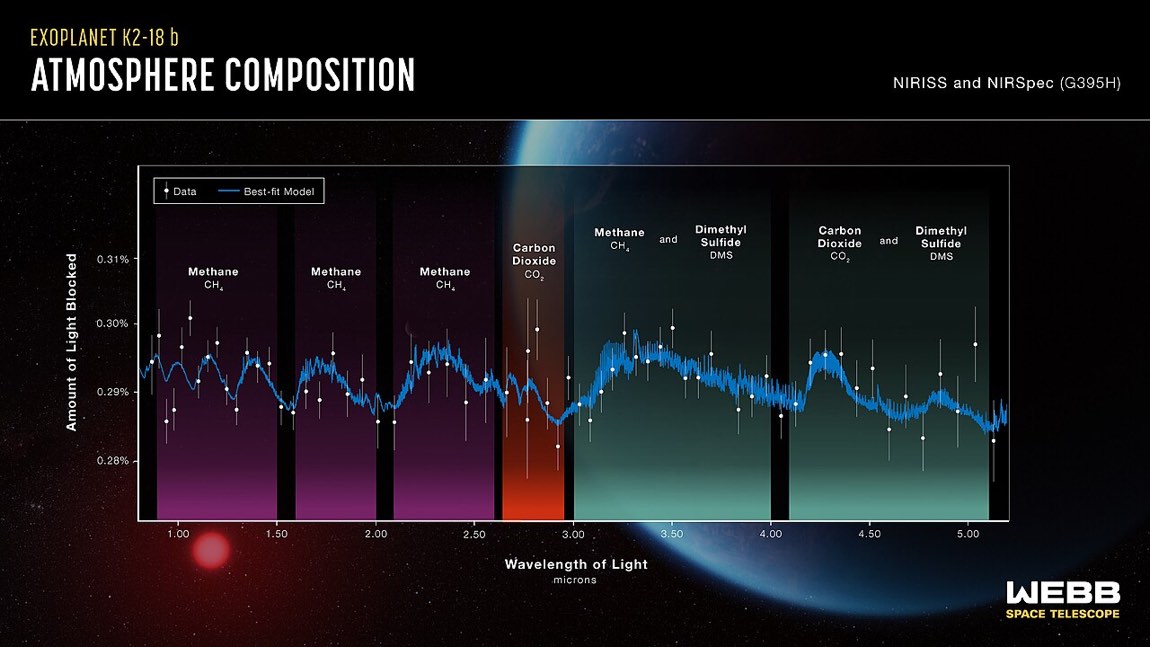
Observations with the Hubble Space Telescope established that K2-18b has a hydrogen-dominated atmosphere with high metallicity. The James Webb Space Telescope then detected water vapour, carbon dioxide, and methane, each at roughly 1% concentration for the carbon-bearing gases — though later observations introduced some doubt about the carbon dioxide detection specifically. Water vapour concentrations appear to be less than 0.1%, a surprisingly small figure that researchers attribute to an efficient cold trap: water condenses out and freezes before reaching the high atmospheric layers JWST probes, leaving the stratosphere comparatively dry. Ammonia concentrations appear unmeasurably low, which is itself informative — if an ocean-atmosphere interface exists, trace gases like ammonia can dissolve into the ocean and vanish from the spectrum. Concentrations of other carbon oxides have only upper limits of a few percent established. Whether hazes are present is unresolved, and evidence for water clouds is conflicting; if clouds do form, they are most likely icy. Ammonium chloride, sodium sulfide, potassium chloride, and zinc sulfide are all candidates for cloud formation depending on precise atmospheric conditions.
06 Atmospheric Escape: Losing Hydrogen to Space Deeper
K2-18b receives considerably higher fluxes of hard ultraviolet radiation and X-rays from its host star than Earth receives from the Sun. This high-energy radiation heats the uppermost atmospheric layers and drives photodissociation of water molecules, liberating hydrogen that fills an extended exosphere reaching beyond the planet's gravitational grip. The estimated escape rate is approximately 350 tons per second — though with wide uncertainty bounds of roughly +400 and −290 tons per second — a rate calculated to be too slow to strip away the planet's atmosphere over its lifetime. For comparison, 350 tons per second is about the mass of a fully loaded Boeing 747 every second, yet against the backdrop of K2-18b's massive hydrogen envelope, this loss is negligible across billions of years. Tentative observational evidence for this exosphere comes from measured dips in Lyman-alpha radiation during planetary transits, though that detection has not yet been confirmed independently.
07 Clouds, Hazes, and Rainfall That Never Lands
Climate simulations of K2-18b paint a striking picture of atmospheric behavior quite unlike anything in our solar system. In the modeling work of Charnay et al. (2021), clouds form preferentially at the substellar point — the spot directly beneath the star — and along the terminator, the boundary between the lit and dark hemispheres. Crucially, these simulations predict virga: rainfall that begins high in the atmosphere but completely evaporates before reaching the surface, never delivering water below. In the upper atmosphere, methane absorbs radiation and creates a temperature inversion layer — a stratosphere — consistent with what most climate models predict. A separate model by Hu (2021) raises the prospect of a sulfur haze layer extending through and above the water clouds, which would significantly complicate spectroscopic studies by blurring chemical signals. The exact nature of clouds and hazes remains one of the largest sources of uncertainty in interpreting observations of K2-18b.
08 The Hycean Planet Concept, Born Here
K2-18b is the prototype for an entirely new category of world: the hycean planet, a term coined to describe planets that combine abundant liquid water with a thick hydrogen envelope. Before K2-18b became a focus of intensive study, planets with this combination of features were generally assumed to be too hot to support liquid water or life, because hydrogen is a potent greenhouse gas. Research into K2-18b upended that assumption, suggesting that under the right conditions — appropriate distance from the star, suitable atmospheric composition — a hycean planet could maintain surface temperatures compatible with liquid water. The strong greenhouse warming from hydrogen could actually be an asset at lower stellar radiation levels, keeping a world habitable that might otherwise freeze. K2-18b is described as probably the best-known hycean planet, serving as the observational anchor for a class of worlds that expands the theoretical space for where life might persist in the universe. Non-hycean interpretations of K2-18b's properties remain viable, both habitable and uninhabitable.
 ⤢
⤢
09 Dimethyl Sulfide: A Biosignature Under Scrutiny
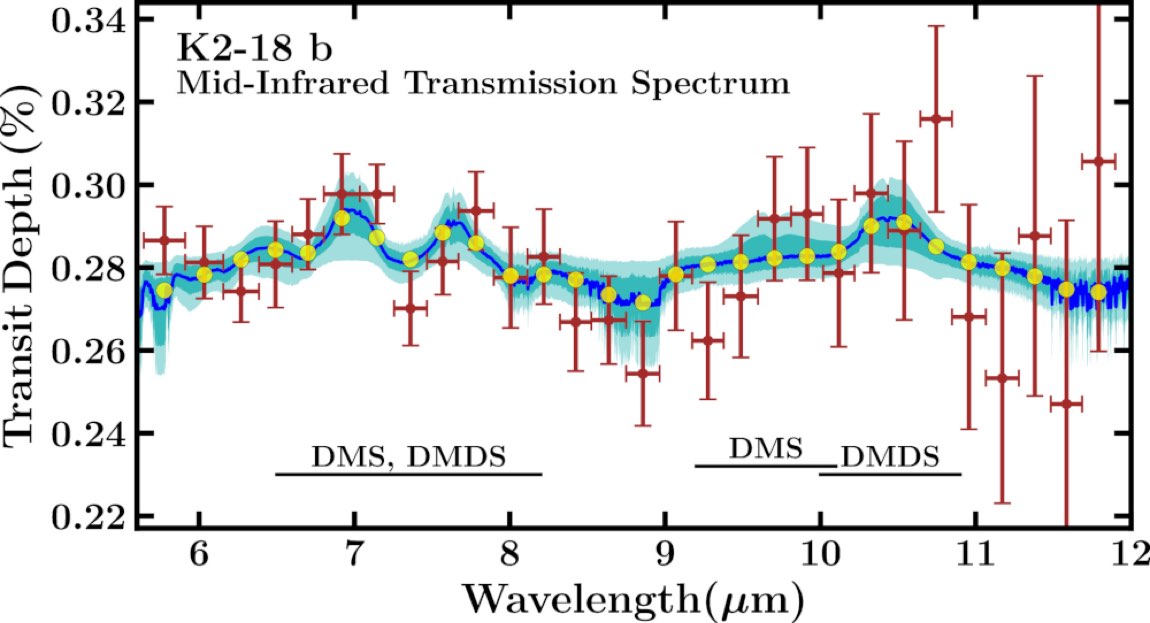
In 2025, researchers reported a tentative detection of dimethyl sulfide (DMS) and methyl chloride in K2-18b's atmosphere — a finding that generated intense scientific and public interest because DMS, on Earth, is produced almost exclusively by marine microorganisms. However, the claim has not been widely accepted. Multiple follow-up analyses found that the same JWST transit data can be processed in different ways, with some approaches yielding a DMS signal and others producing a flat, featureless spectrum consistent with no DMS at all. Statistical significance of the detection is characterized as small. Compounding matters, DMS can be produced by photochemical reactions without any biology, though the reported concentrations — if real — may be too high for purely abiotic chemistry to explain. The modeling work of Tsai et al. (2024) noted that biological processes generating DMS at the required rate would also be expected to produce detectable quantities of ethane, which was not observed — a point raised against a biological interpretation. The required DMS production rate would need to exceed Earth's total biological output by a factor of 20.
10 Discovery Path: From Kepler to Webb
K2-18b was first detected in 2015 by NASA's Kepler space telescope, operating in its extended K2 mission phase — hence the planet's designation. Its existence was subsequently confirmed using the Spitzer Space Telescope and through Doppler velocity measurements that tracked the gravitational wobble the planet induces on its host star. Early estimates of the star's size carried substantial errors, which cascaded into incorrect estimates of the planet's radius and an overestimated density. In 2019, astronomers announced the detection of water vapour in K2-18b's atmosphere — the first such detection on an exoplanet that is not a hot Jupiter, making it a landmark discovery that generated wide scientific discussion. The planet then became a primary target for the James Webb Space Telescope, whose infrared sensitivity allowed detection of carbon dioxide, methane, and the contested DMS signal. Each successive instrument has revealed new layers of complexity, transforming K2-18b from a curiosity into arguably the most intensively debated potentially habitable world beyond our solar system.
11 Exomoons: Why None Can Survive Here Deeper
The question of whether K2-18b could host a moon — and whether such a moon might influence the planet's habitability — has been examined carefully. On Earth, our Moon stabilizes axial tilt and drives tidal cycles that may have played roles in the emergence of life. For K2-18b, the analysis is discouraging: the planet's Hill sphere — the region of space where its gravity dominates over the star's — is simply too small to allow a moon to survive for more than about 10 million years before being lost to tidal disruption or orbital perturbations. Whether planets in K2-18b's orbital regime can host exomoons at all is uncertain; tidal effects from the star or dynamical interactions within the system could destroy any moon that formed or was captured. K2-18 also hosts an inner planet, K2-18c, whose gravitational influence on K2-18b through tidal interactions adds another layer of complexity to the long-term orbital stability picture.
12 What Science Still Cannot Answer About K2-18b
Despite being one of the most observed exoplanets outside our solar system, K2-18b leaves fundamental questions open. Whether a liquid water ocean exists at all cannot be confirmed or ruled out from mass and radius measurements alone, and detecting it remotely is technically formidable. The presence of carbon dioxide remains uncertain after initial JWST reports. The nature of hazes and clouds — their composition, altitude, and optical thickness — is unresolved and directly affects the reliability of every spectroscopic measurement. A paper by Howard et al. (2025) proposed that water and hydrogen may have separated in the planet's interior, which could explain why so little water appears in the atmosphere, adding yet another possible explanation. Whether any of the proposed biosignature detections reflect genuine chemistry — biological or abiotic — or are simply artifacts of data processing and the limitations of spectral databases remains actively debated. K2-18b has become, in this sense, as important for the questions it forces researchers to sharpen as for any answers it has yet delivered.
About this record
The measured values come from the NASA Exoplanet Archive, and any missing value has not been determined yet; the Atlas never fills gaps with guesses. More standout worlds: Proxima b, TRAPPIST-1e, K2-18 b, 55 Cancri e, and the detection methods that found them all.