Confirmed exoplanet · Database record + computed analysis
WASP-12 b
A confirmed world orbiting WASP-12, 1,393.5 light-years away.
A gas giant
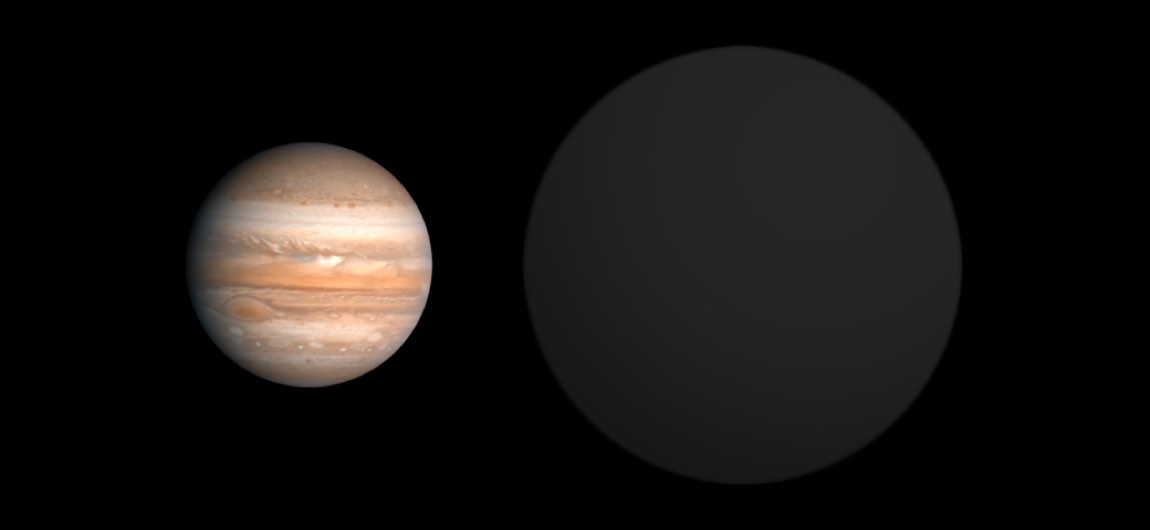
22.03 Earth radii, Jupiter-class (Jupiter is 11.2). At only 467.2 Earth masses for that size, it must be substantially gas or volatile ices: puffy, not rocky. Orbiting this close, it is a classic 'hot Jupiter', a giant that migrated inward from where it formed.
The orbit
Its year, one full orbit, takes just 1.1 Earth days.
Temperature and starlight
Its equilibrium temperature (the airless-world estimate) is about 2,328 °C. Hot enough to melt copper; any surface would glow. It receives 8,220.6 times the starlight Earth gets.
Its sun
Its star is hotter than the Sun (6,265 K), burning brighter and faster. The system holds 3 stars, so its skies have more than one sun.
How far is that, really?
At 1,393 light-years, tonight's light from this system left it around the year 632. A Voyager-speed probe would need roughly 24,654,452 years to get there.
How we found it
It was found by the transit method: the planet crosses its star's face on schedule, dimming it by a tiny, repeating fraction. The dip's depth gives the planet's size. The discovery was announced in 2008 from SuperWASP.
Everything above is computed from the archive’s measured values for this planet. Where a quantity is missing, the statement is omitted rather than guessed.
The deep dive
Researched for the Atlas from Wikipedia — WASP-12b (5,497 characters read) · updated Sep 20, 2026
01 Discovery by the SuperWASP Survey
WASP-12b was discovered in April 2008 by the SuperWASP planetary transit survey, a wide-field photometric project designed to catch the telltale dimming of starlight as a planet crosses in front of its host star. Transit surveys like SuperWASP watch thousands of stars simultaneously, making them powerful tools for finding close-in, large planets that produce deep, frequent dips in brightness. Because WASP-12b completes a full orbit in just a little over one Earth day, it transits its star with remarkable regularity, making it an ideal target for repeated follow-up study. The discovery opened a window onto one of the most extreme planetary environments known: a world squeezed into an orbit only about 3.5 million kilometers from its star — roughly 0.023 astronomical units — a distance that is only one forty-third of the Earth–Sun separation. Within just a few years of its discovery, WASP-12b had become one of the most intensively studied exoplanets in the sky, yielding findings about atmospheric composition, orbital decay, and the physics of tidal destruction.
02 A Planet Being Eaten Alive
On May 20, 2010, the Hubble Space Telescope captured what scientists described as a planet being actively consumed by its star. Although astronomers had long theorized that stars could engulf close-in planets, this was the first time the process had been observed so clearly. The mechanism is tidal stripping: WASP-12b's star exerts gravitational forces strong enough to pull material directly from the planet's puffed-up atmosphere. The rate of atmospheric loss has been estimated at about 10⁻⁷ Jupiter masses per year — roughly 189 quadrillion tons annually, or about 6 billion tons every single second. To put that in perspective, 6 billion tons per second is more than the combined mass of every ship ever built leaving the planet each second. Based on this ongoing erosion, scientists estimate that WASP-12b has between 3 and 10 million years remaining before it is completely consumed. The Hubble observations that revealed this process were made using its Cosmic Origins Spectrograph, and they confirmed predictions published in the journal Nature in February 2009 by Shu-lin Li of Peking University.
03 Tidal Distortion Into a Football Shape Deeper
WASP-12b is so gravitationally stressed by its host star that it can no longer maintain a spherical form. The star's tidal forces stretch the planet into a prolate spheroid — essentially a football or rugby-ball shape — with the long axis pointed toward the star. This distortion is a direct consequence of the planet's extreme proximity, where differential gravitational pull across the planet's diameter becomes large enough to visibly deform it. Compounding the effect, "tidal heating" — the frictional energy generated inside the planet as it is continuously flexed — combines with the intense stellar irradiation to drive the surface temperature above 2,500 K (2,200 °C; 4,000 °F), hotter than many stars' outer layers. This extreme heat has inflated the atmosphere to nearly three times the radius of Jupiter, even though the planet itself has only about 40% more mass than Jupiter. The result is one of the lowest densities recorded for any exoplanet — a world that is simultaneously massive and extraordinarily puffy, a direct product of the ferocious energy it receives from its star.
 ⤢
⤢
04 Pitch-Black and Glowing Red
Despite sitting so close to a blazing star, WASP-12b reflects a strikingly tiny fraction of the light that falls on it. In September 2017, researchers using the Hubble Space Telescope announced that the planet reflects only 6% of incoming starlight — an albedo so low that scientists described it as "black as asphalt" and "pitch black." For comparison, Earth reflects about 30% of sunlight, and even the Moon, considered quite dark, reflects about 12%. The near-total absorption of starlight is thought to result from the extreme temperatures in the atmosphere, which prevent the formation of reflective clouds. Instead, heat-absorbing molecules and atoms dominate the upper layers. Yet WASP-12b is not visually dark in any simple sense: its surface temperature of more than 2,500 K means it glows on its own, emitting a dim but detectable reddish light. The planet is simultaneously one of the least reflective and one of the hottest exoplanets ever studied — a paradox that makes it a key laboratory for understanding how ultra-hot Jupiter atmospheres behave.
05 Water and a Surprisingly Dry Atmosphere
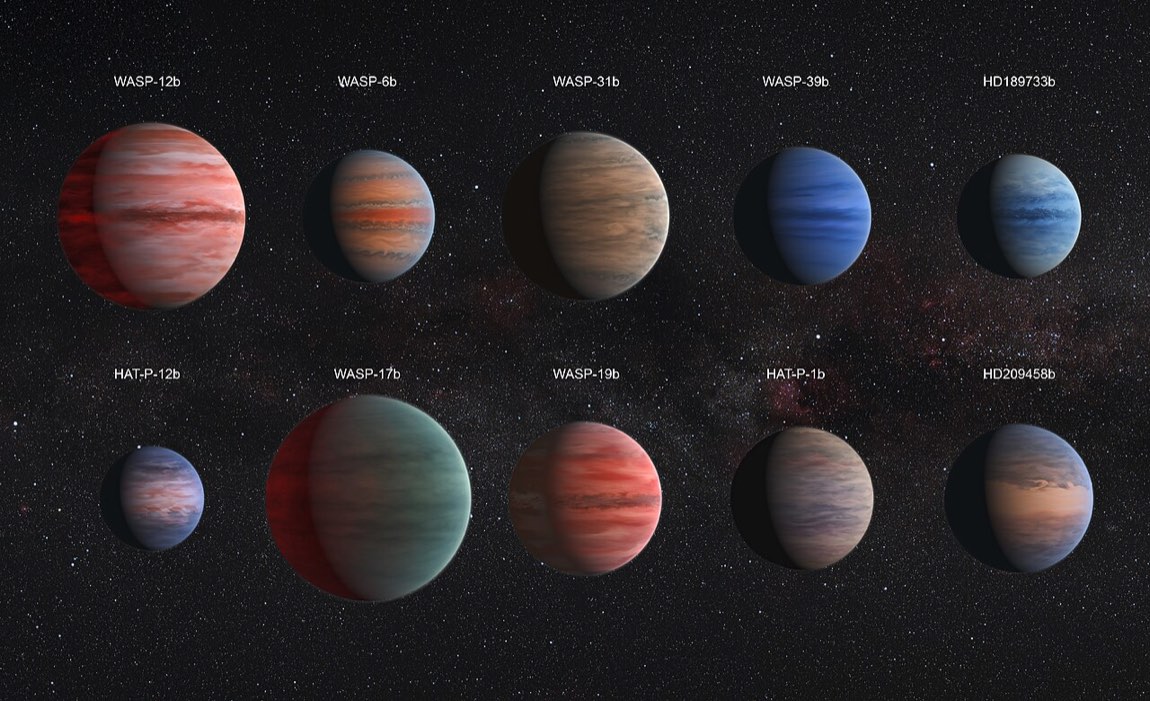
On December 3, 2013, scientists working with the Hubble Space Telescope reported the detection of water vapor in WASP-12b's atmosphere, a significant milestone in exoplanet science. Then, in July 2014, NASA announced a broader finding: three exoplanets orbiting sun-like stars — HD 189733b, HD 209458b, and WASP-12b — all showed unexpectedly dry atmospheres, with far less water than planetary formation models had predicted. The detection of water confirmed that spectroscopic analysis of exoplanet atmospheres could reveal individual molecules, while the dryness result raised important questions about where and how planetary atmospheres form. One explanation is that high-altitude clouds or hazes could mask the water signal, making it appear weaker than it actually is. For WASP-12b in particular, the extreme temperatures complicate matters further, as the same heat that inflates the atmosphere also drives complex chemistry that destroys and creates molecules at a rapid pace. The water findings cemented WASP-12b's status as a prime target for atmospheric characterization.
06 A Carbon World Unlike Anything in Our Solar System Deeper
A 2010 study published in the journal Nature reported evidence that WASP-12b has an unusually high carbon-to-oxygen ratio — approximately 1, compared to the solar value of 0.54. This means the planet has roughly equal numbers of carbon and oxygen atoms in its atmosphere, rather than the oxygen-dominated chemistry seen in our own solar system's giant planets. The carbon is present in atmospheric form as carbon monoxide and methane. The implications extend beyond WASP-12b itself: the researchers noted that in star systems where carbon is abundant relative to oxygen, any solid planets that form could be dominated by graphite or diamond interiors, rather than the silicate rocks that make up Earth. One researcher commented directly that "with more carbon than oxygen, you would get rocks of pure carbon, such as diamond or graphite." The study carefully noted that carbon-rich giant planets like WASP-12b had not previously been observed, but that theory predicts a wide range of compositions for carbon-dominated solid planets. The finding prompted considerable media attention, with some outlets calling WASP-12b a "diamond planet," though that description applies more accurately to hypothetical solid companions than to the gas giant itself.
 ⤢
⤢
07 Heat Transport and Hydrogen Ionization Deeper
Because WASP-12b is tidally locked, one hemisphere bakes under permanent stellar irradiation while the other sits in perpetual darkness — a situation analogous to how the same face of the Moon always points toward Earth. This enormous temperature contrast drives powerful atmospheric circulation, with strong winds sweeping heat from the scorching dayside toward the cooler nightside. Researchers Taylor Bell and Nicolas Cowan identified a particularly elegant mechanism amplifying this heat transport: on the searing dayside, hydrogen atoms are stripped of their electrons and become ionized. These ionized hydrogen atoms flow with the wind toward the cooler nightside, where they recombine into neutral hydrogen, releasing the energy stored during ionization. This ionization-recombination cycle effectively acts as a heat pump, carrying thermal energy around the planet more efficiently than simple wind convection alone. The process is a consequence of the planet's extreme temperature — more than 2,500 K — which is high enough to ionize hydrogen, something that does not happen in the cooler atmospheres of more distant hot Jupiters. Understanding this mechanism helps scientists model how energy is redistributed on the most extreme exoplanets.
08 An Orbit Spiraling Toward Destruction Deeper
Precise timing of WASP-12b's transits has revealed that the planet's orbit is not stable — it is actively decaying. A 2019 study found that the interval between successive transits has been shrinking by 29 ± 2 milliseconds per year since the planet's discovery in 2008. A 2020 update revised this figure to 32.53 ± 1.62 milliseconds per year, implying a remaining lifetime of 2.90 ± 0.14 million years. A 2022 refinement settled the decay rate at 29.81 ± 0.94 milliseconds per year, corresponding to an estimated lifetime of 3.16 ± 0.10 million years. The driver of this decay is tidal interaction between the planet and its host star: energy is gradually transferred from the planet's orbit into the star, causing the orbit to shrink. As the orbit shrinks, the orbital period shortens, bringing the planet ever closer until it merges with the star. This makes WASP-12b's eventual fate a certainty on an astronomical timescale, though 3 million years is still far longer than recorded human history. Notably, the decay rate of WASP-12b is much faster than that of WASP-19b, which shows no measurable decay at all with current data.
09 A Tilted Orbit Out of Step With Its Star Deeper
In most planetary systems, a planet's orbit lies close to the equatorial plane of its host star — a natural consequence of both forming from the same rotating disk of gas and dust. WASP-12b does not follow this pattern. A 2012 study employing the Rossiter–McLaughlin effect — a technique that uses the Doppler shift of starlight during a transit to measure orbital alignment — determined that WASP-12b's orbit is strongly misaligned with the equatorial plane of its star by 59 degrees, with an uncertainty of +15 to −20 degrees. This significant tilt suggests the planet's orbit was altered after formation, possibly through gravitational interactions with another body in the system, or through a high-eccentricity migration pathway that brought the planet to its current extreme proximity. The orbital eccentricity of WASP-12b is described as being the same as Jupiter's. The combination of a misaligned, shrinking orbit and a planet being actively torn apart by tidal forces makes WASP-12b one of the most dynamically violent planetary environments known to science.
10 A Possible Moon in a Hostile Place
Hot Jupiters like WASP-12b are not generally expected to host large moons. The extreme tidal environment close to the host star should strip away any substantial satellite over geologically short timescales, leaving the planet effectively moonless. Yet Russian astronomers studying the light curve of WASP-12b noticed a puzzling pattern: regular variations in the planet's brightness that could be explained by the presence of a plasma torus surrounding at least one exomoon in orbit around WASP-12b. A plasma torus is a doughnut-shaped cloud of ionized gas, similar in concept to the torus maintained by Jupiter's volcanic moon Io in our own solar system. The researchers acknowledged that a true large moon surviving around a hot Jupiter would be scientifically extraordinary. One alternative interpretation is that the detected object might not be a conventional moon at all, but rather a Trojan body — a smaller object trapped in a gravitational equilibrium point along the planet's orbit. The observations have not been confirmed, and the candidate satellite remains an open and intriguing question in WASP-12b research.
11 How Atmospheric Observations Were Made
The detailed atmospheric knowledge accumulated about WASP-12b came almost entirely from the Hubble Space Telescope, which observed the planet using two key instruments. The Cosmic Origins Spectrograph, deployed during Hubble's final servicing mission, was used in the May 2010 observations that revealed the planet being actively consumed by its star. This instrument breaks incoming ultraviolet light into a spectrum, allowing scientists to identify specific atomic and molecular signatures in the planet's extended, escaping atmosphere. The 2013 detection of water vapor also used Hubble's spectroscopic capabilities, taking advantage of the planet's transits to compare the star's spectrum with and without the planet in front of it — the difference reveals what molecules in the planetary atmosphere absorbed particular wavelengths of light. The fact that WASP-12b's atmosphere has ballooned to nearly three times Jupiter's radius makes it a particularly large and detectable target for these transmission spectroscopy techniques. Each transit essentially allows the telescope to sample a thin slice of the planet's atmosphere, building up a chemical portrait observation by observation.
About this record
The measured values come from the NASA Exoplanet Archive, and any missing value has not been determined yet; the Atlas never fills gaps with guesses. More standout worlds: Proxima b, TRAPPIST-1e, K2-18 b, 55 Cancri e, and the detection methods that found them all.