Confirmed exoplanet · Database record + computed analysis
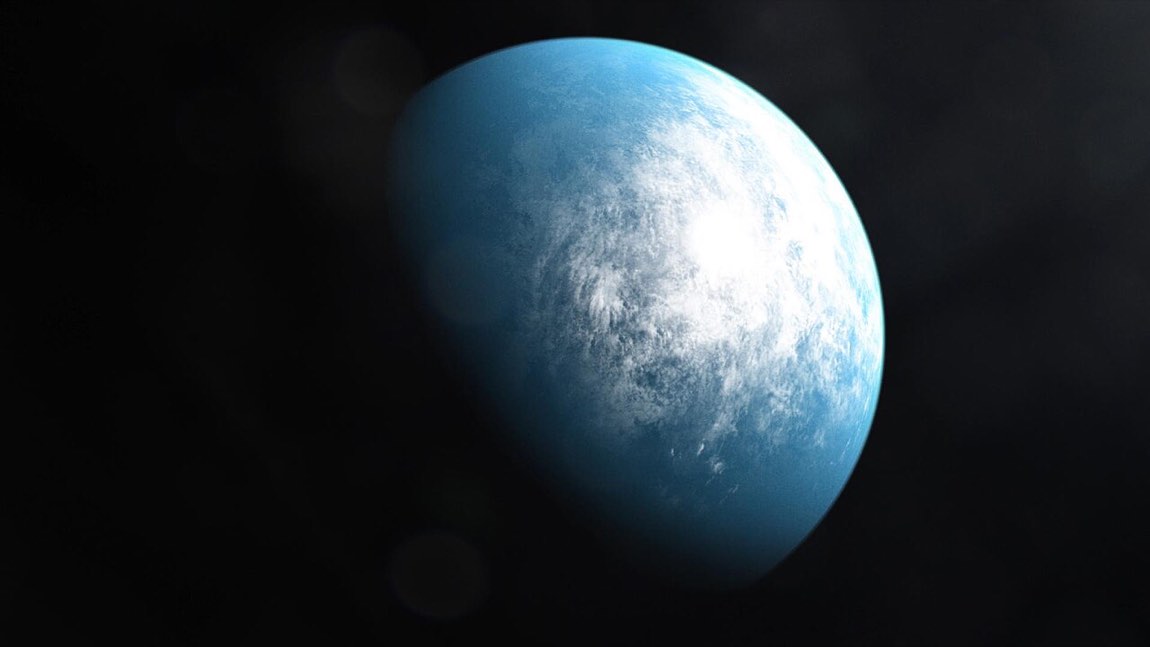
TOI-700 d
A confirmed world orbiting TOI-700, 101.5 light-years away.
An Earth-sized world
1.15 times Earth's radius, squarely in the terrestrial size range. With 1.6 Earth masses packed into that size, its density points to rock and iron rather than gas.
The orbit
Its year, one full orbit, takes just 37.4 Earth days.
Temperature and starlight
Its equilibrium temperature (the airless-world estimate) is about -4 °C. In the range where, with the right atmosphere, liquid water is conceivable; a real atmosphere could shift the true surface figure a lot (Earth's equilibrium value is −18 °C, yet we average +15 °C). It receives 0.85 times Earth's starlight, the same order as our own world.
Its sun
Its star is a red dwarf (3,459 K surface), type M2.5 V: small, dim, flare-prone, and destined to outlive the Sun many times over. It shares the system with 3 other known planets.
How far is that, really?
At 102 light-years, tonight's light from this system left it around the year 1924. A Voyager-speed probe would need roughly 1,796,171 years to get there.
How we found it
It was found by the transit method: the planet crosses its star's face on schedule, dimming it by a tiny, repeating fraction. The dip's depth gives the planet's size. The discovery was announced in 2020 from Transiting Exoplanet Survey Satellite (TESS).
Everything above is computed from the archive’s measured values for this planet. Where a quantity is missing, the statement is omitted rather than guessed.
The deep dive
Researched for the Atlas from Wikipedia — TOI-700 d (3,029 characters read) · updated Sep 20, 2026
01 The TESS Discovery That Made History
TOI-700 d was discovered on 3 January 2020 by a team of astronomers led by Emily Gilbert, using NASA's Transiting Exoplanet Survey Satellite (TESS). The find was historically significant because it marked the first time TESS had detected an Earth-sized planet residing within a star's habitable zone. TESS identifies exoplanets by watching for the tiny dimming of starlight that occurs when a planet passes in front of its host star — a technique called the transit method. TOI-700 d's small size made the detection challenging, but TESS observed the system across 11 full sectors, building up enough data to confirm the planet's existence. The discovery was announced publicly in early 2020 and immediately drew scientific attention as one of the most compelling nearby targets for habitability research, sitting just 101.4 light-years from Earth in the southern constellation Dorado.
02 A Planet Denser Than Any Rocky World We Know Deeper
TOI-700 d has a radius of approximately 1.16 times Earth's and a mass of about 2.40 Earth masses, which together yield a density of around 8.5 grams per cubic centimeter. For context, Earth's average density is about 5.5 g/cm³, and even iron-rich Mercury sits near 5.4 g/cm³, making TOI-700 d substantially denser than any large rocky body in our own Solar System. This high density is a strong signal that the planet contains a greater fraction of iron than Earth does. Scientists suggest this iron-enriched composition could be the legacy of violent giant impact events early in the planet's formation, similar in concept to the collision that is thought to have stripped Mercury of much of its rocky mantle. These energetic collisions would have preferentially removed lighter silicate material, leaving behind a denser, iron-dominated interior. Pinning down the exact internal structure remains an open question, but the density measurement already tells a vivid story of a dramatic early history.
03 Orbit Closer Than Mercury, but Still Habitable
TOI-700 d completes one orbit around its star every 37.42 days, traveling at an orbital radius of just 0.161 AU — roughly 24.1 million kilometers from its host star. That distance is less than half of Mercury's orbital distance from the Sun, which sits at about 0.39 AU. Despite this tight orbit, TOI-700 d falls comfortably within TOI-700's habitable zone. The reason is that TOI-700 is a dim red dwarf, radiating far less energy than our Sun. As a result, the planet receives only about 88% as much stellar energy as Earth receives from the Sun — not dramatically different, and well within the range that could theoretically support liquid water on a planet's surface. The combination of a short year, a close orbit, and relatively mild insolation is a hallmark of planets around M-dwarf stars.
04 Equilibrium Temperature and What It Really Means
A planet's equilibrium temperature is a theoretical baseline — the surface temperature a perfectly absorbing, atmosphere-free world would reach given the starlight it receives. For TOI-700 d, that figure is approximately 268.8 Kelvin, equivalent to about −4.3 °C or 24.2 °F. That is just below the freezing point of water, which might sound discouraging, but equilibrium temperature is rarely the whole story. On Earth, greenhouse gases push the actual surface temperature about 33°C above our own equilibrium value. The article notes that TOI-700 d's real surface temperature would likely be higher if an atmosphere is present, and it acknowledges that a small chance of a runaway greenhouse effect exists — a scenario where warming becomes self-reinforcing and water evaporates entirely, as happened on Venus. Whether the planet's atmosphere tips toward life-friendly warmth or runaway heating remains an open and genuinely exciting question.
 ⤢
⤢
05 The Quiet Star That Keeps Its Planets Safe
TOI-700 is a red dwarf of spectral class M, with roughly 40% of the Sun's mass and radius, and approximately half the Sun's surface temperature. Red dwarfs as a class are notorious for violent stellar flares that can strip planetary atmospheres and bombard surfaces with harmful radiation. TOI-700 is a notable exception to this reputation. Across all 11 sectors of TESS observations, the star did not produce a single detectable white-light flare — a remarkable record of calm. Its low rotation rate reinforces this picture, since rapidly spinning M dwarfs tend to be magnetically active and prone to flaring. Because of this unusually quiet behavior, TOI-700 d is exposed to a solar wind ram pressure and an interplanetary magnetic field intensity that researchers expect to be comparable to what Earth experiences — a far more hospitable environment than most red-dwarf planets endure.
06 Why a Neighbor Planet Helps TOI-700 d's Case Deeper
TOI-700 d is the outermost of four confirmed exoplanets in the TOI-700 system, and evidence from one of its neighbors strengthens the argument that TOI-700 d may have retained an atmosphere. TOI-700 c, which orbits closer to the star and receives more than twice the stellar insolation that d does, apparently still possesses an extended hydrogen and helium envelope. The logic is straightforward: if TOI-700's high-energy radiation — the ultraviolet and X-ray light most capable of heating and stripping atmospheres — was too weak to photoevaporate the lighter hydrogen and helium gas from planet c, then it almost certainly could not strip a denser, heavier atmosphere from TOI-700 d. A secondary atmosphere composed of molecules like carbon dioxide or nitrogen, which have higher mean molecular weights, would be even less susceptible to this kind of atmospheric escape. Planet c therefore serves as a natural laboratory that indirectly raises confidence that TOI-700 d could still be wrapped in protective gases today.
07 Formation Clues Hidden in Iron Abundance Deeper
The unusual density of TOI-700 d — around 8.5 g/cm³ — points scientists toward a specific chapter of its birth. During the chaotic early phase of planetary formation, bodies in a developing system collide repeatedly, sometimes merging and sometimes stripping material away. When a large impactor strikes a young planet at the right angle and speed, it can blast off the outer rocky (silicate) layers while leaving the dense iron core largely intact. The resulting world ends up with a higher iron-to-rock ratio than it started with. This is the leading explanation offered for TOI-700 d's exceptional density. A very similar story has been proposed for Mercury in our own Solar System, though TOI-700 d is considerably more massive. Confirming this origin story would require better constraints on the planet's interior, perhaps through measurements of its gravitational field or future observations that tighten the mass estimate — work that has not yet been done.
08 Where TOI-700 d Sits in the Sky
TOI-700 d's host star is located in the constellation Dorado, a small southern constellation best known for containing most of the Large Magellanic Cloud. At a distance of approximately 101.4 light-years (31.1 parsecs) from Earth, TOI-700 is not among the very nearest red dwarfs, but it is close enough to be reachable by TESS's photometric precision and, in the future, by more powerful observatories. On a cosmic scale, 101.4 light-years is a modest distance — light from that star left when the year was roughly 1923 — yet it is still hundreds of thousands of times farther than any spacecraft humanity has ever launched. Because Dorado is a southern constellation, TOI-700 is best observed from the Southern Hemisphere or from space-based observatories like TESS, which covered the field during its southern-sky survey sectors.
09 Open Questions Scientists Still Need to Answer Deeper
Despite being one of the most studied potentially habitable exoplanets discovered by TESS, TOI-700 d leaves several crucial questions unanswered. Perhaps the most fundamental is whether it actually has an atmosphere, and if so, what that atmosphere is made of — a question that current observations cannot yet definitively resolve. The planet's rotation state is also unknown; planets in close orbits around red dwarfs are often gravitationally locked so that one side always faces the star, which would have dramatic consequences for climate and habitability. The exact mass measurement carries uncertainties that affect density estimates and therefore interior modeling. And while the chance of a runaway greenhouse effect is described as small, it has not been ruled out. Each of these uncertainties represents a target for future telescopes, particularly those capable of directly characterizing exoplanet atmospheres through transmission spectroscopy — work that observatories like the James Webb Space Telescope are now beginning to make possible.
About this record
The measured values come from the NASA Exoplanet Archive, and any missing value has not been determined yet; the Atlas never fills gaps with guesses. More standout worlds: Proxima b, TRAPPIST-1e, K2-18 b, 55 Cancri e, and the detection methods that found them all.