Confirmed exoplanet · Database record + computed analysis
Proxima Cen b
A confirmed world orbiting Proxima Cen, 4.2 light-years away.
An Earth-sized world
1.02 times Earth's radius, squarely in the terrestrial size range. With 1.1 Earth masses packed into that size, its density points to rock and iron rather than gas.
The orbit
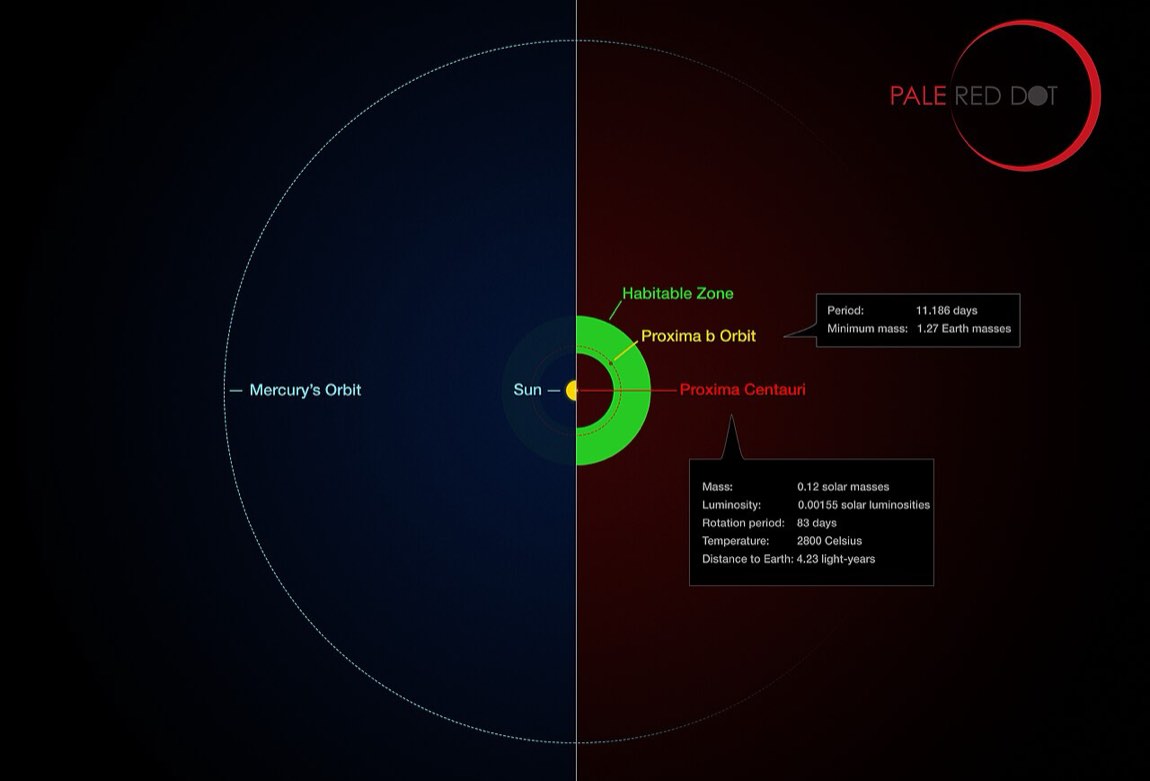
Its year, one full orbit, takes just 11.2 Earth days. Orbiting this tightly around a cool star, it is very likely tidally locked: one hemisphere in permanent day, the other in permanent night.
Temperature and starlight
Its equilibrium temperature (the airless-world estimate) is about -55 °C. In the range where, with the right atmosphere, liquid water is conceivable; a real atmosphere could shift the true surface figure a lot (Earth's equilibrium value is −18 °C, yet we average +15 °C). It receives 0.64 times Earth's starlight, the same order as our own world.
Its sun
Its star is a red dwarf (2,900 K surface), type M5.5 V: small, dim, flare-prone, and destined to outlive the Sun many times over. The system holds 3 stars, so its skies have more than one sun. It shares the system with 1 other known planet.
How far is that, really?
At 4 light-years, tonight's light from this system left it around the year 2021. That is close by galactic standards, which makes it a prime target for follow-up telescopes. A Voyager-speed probe would need roughly 75,086 years to get there.
How we found it
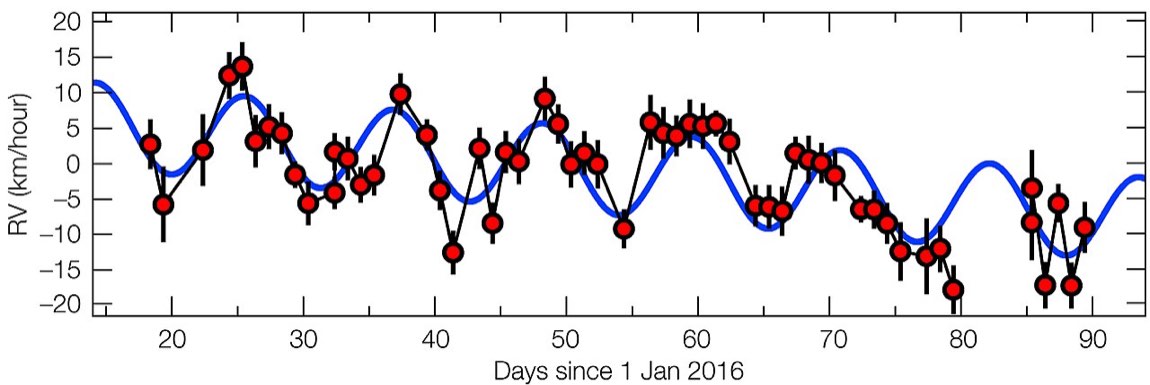
It was found by the radial-velocity method: the planet's gravity swings its star in a small circle, and that wobble shows up as a rhythmic Doppler shift in the starlight. The wobble's size gives the planet's minimum mass. The discovery was announced in 2016 from European Southern Observatory.
Everything above is computed from the archive’s measured values for this planet. Where a quantity is missing, the statement is omitted rather than guessed.
The deep dive
Researched for the Atlas from Wikipedia — Proxima Centauri b (21,916 characters read) · updated Sep 20, 2026
01 The Pale Red Dot campaign that found it
Before 2016, astronomers had already eliminated the possibility of planets larger than Earth in Proxima Centauri's habitable zone, based on searches in 2008 and 2009. The real breakthrough came when earlier European Southern Observatory data revealed subtle, unexplained motion anomalies in the star — wobbles that flares and ordinary chromospheric activity could not account for. In January 2016, a team led by Guillem Anglada-Escudé launched a targeted campaign called the Pale Red Dot project specifically to nail down whether a planet was responsible. The method used was Doppler spectroscopy: as a planet tugs its star toward and away from Earth, the star's light shifts slightly in wavelength. Several years of such measurements, combined before and after 2016, built a convincing case. On 24 August 2016, the European Southern Observatory formally announced the discovery. The name "Pale Red Dot" echoed Carl Sagan's famous description of Earth as a pale blue dot, now applied to hunting for worlds around the nearest red star to our own Sun.
02 Why minimum mass is all we have so far Deeper
Doppler spectroscopy reveals only how hard a planet tugs its star along our line of sight, which depends on the planet's mass multiplied by the sine of the orbital inclination. If the orbit is nearly face-on relative to Earth, the wobble appears smaller than it truly is, and we underestimate the mass. Because the inclination of Proxima Centauri b's orbit remains unknown, every mass estimate is formally a lower bound. As of 2025, that minimum is 1.055 ± 0.055 times Earth's mass. If astronomers assume the planet's orbit is coplanar with the star's own rotation — an inclination of 47 degrees — the true mass rises to 1.44 ± 0.21 Earth masses. That is still close to Earth, but the uncertainty matters: at the high end of plausible masses and with certain compositions, the planet might blur the boundary between a rocky world and a small Neptune-type planet, especially if that compositional cutoff turns out to be lower than previously estimated. Direct imaging or a transit detection would resolve this, but neither has yet succeeded.
 ⤢
⤢
03 A star that is nothing like the Sun
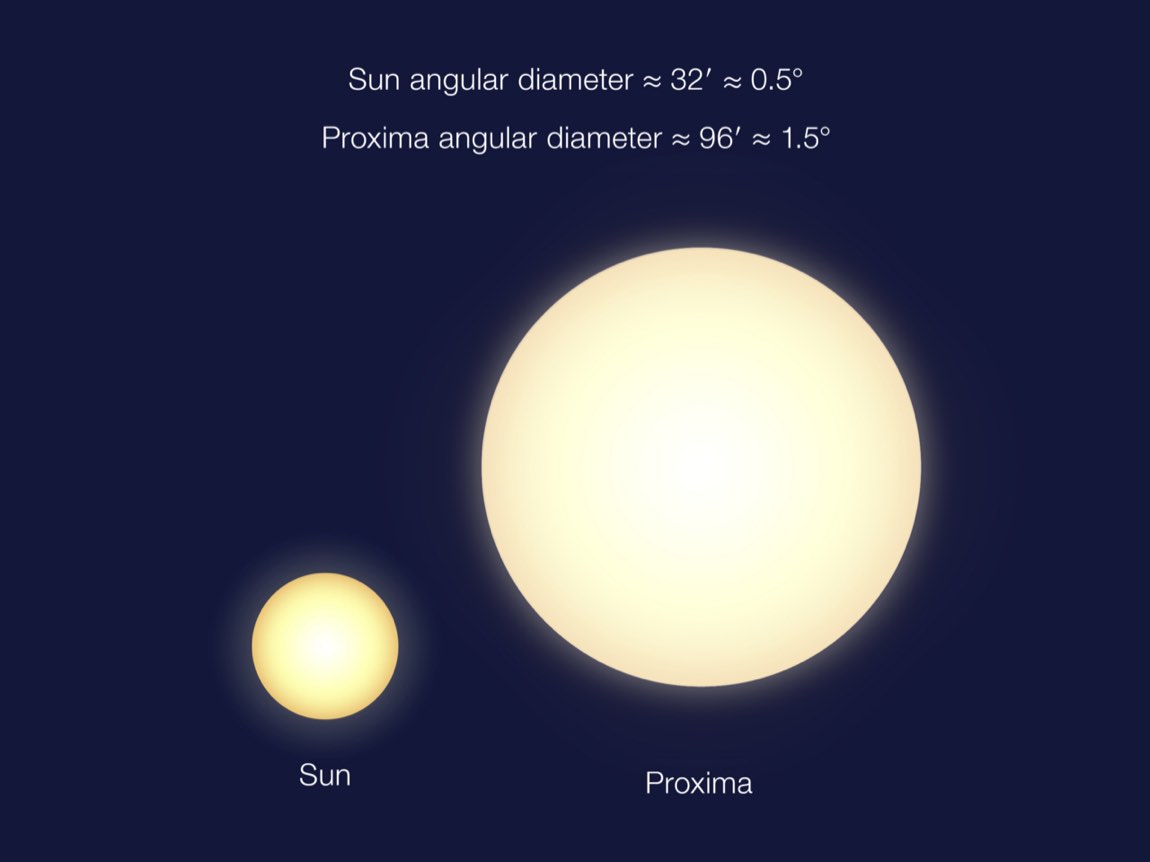
Proxima Centauri is a red dwarf of spectral type M5.5V, meaning it is far smaller, cooler, and dimmer than our Sun. Its mass is only 12.2 percent of the Sun's, its radius just 15.4 percent, and its effective temperature a relatively cool 3,050 ± 100 Kelvin — roughly half the Sun's surface temperature. It radiates only 0.005 percent of the Sun's visible light, which is why it is invisible to the naked eye despite being the closest star to Earth. Its average total luminosity is about 0.155 ± 0.006 times that of the Sun, but that average conceals dramatic swings: Proxima is a flare star whose brightness can jump by a factor of 100 within just a few hours during superflares — moments violent enough that it might briefly become visible without a telescope. Its magnetic field is also far stronger than the Sun's, measured at 600 ± 150 Gauss, and it cycles through a seven-year-long activity period, compared with the Sun's roughly eleven-year cycle.
04 How the planet likely formed and migrated Deeper
Proxima Centauri b probably did not form where we find it today. At its current distance of roughly 0.048 AU from the star — over 20 times closer than Earth is to the Sun — the protoplanetary disk would not have contained enough raw material to build a planet. The most plausible scenario is that either the planet itself or the planetesimals that eventually merged into it formed at larger distances from the star and then drifted inward through gravitational interactions with the disk or with other forming planets. The specific outcome of migration depends heavily on what other planets existed in the system at the time and what materials were available. If the planet originated far from the star, it may have incorporated significant quantities of volatile compounds including water ice. If it formed closer in and migrated only a short distance, it would be drier. The age of the system adds another layer of uncertainty: Proxima Centauri is estimated at roughly 5 billion years old based on comparisons with Alpha Centauri, but some studies put it at 7 to 8 billion years, which would be consistent with Proxima having been gravitationally captured by the Alpha Centauri pair rather than born alongside them.
 ⤢
⤢
05 Tidal locking and its alternatives
Orbiting so close to its star, Proxima Centauri b is widely expected to be tidally locked, meaning the same hemisphere would permanently face the star in a 1:1 resonance — permanent noon on one side, permanent night on the other. But tidal locking is not inevitable. If the planet's orbital eccentricity exceeds about 0.06 to 0.1, gravitational dynamics could instead push it into a 3:2 spin-orbit resonance like Mercury, or even higher-order resonances such as 2:1. Interactions with additional planets in the system, or even long-range influences from Alpha Centauri A and B, could excite just such an eccentricity. There is also a subtler possibility: if the planet is triaxial rather than perfectly symmetrical, it could be captured into a non-locked rotation even at low eccentricity. The trade-off is significant — a non-locked planet would experience tidal heating in its mantle, potentially driving intense volcanism and possibly shutting down the internal dynamo that generates a protective magnetic field. It might also experience ocean tides far more extreme than anything on Earth.
06 Radiation: the planet's greatest threat
Even if Proxima Centauri b sits inside the classical habitable zone in terms of temperature, the radiation environment it endures is brutal. The planet receives roughly 10 to 60 times more ultraviolet radiation and X-rays than Earth does from the Sun, and over its history it may have absorbed 7 to 16 times the cumulative extreme-ultraviolet dose that Earth has received across its lifetime. High-energy radiation splits water molecules into hydrogen and oxygen; the lightweight hydrogen heats up until it moves fast enough to escape the planet's gravity, dragging other gases such as oxygen and nitrogen with it. Stellar winds compound the problem: the wind pressure at Proxima Centauri b's distance may be roughly ten thousand times greater than the pressure of the Sun's wind at Earth, and the wind density could be 10 to 1,000 times higher than what Earth experiences, depending on where Proxima sits in its seven-year magnetic cycle. During the star's pre-main-sequence phase — which may have lasted up to 180 million years — the habitable zone was farther out, meaning the young planet may have endured a runaway greenhouse effect similar to the one that turned Venus into an inferno.
 ⤢
⤢
07 Could a new atmosphere rebuild itself? Deeper
Even if Proxima Centauri b lost its original atmosphere to stellar bombardment, that is not necessarily the end of the story. Volcanic outgassing from the planet's interior could gradually rebuild an atmosphere over geological timescales, and such a second-generation atmosphere would likely be rich in carbon dioxide rather than nitrogen, making it somewhat more resistant to atmospheric collapse, particularly if liquid oceans are present to regulate carbon dioxide through the carbonate-silicate cycle. An atmosphere dominated by carbon dioxide is also less prone to freezing out entirely on the night side if the planet is tidally locked, though carbon dioxide glaciers could still form and then recycle the gas. Comets arriving from the outer parts of the Proxima system — or from further afield — could also deliver fresh water to the surface, partially compensating for losses. If the planet ended up with a subsurface ocean beneath an ice shell less than a kilometre thick, the article notes that cryovolcanic activity could occur at rates comparable to volcanism on Jupiter's moon Io, generating a thin exosphere similar to that of Europa.
08 What star-planet magnetic interaction reveals Deeper
In May 2026, a study examining Proxima Centauri found what researchers interpreted as evidence of star-planet magnetic interaction associated with both Proxima Centauri d and Proxima Centauri b. This type of interaction occurs when a planet's own magnetic field connects with the magnetic field of its host star, creating detectable signals in the star's emissions. The implication is that both planets likely possess magnetic fields of their own. A planetary magnetic field is considered one of the key conditions for long-term atmospheric retention, because it deflects the charged particles in stellar winds that would otherwise erode the atmosphere over millions of years. The detection is not definitive proof, but it offers the most direct observational hint yet that Proxima Centauri b might have at least partial protection against the hostile radiation environment it inhabits. A similar star-planet magnetic interaction had previously been observed at YZ Ceti b, establishing the phenomenon as a recognized if rare observational signature.
09 The strange sky seen from the surface
Standing on Proxima Centauri b — if its surface is solid and accessible — the sky would be deeply alien. Proxima Centauri itself would hang in roughly the same region of the sky at all times on the tidally locked hemisphere, glowing a deep red, and flare events would turn that dim ember into a sudden, brilliant blaze. Looking outward, the two bright stars of the Alpha Centauri binary would be individually visible and dazzling: Alpha Centauri A would shine at an apparent magnitude of −6.8 and Alpha Centauri B at −5.2, each far brighter than Venus ever appears from Earth. The Sun, meanwhile, would appear as a moderately bright but unremarkable star at an apparent magnitude of 0.40, sitting in the constellation Cassiopeia as seen from Proxima's position in space. Its brightness would be comparable to that of Achernar or Procyon in our own night sky — impressive but easily overlooked among the stars.
10 Searching for signals and planning probes
Proxima Centauri b has never been directly imaged. Its angular separation from its host star is too small for current instruments to resolve, and statistical analysis of transit surveys suggests it is unlikely to pass in front of Proxima Centauri as seen from Earth — none of the surveys conducted so far have found any transit signal. The star is monitored by the Breakthrough Listen project, which searches for technology-related radio emissions. In April and May 2019, the project detected a signal dubbed BLC1, which briefly generated excitement, but subsequent analysis indicated it was probably of human origin, likely terrestrial radio interference. Future observatories including the James Webb Space Telescope and the Nancy Grace Roman Space Telescope may be able to observe the planet directly, though separating its faint light from the star's glare will remain technically demanding. The Breakthrough Starshot initiative has proposed developing laser-driven light sails capable of reaching 20 percent of the speed of light, which would allow a probe to reach the Proxima system in a human lifetime — though deceleration upon arrival and damage from interstellar dust remain unsolved problems.
11 Open questions that define the frontier Deeper
Proxima Centauri b is arguably the most famous exoplanet in the world, yet as of the mid-2020s astronomers still do not know its true mass, its radius, whether it has an atmosphere, whether liquid water exists anywhere on or beneath its surface, or even whether it is tidally locked. The orbital eccentricity remains unclear as of 2021. The planet's age is uncertain within a range spanning billions of years: estimates based on Alpha Centauri give about 5 billion years, while some studies suggest 7 to 8 billion years — a difference that would substantially change how much radiation bombardment the planet has endured and how its interior has evolved. The chemical ratios of iron, silicon, and magnesium in Proxima Centauri's spectrum offer a potential window into the planet's bulk composition, since those ratios are expected to roughly reflect the proportions in any planetary bodies in the system; observations so far find Solar System-like values, but composition models still yield a wide range of scenarios, from a Mercury-like iron-rich world to a water-wrapped ocean planet.
About this record
The measured values come from the NASA Exoplanet Archive, and any missing value has not been determined yet; the Atlas never fills gaps with guesses. More standout worlds: Proxima b, TRAPPIST-1e, K2-18 b, 55 Cancri e, and the detection methods that found them all.