Confirmed exoplanet · Database record + computed analysis
Kepler-62 f
A confirmed world orbiting Kepler-62, 981.3 light-years away.
A super-Earth
1.41 Earth radii. Worlds between Earth and Neptune in size are the most common in the galaxy, yet our Solar System has none, which is why each one matters. With 35.0 Earth masses packed into that size, its density points to rock and iron rather than gas.
The orbit
Its year takes 267 Earth days (0.7 Earth years).
Temperature and starlight
Its equilibrium temperature (the airless-world estimate) is about -65 °C. It receives 0.50 times Earth's starlight, the same order as our own world.
Its sun
Its star is an orange K-type (4,925 K), K2 V: cooler and longer-lived than the Sun, a class some astronomers consider ideal for habitability. It shares the system with 4 other known planets.
How far is that, really?
At 981 light-years, tonight's light from this system left it around the year 1044. A Voyager-speed probe would need roughly 17,362,090 years to get there.
How we found it
It was found by the transit method: the planet crosses its star's face on schedule, dimming it by a tiny, repeating fraction. The dip's depth gives the planet's size. The discovery was announced in 2013 from Kepler.
Everything above is computed from the archive’s measured values for this planet. Where a quantity is missing, the statement is omitted rather than guessed.
The deep dive
Researched for the Atlas from Wikipedia — Kepler-62f (8,915 characters read) · updated Sep 20, 2026
01 How a Software Bug Almost Hid This World
The discovery of Kepler-62f is partly a story of human persistence overcoming a machine's failure. NASA's Kepler spacecraft monitored 150,000 stars between 13 May 2009 and 17 March 2012, hunting for the tiny, repeated dips in starlight that betray a planet crossing in front of its sun. The automated software pipeline found three planets around Kepler-62 initially — but a bug in the code caused it to miss Kepler-62f entirely. It was Eric Agol, a Professor of Astronomy at the University of Washington, who spotted three transits that the pipeline had overlooked, each separated by 267 days. A more detailed follow-up analysis by the broader Kepler team confirmed that a fourth planetary body was responsible for those periodic dips. The discovery was formally announced on April 18, 2013, alongside findings about the Kepler-69 planetary system. Without Agol's manual review, this candidate habitable-zone world might have remained hidden in the data for years longer.
02 The Orange Dwarf Sun Kepler-62 Calls Home
Kepler-62f orbits a K-type, or orange dwarf, star — a class cooler and less massive than our own Sun. Kepler-62 has a mass of just 0.69 solar masses and a radius of 0.64 solar radii, with a surface temperature of 4,925 K compared to the Sun's 5,778 K. Its luminosity is only 21% that of the Sun, meaning it sheds far less light and heat across its planetary system. The star is also notably metal-poor, with a metallicity of −0.37 on the standard logarithmic scale, corresponding to roughly 42% of the solar iron abundance — suggesting it formed from an earlier, less chemically enriched generation of interstellar gas. At an estimated age of 7 billion years, it is already older than the Sun's current 4.6 billion years. Orange dwarf stars like Kepler-62 are expected to live for approximately 20 to 40 billion years, two to four times longer than the Sun's projected lifespan, giving any life that might arise around them an extraordinarily long window of opportunity.
03 An Orbit Closer to Venus Than Earth
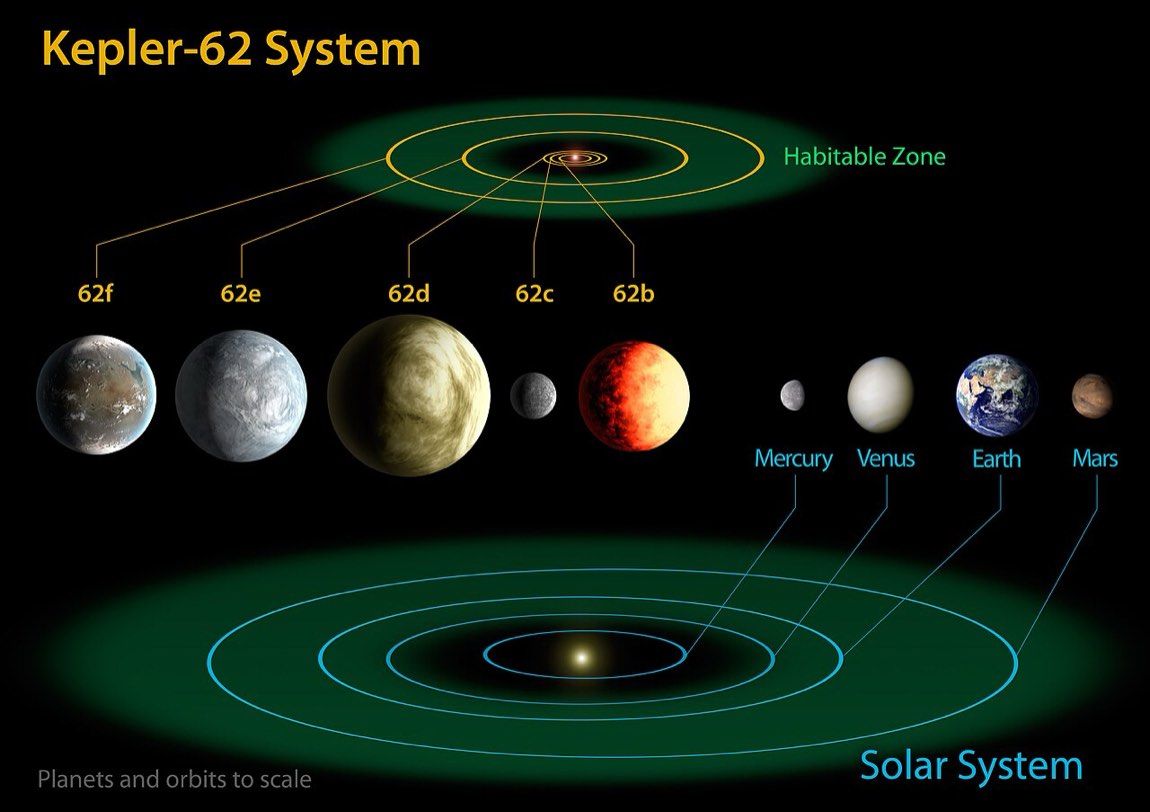
Despite sitting in its star's habitable zone, Kepler-62f follows an orbit that, in raw distance, more closely resembles Venus's path around the Sun than Earth's. Its semi-major axis is 0.718 AU — about 107,400,000 kilometers — compared to Earth's 1.0 AU and Venus's roughly 0.72 AU. Yet because Kepler-62 is a much dimmer star than the Sun, that closer distance still places the planet in the cool outer reaches of the habitable zone. A year on Kepler-62f lasts 267.29 days, about 73% of an Earth year. The planet receives only about 41% of the sunlight Earth gets from the Sun, a figure strikingly similar to Mars, which receives 43%. In practical terms, even at that relatively close orbital distance, the feeble warmth from its faint host star gives Kepler-62f an equilibrium temperature of just 208 K, or −65 °C — close to the average temperature of Mars.
04 Size, Mass, and What We Still Don't Know Deeper
Kepler-62f has a measured radius of 1.46 times Earth's — a figure that carries significant interpretive weight. Planets with radii below roughly 1.6 Earth radii are thought likely to be rocky rather than mini-Neptunes wrapped in thick volatile envelopes with no solid surface, so Kepler-62f sits just under that important threshold. Its mass, however, remains entirely unconstrained by direct measurement. Current data place only a loose upper limit of less than 35 Earth masses — a wide range that spans everything from a rocky super-Earth to a small gas-dominated world. The Planetary Habitability Laboratory has estimated a mass of around 2.6 Earth masses, assuming a rocky, Earth-like silicate-iron composition. If instead the planet has the same bulk density as Earth, calculations yield a mass of either 1.41 or 2.80 Earth masses depending on the modeling approach. Pinning down the true mass would require detecting the planet's gravitational tug on its star — a radial velocity measurement beyond the reach of current instruments at its distance of 982 light-years.
05 Ocean World or Frozen Snowball?
Planetary scientists have sketched two vivid but starkly different portraits of Kepler-62f's surface. Because it lies in the outer portion of its host star's habitable zone, the planet's fate depends heavily on its atmosphere. Without a meaningful greenhouse effect, its equilibrium temperature of 208 K points toward a world entirely locked under ice — a frozen snowball rather than a living ocean. Modeling studies suggest that to sustain an Earth-like average surface temperature in the range of 284–290 K, the planet would need at least 5 bars of carbon dioxide in its atmosphere, nearly five times Earth's total atmospheric pressure of roughly 1 bar. On the other hand, research indicates that a large fraction of planets in Kepler-62f's size range are expected to be completely covered by ocean. A rocky, silicate-iron composition combined with a substantial water inventory is considered plausible given the planet's age, irradiance, and radius — but whether liquid water actually exists at the surface hinges entirely on an atmosphere that has not yet been detected or characterized.
06 UCLA's Climate Simulations Open New Doors Deeper
On 13 May 2016, researchers at the University of California, Los Angeles announced a significant modeling study that broadened the case for Kepler-62f's potential habitability. Rather than assuming a single fixed atmosphere, the team tested a wide range of scenarios. Atmospheric thickness was varied from Earth-equivalent all the way up to twelve times Earth's atmospheric mass. Carbon dioxide concentrations were explored across an enormous span — from current Earth levels up to 2,500 times that concentration. Several different possible orbital configurations were also run through the simulations. Across this broad parameter space, the team found multiple combinations that would allow the planet to maintain habitable surface conditions. Then in June 2018, further studies suggested that Kepler-62f might experience seasons and a climate broadly similar to those on Earth. Together, these results demonstrate that habitability for this world is not ruled out — but they also underscore that the conclusions rest entirely on models, since no atmospheric data have been directly gathered from a planet 982 light-years away.
 ⤢
⤢
07 Axial Tilt and the Rhythm of Seasons Deeper
One underappreciated factor in Kepler-62f's habitability story is its likely axial tilt. Because the planet sits as the outermost of five planets in its system, tidal forces from both the inner planets and the host star are thought to have had minimal effect on its spin over its 7-billion-year history. This means the planet's axial tilt has probably remained relatively stable, with estimates placing it somewhere between 14° and 30° — a range that overlaps comfortably with Earth's own 23.5°. A stable, Earth-like axial tilt matters enormously for climate: it drives the seasonal redistribution of sunlight that prevents permanent extreme cold or heat from dominating any single hemisphere. It also facilitates heat transfer from the day side to the night side, avoiding the scenario of a planet permanently half-liquid and half-frozen. A rotational period also broadly similar to Earth's is considered plausible under the same reasoning, further supporting the possibility of a dynamic, circulating atmosphere rather than a tidally locked one.
08 A Quiet Star and Its Radiation Benefits
One of the strongest arguments in Kepler-62f's favor as a habitable candidate is the temperament of its host star. K-type orange dwarfs like Kepler-62 are considered relatively quiet stars — they produce significantly less high-energy ultraviolet and X-ray radiation than younger, more active stars, and they experience fewer violent stellar flares. This creates what researchers describe as a relatively benign radiation environment for planets orbiting in the habitable zone. By contrast, many red dwarf stars — which are even smaller and cooler — are notorious for intense flare activity that could strip away planetary atmospheres or bombard surfaces with harmful radiation. Kepler-62's low stellar activity means that even without a strong planetary magnetic field, an atmosphere around Kepler-62f would face a gentler erosive environment. A 2015 review essay identified Kepler-62f, alongside Kepler-186f and Kepler-442b, as among the best candidates for potential habitability known at that time, partly on the strength of this favorable stellar environment.
09 Could Kepler-62f Host a Moon? Deeper
A study examining tidal effects on potentially habitable planets found that Kepler-62f has the potential to host a natural satellite — a moon. This is not a trivial detail. Earth's Moon plays a stabilizing role in maintaining our planet's axial tilt over geological time, and a large moon could perform a similar function for Kepler-62f, helping to prevent the wild axial swings that could otherwise destabilize its climate. The same article also notes that Kepler-62f may be the only habitable-zone candidate that would avoid losing its water through a process called desiccation by irradiation — where stellar radiation drives water molecules from a planet's upper atmosphere into space — at its current orbital position around its host star. No moon has been detected around Kepler-62f, and at a distance of 982 light-years, detection of an exomoon would be extraordinarily difficult with any telescope currently operating or planned in the near future.
10 SETI's Long Listen Into the Dark
Kepler-62f and the other planets in the Kepler-62 system have been specifically selected as targets by the Search for Extraterrestrial Intelligence, or SETI. Radio telescope programs are scanning the direction of the system for any signals that might indicate the presence of a technological civilization. The endeavor carries a built-in time lag that gives it an almost philosophical dimension: because the system lies 982 light-years away, any signal detected today would have left the planet 982 years ago — around the year 1043 CE on Earth's calendar. Conversely, any radio signal Earth has ever broadcast has traveled only a small fraction of that distance and has not yet reached the system. As of 2025, no signals of any kind have been detected from Kepler-62f or its neighbors. The Square Kilometer Array, once complete, is expected to significantly improve radio observation sensitivity over the earlier Arecibo Observatory and Green Bank Telescope, potentially opening new windows on the search.
11 Why Current Telescopes Can't Crack It Open
Despite Kepler-62f's status as one of the most discussed potentially habitable exoplanets, it sits frustratingly beyond the reach of detailed study by any existing or near-future instrument. At 982 light-years — roughly 9.3 quadrillion kilometers — it is too distant and its host star too faint (apparent magnitude 13.65, invisible to the naked eye) for current telescopes to measure the planet's mass via radial velocity or detect the chemical fingerprint of an atmosphere via transmission spectroscopy. The Kepler spacecraft that found it was designed for statistical discovery across a fixed sky patch, not for follow-up characterization. Next-generation survey telescopes like TESS and CHEOPS focus on nearby stars where characterization is more practical. The James Webb Space Telescope and future large ground-based observatories will be able to probe atmospheres of nearby exoplanets, but Kepler-62f lies far outside their effective range. The planet may remain in a category of known-but-unknowable worlds until a fundamentally new generation of technology emerges.
12 Congressional Attention After the Announcement
The public and political response to Kepler-62f's discovery was unusually swift. On 9 May 2013, less than a month after the formal announcement on April 18, two subcommittees of the U.S. House of Representatives convened a congressional hearing titled "Exoplanet Discoveries: Have We Found Other Earths?" The hearing was prompted specifically by the discoveries of Kepler-62f, its neighbor Kepler-62e, and the exoplanet Kepler-69c. Around the same time, the journal Science published a special issue devoted to describing the discoveries in technical detail. The hearing reflected broader public fascination with the question of Earth-like worlds and life beyond our solar system. It is relatively rare for a single astronomical discovery to draw congressional scrutiny so quickly, underscoring how much the announcement of a plausibly habitable super-Earth resonated beyond the scientific community and into the realm of national science policy and public imagination.
About this record
The measured values come from the NASA Exoplanet Archive, and any missing value has not been determined yet; the Atlas never fills gaps with guesses. More standout worlds: Proxima b, TRAPPIST-1e, K2-18 b, 55 Cancri e, and the detection methods that found them all.