Confirmed exoplanet · Database record + computed analysis
Kepler-452 b
A confirmed world orbiting Kepler-452, 1,799.5 light-years away.
A super-Earth
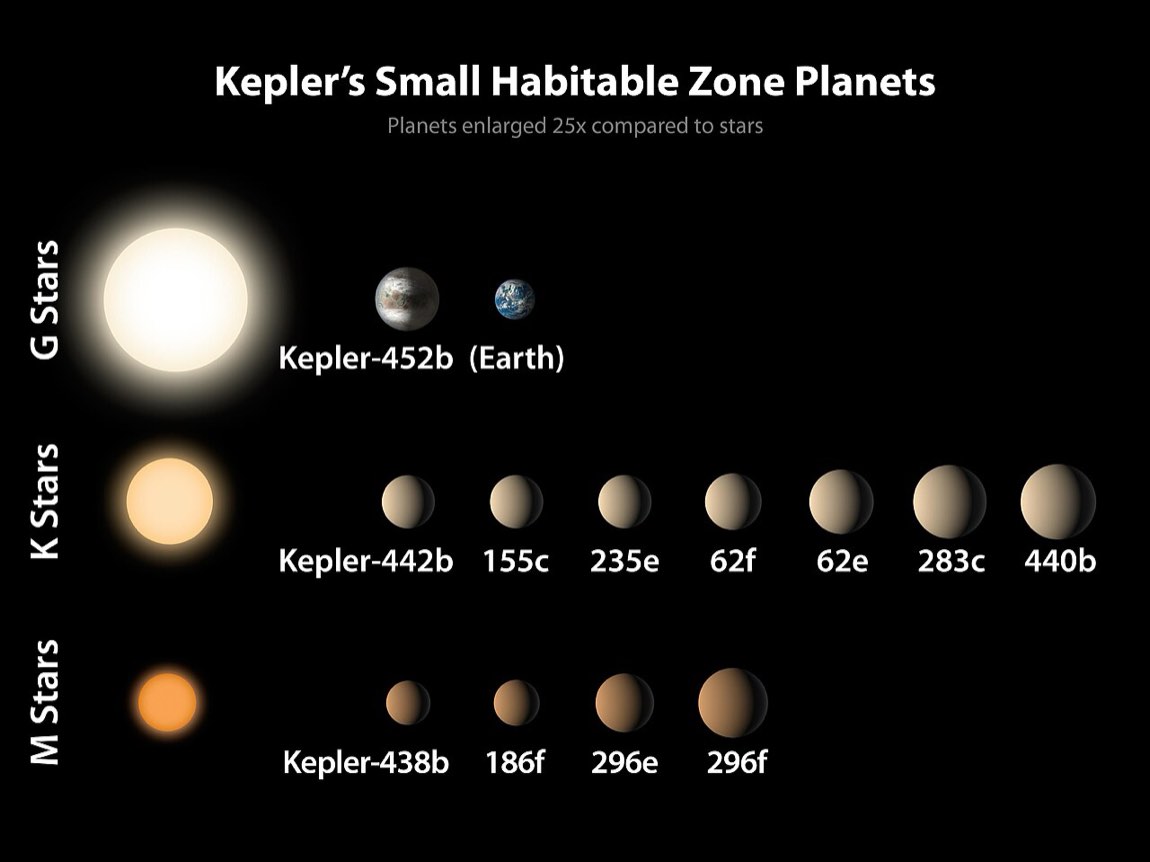
1.63 Earth radii. Worlds between Earth and Neptune in size are the most common in the galaxy, yet our Solar System has none, which is why each one matters.
The orbit
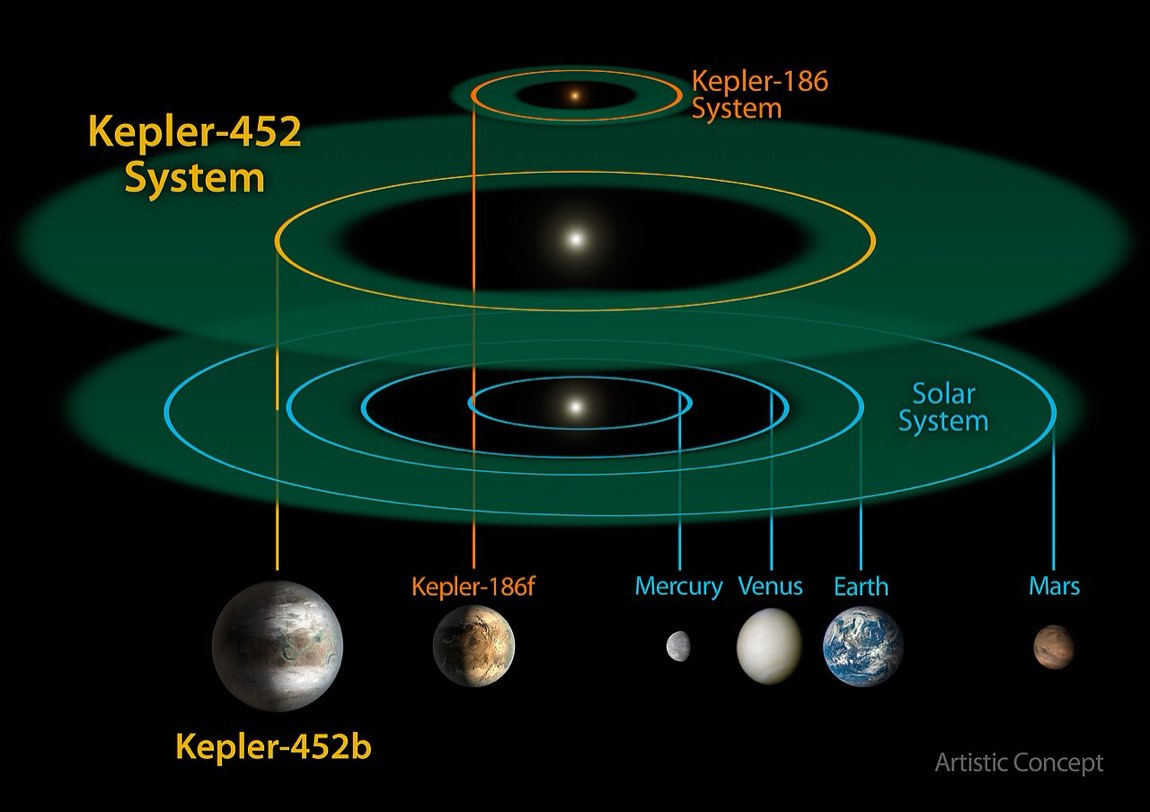
Its year takes 385 Earth days (1.1 Earth years).
Temperature and starlight
Its equilibrium temperature (the airless-world estimate) is about -8 °C. In the range where, with the right atmosphere, liquid water is conceivable; a real atmosphere could shift the true surface figure a lot (Earth's equilibrium value is −18 °C, yet we average +15 °C). It receives 1.10 times Earth's starlight, the same order as our own world.
Its sun
Its star is Sun-like (5,757 K, G2; the Sun is 5,772 K).
How far is that, really?
At 1,799 light-years, tonight's light from this system left it around the year 226. A Voyager-speed probe would need roughly 31,837,692 years to get there.
How we found it
It was found by the transit method: the planet crosses its star's face on schedule, dimming it by a tiny, repeating fraction. The dip's depth gives the planet's size. The discovery was announced in 2015 from Kepler.
Everything above is computed from the archive’s measured values for this planet. Where a quantity is missing, the statement is omitted rather than guessed.
The deep dive
Researched for the Atlas from Wikipedia — Kepler-452b (7,741 characters read) · updated Sep 20, 2026
01 A planet that may not exist — yet probably does
Kepler-452b carries an unusual asterisk in the exoplanet catalog: it is officially listed as a candidate, not a confirmed planet. A 2018 study by Mullally and colleagues argued that statistically the detection had not cleared the bar of proof, meaning a false positive — a background star or instrumental artifact mimicking a transit — could not be ruled out. The planet has never been shown to be a false positive either, so it occupies an uncomfortable middle ground. That uncertainty has not faded quietly into history. As of 2025, independent analysis estimated the probability of a false positive at less than 1%, which substantially strengthens the case for the planet's reality without formally closing the debate. Astronomers walk a careful line: the object is still called KOI-7016.01, its Kepler Object of Interest designation, precisely because the confirmation threshold has not been officially crossed. The honest answer to "does Kepler-452b exist?" is: almost certainly yes, but the community has not yet stamped it confirmed.
02 How Kepler caught the signal
The Kepler space telescope was not built to photograph planets directly. Instead its photometer watched for the tiny dimming that occurs when a planet crosses in front of its host star — a transit event. Beginning on 13 May 2009, Kepler monitored some 50,000 stars drawn from the Kepler Input Catalog, including the star now called Kepler-452. The preliminary light curves were shipped to the Kepler science team, who combed through them to flag the most promising planetary signals for follow-up by ground-based telescopes. Observations for Kepler-452b's candidate transit ran through 17 March 2012. Over that span, the signal repeated with a period of roughly 385 days — a slow, patient rhythm that required years of watching just to accumulate enough transits to be convincing. NASA announced the discovery on 23 July 2015. The long observation window needed to catch a nearly year-long orbit illustrates why Earth-analogue planets are among the hardest targets for transit surveys: they simply do not cross their stars very often.
 ⤢
⤢
03 The volcano world hypothesis Deeper
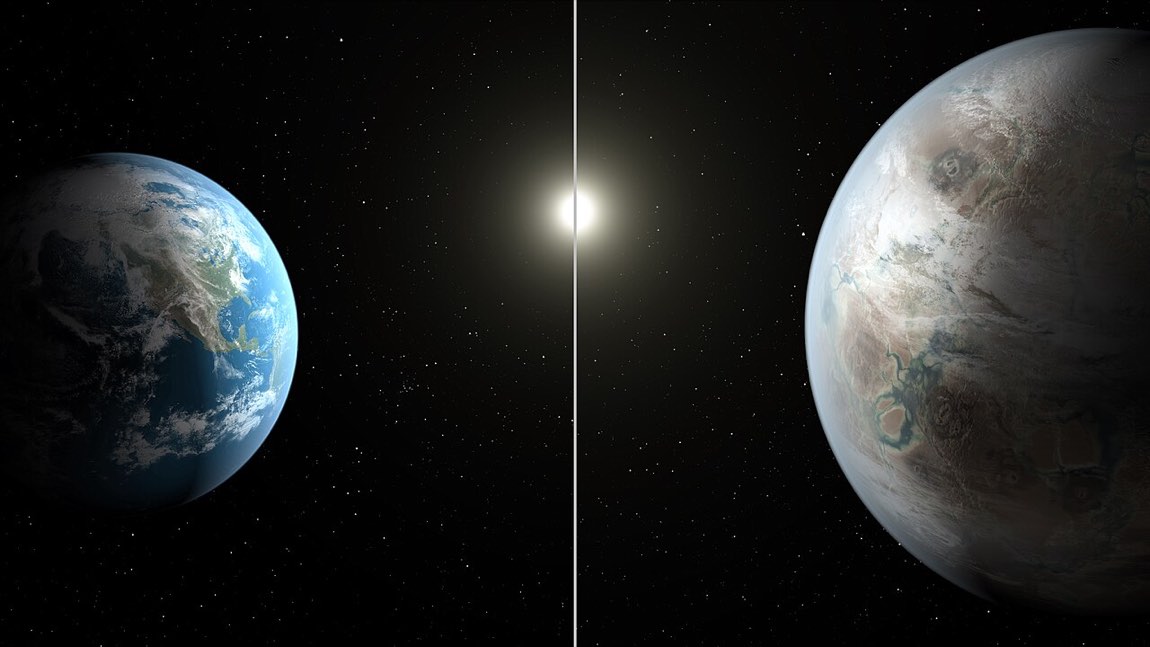
If Kepler-452b is a rocky planet — itself still disputed — its interior is expected to be dramatically more restless than Earth's. The planet's probable mass is estimated at five times Earth's, and that extra bulk translates directly into higher internal pressure and more retained radioactive heat. Scientists predict the result would be many active volcanoes, a geologically hyperactive surface quite unlike the relatively quiet continents we stand on. This elevated volcanism is not purely destructive for habitability. The carbonate-silicate cycle, which on Earth acts as a long-term thermostat by drawing carbon dioxide out of the atmosphere through weathering and returning it through volcanic outgassing, would be "buffered" and extended by the increased volcanic activity. In effect, a more volcanic Kepler-452b might sustain the very feedback loop that keeps a planet's climate stable for billions of years. The thick, misty clouds predicted to cover much of the planet from orbit could themselves be partly a product of an atmosphere churned by intense volcanic emissions interacting with any surface water.
04 500 million years before the oceans boil
One of the most striking findings tied to Kepler-452b is a countdown. The planet's star, Kepler-452, is already about 6 billion years old — roughly 1.5 billion years older than the Sun — and it is slowly brightening as all main-sequence stars do. Kepler-452b is currently receiving 10% more energy from its star than Earth receives from the Sun, pushing it toward conditions that could trigger a runaway greenhouse effect like the one that turned Venus into an inferno. However, the planet's large mass, estimated at five Earth masses, works in its favor. That mass could allow it to hold on to any oceans it possesses for longer than a lighter world would. Scientists estimate this buys an additional 500 million years before a runaway greenhouse takes hold. Looking further out, the habitable zone around the aging star will drift outward entirely, and models suggest any life on the surface could persist for 500 to 900 million more years before that boundary passes Kepler-452b's orbit.
 ⤢
⤢
05 Gravity nearly twice as strong as Earth's
With a radius about 63% larger than Earth's and a probable mass roughly five times greater, Kepler-452b would greet any visitor with surface gravity nearly double what humans experience at home. That has vivid physical consequences. A person weighing 70 kilograms on Earth would feel like they weigh around 140 kilograms, making every movement exhausting. Planetary scientists note, though, that mass estimates for exoplanets this distant are only rough calculations — the article is careful to flag that these figures are approximate. The high gravity also shapes the planet's atmosphere and geology. Gas is harder to escape into space, making it more likely that the planet retains a thick atmospheric envelope, and the crust would be compressed under greater load. Whether the surface is solid rock, deep ocean, or something stranger is unknown, because astronomers cannot yet distinguish between a rocky super-Earth and a denser, more Neptune-like body at a distance of 1,800 light-years.
06 An equilibrium temperature colder than it sounds Deeper
Kepler-452b has a calculated equilibrium temperature of 265 K, which converts to −8 °C or 17 °F — slightly warmer than Earth's equilibrium temperature but still well below the freezing point of water. Equilibrium temperature is the theoretical surface temperature a planet would have if it simply re-radiated all the energy it absorbed from its star, with no atmospheric greenhouse warming added. Earth's own equilibrium temperature is well below freezing; it is the greenhouse effect of our atmosphere that pushes average surface temperatures above 15 °C. For Kepler-452b, the equilibrium figure is therefore a floor, not the expected surface temperature. If the planet has a thick atmosphere rich in greenhouse gases — which its high volcanic activity might supply in abundance — actual surface temperatures could be dramatically higher. The uncertainty cuts both ways: a dense cloud cover could also reflect more starlight, reducing warming. Without atmospheric measurements, which current telescopes cannot obtain at this distance, the true surface temperature remains unknown.
 ⤢
⤢
07 The SETI search for signals from Cygnus
Within weeks of the July 2015 announcement, scientists at the SETI Institute pointed the Allen Telescope Array toward Kepler-452b. The array is a collection of 6-meter dishes located in the Cascade Mountains of California, purpose-built for scanning the sky for radio signals that might indicate technological civilizations. By July 2015 the array had already swept the direction of Kepler-452b across more than 2 billion frequency bands, listening for any structured radio transmission. No signal was found. The search was not finished, however: the plan called for scanning a total of 9 billion channels in all. The choice to prioritize Kepler-452b reflected its status as the first near-Earth-size world identified in the habitable zone of a convincingly Sun-like star — a combination that made it a natural early target. The silence so far carries no strong conclusion; 9 billion channels is a large number, but the space of possible signal types and frequencies is vastly larger.
08 Why the host star's age matters so much Deeper
Kepler-452 is estimated to be about 6 billion years old, compared to the Sun's estimated 4.6 billion years. That extra 1.5 billion years of stellar evolution is scientifically significant in several ways. On Earth, complex multicellular life took roughly 3 to 4 billion years to emerge from single-celled ancestors, meaning Kepler-452b has had more than enough time, in principle, for biology to move through multiple major transitions if it ever started. The planet has spent most of its existence — a duration described as just over 6 billion years — inside Kepler-452's habitable zone, giving any life a prolonged opportunity to develop. The flip side is that the star's greater age also means it has already brightened more than the Sun has, which is why Kepler-452b now absorbs 10% more stellar energy than Earth does and is inching toward potentially hostile conditions. The planet's history illustrates a pattern familiar from Earth: habitability is not a fixed property but a window in time, and for Kepler-452b that window is in its later stages.
09 Why we cannot measure its mass directly
For most nearby exoplanets, astronomers confirm a transit detection and then pin down the planet's mass using the radial-velocity method — tracking the tiny wobble a planet induces in its host star's light as the two bodies orbit their common center of gravity. At 1,800 light-years, Kepler-452 is simply too faint and too distant for current spectrographs to measure that wobble accurately. The star has an apparent magnitude of 13.426, far too dim for the naked eye and at the limit of what high-precision instruments can analyze. As a result, the mass figures quoted for Kepler-452b — at least three times Earth's mass in some estimates, and a probable five times Earth's mass in others — come from statistical models and planetary structure theory rather than direct measurement. Future large ground-based telescopes and space observatories like the James Webb Space Telescope are expected to push follow-up studies, but those instruments will first focus on closer exoplanets where the signal-to-noise ratio is more favorable. Kepler-452b may wait a long time for a precise mass measurement.
10 What next-generation telescopes might reveal
Kepler stared at a single fixed patch of sky, which is why it could accumulate years of transit observations on stars like Kepler-452. Its successors work differently. TESS, the Transiting Exoplanet Survey Satellite, and CHEOPS survey stars spread across the whole sky, targeting a wide variety of stellar types at much closer distances. The trade-off is that they favor planets with short orbital periods, making a near-365-day orbit like Kepler-452b's harder to catch. The James Webb Space Telescope and future large ground-based observatories are designed to analyze the atmospheres of exoplanets through transmission spectroscopy — measuring which wavelengths of starlight are filtered by a planet's atmosphere during transit. For Kepler-452b, at 1,800 light-years, these techniques remain out of reach with current and near-future instruments. The article notes explicitly that neither the current generation of telescopes nor the next planned generation can determine the planet's true mass or whether it has an atmosphere, leaving its fundamental nature unresolved for the foreseeable future.
11 A sky that looks like ours, almost
One quietly remarkable detail about Kepler-452b is what its sky would look like. From the planet's surface, the host star Kepler-452 would appear almost identical to the Sun as seen from Earth. The star's surface temperature is 5,757 K compared to the Sun's 5,778 K — a difference of only 21 K, well within the range that human eyes could not distinguish in terms of color. The star is 11% larger in physical size and 3.7% more massive than the Sun, but viewed from a nearly identical orbital distance of 1.04 AU, it would subtend almost the same angle across the sky. The light falling on any surface or ocean would be the same warm yellow-white that illuminates Earth's landscapes. This visual near-identity with our own solar experience is part of what drove the informal labels Earth 2.0 and Earth's Cousin that circulated when the planet was announced — though those names should be understood as descriptions of orbital and stellar similarity, not confirmed surface conditions.
About this record
The measured values come from the NASA Exoplanet Archive, and any missing value has not been determined yet; the Atlas never fills gaps with guesses. More standout worlds: Proxima b, TRAPPIST-1e, K2-18 b, 55 Cancri e, and the detection methods that found them all.