Confirmed exoplanet · Database record + computed analysis
Kepler-442 b
A confirmed world orbiting Kepler-442, 1,193.6 light-years away.
A super-Earth
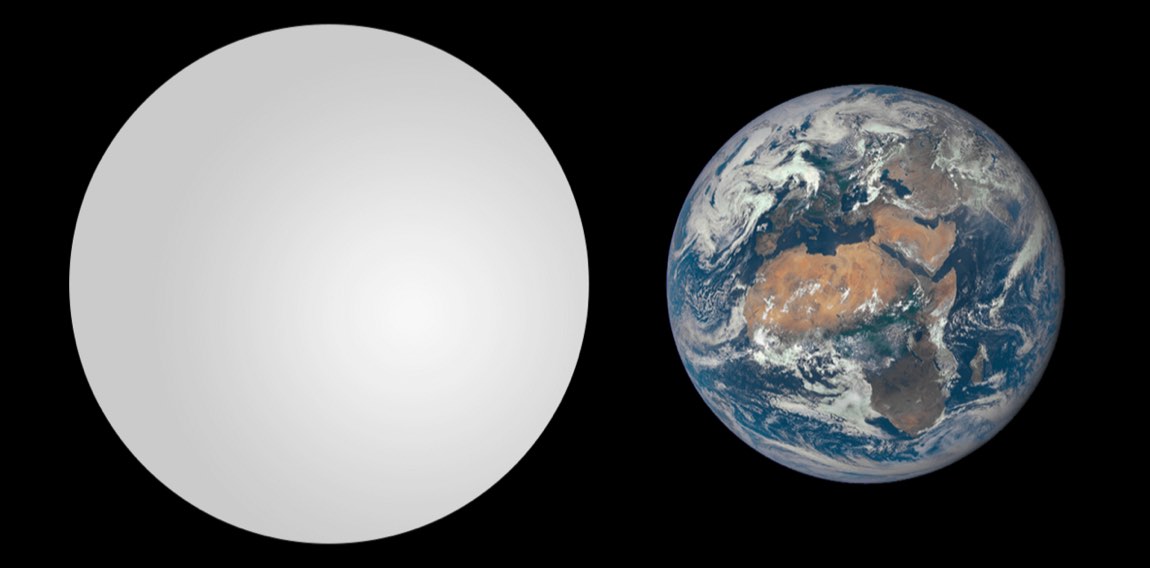
1.34 Earth radii. Worlds between Earth and Neptune in size are the most common in the galaxy, yet our Solar System has none, which is why each one matters. With 2.4 Earth masses packed into that size, its density points to rock and iron rather than gas.
The orbit
Its year takes 112 Earth days (0.3 Earth years).
Temperature and starlight
Its equilibrium temperature (the airless-world estimate) is about -32 °C. In the range where, with the right atmosphere, liquid water is conceivable; a real atmosphere could shift the true surface figure a lot (Earth's equilibrium value is −18 °C, yet we average +15 °C). It receives 0.66 times Earth's starlight, the same order as our own world.
Its sun
Its star is an orange K-type (4,402 K): cooler and longer-lived than the Sun, a class some astronomers consider ideal for habitability.
How far is that, really?
At 1,194 light-years, tonight's light from this system left it around the year 832. A Voyager-speed probe would need roughly 21,118,200 years to get there.
How we found it
It was found by the transit method: the planet crosses its star's face on schedule, dimming it by a tiny, repeating fraction. The dip's depth gives the planet's size. The discovery was announced in 2015 from Kepler.
Everything above is computed from the archive’s measured values for this planet. Where a quantity is missing, the statement is omitted rather than guessed.
The deep dive
Researched for the Atlas from Wikipedia — Kepler-442b (6,751 characters read) · updated Sep 20, 2026
01 A World on the Rocky-Gas Border
Kepler-442b sits in an uncomfortable scientific gray zone. With a radius of 1.34 times Earth's and an estimated mass of 2.36 Earth masses, it qualifies as a super-Earth — larger than our planet but smaller than ice giants like Uranus and Neptune. The trouble is that this size range is exactly where planetary scientists struggle to tell rock from gas. Astronomer Ethan Siegel has noted that these numbers put Kepler-442b "right on the border" between a genuinely rocky world and a mini-Neptune, a planet with a thick hydrogen-rich envelope surrounding a denser core. If it is rocky, its surface gravity would be about 30% stronger than Earth's — enough to make a 68-kilogram person feel like they weigh roughly 88 kilograms. If it turns out to be a mini-Neptune, any notion of a solid surface, and with it most habitability scenarios, largely dissolves. Without a measured atmosphere or a more precise mass, scientists cannot yet resolve this fundamental question about the planet's basic nature.
02 The Cool, Long-Lived Star It Orbits
Kepler-442 is a K-type main-sequence star, a class smaller, cooler, and dimmer than our Sun. Its mass is only 0.61 solar masses, its radius 0.60 solar radii, and its surface temperature 4,402 K — compared to the Sun's 5,778 K. That cooler temperature gives it an orange hue rather than the Sun's yellow-white. The star's luminosity is just 12% of the Sun's, which is why Kepler-442b can sit at only about 0.409 AU and still receive a survivable amount of energy. One striking property is the star's longevity: K-type stars remain on the main sequence for 18 to 34 billion years, nearly twice to more than three times the Sun's estimated 10-billion-year lifespan. Kepler-442 itself is estimated to be about 2.9 billion years old, though with some uncertainty. That still leaves the system potentially billions of years of stable stellar output ahead — a significant asset for any life that might be trying to gain a foothold. At an apparent magnitude of 14.76, the star is far too faint to see without a telescope.
03 Why the Planet Receives 70% of Earth's Sunlight
Despite sitting much closer to its star than Earth does to the Sun — about 0.409 AU versus Earth's 1 AU — Kepler-442b receives only around 70% of the stellar flux that Earth gets from the Sun. The reason is straightforward: Kepler-442 is dramatically fainter, radiating just 12% of the Sun's luminosity. So even though the planet is physically nearer to its star, the star simply puts out far less energy. The result is an equilibrium temperature of 233 K, which is −40 °C or −40 °F — roughly the temperature of Antarctica's interior in winter, or comparable to the surface of Mars on a relatively warm day. This equilibrium temperature is calculated assuming the planet radiates energy like a simple blackbody, without any greenhouse warming factored in. If Kepler-442b has a substantial atmosphere with greenhouse gases, its actual surface temperature could be considerably warmer — potentially nudging it into a range comfortable for liquid water. That uncertainty is one of the key unknowns driving scientific interest in the planet.
04 Inside the Habitable Zone — But Just Barely Untidally Locked Deeper
Kepler-442b occupies a particularly prized position within its star's habitable zone, the range of orbital distances where liquid water could theoretically persist on a planetary surface. What makes its location especially notable is the tidal locking boundary. The critical orbital distance at which tidal forces from Kepler-442 would be strong enough to fully lock the planet's rotation to its orbit — forcing one hemisphere to face the star perpetually — is approximately 0.362 AU. Kepler-442b orbits at about 0.409 AU, safely outside that threshold. This distinction matters enormously for habitability: a tidally locked planet faces extreme temperature contrasts between its permanent day and night sides, potentially driving violent atmospheric dynamics or freezing atmospheric gases on the cold side. As of July 2018, this combination of being inside the habitable zone yet free from tidal locking made Kepler-442b the most habitable non-tidally-locked exoplanet known. Its orbital eccentricity is also estimated to be very low, around 0.04, meaning its distance from the star barely changes across one orbit and the planet avoids the dramatic seasonal swings driven by orbital shape that Mars experiences.
05 Slow Days, No Seasons: Tidal Effects on Daily Life Deeper
Even though Kepler-442b is not fully tidally locked, its proximity to its star means tidal friction has almost certainly slowed its rotation dramatically compared to Earth's 24-hour day. Scientists expect the planet's day could be weeks or even months long. A leisurely rotation of this kind would have profound consequences for weather and climate: the slow-moving terminator between day and night would allow one hemisphere to accumulate enormous heat while the other radiates it away. Atmospheric circulation patterns would bear little resemblance to Earth's familiar jet streams and trade winds. Adding to the lack of dynamic seasons, the planet's axial tilt — its obliquity — is thought to be very small. On Earth, a 23.5-degree tilt is responsible for the four seasons; on Mars, a similar tilt produces seasonal changes visible even from Earth. If Kepler-442b's axis is nearly perpendicular to its orbital plane, tilt-driven seasons essentially vanish. Combined with its near-circular orbit and therefore no eccentricity-induced seasonal cycle either, the planet would experience an extremely stable, if extreme, climate regime year-round — a double-edged characteristic for habitability.
 ⤢
⤢
06 A Star's Stormy Youth and What It Means Deeper
K-type stars like Kepler-442 are not uniformly gentle hosts. Early in their lives, smaller stars including K-types and the even smaller M-types are intensely active, unleashing powerful stellar winds that can strip away planetary atmospheres. The duration of this hostile phase is inversely linked to stellar size — smaller stars tend to remain in this turbulent period longer, which is one reason M-dwarf planets face such threats. The article notes that because of uncertainty about Kepler-442's age, estimated at roughly 2.9 billion years, it is plausible the star has already moved past this most aggressive phase. If that is the case, any atmosphere Kepler-442b managed to hold onto during the star's youth could have survived and potentially stabilized. This remains speculative, since neither the star's age nor the planet's atmospheric status is precisely known. It represents one of the central uncertainties scientists weigh when evaluating the planet's potential for habitability — history matters as much as present conditions when asking whether a world could support life.
07 A Habitability Score That Outranks Earth
In 2015, researchers introduced a habitability index that attempts to quantify, on a single numerical scale, how suitable a planet might be for life as we know it. Applied to Kepler-442b, the index returned a score of 0.836 — notably higher than Earth's own score of 0.829 on the same scale. At first glance this sounds remarkable, but the authors of the paper were careful to clarify that a higher-than-Earth value does not mean these planets are "more habitable" than Earth. The index captures factors like stellar flux and planet size in relation to what models suggest is optimal, not actual confirmed conditions. A 2015 review essay separately ranked Kepler-442b alongside Kepler-186f and Kepler-62f as among the best candidates for potentially habitable planets discovered at that time. Despite these encouraging rankings, the authors themselves acknowledged that Kepler-442b's atmosphere and surface conditions remain entirely unknown, and those unknowns carry enormous weight in any realistic assessment of whether the planet could actually host life.
08 How Kepler Found It: The Transit Method
Kepler-442b was discovered by NASA's Kepler spacecraft, which hunted for planets by measuring tiny, repeated dips in a star's brightness as an orbiting planet passed in front of it — a technique called the transit method. NASA's Kepler began observing in 2009, and during an early test phase the spacecraft monitored 50,000 stars from the Kepler Input Catalog, including Kepler-442. The raw light curves were sent back to the science team, who sifted through them for promising transit signatures. Observations specifically relevant to Kepler-442b spanned from 13 May 2009 to 17 March 2012. During that window, scientists tracked transits repeating roughly every 113 days — matching what would become the planet's confirmed orbital period. After ruling out other explanations for the dimming signal, the team concluded a planetary body was responsible. The formal announcement of Kepler-442b's confirmation came on 6 January 2015, packaged alongside discoveries associated with the stars Kepler-438 and Kepler-440. The planet also carries the Kepler Object of Interest designation KOI-4742.01, its working label before confirmation.
09 The Distance Problem: Why It's So Hard to Study
At approximately 1,196 light-years — or about 370 parsecs — Kepler-442b is far beyond the reach of detailed characterization with current telescopes. The Kepler spacecraft itself was designed to detect planets through brightness dips, not to probe their atmospheres or determine their masses with precision. At such a distance, even forthcoming instruments face serious challenges. The article notes that planned planet-hunting missions like TESS and CHEOPS are expected to survey stars across the entire sky, which could help build context around distant systems like Kepler-442. But for measuring an atmosphere or determining a precise mass, heavier artillery is needed. The James Webb Space Telescope and future large ground-based observatories are identified as the tools most likely to make progress on nearby planetary atmospheres, and what is learned there could eventually be applied to understanding more distant worlds by analogy. The Square Kilometer Array, a next-generation radio telescope network, is also flagged as a significant improvement over predecessors like the Arecibo Observatory and Green Bank Telescope for radio observations relevant to such systems.
10 Where in the Sky to Point a Telescope
Kepler-442 lies in the constellation of Lyra, a small but distinctive northern constellation best known for containing Vega, one of the brightest stars in the sky and a vertex of the prominent Summer Triangle asterism. Lyra is well-placed for observation from the Northern Hemisphere during summer and early autumn evenings. However, finding Kepler-442 itself is a different matter — the star shines at an apparent magnitude of only 14.76, which places it far below the threshold of naked-eye visibility and even below what most amateur telescopes can show in useful detail. A magnitude of around 6 is the naked-eye limit under ideal conditions; magnitude 14.76 is roughly 3,600 times fainter than that threshold. Professional-grade equipment is required just to detect the star's light, let alone study the planet. Kepler's original strategy of staring at a fixed patch of sky containing Lyra and neighboring constellations was well-suited for accumulating the long baseline of observations needed to catch Kepler-442b's 112-day transits repeatedly over the three-year observation window.
11 An Iron-Poor Star in a Metal-Poor System Deeper
One underappreciated detail about the Kepler-442 system is the host star's chemical composition. Kepler-442 is described as somewhat metal-poor, with a metallicity expressed as Fe/H of −0.37, meaning it contains only about 43% of the iron abundance found in the Sun. In stellar astronomy, "metals" refers to all elements heavier than hydrogen and helium, with iron serving as a convenient proxy. A metal-poor star likely formed from a gas cloud that had undergone less chemical enrichment by previous generations of stars. This has potential implications for the planets around it: rocky planets form from the solid, rocky components of the protoplanetary disk, which in turn derive from the disk's metal content. A metal-poorer disk might yield planets with somewhat different bulk compositions compared to those in more enriched systems like our own. Whether Kepler-442b's possible rocky composition is affected by the star's lower metallicity is unknown, but it is a factor scientists would need to account for when modeling the planet's interior and surface chemistry.
About this record
The measured values come from the NASA Exoplanet Archive, and any missing value has not been determined yet; the Atlas never fills gaps with guesses. More standout worlds: Proxima b, TRAPPIST-1e, K2-18 b, 55 Cancri e, and the detection methods that found them all.