Confirmed exoplanet · Database record + computed analysis
Kepler-186 f
A confirmed world orbiting Kepler-186, 579.2 light-years away.
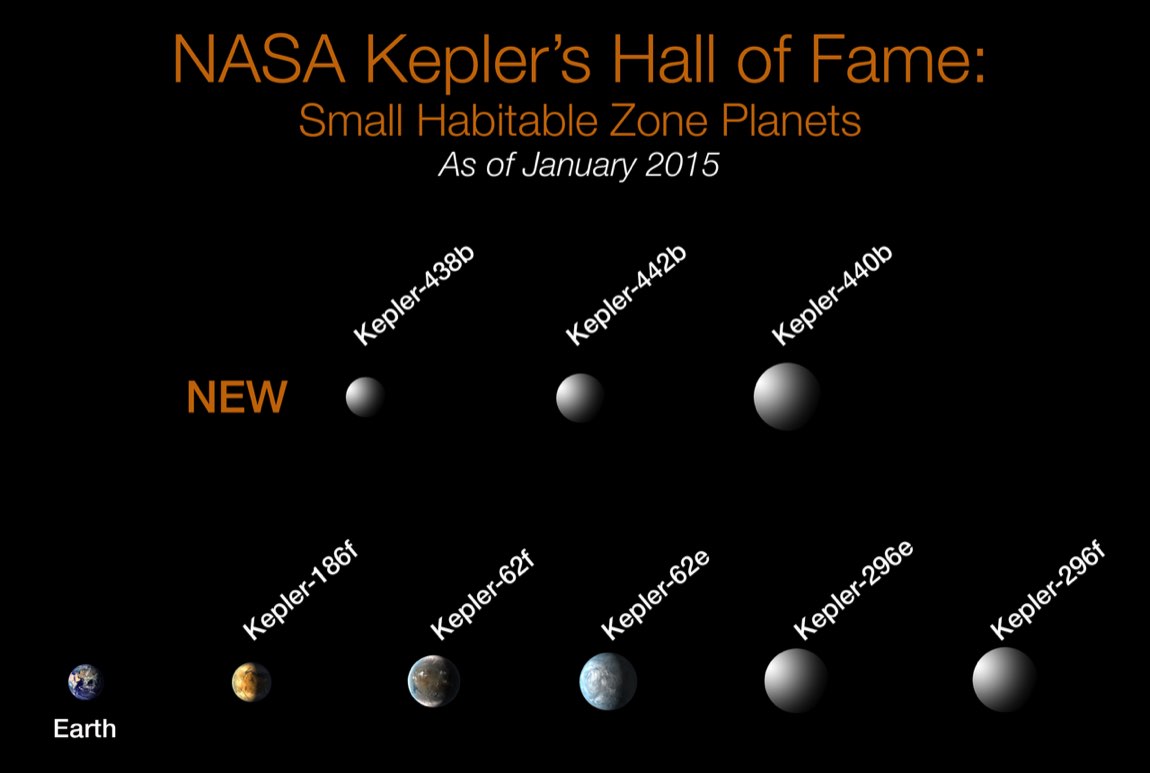
An Earth-sized world
1.17 times Earth's radius, squarely in the terrestrial size range. With 1.7 Earth masses packed into that size, its density points to rock and iron rather than gas.
The orbit
Its year takes 130 Earth days (0.4 Earth years).
Temperature and starlight
Its equilibrium temperature (the airless-world estimate) is about -96 °C. It receives 0.30 times Earth's starlight, the same order as our own world.
Its sun
Its star is a red dwarf (3,755 K surface), type M1: small, dim, flare-prone, and destined to outlive the Sun many times over. It shares the system with 4 other known planets.
How far is that, really?
At 579 light-years, tonight's light from this system left it around the year 1446. A Voyager-speed probe would need roughly 10,248,154 years to get there.
How we found it
It was found by the transit method: the planet crosses its star's face on schedule, dimming it by a tiny, repeating fraction. The dip's depth gives the planet's size. The discovery was announced in 2014 from Kepler.
Everything above is computed from the archive’s measured values for this planet. Where a quantity is missing, the statement is omitted rather than guessed.
The deep dive
Researched for the Atlas from Wikipedia — Kepler-186f (11,201 characters read) · updated Sep 20, 2026
01 How Kepler's Telescope Found This World
Detecting Kepler-186f required three full years of data from NASA's Kepler space telescope — an unusually long haul even by the mission's standards. Kepler watched for transits, the faint dimming that occurs when a planet crosses in front of its star. The dimming signal Kepler-186f produces is tiny: the ratio of the planet's disk to the star's disk was measured at just 0.021, meaning the planet blocks about 0.044 percent of the star's light. From that single ratio, scientists could calculate the planet's radius relative to Kepler-186. The discovery was first presented at a scientific conference on 19 March 2014, and the formal announcement followed on 17 April 2014, simultaneous with publication in the journal Science. Four additional planets around the same star were found in the same dataset, all orbiting far closer to Kepler-186 and each modestly larger than Earth. Kepler-186f stood out as the outermost of the five, and the one sitting inside the star's habitable zone.
02 Still a Candidate: The Confirmation Debate Deeper
Despite its fame, Kepler-186f has not been fully confirmed as a planet, and that distinction matters scientifically. Follow-up studies have indicated that it, like Kepler-452b, may still fall below the statistical threshold required for formal confirmation, keeping it technically classified as a planet candidate. The concern centers on the false positive probability — the chance that the transit signal is produced by something other than a planet, such as a background eclipsing binary star. A 2019 study estimated that false positive probability at 4%, which is borderline acceptable. A more cautious 2025 study pushed that figure up to 20%, a level most astronomers would consider too uncertain for confirmation. Until radial velocity measurements or other independent techniques can pin down the planet's mass — something current telescopes cannot do at 580 light-years — Kepler-186f remains a highly promising, but not fully verified, world.
03 Size, Volume, and What the Numbers Mean
Kepler-186f has a measured radius of 1.17 ± 0.08 times that of Earth, making it roughly 11 percent larger in radius. Because volume scales with the cube of radius, that modest size difference translates to a volume about 1.37 times Earth's — anywhere from 0.87 to 2.03 times as large depending on where within the measurement uncertainty the true value falls. The 11 percent radius difference is comparable to the difference between a standard basketball and one inflated slightly beyond regulation — noticeable, but not dramatic. Critically, the radius sits below the 1.5 Earth-radius threshold that astronomers associate with the onset of thick hydrogen and helium atmospheres, which tend to make planets less hospitable. That boundary suggests Kepler-186f could plausibly be a rocky world rather than a mini-Neptune, though the composition remains entirely unknown from current observations.
04 Mass Guesses: From Ice Balls to Iron Worlds Deeper
Because no mass measurement is possible at Kepler-186f's distance, scientists instead calculate a wide bracket of plausible masses by combining the known radius with assumed compositions. At one implausible extreme, a pure water-and-ice body of this size would have a mass of just 0.32 times Earth's mass. At the other implausible extreme, a planet made entirely of iron would weigh in at 3.77 Earth masses. The most physically reasonable scenario uses an Earth-like composition — roughly one-third iron core and two-thirds silicate rock — applied to a radius of 1.11 Earth radii, which yields a mass of about 1.44 Earth masses after accounting for the higher internal pressures that compress material more tightly than in Earth's interior. That Earth-like composition scenario produces a surface gravity about 17 percent higher than what we experience on Earth. An alternative that the article notes is an ocean planet with a lower density and thick atmosphere, which would place the mass somewhere between those extremes.
05 A Frozen Baseline: Equilibrium Temperature
Without any atmosphere to trap heat, Kepler-186f's equilibrium temperature — the temperature set purely by the balance between absorbed starlight and radiated heat — is estimated at around 188 K, which is −85 °C or −121 °F. That is colder than the equilibrium temperature of Mars, and well below the freezing point of water. This number is not a prediction of actual surface conditions; it is a baseline. Earth's own equilibrium temperature is around 255 K (−18 °C), yet the surface averages 288 K (15 °C) because of the greenhouse effect. For Kepler-186f to have liquid water on its surface, it would need an atmosphere capable of significant greenhouse warming. Climate modeling suggests that if the planet carries at least 0.5 to 5 bars of carbon dioxide — depending on how much nitrogen is also present — surface temperatures could exceed 273 K, the melting point of water ice, even from this frigid baseline.
06 The Outer Edge of the Habitable Zone
Kepler-186f orbits its star at about 0.43 AU with an orbital period of 129.9 days, completing a year in roughly four Earth months. The host star shines with only about 5 percent of the Sun's luminosity, so even at this relatively close distance the planet receives just about 32 percent of the solar energy Earth gets. The habitable zone for the Kepler-186 system is conservatively estimated to span from 0.23 to 0.46 AU — the range over which a planet would receive between 88 percent and 25 percent of Earth's illumination. At 32 percent, Kepler-186f sits inside that conservative zone but near its cold outer edge, in a position analogous to Mars in our own solar system. Mars, of course, is not currently habitable, but the analogy is orbital geometry only; the climate outcome depends strongly on atmospheric composition, which for Kepler-186f is entirely unknown.
 ⤢
⤢
07 Tidal Locking: A Coin Toss for This Planet Deeper
The four innermost planets of the Kepler-186 system are almost certainly tidally locked to their star, meaning the same hemisphere always faces the star — just as our Moon always shows the same face to Earth. Kepler-186f sits farther out, where tidal forces are weaker, and the system is about 4 billion years old. Given that combination of distance and age, the probability that Kepler-186f is tidally locked is estimated at approximately 50 percent — essentially a coin toss. Even if it is not fully locked, the planet's rotation has probably slowed considerably compared to Earth's. Its day could be weeks or months long. A slowly rotating planet with a significant atmosphere would develop very different circulation patterns than Earth, potentially with extreme temperature contrasts between the day side and night side if it is fully locked, or powerful seasonal wind patterns if it rotates slowly but not synchronously.
08 Axial Tilt, Seasons, and a Hidden Planet Deeper
Kepler-186f's axial tilt is likely very small, which would eliminate the kind of tilt-driven seasons Earth experiences through its 23.5-degree obliquity. Its orbit is probably also nearly circular, ruling out eccentricity-induced seasonal swings like those Mars experiences. The result could be a remarkably stable, uniform climate — or a relentlessly cold one, depending on atmospheric conditions. There is, however, an intriguing wildcard. Planetary formation simulations suggest that at least one additional, undetected planet likely orbits between Kepler-186f and Kepler-186e. If such a planet exists, it could gravitationally perturb Kepler-186f's axial tilt upward to around 23 degrees, producing Earth-like seasonal variation. Any such hidden planet cannot be much more massive than Earth, because a heavier body would destabilize the orbits of its neighbors. It would also have to be non-transiting — meaning its orbital plane is tilted slightly away from our line of sight — to have escaped Kepler's detection.
09 Why the Atmosphere Stays Out of Reach
One of the most fundamental questions about Kepler-186f — whether it has an atmosphere at all — cannot currently be answered. The planet is located about 580 light-years (180 parsecs) from Earth in the constellation Cygnus, and its host star has an apparent magnitude of 14.62, far too faint to see with the naked eye and requiring a substantial telescope just to detect. That combination of distance and stellar faintness places the planet beyond the reach of even the James Webb Space Telescope for atmospheric characterization. Transmission spectroscopy, the technique used to detect atmospheric gases as starlight filters through a planet's atmosphere during transit, demands a much brighter star and a much closer planet. The discovery of Kepler-186f was scientifically transformative precisely because it proved Earth-sized planets can exist in habitable zones, but the planet itself may remain atmospherically mysterious for decades until far more powerful observatories are built.
10 The Red Dwarf Host and Its Hazards
Kepler-186 is an M-type red dwarf with a mass of 0.54 solar masses and a radius of 0.52 solar radii, making it just over half the size of our Sun in both dimensions. Its surface temperature is 3,755 K — roughly two-thirds the Sun's 5,778 K — which gives it a distinctly orange-red color. The star is about 4 billion years old, some 600 million years younger than the Sun. Red dwarfs are relevant to habitability in a complicated way: they are the most common type of star in the galaxy, but they emit far stronger extreme ultraviolet radiation when young than they do in maturity. That intense early XUV flux would have bombarded Kepler-186f's primordial atmosphere through a process called hydrodynamic mass loss, potentially stripping away any original hydrogen and helium envelope. Whether a secondary atmosphere — outgassed from the planet's interior, as Earth's was — could have subsequently built up is one of the central open questions about this world.
11 Listening for Signals: The SETI Connection
Within hours of Kepler-186f's public announcement on 17 April 2014, it was already a target of the search for extraterrestrial intelligence. The Allen Telescope Array, operated by the SETI Institute, had spent roughly a month listening to the Kepler-186 system for artificial radio emissions before the announcement date. No signals attributable to extraterrestrial technology were detected. There is an important caveat: to be picked up across 580 light-years, a radio signal broadcast equally in all directions would need to be at least ten times more powerful than the transmissions from the Arecibo Observatory. A separate crowdsourced search through the SETI-Live project reviewed the Allen Array data and reported inconclusive but, by their characterization, optimistic-looking patterns in the radio noise. Regardless of outcome, any signal detected today would have left Kepler-186f roughly 580 years ago — around the time Columbus was crossing the Atlantic.
12 The Naming Trail from KIC to Kepler-186f
Every world found by the Kepler mission moves through a structured naming pipeline before receiving its familiar designation. The host star Kepler-186 began its catalogued life as KIC 8120608 in the Kepler Input Catalog, a survey database assembled before the mission launched to characterize target stars. As evidence for orbiting planets accumulated, the system graduated to Kepler Object of Interest status and was assigned the identifier KOI-571. The planet now called Kepler-186f was referenced in 2013 papers and discussions under variations such as KOI-571-05 and KOI-571.05 — the digit 05 indicating it was the fifth candidate planet signal identified in the system, corresponding to the fifth planet outward. The final designation Kepler-186f follows the convention of appending lowercase letters in order of discovery, starting with b for the innermost planet, making f the fifth and outermost known planet.
13 Open Questions and the Road Ahead Deeper
Kepler-186f sits at the intersection of what we can detect and what we cannot yet understand. Its radius is measured to useful precision, and its orbital parameters are well characterized. Everything else — mass, composition, atmospheric pressure, presence of liquid water, rotation rate, magnetic field — remains unknown or estimated only within very wide ranges. Next-generation planet-hunting missions like TESS and CHEOPS focus on nearby, brighter stars rather than the distant Kepler field, making them unlikely to contribute new data on this specific system. The Square Kilometer Array could greatly improve radio observations relative to Arecibo and the Green Bank Telescope, potentially reviving SETI searches. Future large ground-based telescopes working in concert with the James Webb Space Telescope could, in principle, begin characterizing nearby habitable-zone planets, though Kepler-186f itself remains too distant. It stands, then, as a landmark discovery that changed what astronomers knew was possible — a proof of concept for Earth-sized worlds in habitable zones — while remaining, for now, fundamentally unknowable in its details.
About this record
The measured values come from the NASA Exoplanet Archive, and any missing value has not been determined yet; the Atlas never fills gaps with guesses. More standout worlds: Proxima b, TRAPPIST-1e, K2-18 b, 55 Cancri e, and the detection methods that found them all.