Confirmed exoplanet · Database record + computed analysis
Kepler-11 b
A confirmed world orbiting Kepler-11, 2,108.1 light-years away.
A super-Earth
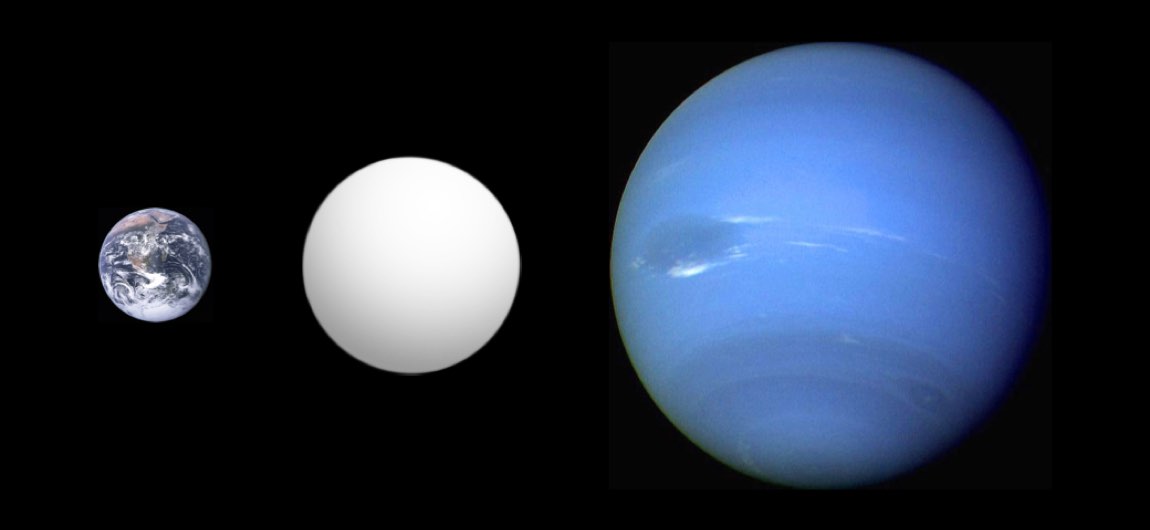
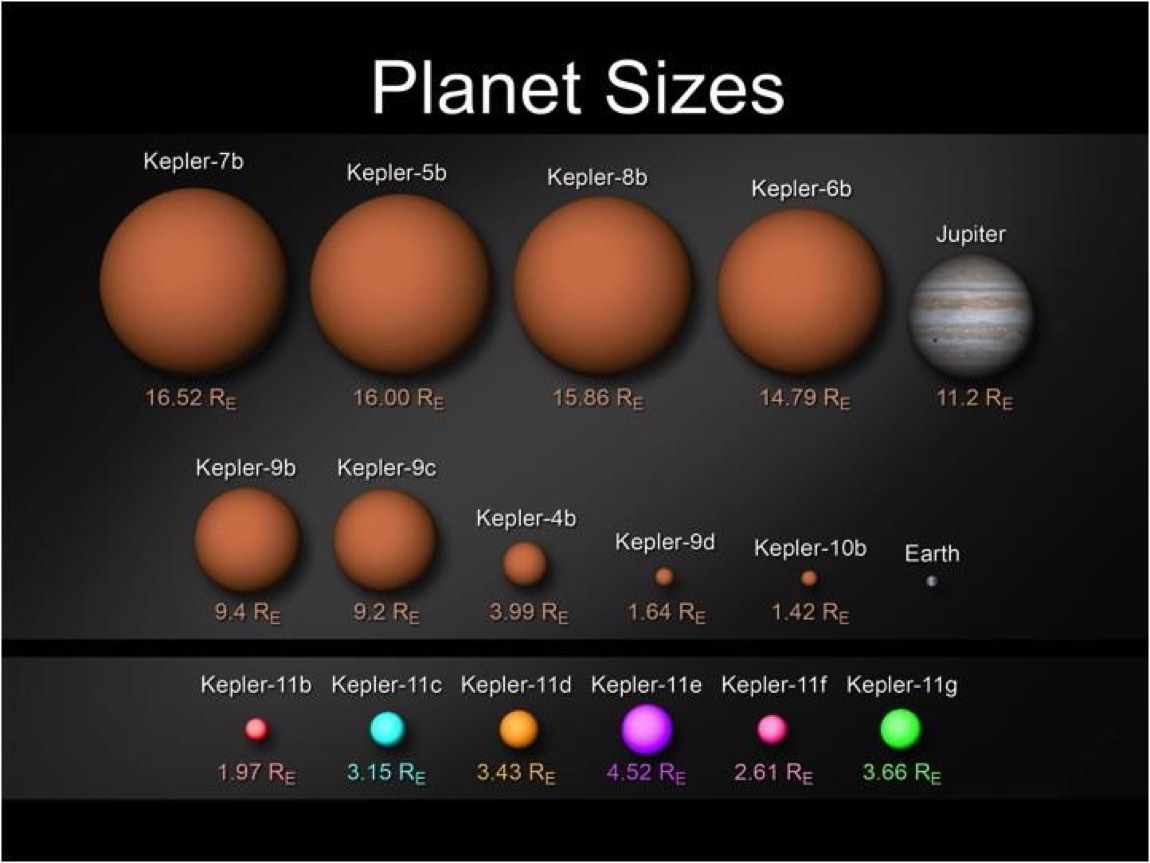
1.80 Earth radii. Worlds between Earth and Neptune in size are the most common in the galaxy, yet our Solar System has none, which is why each one matters. At only 1.9 Earth masses for that size, it must be substantially gas or volatile ices: puffy, not rocky.
The orbit
Its year, one full orbit, takes just 10.3 Earth days.
Temperature and starlight
Its equilibrium temperature (the airless-world estimate) is about 576 °C. Hotter than Venus's surface. It receives 146.4 times the starlight Earth gets.
Its sun
Its star is Sun-like (5,663 K; the Sun is 5,772 K). It shares the system with 5 other known planets.
How far is that, really?
At 2,108 light-years, tonight's light from this system left it around the year -82. A Voyager-speed probe would need roughly 37,297,731 years to get there.
How we found it
It was found by the transit method: the planet crosses its star's face on schedule, dimming it by a tiny, repeating fraction. The dip's depth gives the planet's size. The discovery was announced in 2010 from Kepler.
Everything above is computed from the archive’s measured values for this planet. Where a quantity is missing, the statement is omitted rather than guessed.
The deep dive
Researched for the Atlas from Wikipedia — Kepler-11b (5,638 characters read) · updated Sep 20, 2026
01 How Kepler-11 b Was Found and Confirmed
Kepler-11 b was detected by NASA's Kepler space telescope, which hunts for planets by watching for tiny dips in a star's brightness as a planet crosses in front of it. The host star, originally catalogued under the name KOI-157, showed several such dips, hinting at a busy planetary system. But a dip alone is not proof of a planet, so scientists enlisted ground-based telescopes spread across California, Hawaii, the Canary Islands, Arizona, and Texas, plus the orbiting Spitzer Space Telescope, to conduct follow-up observations. The clinching evidence came from a phenomenon called transit timing variations — subtle shifts in when Kepler-11 b crosses its star, caused by the gravitational tug of its neighbor Kepler-11 c. That measurable orbital resonance effect between the two planets confirmed that the signal was real. The discovery was announced to the public on February 2, 2011, simultaneously with the five other planets in the system.
02 Why the Letter 'b' Belongs to This Planet
Planetary naming conventions assign letters in order of announcement, starting with 'b' — the host star itself takes the system's base name with no letter. Because all six Kepler-11 planets were announced at the same moment, scientists assigned the letters by position rather than discovery sequence, giving 'b' to the innermost planet. That innermost planet is Kepler-11 b. The star's own name, Kepler-11, honors the Kepler Mission that flagged it as a candidate transit host. This two-part naming logic — star name plus positional letter — is standard across the thousands of exoplanets catalogued in the Kepler era, and it means the simple letter 'b' carries real physical meaning: it tells you this world sits closer to its star than any of its five siblings.
03 A Star Almost, But Not Quite, Like the Sun
Kepler-11, the star this planet circles, lives in the constellation Cygnus and is remarkably Sun-like without being a solar twin. It carries a mass of 0.95 (± 0.1) solar masses — about 5% less than the Sun — and a radius of 1.1 (± 0.1) solar radii, making it 10% wider. Its metallicity is measured at 0 (± 0.1), meaning its iron content, used as a proxy for all heavy elements, is essentially identical to the Sun's. That near-solar metallicity is worth noting: stars with higher metallicity tend to host more detectable planets, possibly because extra heavy elements provide raw material for building massive cores quickly, or because they encourage planet migration toward the star. With an apparent magnitude of 14.2, Kepler-11 is far too faint to see with the unaided eye from Earth.
 ⤢
⤢
04 Size, Mass, and a Surprisingly Modest Density
Kepler-11 b has an estimated mass of 2.78 (+ 0.64 / − 0.66) Earth masses and a radius of 1.8 Earth radii. Those numbers put it firmly in the super-Earth category, yet its density tells a more complicated story. At an estimated 4.5 g/cm³ — less than Venus's density — it is denser than Jupiter or Saturn but just slightly less dense than Earth and the other rocky worlds of our solar system. Scientists conclude it is not of Earth-like composition, even though it is built mostly from elements heavier than helium. The mass estimate itself comes with an important caveat: it was derived from transit timing variations of Kepler-11 c rather than from a direct radial-velocity measurement, and the article notes it is limited by the quality of the available data, leaving meaningful uncertainty in the planet's true bulk properties.
05 An Orbit That Keeps Mercury in Perspective
Kepler-11 b completes a full orbit around its star every 10.30375 days at a distance of just 0.091 AU — roughly one-tenth the Earth–Sun distance. To appreciate how tight that is, consider that Mercury, the innermost planet in our own solar system, orbits at 0.387 AU and takes 87.97 days to complete one circuit. Kepler-11 b moves in a fraction of the time at less than a quarter of Mercury's distance. The orbital inclination is 88.5°, meaning the planet's path deviates slightly from a perfectly edge-on plane. Interestingly, that deviation is actually larger than those of the other five planets announced at the same time, making Kepler-11 b the least perfectly aligned of the six — though the system as a whole is still described as the flattest known planetary system.
06 Heat, Insolation, and a Torched Atmosphere Deeper
Because Kepler-11 b sits so close to its star, it endures intense insolation — the stellar radiation falling on it — and that relentless heat has had dramatic consequences. The planet's effective temperature is 900 K (roughly 627°C), making it the hottest world in the Kepler-11 system. Scientists believe this fierce irradiation stripped away whatever light-element envelope of hydrogen or helium the planet accumulated during formation. Yet the planet's observed low density still demands a gaseous envelope of some kind. The leading explanation is that this secondary atmosphere was produced either through outgassing of hydrogen from the planet's condensed rocky core, or through the evaporation of water ice. The total mass of Kepler-11 b's atmosphere is not strongly constrained by current observations; estimates suggest it may represent about 0.04 ± 0.03% of the planet's total mass — a figure close to Venus's atmospheric mass fraction, and far larger than Earth's atmosphere mass ratio of 0.00008%.
 ⤢
⤢
07 The 5:4 Resonance Locking Kepler-11 b and c Deeper
Kepler-11 b and its neighbor Kepler-11 c share a gravitational relationship called an orbital resonance, where their orbital periods maintain a precise integer ratio — in this case, 5:4. For every five orbits Kepler-11 b completes, Kepler-11 c completes approximately four, and the repeating gravitational nudges at the same orbital positions keep both planets in stable, predictable paths. This resonance is not merely a curiosity; it was the key observational signature that confirmed Kepler-11 b's existence, because the mutual gravity causes measurable timing shifts in each planet's transits. However, the article notes a sobering risk: Kepler-11 b's orbit sits in a regime where secular resonance could abruptly destabilize it. If that destabilization were to occur, the most probable outcome would be a collision between Kepler-11 b and Kepler-11 c — a dramatic end for two of the system's innermost worlds.
08 A Record-Breaking System Around One Small Star
Kepler-11 b's greatest claim to fame may be the company it keeps. The six-planet Kepler-11 system was the first discovered to contain more than three transiting planets, and at the time of announcement it was called the most densely packed known planetary system. Remarkably, the first five planets — Kepler-11 b through f — all orbit within the space that Mercury occupies in our solar system. Only the outermost planet, Kepler-11 g, ventures beyond that boundary. The system also holds the record as the flattest known planetary system, meaning all six orbital planes are aligned with extraordinary precision. Before this discovery, the best comparable example was Kepler-9, which had three confirmed planets with two confirmed transiting — Kepler-11 blew past that record in a single announcement, doubling the number of confirmed transiting planets in one system.
09 What the Planet's Interior Probably Looks Like Deeper
Although direct imaging of Kepler-11 b's interior is impossible, scientists can piece together a structural picture from its measured mass, radius, and density. The density of 4.5 g/cm³ rules out a composition dominated by lightweight hydrogen and helium gas, as seen in the solar system's gas giants. It also falls below the densities of purely rocky terrestrial worlds like Earth or Mars, so a pure silicate and iron interior is equally incompatible. The most consistent interpretation is a planet whose core is built from elements heavier than helium — likely a mix of rock and possibly water ice or other volatiles — surrounded by a modest gaseous envelope. Early estimates explicitly ruled out Earth-like composition. The uncertainty in the mass measurement, derived indirectly from transit timing variations of Kepler-11 c, means the exact proportions of rocky core versus volatile envelope remain an open question that better data could eventually resolve.
10 Why Metallicity Shaped This Entire System Deeper
The near-solar metallicity of Kepler-11 — measured at 0 (± 0.1) on the logarithmic scale relative to the Sun — offers a window into why this system formed with so many planets packed so closely together. The article explains two competing theories linking metallicity to planet formation and detection. In the first, higher metallicity means more heavy elements are available in the protoplanetary disk, allowing solid cores to accumulate mass quickly and potentially grow into gas giants before the disk disperses. In the second theory, higher metallicity drives planet migration, pulling planets inward toward the star where transit detection is easier. Kepler-11's metallicity sits right at solar — neither enriched nor depleted — yet it still managed to produce at least six planets in a remarkably tight configuration, suggesting that even solar-composition disks can produce densely packed architectures under the right conditions.
11 Open Questions Scientists Still Face Deeper
Despite a well-publicized discovery in 2011, Kepler-11 b leaves researchers with several genuine uncertainties. The planet's mass, at 2.78 (+ 0.64 / − 0.66) Earth masses, carries substantial error bars because it was inferred from transit timing variations rather than the more direct radial-velocity method, and the article explicitly notes this is limited by data quality. The atmospheric mass is even less constrained, with an estimate of 0.04 ± 0.03% of planetary mass — the uncertainty range is nearly as large as the central value itself. The origin of the secondary atmosphere, whether from hydrogen outgassing or water-ice evaporation, has not been definitively settled. Most pressingly, the planet's orbit sits in a regime where secular resonance could abruptly destabilize it, and predicting whether or when that might happen depends on gravitational models that carry their own assumptions. These open questions make Kepler-11 b a continuing target for theoretical study.
About this record
The measured values come from the NASA Exoplanet Archive, and any missing value has not been determined yet; the Atlas never fills gaps with guesses. More standout worlds: Proxima b, TRAPPIST-1e, K2-18 b, 55 Cancri e, and the detection methods that found them all.