Confirmed exoplanet · Database record + computed analysis
Kepler-10 b
A confirmed world orbiting Kepler-10, 605.0 light-years away.
A super-Earth
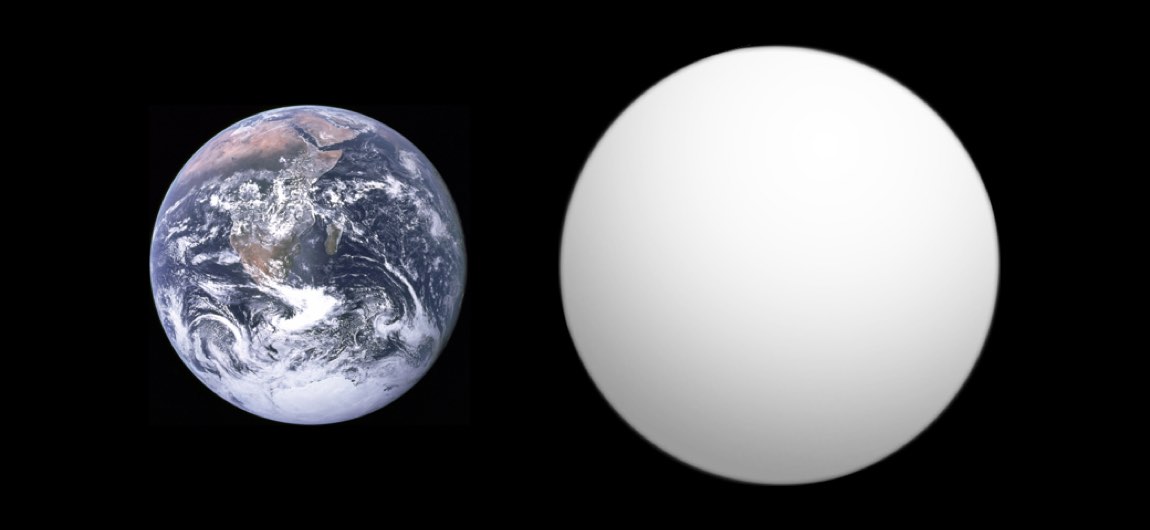
1.47 Earth radii. Worlds between Earth and Neptune in size are the most common in the galaxy, yet our Solar System has none, which is why each one matters. With 3.2 Earth masses packed into that size, its density points to rock and iron rather than gas.
The orbit
Its year lasts about 20.1 hours, making it an ultra-short-period planet skimming its star.
Temperature and starlight
Its equilibrium temperature (the airless-world estimate) is about 1,915 °C. Hot enough to melt copper; any surface would glow. It receives 3,741.8 times the starlight Earth gets.
Its sun
Its star is Sun-like (5,708 K; the Sun is 5,772 K). It shares the system with 2 other known planets.
How far is that, really?
At 605 light-years, tonight's light from this system left it around the year 1420. A Voyager-speed probe would need roughly 10,704,720 years to get there.
How we found it
It was found by the transit method: the planet crosses its star's face on schedule, dimming it by a tiny, repeating fraction. The dip's depth gives the planet's size. The discovery was announced in 2011 from Kepler.
Everything above is computed from the archive’s measured values for this planet. Where a quantity is missing, the statement is omitted rather than guessed.
The deep dive
Researched for the Atlas from Wikipedia — Kepler-10b (4,942 characters read) · updated Sep 20, 2026
01 The First Rocky World Found by Kepler
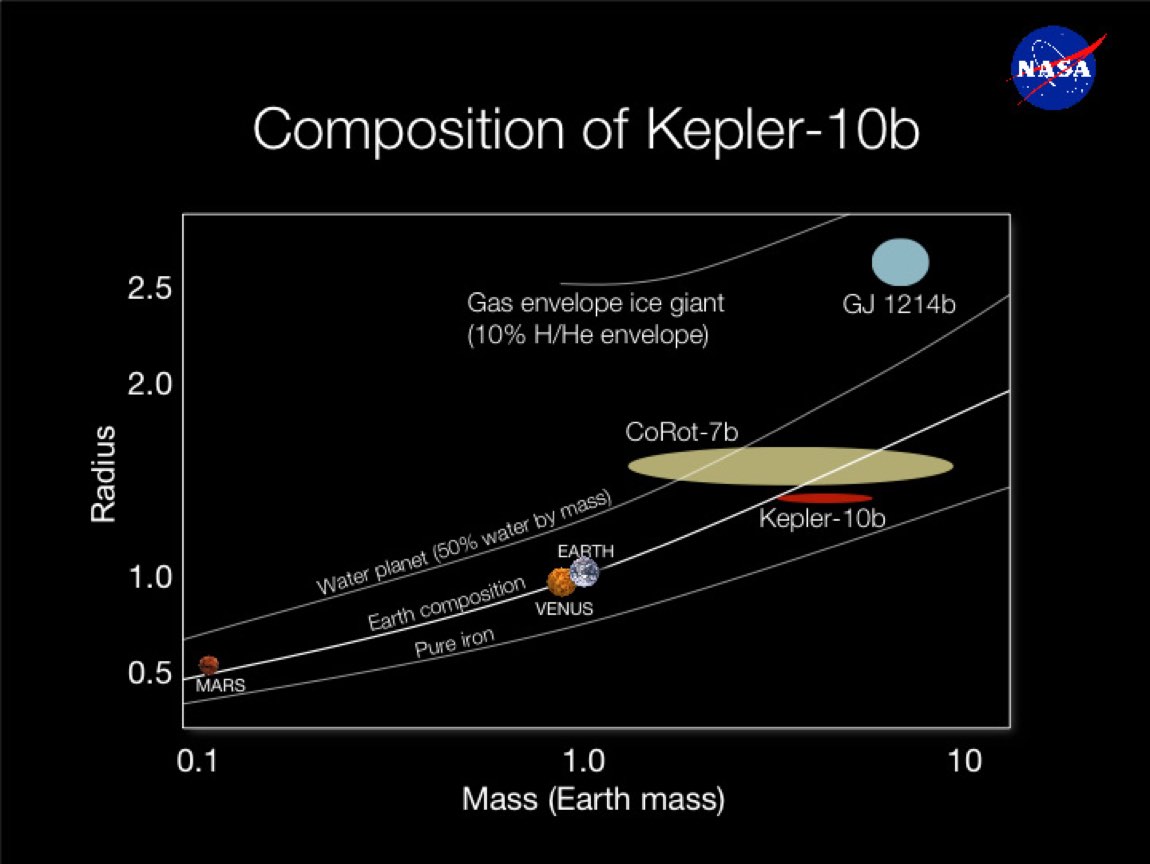
When the Kepler Space Telescope began scanning the sky in May 2009, one of its earliest prizes was Kepler-10b, the first confirmed terrestrial planet discovered by the mission. Eight months of photometric data collected between May 2009 and January 2010 revealed that the star Kepler-10 dimmed by one part in ten thousand every 0.83 days — a tiny but unmistakable signal. The first transits were spotted in July 2009, and the planet's existence was publicly announced on January 10, 2011. What made the discovery especially significant was that earlier rocky planet candidates, such as CoRoT-7b, carried enough mass uncertainty that alternative compositions — even a predominantly water world — could not be ruled out. Kepler-10b suffered no such ambiguity. Its characteristics pointed unambiguously to a solid, rocky body, cementing its place as the first confirmed terrestrial exoplanet found by Kepler and, by many astronomers' reckoning, one of the most important exoplanet discoveries ever made.
02 How Two Telescopes Confirmed One Planet
Detecting a planet's transit tells you its size, but measuring its mass requires a different technique entirely. After Kepler flagged Kepler-10 as a high-priority target — it was the very first star in the telescope's field of view identified as capable of hosting a small transiting planet — astronomers turned to the Keck I telescope at the W. M. Keck Observatory in Hawaii. Using the radial velocity method, they monitored the Doppler shift in Kepler-10's spectrum intermittently between August 2009 and August 2010. A periodic shift consistent with the orbital period seen in the transit data confirmed that a planet was genuinely tugging on the star, rather than some other phenomenon mimicking a transit. This two-telescope confirmation is now a standard workflow: Kepler measures the radius from the transit depth, and ground-based spectrographs measure the mass from the Doppler wobble. Together they yield density, which is what ultimately distinguishes a rocky planet from a gaseous or watery one.
03 Size, Mass, and a Surprisingly High Density
Kepler-10b has a radius of 1.47 Earth radii and a mass of 3.72 ± 0.42 Earth masses, though the Characteristics section of the discovery literature also cites the mass as 3.58 Earth masses depending on the analysis applied. Either way, the numbers combine to produce an average density of 6.46 g/cm³. For comparison, Earth's average density is about 5.51 g/cm³, so Kepler-10b is measurably denser than our own planet despite being substantially larger. That elevated density strongly implies an interior dominated by rock and iron rather than lighter materials such as water ice or thick gas envelopes. It was precisely this high, well-constrained density that allowed scientists to confidently classify Kepler-10b as terrestrial, setting it apart from the compositionally ambiguous CoRoT-7b and making it the benchmark rocky exoplanet of its era.
04 An Orbit Tighter Than Anything in Our Solar System
Kepler-10b's orbital period is less than one Earth day — just 0.83 days — meaning a year on this world lasts roughly twenty hours. To complete such a rapid orbit, the planet must sit extraordinarily close to its star: less than one-twentieth of the distance between Mercury and the Sun. Mercury itself is already the solar system's innermost planet, orbiting at about 58 million kilometers from the Sun, so one-twentieth of that gap is a vanishingly small separation by any intuitive standard. At such proximity the gravitational and radiative environment is extreme. The planet is bombarded with intense stellar radiation, its surface temperature on the day side reaches approximately 1,833 K — hot enough to melt iron and comparable to the interior of a blast furnace — and it is gravitationally locked into synchronous rotation, forever showing the same face to its host star.
 ⤢
⤢
05 Tidally Locked: A Planet of Two Extremes Deeper
Because Kepler-10b is tidally locked to Kepler-10, it does not rotate freely. One hemisphere bakes perpetually in starlight while the opposite hemisphere languishes in permanent darkness. The resulting temperature contrast between the day and night sides is extreme — a feature that turned out to be scientifically useful. In September 2011, astronomers announced the detection of secondary transits and orbital phase variations in Kepler-10b's light curve. By measuring how the total brightness of the star-planet system changed as the planet moved through its orbit, they could disentangle the planet's own thermal emission and reflected light from the stellar flux. Kepler-10b thus became the first terrestrial exoplanet for which orbital phases were observed, a milestone that allowed direct constraints on both the planet's temperature distribution and its albedo. The very extremity of the day-night temperature swing was what made these phase variations detectable in the first place.
06 Albedo, Reflectivity, and Possible Magma Oceans Deeper
The phase-curve analysis revealed that Kepler-10b reflects roughly half of the starlight it receives — a relatively high Bond albedo for a body expected to be rock and iron. This result surprised researchers, since bare rocky surfaces tend to be dark. One proposed explanation is that Kepler-10b may be a coreless rocky planet whose surface hosts magma oceans rich in iron oxides. Such molten, mineral-laden surfaces could plausibly reflect more light than a cold, basaltic crust. The coreless structure would mean that all the iron was oxidized and distributed throughout the mantle rather than sinking to form a metallic core, fundamentally altering both the planet's interior architecture and its surface optical properties. This remains a hypothesis rather than a confirmed finding, but it illustrates how albedo measurements — once thought useful only for gas giants — can probe the interior chemistry of rocky worlds when the observational signal is strong enough.
07 Super-Mercury or Super-Earth? A Naming Debate
When Kepler-10b was announced, it was widely grouped under the popular label "super-Earth," a catch-all term for rocky planets larger than Earth. But not everyone agreed with the classification. Diana Valencia at the University of Côte d'Azur in Nice, France argued that Kepler-10b's physical characteristics made it more accurately a "super-Mercury" — a planet more analogous to the dense, iron-rich innermost planet of our own solar system than to Earth itself. The distinction matters scientifically. Mercury is thought to have lost much of its outer mantle through collisions early in solar system history, leaving behind a disproportionately large iron core and an unusually high bulk density. If Kepler-10b shares a similar composition or formation pathway, that carries different implications for models of planetary interiors and migration histories than the super-Earth label would suggest. Meanwhile, Geoff Marcy of the University of California at Berkeley described Kepler-10b as "a bridge between the gas giant planets we've been finding and the Earth itself."
08 The Star Behind the Planet: Ancient and Sun-Like
Kepler-10b orbits a star called Kepler-10, located 560 light-years from the Solar System in the constellation Draco. The star is approximately the same size as the Sun, making it a near-solar analog in terms of physical scale. What sets it apart is its age: Kepler-10 is estimated to be approximately 12 billion years old, roughly two and a half times older than Earth and about 85 percent of the age of the universe itself. This antiquity raises intriguing questions about the planet's long-term history. A rocky planet orbiting so close to a very old star has endured billions of years of intense irradiation, stellar wind, and tidal forces — a timescale over which any primordial atmosphere would almost certainly have been stripped away. The star's name derives from the Kepler Mission, the NASA-led project whose mandate was to find transiting terrestrial planets, and Kepler-10b was the first planet confirmed in orbit around it, earning the designation "b" by standard exoplanet naming convention.
 ⤢
⤢
09 Why CoRoT-7b Could Not Claim the Crown Deeper
Before Kepler-10b, CoRoT-7b held tentative claim to being the first confirmed rocky exoplanet. Discovered by the European CoRoT space telescope, it was announced as a rocky world and predates Kepler-10b's discovery. However, the mass of CoRoT-7b was highly uncertain, and that uncertainty left room for radically different interior compositions. Without a reliable mass, the planet's density cannot be pinned down, and without density, composition remains speculative — CoRoT-7b could, under some mass estimates, be predominantly water rather than rock and iron. Kepler-10b's mass was measured far more precisely through extensive radial velocity monitoring with Keck I, yielding a density of 6.46 g/cm³ that closed off alternative interpretations. It is this tighter constraint that earned Kepler-10b the designation of the first confirmed terrestrial exoplanet found by the Kepler mission and the first to be unambiguously classified as rocky, even though CoRoT-7b was identified earlier.
10 How the Transit Method Worked Here
The transit method exploits a simple geometric fact: when a planet crosses between its star and Earth, the star's brightness dips by an amount proportional to the ratio of the planet's area to the star's area. For Kepler-10b, this dip amounted to just one part in ten thousand — a signal so subtle it was undetectable with earlier ground-based telescopes and demanded the photometric precision of a space observatory. Kepler detected this dip recurring every 0.83 days, establishing both the orbital period and, combined with knowledge of the star's size, the planet's radius of 1.47 Earth radii. The transit method alone cannot determine mass; it can only rule out very large bodies. That is why radial velocity follow-up with Keck was essential. Together, the two techniques provided the radius and mass needed to calculate density, the single most informative number for determining whether a distant world is a gas ball, a water world, or a true rocky planet like Earth.
11 Scientific Significance and Astronomers' Reactions
The announcement of Kepler-10b generated immediate and enthusiastic responses from the planetary science community. Geoff Marcy of the University of California at Berkeley ranked the discovery as "among the most profound scientific discoveries in human history" and predicted that the planet "will go into every textbook worldwide." That enthusiasm reflected more than excitement about a single object. Kepler-10b represented proof of concept: rocky, Earth-scale planets do exist orbiting other stars, and the Kepler telescope could find and characterize them. Astronomers hoped that studying the mass, radius, and density of Kepler-10b would illuminate general principles about the internal structure of terrestrial planets — how they partition iron between cores and mantles, how dense they become, and how they form in the first place. Marcy captured the broader framing by calling Kepler-10b "a bridge" connecting the gas giants that had dominated the exoplanet catalog up to that point with the rocky, Earth-like worlds that the Kepler Mission was ultimately designed to find.
12 Open Questions About This Extreme World Deeper
Despite being extensively characterized, Kepler-10b leaves several important questions unresolved. The high Bond albedo — roughly half of incoming starlight reflected — is difficult to explain with conventional rocky-planet surface models and has prompted speculation about iron oxide-rich magma oceans, but no definitive surface characterization has been made. The hypothesis that Kepler-10b is a coreless planet, with iron distributed through the mantle rather than concentrated in a metallic core, remains one possible interpretation rather than an established fact. The planet's formation history is also unclear: did it form close to its current orbit, or did it migrate inward from a more distant birthplace? At less than one-twentieth of the Mercury-Sun distance, it occupies a region where protoplanetary disk conditions would have been extraordinarily hostile. And while tidal locking is essentially certain given the orbital period, the detailed atmospheric dynamics — or lack thereof, if no atmosphere survives — remain unmeasured and largely theoretical for a body this close to its star.
About this record
The measured values come from the NASA Exoplanet Archive, and any missing value has not been determined yet; the Atlas never fills gaps with guesses. More standout worlds: Proxima b, TRAPPIST-1e, K2-18 b, 55 Cancri e, and the detection methods that found them all.