Confirmed exoplanet · Database record + computed analysis
KELT-9 b
A confirmed world orbiting KELT-9, 666.8 light-years away.
A gas giant
21.70 Earth radii, Jupiter-class (Jupiter is 11.2). At only 915.3 Earth masses for that size, it must be substantially gas or volatile ices: puffy, not rocky. Orbiting this close, it is a classic 'hot Jupiter', a giant that migrated inward from where it formed.
The orbit
Its year, one full orbit, takes just 1.5 Earth days.
Temperature and starlight
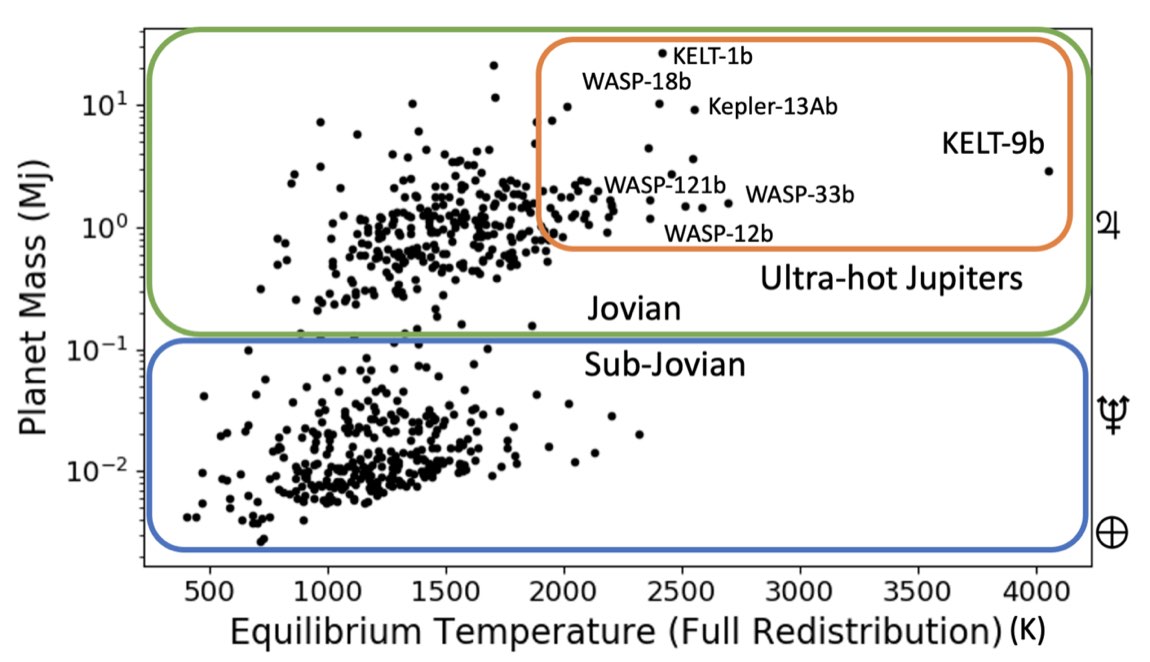
Its equilibrium temperature (the airless-world estimate) is about 3,648 °C. Hot enough to melt copper; any surface would glow. It receives 44,900.0 times the starlight Earth gets.
Its sun
Its star is hotter than the Sun (9,270 K, A), burning brighter and faster. The system holds 2 stars, so its skies have more than one sun.
How far is that, really?
At 667 light-years, tonight's light from this system left it around the year 1359. A Voyager-speed probe would need roughly 11,798,182 years to get there.
How we found it
It was found by the transit method: the planet crosses its star's face on schedule, dimming it by a tiny, repeating fraction. The dip's depth gives the planet's size. The discovery was announced in 2017 from KELT-North.
Everything above is computed from the archive’s measured values for this planet. Where a quantity is missing, the statement is omitted rather than guessed.
The deep dive
Researched for the Atlas from Wikipedia — KELT-9b (3,071 characters read) · updated Sep 20, 2026
01 A Star Almost Too Hot to Host a Planet
KELT-9 is no ordinary stellar host. With a surface temperature of 10,170 K — compared to the Sun's roughly 5,778 K — it sits right on the boundary between spectral classes, classified as B9.5-A0. That ambiguity matters: before KELT-9b was found, only six A-type stars were known to have planets at all, and the hottest of those, WASP-33, reached just 7,430 K. No B-type star had previously been confirmed to host a planet. If KELT-9 is ultimately pinned as a B-type star, its planet becomes even more extraordinary — a world orbiting a class of star that astronomers had considered essentially planetless. The star itself is 2.3 times larger and 2.4 times more massive than the Sun, meaning its energy output vastly outstrips anything in our solar neighborhood. That torrent of radiation is the defining force shaping everything about KELT-9b's existence, from its bloated size to its steadily evaporating atmosphere.
02 Discovered by a Deliberately Small Telescope
The name KELT-9b carries its own backstory: KELT stands for Kilodegree Extremely Little Telescope, a survey instrument deliberately designed to be modest in aperture but enormous in field of view. The discovery was announced in 2016, and the planet is also catalogued under its stellar designation as HD 195689 b. Located about 670 light-years from Earth — close enough to study in detail, far enough to feel genuinely alien — KELT-9b emerged from a survey optimized to catch transiting planets around bright stars. Because KELT-9 itself is so luminous, it is visible to modest ground-based instruments, which made follow-up characterization far more tractable than for planets orbiting dimmer hosts. The discovery immediately drew attention because the host star's temperature was so extreme that many astronomers had assumed such stars would be barren of detectable planets.
03 An Orbit Closer Than Mercury, Tilted Pole to Pole
KELT-9b circles its star at just 0.03462 AU — a distance so small that Mercury, at 0.39 AU from the Sun, seems comfortably remote by comparison. The orbital period is less than 1.5 days, meaning the planet completes a full year in the time it takes Earth to experience a long weekend. More striking still is the orbit's geometry: KELT-9b is in a polar orbit, meaning its path carries it roughly over the star's poles rather than tracing its equator. This strongly inclined trajectory is unusual even among hot Jupiters, which already tend to have eccentric or misaligned orbits compared to planets in our solar system. Despite all that dynamical drama, the orbit itself is circular rather than elliptical — the planet has settled into a tidally circularized path, even as it remains wildly tilted relative to the star's spin axis.
04 Hotter Than Thousands of Known Stars
As of 2022, KELT-9b holds the record as the hottest known exoplanet, with dayside temperatures approaching 4,600 K. To put that in perspective, K-type stars — a common class of orange dwarf stars — have surface temperatures in roughly the same range, meaning KELT-9b's day side is comparable in temperature to the photosphere of an actual star. The planet is tidally locked, so one hemisphere permanently faces the scorching host star while the other faces perpetual night. Yet even the night side is not spared entirely: astronomers have measured an enhanced heat transfer efficiency of 0.3 between the dayside and nightside, indicating that enormous amounts of energy are being transported from one hemisphere to the other, likely driven by the latent heat released when dissociated molecules reform on the cooler side.
05 Where Molecules Cannot Survive the Day Deeper
On the dayside of KELT-9b, the radiation environment is so intense that molecules are torn apart into their constituent atoms. This is not atmospheric chemistry as planetary scientists usually study it — it is closer to the conditions inside a stellar atmosphere. Under these conditions, normally refractory elements that would be locked into mineral grains or cloud particles at lower temperatures instead float freely as atomic species. Spectroscopic observations have confirmed the presence of neutral oxygen, neutral atomic iron (Fe), singly ionized iron (Fe+), and singly ionized titanium (Ti+) in the atmosphere. These atoms are only able to exist in atomic form on the dayside; once atmospheric circulation carries them to the cooler night side, they temporarily recombine into molecules. This cycle of dissociation and recombination is thought to be the engine behind the unusually efficient heat transfer measured between the planet's two hemispheres.
 ⤢
⤢
06 Molecular Surprises Hidden in the Spectrum Deeper
Given that the dayside temperatures destroy molecules outright, astronomers were genuinely surprised when spectra taken in 2021 unambiguously indicated the presence of metal oxides and hydrides in the planetary atmosphere. This was unexpected because the extreme temperatures seemed to rule out stable molecular species. Adding another layer of complexity, higher-resolution spectra taken in the same year found no molecular emissions coming from the planetary dayside specifically — suggesting that the molecules detected may be confined to cooler regions, perhaps the night side or the atmospheric limb where temperatures are somewhat lower. The planet's elemental abundances remain largely unknown as of 2022, though researchers strongly suspect a low carbon-to-oxygen ratio. These open questions mean KELT-9b continues to challenge models built for cooler, better-understood hot Jupiters.
07 A Thermosphere Rivaling the Star Below Deeper
If the dayside temperature of 4,600 K seems extreme, the planet's thermosphere — the uppermost layer of its atmosphere — is expected to reach even more staggering temperatures of 10,000 to 11,000 K. That range overlaps with the surface temperature of KELT-9 itself, which sits at 10,170 K. The mechanism driving this thermospheric heating is thought to be the ionization of heavy metal atoms such as iron, which absorb high-energy radiation from the host star and deposit that energy high in the atmosphere. This process differs from the UV-driven thermospheric heating familiar from Earth or even other hot Jupiters, because the sheer abundance of metallic atomic species makes KELT-9b's upper atmosphere a uniquely efficient absorber of its host star's intense radiation field.
08 Atmospheric Escape at a Planetary Scale
KELT-9b is not just hot — it is actively losing itself. The outer boundary of its atmosphere nearly reaches its Roche lobe, the teardrop-shaped gravitational boundary beyond which material is no longer bound to the planet and instead flows toward the star. In 2020, researchers measured the atmospheric loss rate and found it to be between 18 and 68 Earth masses per billion years. While that sounds modest over human timescales, it represents a continuous planetary hemorrhage driven entirely by radiation pressure from the host star. The planet's relatively low density — less than half that of Jupiter despite having about 2.2 times Jupiter's mass, possible because its radius is nearly twice Jupiter's — reflects how thoroughly the atmosphere has been puffed up by stellar heating, creating the conditions for this ongoing escape.
09 Hydrogen Winds Detected Escaping Upward Deeper
In June 2026, scientists reported a newly detected phenomenon in KELT-9b's upper atmosphere: a self-absorption feature in the Hα spectral line, the characteristic red emission of hydrogen. This spectral fingerprint indicates that hydrogen atoms in the upper atmosphere are absorbing their own radiation rather than letting it escape freely — a sign of a dense, outflowing layer of gas. Based on this detection, researchers estimated that the planet is losing approximately 10 to the 13th power grams of material per second, and that the outflowing gas is moving upward and outward at a vertical wind speed of roughly 5 km/s. To picture the escape rate: 10¹³ grams per second is about 10 billion kilograms every second, an extraordinary but sustained drain on the planet's bulk driven by the relentless irradiation it receives.
10 Why Its Density Defies Simple Expectations
KELT-9b's physical proportions are puzzling at first glance. The planet carries about 2.2 times the mass of Jupiter, which sounds like a dense, compact world. Yet its radius is nearly twice that of Jupiter, giving it a density less than half of Jupiter's. This extreme inflation is a direct consequence of the enormous radiation flux it absorbs from KELT-9. Hot Jupiters are broadly known to be puffier than cold gas giants because stellar heating slows atmospheric contraction, but KELT-9b takes this to an extreme. The result is a planet with a large mass but a very low average density, something more like a diffuse gas balloon than a solid body. That puffiness also explains why the atmosphere extends so far outward — all the way to the edge of the Roche lobe — making atmospheric escape almost inevitable rather than just possible.
11 What We Still Do Not Know About KELT-9b
For all the remarkable measurements made since its 2016 discovery, KELT-9b remains genuinely mysterious in key respects. Its elemental abundances — the basic chemical recipe of the planet — were still largely unknown as of 2022. The suspicion of a low carbon-to-oxygen ratio exists, but has not been firmly established. The exact nature of the metal oxide and hydride detections in 2021 spectra remains puzzling, particularly because dayside molecular emission was not found at higher resolution. The thermospheric heating mechanism involving heavy metal ionization is theoretically expected but has not been fully confirmed observationally. Whether the atmospheric loss rate will eventually strip the planet down to a rocky core or whether KELT-9b is massive enough to survive as a gas giant for the lifetime of its host star also remains an open question — one that depends sensitively on the star's future evolution as well as the planet's current composition.
About this record
The measured values come from the NASA Exoplanet Archive, and any missing value has not been determined yet; the Atlas never fills gaps with guesses. More standout worlds: Proxima b, TRAPPIST-1e, K2-18 b, 55 Cancri e, and the detection methods that found them all.