Confirmed exoplanet · Database record + computed analysis
HD 209458 b
A confirmed world orbiting HD 209458, 157.5 light-years away.
A gas giant
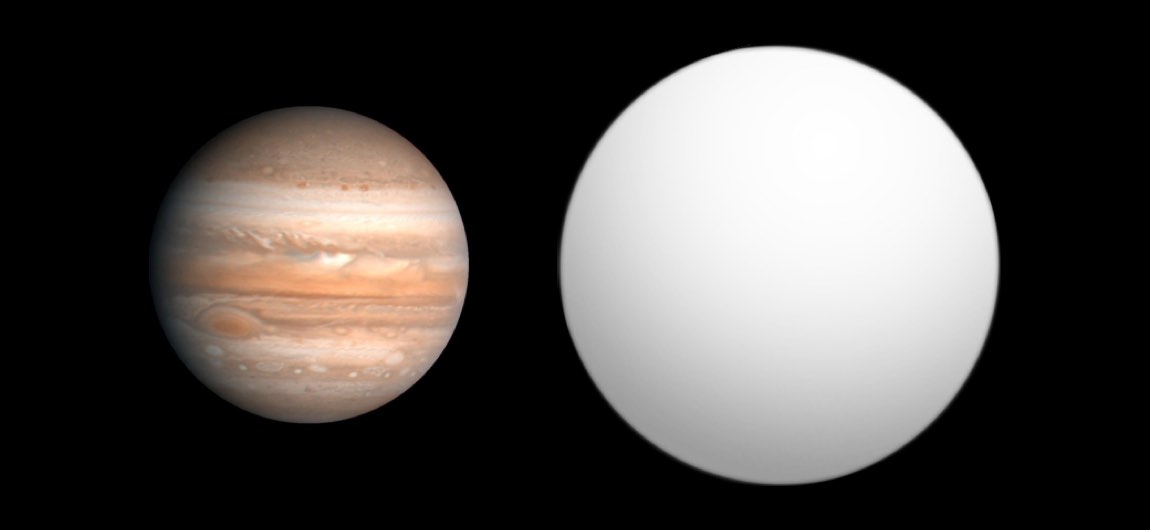
15.58 Earth radii, Jupiter-class (Jupiter is 11.2). At only 232.0 Earth masses for that size, it must be substantially gas or volatile ices: puffy, not rocky. Orbiting this close, it is a classic 'hot Jupiter', a giant that migrated inward from where it formed.
The orbit
Its year, one full orbit, takes just 3.5 Earth days.
Temperature and starlight
Its equilibrium temperature (the airless-world estimate) is about 1,186 °C. Hot enough to melt copper; any surface would glow. It receives 587.1 times the starlight Earth gets.
Its sun
Its star is hotter than the Sun (6,091 K, G0 V), burning brighter and faster.
How far is that, really?
At 158 light-years, tonight's light from this system left it around the year 1868. A Voyager-speed probe would need roughly 2,787,269 years to get there.
How we found it
It was found by the radial-velocity method: the planet's gravity swings its star in a small circle, and that wobble shows up as a rhythmic Doppler shift in the starlight. The wobble's size gives the planet's minimum mass. The discovery was announced in 1999 from W. M. Keck Observatory.
Everything above is computed from the archive’s measured values for this planet. Where a quantity is missing, the statement is omitted rather than guessed.
The deep dive
Researched for the Atlas from Wikipedia — HD 209458 b (13,978 characters read) · updated Sep 20, 2026
01 Eight Firsts That Changed Exoplanet Science
HD 209458 b occupies a unique position in the history of astronomy because it has been the first exoplanet to achieve not one but a cascade of milestones. It was the first transiting extrasolar planet, the first planet detected through more than one method, the first confirmed to have an atmosphere, and the first found to have an evaporating hydrogen atmosphere. It was also the first exoplanet known to contain oxygen and carbon in its atmosphere, one of the first two planets observed spectroscopically in emission, the first extrasolar gas giant to have its superstorm measured, and the first planet to have its orbital speed measured in a way that determined its mass directly. As of April 2007, updated theoretical models made it the first exoplanet suspected to contain water vapor as well. Few objects in modern astronomy have rewritten so many textbook assumptions in such quick succession, making it a cornerstone of what planetary scientists now know about worlds beyond the Solar System.
02 Two Teams Racing to Confirm One Transit
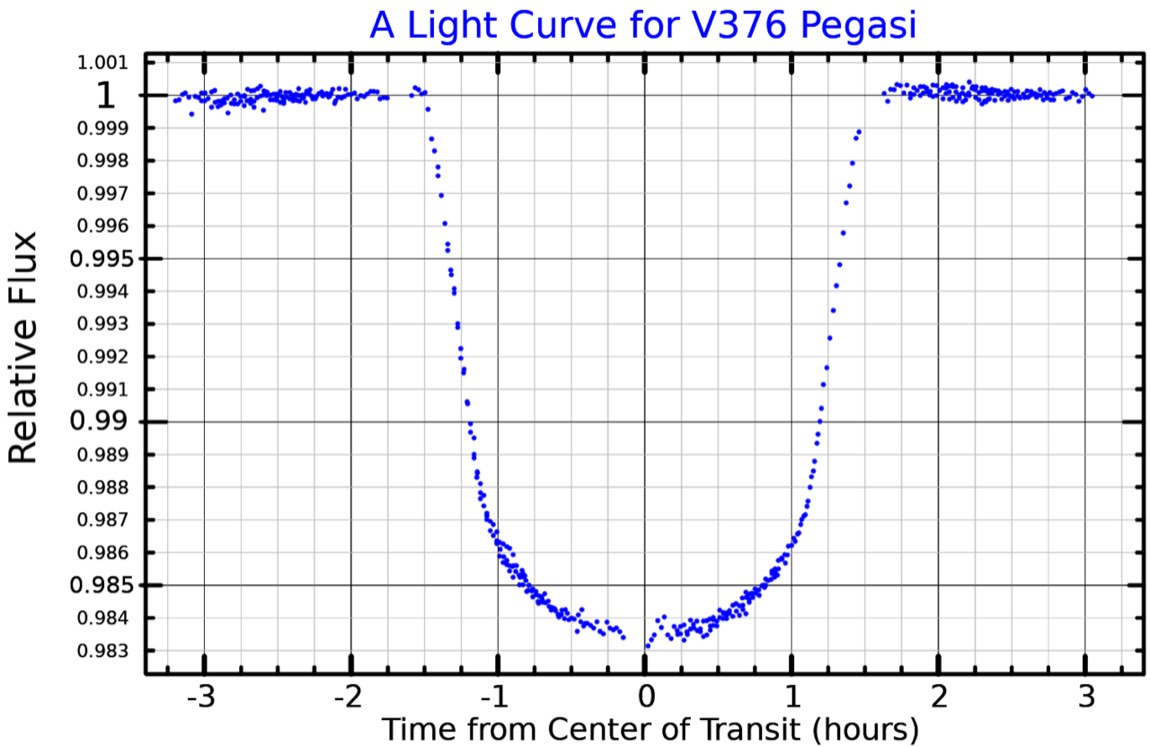
The discovery of HD 209458 b's transits unfolded as something of a scientific race. Spectroscopic studies had first revealed the planet on November 5, 1999, but confirming a transit required watching for the precise moment when the planet crossed its star's face. A team led by David Charbonneau, including Timothy Brown, measured a 1.7% drop in the star's brightness on September 9 and 16, 1999 — a dip consistent with the planet covering roughly 1.5% of the star's visible disk. A separate team led by Gregory W. Henry observed only a partial transit on November 8, catching just the ingress. Henry's group, initially uncertain of their result, rushed their paper to publication after overhearing rumors that Charbonneau had already captured a complete transit. Both papers appeared simultaneously in the same issue of the Astrophysical Journal. Each transit lasts approximately three hours, and archival data from the Hipparcos satellite allowed astronomers to pin down the orbital period to an impressive precision of 3.524736 days.
03 Why This Planet Is Inflated Beyond All Logic Deeper
One of the most puzzling physical facts about HD 209458 b is its sheer size relative to its mass. Spectroscopic analysis established its mass at roughly 0.69 Jupiter masses — somewhat below Jupiter's own — yet its radius is about 35% larger than Jupiter's, giving it a volume approximately 2.5 times greater. A planet less massive than Jupiter has no business being so puffed up. Astronomers had previously hypothesized that hot Jupiters orbiting very close to their parent stars should be inflated by the intense irradiation of their outer atmospheres, and HD 209458 b appeared to confirm that idea. But heating alone may not be the whole story. Tidal heating driven by orbital eccentricity — which may have been significantly greater when the planet first formed — could also have deposited energy into the interior over the past billion years or more. The exact mechanism behind the inflation remains an active area of investigation, and HD 209458 b continues to serve as the canonical test case for competing models.
04 The Infrared Fingerprint: Spitzer's Historic Look
On March 22, 2005, NASA announced that the Spitzer Space Telescope had measured infrared light directly from HD 209458 b — the first time any light from an extrasolar planet had ever been directly detected. The technique was elegant in its logic: Spitzer measured total brightness as the planet moved in front of the star and then again as the planet slipped behind it. By subtracting the star's constant contribution, astronomers isolated the planet's own infrared glow. The measurements set a lower bound on the planet's temperature of at least 750 °C (1,020 K; 1,380 °F). The observations also confirmed that HD 209458 b travels in a nearly circular orbit — important because a significantly elliptical orbit would have complicated the temperature measurements and raised questions about tidal heating. This detection opened an entirely new observational era in which planets could be studied not just through the shadow they cast but through the light they themselves emit.
 ⤢
⤢
05 A Superstorm Clocked at 7,000 Kilometres Per Hour
On June 23, 2010, astronomers using the European Southern Observatory's Very Large Telescope and its CRIRES spectrograph announced the first direct measurement of a storm in the atmosphere of another planet outside the Solar System. Carbon monoxide gas was tracked moving from the intensely hot dayside of HD 209458 b toward the cooler nightside at wind speeds reaching up to 7,000 km/h (2,000 m/s; 4,000 mph). To put that in perspective, the most powerful hurricanes on Earth barely exceed 300 km/h. This raging flow is driven by the enormous temperature difference between the two hemispheres — a contrast that exists because HD 209458 b is almost certainly tidally locked to its star, keeping one face perpetually baked and the other in permanent darkness. The same high-precision observations yielded a historic bonus: by tracking the Doppler shift of the planet's spectral lines across its orbit, the team obtained the first direct measurement of the planet's orbital speed, which in turn provided the first direct determination of its mass without relying on the mass of the host star.
06 An Atmosphere That Is Slowly Boiling Away Deeper
Between 2003 and 2004, astronomers using the Hubble Space Telescope Imaging Spectrograph uncovered a vast ellipsoidal envelope of hydrogen, carbon, and oxygen surrounding HD 209458 b and reaching temperatures of 10,000 K (roughly 10,000 °C; 20,000 °F). The hydrogen exosphere extends to a distance of 3.1 Jupiter radii from the planet's center, compared to the planetary radius itself of only 1.32 Jupiter radii. At those temperatures and distances, the Maxwell–Boltzmann distribution of particle velocities means that a significant fraction of atoms are moving faster than the local escape velocity and streaming away into space. The planet is estimated to be losing 100 to 500 million kg of hydrogen every single second — equivalent to shedding hundreds of fully loaded cargo ships worth of mass per second. The heavier carbon and oxygen atoms are not escaping under their own thermal energy; instead they are being dragged outward by the extreme hydrodynamic pull of the escaping hydrogen. The hydrogen tail trailing the planet stretches approximately 200,000 km, roughly equal to the planet's own diameter. Despite this dramatic loss, models suggest HD 209458 b has shed only about 7% of its total mass over an estimated lifetime of 5 billion years and will not evaporate entirely.
07 Clouds of Silicate Dust and Unexpected Spectral Peaks Deeper
On February 21, 2007, NASA and the journal Nature announced that HD 209458 b had become one of the first two exoplanets to have its spectrum measured, alongside HD 189733 b. A team led by Jeremy Richardson of NASA's Goddard Space Flight Center measured the atmosphere across wavelengths of 7.5 to 13.2 micrometres. The results defied theoretical predictions in multiple ways. Models had forecast a peak at 10 micrometres that would indicate water vapor, but no such peak appeared. Instead, an unpredicted peak at 9.65 micrometres was attributed to clouds of silicate dust, a phenomenon not previously observed in any exoplanet atmosphere. A further unexpected peak at 7.78 micrometres appeared, for which the investigators had no explanation. A separate team led by Mark Swain of the Jet Propulsion Laboratory independently reanalyzed the same data and reached similar conclusions. As of 2021, spectra gathered by different instruments remain highly inconsistent with one another, suggesting either a metal-poor atmosphere, temperatures below blackbody equilibrium, or chemical disequilibrium — leaving the true atmospheric structure of this iconic planet genuinely unresolved.
08 Water, Carbon, and the Carbon Planet Hypothesis Deeper
The question of exactly what molecules fill HD 209458 b's atmosphere has evolved dramatically over two decades of investigation. On April 10, 2007, Travis Barman of the Lowell Observatory announced evidence for water vapor absorption, drawing on Hubble Space Telescope data gathered by Harvard student Heather Knutson and applying new theoretical models. His method used the way the atmosphere absorbs starlight as the planet transits — and noted that water absorption makes a planet appear measurably larger in certain infrared wavelengths compared to visible ones. Astronomer David Charbonneau, who led the original Hubble observations, cautioned that instrument artifacts could be mimicking the water signature. On October 20, 2009, JPL researchers announced detection of water vapor, carbon dioxide, and methane. Then, refined spectra from 2021 identified a dramatically different mix: water vapor, carbon monoxide, hydrogen cyanide, methane, ammonia, and acetylene — a chemical cocktail consistent with a carbon-to-oxygen molar ratio of 1.0, far above the Sun's ratio of 0.55. This extreme ratio raises the possibility that HD 209458 b may be an example of a carbon planet, a world whose chemistry is fundamentally dominated by carbon rather than oxygen.
 ⤢
⤢
09 How Dark Is This Planet, and Why?
Despite being a bloated gas giant orbiting extraordinarily close to a Sun-like star, HD 209458 b reflects surprisingly little light. Initial observations with the Microvariability and Oscillations of STars telescope capped its albedo below 0.3, and subsequent measurements refined the geometric albedo to just 0.038 ± 0.045 — meaning it reflects only about 3 to 4% of incoming starlight. Jupiter, by comparison, has an albedo of 0.52, reflecting more than half the sunlight that strikes it. Such darkness suggests that the upper cloud deck of HD 209458 b is made of far less reflective material than Jupiter's ammonia ice clouds. Models propose that these upper clouds consist of vanadium and titanium oxides, though compounds like tholins cannot yet be ruled out. A 2016 study estimated that the high-altitude cloud cover is patchy, covering approximately 57% of the planet. Where clouds are absent, the planet's atmosphere Rayleigh-scatters incoming radiation similarly to how Earth's dark oceans scatter light — which also contributes to its low reflectivity.
10 The Planet's Spin–Orbit Alignment Deeper
One subtle but revealing measurement astronomers make for transiting planets is the Rossiter–McLaughlin effect — a distortion in the host star's spectral lines caused by the planet blocking different portions of the rotating stellar disk as it transits. This effect reveals the angle between the planet's orbital plane and the star's rotational equator, a quantity called the spin–orbit angle. For HD 209458 b, the first such measurement in August 2008 yielded a spin–orbit angle of −4.4 ± 1.4 degrees, indicating that the planet's orbit is very nearly aligned with its star's rotation. A follow-up study in 2012 updated this value to −5 ± 7 degrees, consistent with near-perfect alignment. This result matters because strongly misaligned hot Jupiters are thought to have arrived at their close orbits through dynamically violent processes such as gravitational scattering or Kozai–Lidov oscillations, while well-aligned ones may have migrated more gently through the protoplanetary disk. HD 209458 b's near-zero spin–orbit angle is therefore a modest piece of evidence in favor of disk migration for this particular world.
11 The First Magnetic Field Detected on an Exoplanet
In 2014, scientists inferred the existence of a magnetic field around HD 209458 b by studying the pattern of hydrogen evaporation from the planet's atmosphere. This marked the first indirect detection of a magnetic field on any planet beyond the Solar System. The estimated field strength is roughly one-tenth that of Jupiter's magnetic field — weaker, but still potentially significant. At the planet's orbital distance of just 0.047 AU, theorists had speculated that its magnetic interactions with the host star might trigger stellar flares synchronized with the planet's 3.5-day orbital period. A 2011 search specifically targeting such interactions looked for coronal radio emissions driven by magnetic star–planet coupling but detected no signal. Likewise, no magnetospheric radio emissions were detected from the planet itself. Whether the planet's field is strong enough to meaningfully slow the escape of its evaporating exosphere — by trapping and containing ions before they can stream away — remains an open question that future radio observations may eventually resolve.
12 Why the Planet Was Named Osiris
The informal name Osiris was first proposed in 2003 by astronomers A. Vidal-Madjar and A. Lecavelier des Etangs, who drew an elegant parallel between the planet's situation and the Egyptian myth of Osiris. In the myth, Osiris suffers the loss of part of his body during his death and subsequent resurrection — a narrative the astronomers connected to HD 209458 b's observable loss of its own atmosphere, streaming away into space as a massive hydrogen tail. The formal designation HD 209458 b follows standard exoplanet naming convention: the star is catalogued in the Henry Draper Catalogue as HD 209458, and the lowercase letter b designates it as the first confirmed planet around that star. The name Osiris has seen some adoption among other astronomers and has been acknowledged by the International Astronomical Union, but as of 2025 it has not been approved as an official proper name, leaving the planet in a curious state — famous enough to earn a mythological nickname, but not yet formally baptized with one.
About this record
The measured values come from the NASA Exoplanet Archive, and any missing value has not been determined yet; the Atlas never fills gaps with guesses. More standout worlds: Proxima b, TRAPPIST-1e, K2-18 b, 55 Cancri e, and the detection methods that found them all.