Confirmed exoplanet · Database record + computed analysis
HD 189733 b
A confirmed world orbiting HD 189733, 64.5 light-years away.
A gas giant
12.67 Earth radii, Jupiter-class (Jupiter is 11.2). At only 359.1 Earth masses for that size, it must be substantially gas or volatile ices: puffy, not rocky. Orbiting this close, it is a classic 'hot Jupiter', a giant that migrated inward from where it formed.
The orbit
Its year, one full orbit, takes just 2.2 Earth days.
Temperature and starlight
Its equilibrium temperature (the airless-world estimate) is about 936 °C. Hot enough to melt copper; any surface would glow. It receives 356.0 times the starlight Earth gets.
Its sun
Its star is an orange K-type (5,052 K), K2 V: cooler and longer-lived than the Sun, a class some astronomers consider ideal for habitability. The system holds 2 stars, so its skies have more than one sun.
How far is that, really?
At 64 light-years, tonight's light from this system left it around the year 1961. A Voyager-speed probe would need roughly 1,140,480 years to get there.
How we found it
It was found by the radial-velocity method: the planet's gravity swings its star in a small circle, and that wobble shows up as a rhythmic Doppler shift in the starlight. The wobble's size gives the planet's minimum mass. The discovery was announced in 2005 from Haute-Provence Observatory.
Everything above is computed from the archive’s measured values for this planet. Where a quantity is missing, the statement is omitted rather than guessed.
The deep dive
Researched for the Atlas from Wikipedia — HD 189733 b (12,259 characters read) · updated Sep 20, 2026
01 How Astronomers First Found This World
French astronomers announced the discovery of HD 189733 b on October 6, 2005, using two complementary techniques in rapid succession. First, real-time radial velocity measurements detected the Rossiter–McLaughlin effect — a subtle shift in the host star's spectral lines caused by the planet covering part of the rotating stellar surface as it passed in front. That detection came before photometric measurements formally confirmed the transit. Once the transit geometry was established, Doppler spectroscopy locked down the planet's mass, finding it to be about 16% larger than Jupiter's. The following year, a team led by Drake Deming pushed further by measuring the flux decrement during the planet's secondary eclipse — the moment when it slips behind its star — and announced the detection of strong infrared thermal emission. That secondary eclipse measurement was crucial because it gave astronomers their first direct read on the planet's own heat, not just the shadow it casts. The combination of transit and eclipse observations has since made HD 189733 b one of the most intensively studied planets outside our solar system.
02 Why This Planet Glows Deep Cobalt Blue
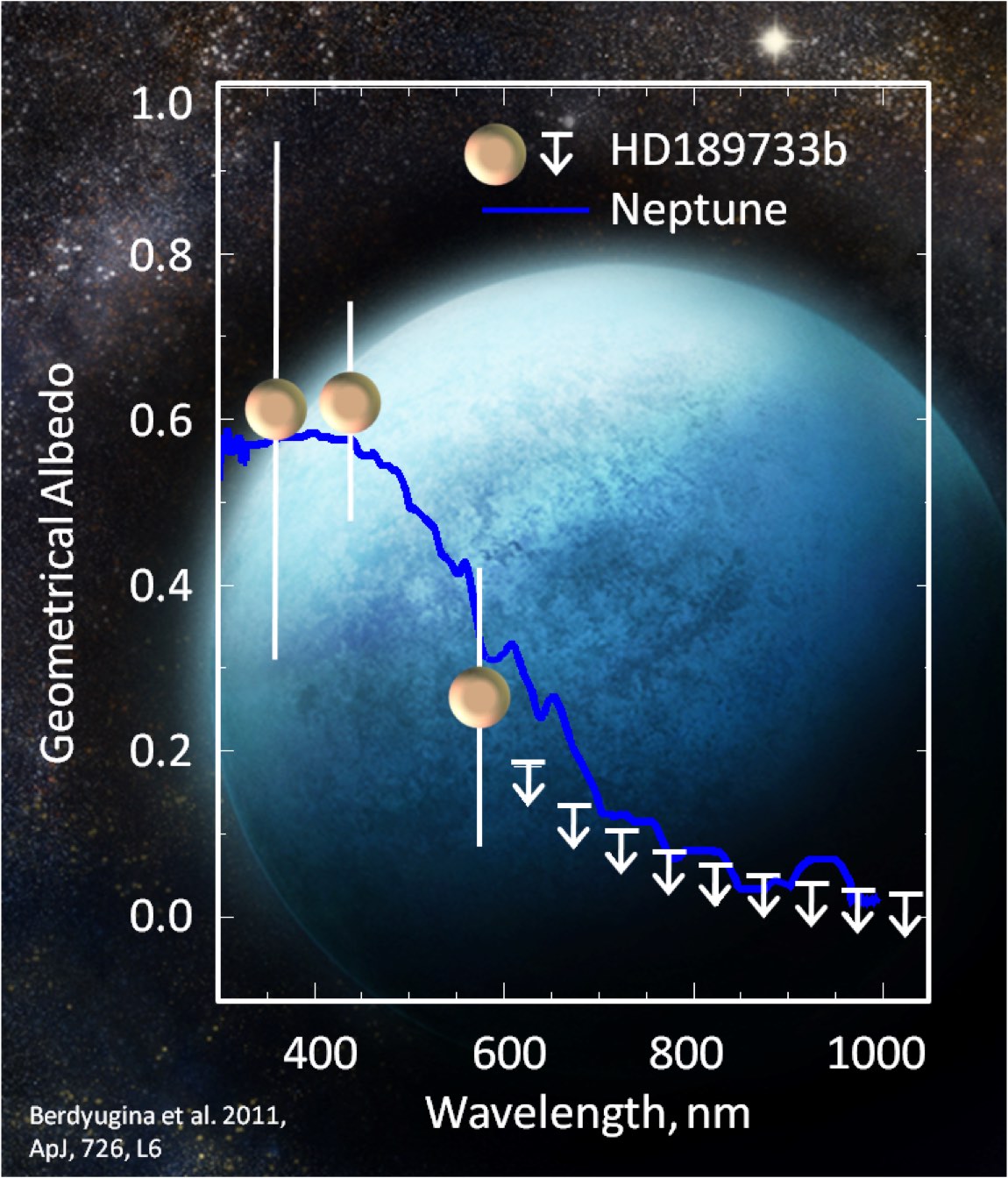
HD 189733 b is the first exoplanet to have its overall color pinned down, and the answer is a vivid deep blue — not because of oceans, but because of physics. The leading explanation is Rayleigh scattering, the same mechanism that makes Earth's daytime sky blue: tiny particles scatter shorter blue wavelengths far more efficiently than longer red ones. Spectral observations during the planet's transit in early 2008 used this model to infer that molecular hydrogen, if present, would produce an atmospheric pressure of 410 ± 30 mbar at 0.1564 solar radii. The Mie approximation model pointed to a possible atmospheric condensate — magnesium silicate (MgSiO3) — with particle sizes of roughly 10⁻² to 10⁻¹ μm. Together, both models constrained the planet's temperature to between 1,340 and 1,540 K. The blue color was first hinted at by polarimetry in 2008, appeared confirmed by the same team in 2011, and was independently corroborated in 2013 using a second technique, making HD 189733 b the first planet confirmed by two separate methods. However, two later teams using more sensitive polarimeters disputed the polarimetric signal, providing only upper limits, so that particular line of evidence remains contested.
 ⤢
⤢
03 A First-Ever Thermal Map of Another Planet
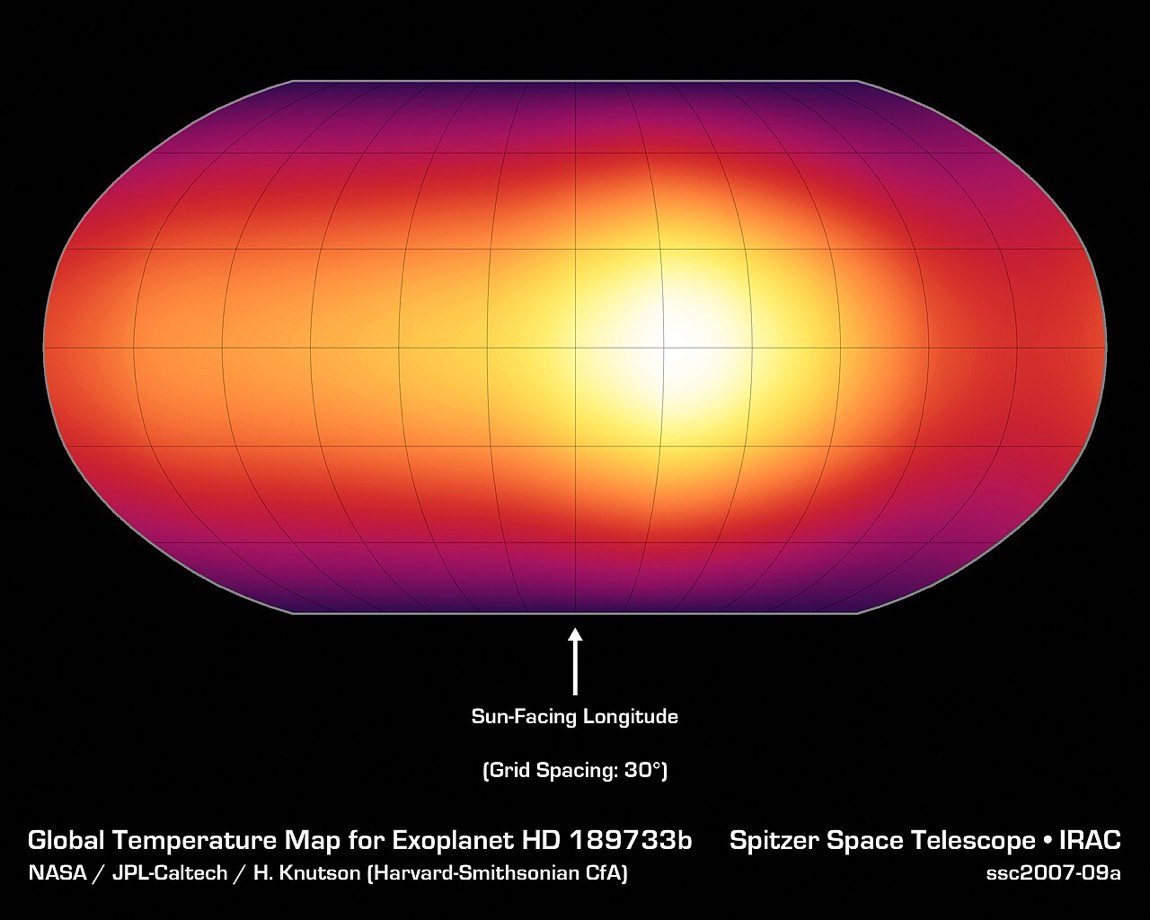
In 2007, the Spitzer Space Telescope was pointed at the HD 189733 system for 33 consecutive hours — starting when only the planet's night side faced Earth, then watching as the orbit gradually rotated the dayside into view. By tracking how the total infrared brightness changed across half an orbit, scientists stitched together the first temperature map ever published for a planet outside our solar system. The map revealed a temperature swing from 973 ± 33 K on the cooler side to 1,212 ± 11 K at the hottest point — a difference of roughly 239 K across the planet's face. Crucially, the hottest region was not centered directly under the star but was shifted 30 degrees east of the substellar point, exactly as theoretical models of hot Jupiters had predicted when accounting for day-to-night atmospheric redistribution. This offset shows that powerful winds are sweeping heat around the planet rather than letting it pile up directly below the star. Scientists at the University of Warwick calculated those winds at up to 8,700 km/h (5,400 mph), blasting continuously from the scorching dayside toward the cooler night hemisphere.
04 Glass Rain and a Haze of Silicates
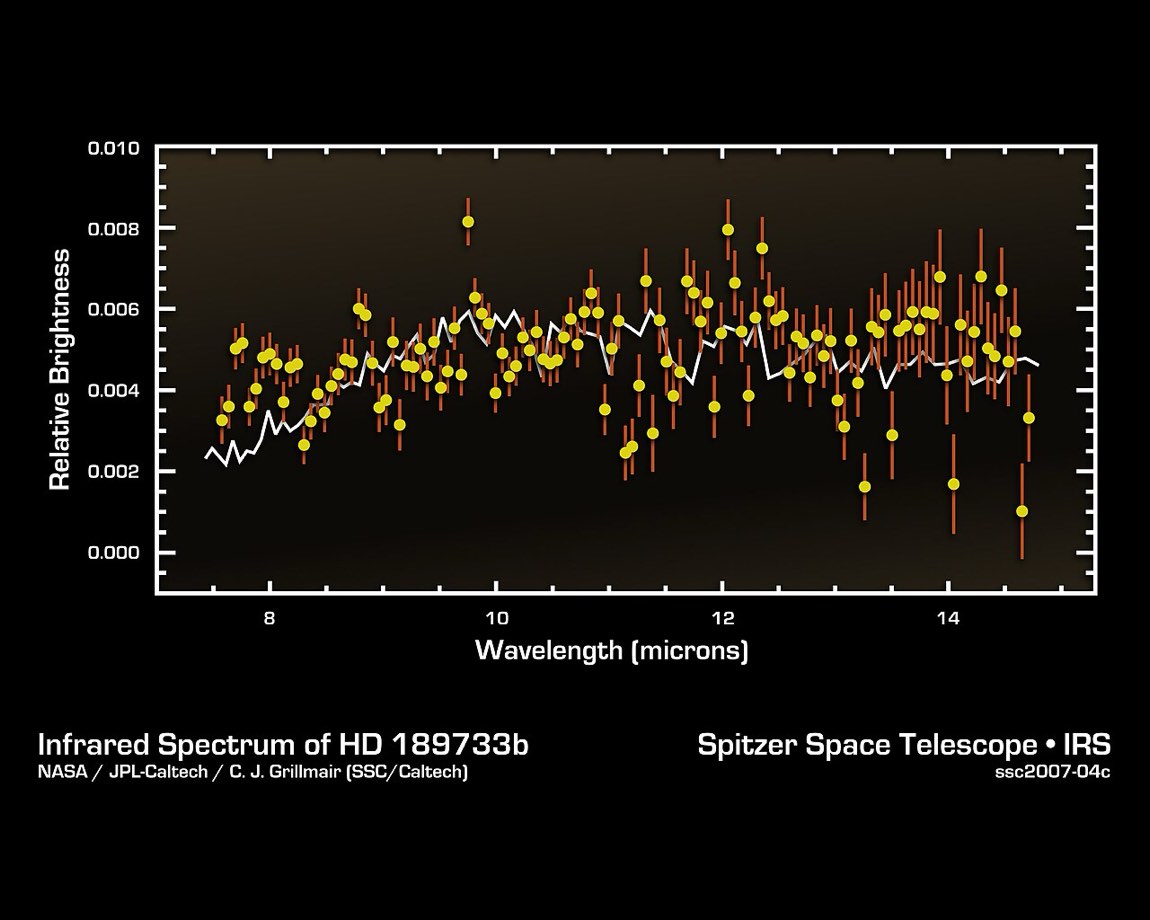
HD 189733 b's weather is among the most hostile yet characterized for any world. Researchers determined that the planet's atmosphere includes raining molten glass — silicate particles swept through the air at extreme temperatures. The specific condensate identified in atmospheric models is magnesium silicate (MgSiO3), with individual particles ranging from about 10⁻² to 10⁻¹ μm in size. These particles form a haze layer roughly 1,000 kilometres (620 mi) above the surface when viewed in infrared light. That same haze initially obscured the sodium signal astronomers were searching for; once they worked through it, sodium was detected at three times the concentration found in the atmosphere of HD 209458 b. Potassium was also eventually detected in 2020, though in significantly smaller concentrations than sodium. Looking upward from the surface, sunsets would appear red because the haze scatters shorter wavelengths away. In 2024, the atmospheric inventory expanded further when hydrogen sulfide was detected, and a separate analysis identified both lithium and sodium. Carbon dioxide had already been confirmed earlier, making HD 189733 b the first exoplanet known to harbor it.
 ⤢
⤢
05 Water, Methane, and a Chemical Puzzle Deeper
On July 11, 2007, a team led by Giovanna Tinetti published Spitzer Space Telescope observations providing solid evidence for significant water vapor in HD 189733 b's atmosphere. Hubble Space Telescope follow-up confirmed water vapor and also detected neutral oxygen and the organic compound methane. Very Large Telescope observations later added carbon monoxide on the planet's dayside. By 2021, high-resolution emission spectra pinned the water vapor fraction at roughly 0.004% by volume. The methane detection, however, opened a stubborn puzzle: at the planet's high temperature of around 700 °C, water and methane should react with each other, converting both into carbon monoxide. The simultaneous presence of methane and water is chemically unexpected under equilibrium conditions, and it remains unknown how the methane originated or persists. This kind of disequilibrium chemistry is scientifically valuable because it forces astronomers to think carefully about vertical mixing, photochemistry, or other processes that can maintain molecules in proportions that pure thermodynamics would not predict. HD 189733 b has consequently become a testbed for non-equilibrium atmospheric models.
06 Evaporating Into Space at a Startling Rate Deeper
Transit observations taken in March 2010 using the HI Lyman-alpha emission line revealed that HD 189733 b is actively shedding its atmosphere. The escaping material forms an extended exosphere of atomic hydrogen extending well beyond the planet's opaque disk, and the inferred evaporation rate sits between 1 and 100 gigagrams per second. To picture what that range means: one gigagram equals one billion kilograms, so even at the low end, the planet is losing at least a billion kilograms of material every second. HD 189733 b was only the second exoplanet after HD 209458 b for which atmospheric evaporation was detected. The X-ray spectrum provides a complementary angle on this process: NASA reported in July 2013 that the planet's atmosphere blocks three times more X-rays than visible light during transit, suggesting a large, extended, and absorbing upper atmosphere — exactly what you would expect if intense stellar radiation is puffing it up and driving mass loss from the top. Over billions of years, this slow bleeding of gas could significantly alter the planet's character.
 ⤢
⤢
07 Tidal Locking and What It Means for Weather
Like most hot Jupiters, HD 189733 b is thought to be tidally locked to its host star, meaning the same hemisphere permanently faces the star while the opposite side sits in perpetual night. This arrangement sets up one of the most extreme thermal contrasts imaginable on a planetary body. The Spitzer temperature map confirms that the planet does not accumulate all its heat at the substellar point; instead, winds of up to 8,700 km/h (5,400 mph) redistribute energy toward the nightside. Even so, the temperature difference across the planet — from 973 ± 33 K at the coolest measured region to 1,212 ± 11 K at the hottest — represents a gradient strong enough to drive those ferocious atmospheric jets. The scattering atmosphere detected through polarimetry appears to extend more than 30% beyond the opaque body of the planet seen during transits, suggesting that the gas envelope is dramatically puffed out. One consequence of tidal locking relevant to the planet's structure is the complete absence of an oblique seasonal cycle; without axial tilt variation, the climate is locked into a permanent, if violent, steady state.
08 Peaceful Formation Written in Orbital Alignment Deeper
While HD 189733 b's present environment is ferocious, its formation history appears to have been comparatively orderly. The Rossiter–McLaughlin effect — measured from the shift in the host star's spectral lines as the planet crosses its rotating surface — allows astronomers to determine how well the planet's orbital plane is aligned with the star's equatorial plane. For HD 189733 b, this misalignment is only -0.5 ± 0.4 degrees, meaning the orbit and stellar equator are almost perfectly coplanar. That near-perfect alignment is a meaningful clue. By analogy with HD 149026 b, astronomers interpret such tight alignment as evidence that the planet's migration inward was a gradual, gentle process driven by interactions with the protoplanetary disc rather than a violent gravitational scattering event involving other planets. If the planet had been flung into its current orbit through chaotic close encounters with other large bodies, the orbital plane would likely be tilted at a much larger angle relative to the star. HD 189733 b's nearly flat orbit thus tells a story of disc-driven migration — a slow inward spiral over millions of years to its current position just 0.031 AU from its star.
 ⤢
⤢
09 The Debunked Star-Planet Interaction Claim Deeper
Beginning in 2008, a controversy arose over whether HD 189733 b was directly influencing its host star's behavior. Astronomers first reported that as the planet reached a particular point in its orbit, it seemed to trigger increased stellar flaring. A 2010 study found an apparent correlation between the planet's orbital position and detected X-ray flares, reinforcing the idea that magnetic field interactions or tidal forces between planet and star were amplifying activity. Theoretical work going back to 2000 had proposed exactly this kind of star-planet interaction for very close-in planets. However, in 2019 a thorough reanalysis using data from the Arecibo Observatory, the MOST satellite, and the Automated Photoelectric Telescope — combined with archival radio, optical, ultraviolet, and X-ray observations — reached a different conclusion. The host star lacked many standard signatures of high stellar activity, including sunspots and characteristic spectral changes. Statistically, flares appeared regardless of the planet's orbital position, not clustered at a particular orbital phase. The investigators concluded that the earlier claims were exaggerated, that the magnetic fields of star and planet do not meaningfully interact, and that the system does not host a genuine star-planet interaction. A parallel claim — that the star accretes gas from the hot Jupiter at rates comparable to T Tauri protostars — was similarly refuted, with later analysis finding little or no evidence of such accretion.
10 Searching for Moons Around a Hostile World
Despite the extreme conditions, several teams have hunted for moons orbiting HD 189733 b. A 2014 study proposed a candidate moon based on periodic variations in the planet's light output, but the proposed moon would have orbited beyond the planet's Hill sphere — the gravitational zone within which a moon could remain stable — making its existence physically implausible. Two studies from the same research group, published in 2019 and 2020, proposed so-called exo-Io candidates around HD 189733 b and several other hot Jupiters including WASP-49b. These candidates were inferred from detections of sodium and potassium, interpreted as consistent with volcanically active moons evaporating material and creating a gas torus around the planet, similar to Io's interaction with Jupiter. However, a dedicated follow-up study in 2022 found no convincing evidence for a moon around HD 189733 b. The sodium and potassium signals may have simpler explanations within the planet's own atmosphere, which is already known to host both elements. The moon question remains formally open but skeptical.
11 Sizing Up the Planet: Mass, Radius, and Transit Depth
HD 189733 b is a gas giant clearly in the hot Jupiter category. Its mass is estimated at 11.2% higher than Jupiter's, and its radius is 11.4% greater, giving it a slightly puffed-up bulk compared to our solar system's largest planet — a common feature of hot Jupiters whose upper atmospheres are inflated by intense stellar irradiation. The polarimetric scattering atmosphere extends more than 30% beyond the planet's opaque body, further adding to its effective size in certain wavelengths. During each transit, the planet blocks approximately 3% of the host star's light — one of the largest photometric transit depths measured for any exoplanet so far observed. That deep, clean dip in brightness made HD 189733 b an attractive early target: both the planet and its host star are bright enough that the transit stands out clearly. The host star is among the two brightest transiting-planet host stars known, alongside the parent of HD 209458 b, guaranteeing continued close scrutiny. The planet's orbit is inclined such that its apparent longitude of ascending node lies 16 degrees ± 8 from the north-south axis of our sky.
12 What We Still Do Not Know Deeper
Despite more than two decades of observations, HD 189733 b retains genuine scientific mysteries. The origin and persistence of methane in an atmosphere hot enough that thermodynamic equilibrium should destroy it remains unexplained. The early detection of its color through polarimetry has been disputed by more sensitive instruments, leaving the polarimetric confirmation of Rayleigh scattering uncertain. The atmosphere was initially predicted to lack a temperature-inversion stratosphere — placing it in the so-called pL class resembling L-dwarf stars without titanium or vanadium oxides — but follow-up tests against stratospheric models yielded inconclusive results, so the stratosphere question is unresolved. The wide range in the evaporation rate estimate, spanning 1 to 100 gigagrams per second, reflects genuine measurement uncertainty rather than a settled figure. No moons have been confirmed despite multiple searches. And the 2024 detections of hydrogen sulfide and lithium are fresh enough that their implications for atmospheric chemistry and formation history are still being worked out. HD 189733 b remains, decades after its discovery, a planet that keeps generating questions as fast as it generates answers.
About this record
The measured values come from the NASA Exoplanet Archive, and any missing value has not been determined yet; the Atlas never fills gaps with guesses. More standout worlds: Proxima b, TRAPPIST-1e, K2-18 b, 55 Cancri e, and the detection methods that found them all.