Confirmed exoplanet · Database record + computed analysis
GJ 436 b
A confirmed world orbiting GJ 436, 31.8 light-years away.
A Neptune-class world
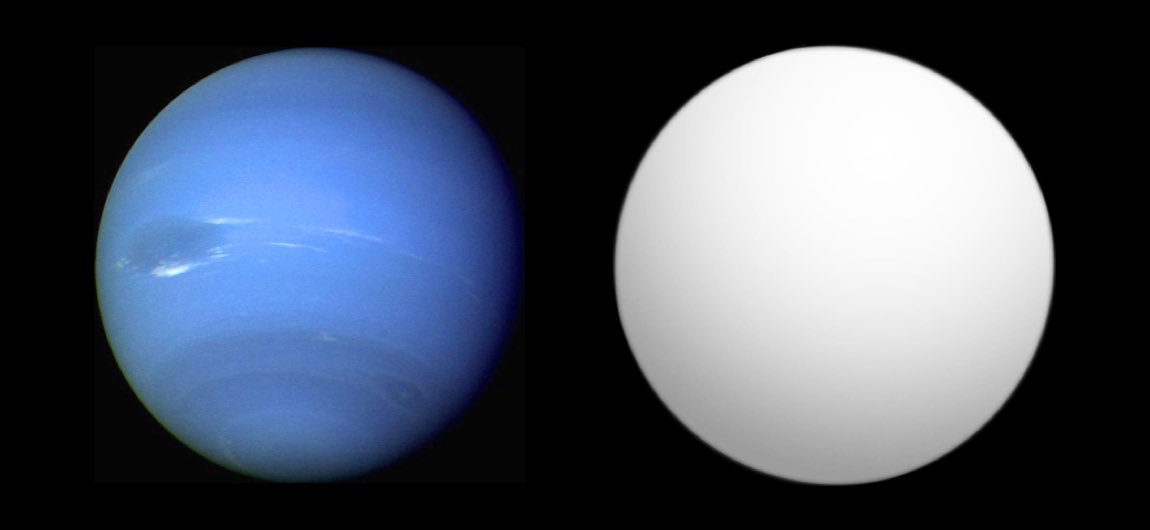
4.17 Earth radii, in the ice-giant size range. At only 22.1 Earth masses for that size, it must be substantially gas or volatile ices: puffy, not rocky.
The orbit
Its year, one full orbit, takes just 2.6 Earth days. Orbiting this tightly around a cool star, it is very likely tidally locked: one hemisphere in permanent day, the other in permanent night.
Temperature and starlight
Its equilibrium temperature (the airless-world estimate) is about 413 °C. Hotter than Venus's surface. It receives 29.4 times the starlight Earth gets.
Its sun
Its star is a red dwarf (3,586 K surface), type M2.5 V: small, dim, flare-prone, and destined to outlive the Sun many times over.
How far is that, really?
At 32 light-years, tonight's light from this system left it around the year 1994. That is close by galactic standards, which makes it a prime target for follow-up telescopes. A Voyager-speed probe would need roughly 562,814 years to get there.
How we found it
It was found by the radial-velocity method: the planet's gravity swings its star in a small circle, and that wobble shows up as a rhythmic Doppler shift in the starlight. The wobble's size gives the planet's minimum mass. The discovery was announced in 2004 from W. M. Keck Observatory.
Everything above is computed from the archive’s measured values for this planet. Where a quantity is missing, the statement is omitted rather than guessed.
The deep dive
Researched for the Atlas from Wikipedia — Gliese 436 b (5,482 characters read) · updated Sep 20, 2026
01 How Awohali Was Found
Gliese 436 b was discovered in August 2004 by R. Paul Butler and Geoffrey Marcy, working at the Carnegie Institute of Washington and the University of California, Berkeley, respectively. They used the radial velocity method, which detects the tiny gravitational tug a planet exerts on its star as it orbits — a technique that reveals a planet's presence without ever seeing the planet directly. Together with 55 Cancri e, this world became one of the first representatives of a brand-new class of planets whose minimum mass is similar to Neptune's. What made the discovery especially striking was the setting: the host star Gliese 436 is a red dwarf, a dim, cool star far smaller than the Sun. Detecting a Neptune-mass world around such a faint object pushed radial velocity measurements close to their limits at the time. The find opened the door to a population of mid-sized exoplanets — neither the rocky super-Earths nor the gas giants — that astronomers had barely begun to imagine finding in such tight orbits.
02 The Transit That Almost Went Unnoticed
On January 11, 2005, an automated observing system at New Mexico State University recorded Awohali crossing the face of its star — a transit event that would have unlocked the planet's true size on the spot. But the detection went unheeded at the time, and the discovery sat dormant in data. It was not until 2007 that Michael Gillon from Geneva University in Switzerland led a team that deliberately observed the transit and recognized its significance. Because the planet grazes the stellar disc at a shallow angle relative to Earth's line of sight, the transit geometry required careful analysis. Those observations finally allowed astronomers to determine both the exact mass and exact radius of Awohali, confirming that both values are very close to Neptune's. At the moment of that 2007 confirmation, Awohali became the smallest known transiting extrasolar planet — a record it held until the Kepler space telescope began uncovering far smaller worlds around 2010.
03 A Name Drawn From Cherokee Legend
In August 2022, Gliese 436 b and its host star were included in the third NameExoWorlds project, one of twenty planetary systems opened for public naming proposals. A team from the United States submitted names drawn from Cherokee tradition, and the International Astronomical Union announced the approved names in June 2023. The planet became Awohali — spelled ᎠᏬᎭᎵ and pronounced Ah-Wo-Ha-Lee — one of the Cherokee words for "eagle." The host star became Noquisi, meaning "star." The choice is not merely poetic. Cherokee legend tells of an eagle that flew to the Sun to carry a warrior's prayer; in return, the Sun kissed the eagle's tail feather and sent it back as a token of the bond between the people and the Great Spirit. That sun-kissed feather is a deliberate metaphor for Awohali's comet-like stream of evaporating atmosphere, a real physical structure stretching away from the planet under the radiation pressure of its own star.
04 Size, Mass, and What Lies Inside
Awohali is genuinely Neptune-sized: its diameter is about four thousand kilometers larger than Uranus and about five thousand kilometers larger than Neptune, and it is slightly more massive than Neptune. These numbers place it in a gap that was largely theoretical before its discovery — bigger than any rocky planet we know but far smaller than Jupiter or Saturn. Early models predicted that the planet's bulk would be dominated by hot "ice" — water, ammonia, and methane compressed into exotic high-pressure solid phases by the planet's own gravity, despite surface temperatures high enough to melt ordinary materials. However, once the radius was measured precisely, ice alone could not account for the observed size. A layer of hydrogen and helium amounting to up to ten percent of the planet's total mass was needed to explain why the planet is as large as it appears. An alternative model substitutes a dense rocky core surrounded by a smaller envelope of hydrogen. Which picture is closer to reality remains an open question.
05 An Orbit Closer Than Mercury Comes
Awohali circles Gliese 436 at a distance of only four million kilometers — one-fifteenth of the average distance between Mercury and the Sun. A single orbit takes just about two days and fifteen and a half hours. At that range, the planet is roasted by stellar radiation far more intensely than any world in our own solar system experiences. Yet the orbit is not circular. Its eccentricity is measurably non-zero, and that is theoretically puzzling: tidal forces at such short distances should have circularized the orbit long ago. The persistence of this eccentricity implies that something is maintaining it — most likely the gravitational pull of a second, as yet undetected planet in the system. No companion has been confirmed, but the orbital mismatch remains one of the central unsolved puzzles about Awohali and keeps the search for additional worlds in the system scientifically motivated.
06 A Wildly Tilted Orbit Around Its Star Deeper
A study published in the journal Nature revealed that Awohali's orbital plane is nearly perpendicular to the equatorial plane of its host star Noquisi, inclined by 103.2 degrees, with an uncertainty of about plus 12.8 or minus 11.5 degrees. In a well-behaved planetary system like our own solar system, planets orbit close to the equatorial plane of their star because both formed from the same flat disk of gas and dust. An inclination of roughly 103 degrees means Awohali's orbit is nearly at right angles to that disk — a dramatic departure from the expected arrangement. Astronomers interpret both the high inclination and the lingering orbital eccentricity as evidence of past gravitational interactions with an unseen companion body. That interaction could have flung Awohali into its current tilted, eccentric orbit and, at the same time, driven the inward migration that placed it so close to Noquisi — close enough that atmospheric escape is now ongoing.
 ⤢
⤢
07 Temperature Higher Than Starlight Alone Explains
By measuring how bright Awohali is when it passes behind Gliese 436 and comparing that to when it is visible, astronomers estimated its surface temperature at 712 K — about 439 degrees Celsius, or 822 degrees Fahrenheit. This is strikingly higher than the 520 K that would be expected if the planet were warmed only by absorbed starlight. Before the direct measurement was made, models accounting for a modest greenhouse effect raised the estimate to a range of 520 to 620 K, still well short of 712 K. Tidal heating from the star's gravitational kneading of the planet was considered as an explanation, but the article notes that whatever energy tidal effects deliver does not significantly affect the temperature. A strong greenhouse effect would predict an even higher temperature than 520 to 620 K — and that range itself already falls well below the observed value. The source of this excess warmth remains incompletely explained.
08 Carbon Chemistry Gone Wrong Deeper
Observations of Awohali with the Spitzer Space Telescope revealed something deeply unexpected in its atmospheric chemistry. At the planet's temperature, standard thermochemical models predict that carbon atoms in the atmosphere should bond preferentially with hydrogen to form methane rather than combining with oxygen to form carbon monoxide. Instead, results published in Nature showed that the dayside atmosphere is rich in carbon monoxide and deficient in methane by a factor of roughly seven thousand. That is an enormous discrepancy — not a small modeling error but a departure of several orders of magnitude from prediction. The leading explanation is thermochemical disequilibrium: some process, possibly vigorous vertical mixing in the atmosphere, is dredging gases from deeper, hotter layers where carbon monoxide is more stable and preventing them from converting to methane at the cooler, observable heights. This disequilibrium is one of the reasons researchers have also floated the idea that Awohali might be a helium-dominated planet, though that idea remains hypothetical.
09 Clouds Hinted at in 2013
In December 2013, NASA reported that clouds may have been detected in the atmosphere of Awohali. The announcement was notable because detecting clouds on a planet more than 30 light-years away requires reading the subtle fingerprints that atmospheric particles leave on starlight during a transit. Clouds are important beyond their visual interest: they alter how much radiation reaches lower atmospheric layers, they can change surface temperatures substantially, and they complicate efforts to measure atmospheric chemistry because they can obscure spectral features that scientists rely on to identify molecules. The possible detection added another layer of complexity to an atmosphere already known to be chemically surprising, with its anomalously high carbon monoxide and low methane. Whether the clouds are water ice, mineral dust, or some other condensate was not resolved, and the detection was framed as a possibility rather than a certainty, reflecting the difficulty of the measurement.
10 A Comet-Like Tail of Escaping Gas
In June 2015, scientists reported one of the most visually dramatic findings associated with Awohali: its atmosphere is actively evaporating, and the escaping gas forms a giant cloud enveloping the planet. Driven outward by radiation from Gliese 436, that cloud stretches into a long trailing tail 14 million kilometers long — roughly nine million miles, or about one-tenth of the distance from Earth to the Sun. The tail structure closely resembles the tails of comets in our own solar system, where solar radiation and wind sweep evaporated ices into glowing streamers. For Awohali, the evaporating material is atmospheric gas rather than comet ice, but the physical mechanism is analogous. This atmospheric escape is not merely a curiosity: over geological timescales it could significantly alter the planet's composition and mass. The Cherokee name Awohali — the eagle whose tail feather was kissed by the Sun — was chosen specifically to honor this remarkable, sun-sculpted feature of the planet's environment.
11 How Awohali Might Have Formed Deeper
Awohali's current position, just four million kilometers from its star, is almost certainly not where it formed. At such distances, a protoplanetary disk typically lacks enough solid material to build even a small planet. The leading hypothesis is that Awohali originally formed much farther out, as a gas giant, in a cooler region of the disk where ices could condense and provide enough building material. Over time, interactions with the disk or with other planets drove it inward toward its current orbit — a process called migration. As it moved closer to Gliese 436, intense stellar radiation, including coronal mass ejections, would have stripped away much of its original hydrogen envelope, explaining why a Neptune-mass object is what remains rather than a Jupiter-mass giant. The gravitational interaction invoked to explain the orbit's eccentricity and steep tilt may itself be what triggered the inward migration, linking the formation story, the orbital architecture, and the ongoing atmospheric escape into a single connected narrative.
12 First Certain Hot Neptune: Why It Matters
When Awohali was confirmed as a transiting planet in 2007, it earned a distinction no other world had held: the first hot Neptune discovered with certainty. Hot Jupiters — gas giants in tight orbits — were already well known by then, but finding a much smaller world of similar type was a significant step. It demonstrated that the same migration processes thought to produce hot Jupiters could also deliver Neptune-class planets to scorching inner orbits, implying a richer diversity of planetary architectures than models had fully predicted. At the same time, Awohali's unusual atmospheric chemistry, its tilted and eccentric orbit, and its evaporating exosphere quickly made it one of the most scientifically productive individual exoplanets known. It raised new questions about what happens to mid-sized planets when they are transplanted to extreme environments, and those questions still drive observational campaigns and theoretical modeling more than a decade after the initial transit confirmation.
About this record
The measured values come from the NASA Exoplanet Archive, and any missing value has not been determined yet; the Atlas never fills gaps with guesses. More standout worlds: Proxima b, TRAPPIST-1e, K2-18 b, 55 Cancri e, and the detection methods that found them all.