Confirmed exoplanet · Database record + computed analysis
GJ 1214 b
A confirmed world orbiting GJ 1214, 47.8 light-years away.
A sub-Neptune
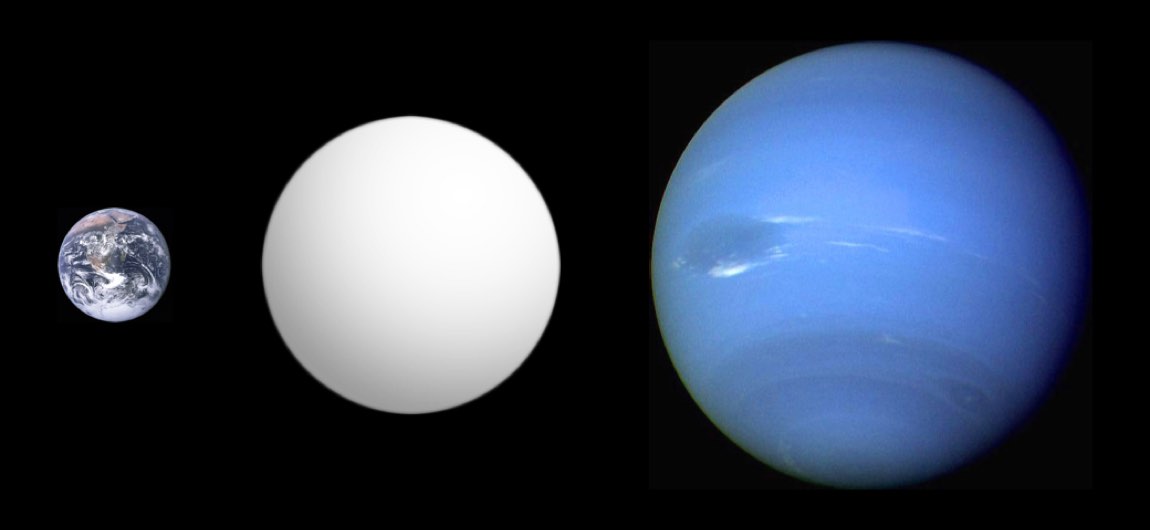
2.73 Earth radii, likely a rocky core under a thick gas or steam envelope rather than a walkable surface.
The orbit
Its year, one full orbit, takes just 1.6 Earth days. Orbiting this tightly around a cool star, it is very likely tidally locked: one hemisphere in permanent day, the other in permanent night.
Temperature and starlight
Its equilibrium temperature (the airless-world estimate) is about 294 °C. Above water's boiling point. It receives 17.2 times the starlight Earth gets.
Its sun
Its star is a red dwarf (3,101 K surface), type M4 V: small, dim, flare-prone, and destined to outlive the Sun many times over.
How far is that, really?
At 48 light-years, tonight's light from this system left it around the year 1978. That is close by galactic standards, which makes it a prime target for follow-up telescopes. A Voyager-speed probe would need roughly 844,965 years to get there.
How we found it
It was found by the transit method: the planet crosses its star's face on schedule, dimming it by a tiny, repeating fraction. The dip's depth gives the planet's size. The discovery was announced in 2009 from MEarth Project.
Everything above is computed from the archive’s measured values for this planet. Where a quantity is missing, the statement is omitted rather than guessed.
The deep dive
Researched for the Atlas from Wikipedia — GJ 1214 b (7,148 characters read) · updated Sep 20, 2026
01 How GJ 1214 b Was Found in 2009
The discovery of GJ 1214 b began with the MEarth Project, a survey specifically designed to catch the faint dimming that happens when a planet slides across the face of its star as seen from Earth. In early 2009, astronomers running the project noticed that the star GJ 1214 showed exactly those telltale brightness dips. Closer watching confirmed that the star dims by roughly 1.5% every 1.58 days — a remarkably short orbital period. That photometric signal alone was suggestive, but not conclusive. The team then turned to the HARPS spectrograph, mounted on the European Southern Observatory's 3.6-meter telescope at La Silla, Chile, and measured tiny Doppler shifts in the star's spectral lines caused by the planet's gravitational tug. Those radial-velocity measurements provided independent confirmation that a real planet was responsible for the dimming. The results were published in the journal Nature, which introduced the world to GJ 1214 b along with initial estimates of its mass, radius, and orbital parameters — making it only the second planet between Earth and Neptune in mass to have both quantities directly measured.
02 Measuring Mass and Radius from Afar
Because GJ 1214 b transits its host star, astronomers can derive its size without ever sending a probe. The fraction of starlight blocked during transit scales with the ratio of the planet's area to the star's area, yielding a radius of 2.733 (+0.033, −0.031) Earth radii — roughly 2.7 times wider than our planet. Mass is trickier: it requires tracking how strongly the planet's gravity tugs the star toward and away from us via the Doppler effect on the star's spectral lines. That technique gives a mass of 8.41 (+0.36, −0.35) Earth masses. Combining mass and radius produces a density, and density is where the real detective work begins. By comparing the calculated density against theoretical interior models, scientists can start to constrain what the planet is actually made of — whether its bulk is dominated by rock, water, gas, or some layered combination. The uncertainties on both measurements are small enough to be scientifically meaningful, yet large enough that several very different interior compositions remain consistent with the data, which is why the planet's true nature has been debated for over a decade.
03 A Planet on the Cool Edge of Transiting Worlds
Despite orbiting its star every 1.58 days — an orbit that would fit comfortably inside Mercury's path around the Sun — GJ 1214 b is not scorching by the standards of hot Jupiters. Its equilibrium temperature is estimated to fall somewhere between 393 and 555 K, which translates to roughly 120–282 °C or 248–539 °F. The wide range reflects genuine uncertainty about the planet's albedo: a more reflective surface bounces more starlight back into space and stays cooler, while a darker surface absorbs more and runs hotter. At the time of its discovery, GJ 1214 b was considered to be cooler than any other known transiting planet, a distinction it held until the Kepler mission announced Kepler-16b in 2011. The moderate temperatures, at least by exoplanet standards, were part of what made scientists initially enthusiastic about the ocean-planet hypothesis — liquid water at the surface seemed at least thermodynamically plausible under certain assumptions, even though later evidence has substantially undermined that picture.
04 The "Waterworld" Idea and Why It Faded
At the time of its discovery in December 2009, GJ 1214 b was celebrated as the most plausible candidate for an ocean planet yet known, and scientists routinely called it a "waterworld." The logic rested on its density: too light to be purely rocky, yet too small and dense to be a conventional gas giant. One tidy solution was a world with roughly 75% water and 25% rock by mass, capped by a thin gaseous envelope of hydrogen and helium making up about 0.05% of total mass. Scientists even drew comparisons to a hotter, larger version of Jupiter's moon Europa. However, the article is careful to note that no scientist actually claimed to believe GJ 1214 b is an ocean planet — it was always a model assumption, not a conclusion. A study informed by James Webb Space Telescope observations later concluded that a waterworld composition is implausible, pointing instead toward a thick gaseous envelope of hydrogen, helium, water vapor, and other volatiles such as methane or carbon dioxide. A January 2025 spectroscopic analysis further cemented the shift, describing the atmosphere as metallic with carbon dioxide acting as an aerosol, making an ocean planet unlikely.
05 Inside a Water World: Exotic Phases of H₂O Deeper
If GJ 1214 b were an ocean planet — a scenario now considered unlikely but still scientifically instructive — the interior would be far stranger than any ocean on Earth. Models of such a world predict that water would exist simultaneously in multiple exotic states depending on depth and pressure. Near the top, temperatures and pressures could sustain steam. Deeper down, liquid water might transition into a superfluid state with no viscosity. Still deeper, the crushing pressures would force water into high-pressure ice phases, including the exotic form known as ice VII — a solid that can exist at temperatures far above water's normal boiling point because extreme pressure forces molecules into a rigid crystalline lattice regardless of heat. At the deepest levels, water could enter a plasma phase. This layered portrait of H₂O running through steam, liquid, superfluid, high-pressure ices, and plasma within a single planet illustrates why "water world" is not simply a poetic label but a descriptor of genuinely alien chemistry that has no direct analog anywhere in our Solar System.
06 Atmospheric Loss and the Helium Detective Story Deeper
Whatever atmosphere GJ 1214 b has today is almost certainly not the one it was born with. Scientists calculated that the planet loses atmosphere through a process called hydrodynamic escape at a rate of 900 tonnes per second. Over the estimated old age of the planetary system, that leakage adds up to a massive loss of lighter gases. Hydrodynamic escape preferentially strips lower-mass molecules and atoms from the top of the atmosphere, meaning the original hydrogen-dominated primordial atmosphere would have been steadily eroded. This was indirectly confirmed in 2020, when observers failed to detect any helium at GJ 1214 b — helium being one of the species expected to escape readily and thus be detectable in the upper atmosphere as it bleeds away. By 2022, however, helium was tentatively detected after all, adding a layer of ambiguity. The detection status of helium at this planet thus shifted from absent in 2020 to tentative in 2022, illustrating how the field of exoplanet atmospheric science is still maturing and how results can evolve significantly within just a few years of improved observations.
 ⤢
⤢
07 Clouds, Hazes, and a Featureless Spectrum Deeper
One of the most puzzling early findings about GJ 1214 b was published in December 2010: observations of the planet's atmosphere over a wavelength range of 750 to 1000 nanometers produced a spectrum that was largely featureless. This was scientifically striking because a clear, hydrogen-rich atmosphere would have generated strong, detectable absorption features from molecules such as water vapor. The absence of such features ruled out a thick, cloud-free hydrogen-dominated atmosphere. Yet the spectrum was not informative enough to clearly identify what was present either — no definitive signs of water vapor or any other specific molecule appeared. The two leading explanations were a water-vapor-dominated atmosphere and a thick high-altitude cloud or haze layer that absorbs starlight before it can interact with molecules below. In December 2013, NASA reported tentative evidence for clouds in the atmosphere. This cloud-and-haze picture is consistent with the January 2025 report of carbon dioxide acting as an aerosol suspended in a metallic atmospheric layer — a configuration likened to a "Super-Venus" rather than anything resembling a habitable ocean world.
08 From Mini-Neptune to Super-Venus: Shifting Labels
GJ 1214 b has worn several labels since its discovery, each reflecting the best available evidence at the time. It was first celebrated as an ocean planet or waterworld. Its intermediate size — larger than Earth but much smaller than Neptune — also earned it the designation sub-Neptune or mini-Neptune, categories that did not even have confirmed members until the late 2000s. The article describes it as the first of a new class of planets characterized by small size and relatively low density. As atmospheric observations accumulated and pointed away from a liquid-water surface, comparisons shifted toward Venus: a 2024 study suggested the atmosphere may be rich in carbon dioxide, resembling that of Venus, and a 2025 analysis introduced the term "Super-Venus" to describe a planet with a metallic atmosphere and carbon dioxide aerosols. Each relabeling is not mere semantics — it reflects fundamentally different physics, chemistry, and implications for whether similar worlds elsewhere could be habitable. GJ 1214 b's journey through these categories mirrors the broader scientific community's growing sophistication in characterizing planets that have no direct equivalent in our own Solar System.
09 How Migration Could Have Built This World Deeper
The existence of a planet like GJ 1214 b — positioned very close to its star yet composed partly or largely of volatile-rich material — has prompted theorists to invoke planetary migration. Water-rich planets, the reasoning goes, most naturally form beyond the snow line, the distance from a young star where temperatures are cold enough for water ice to condense into solid grains that can be incorporated into a growing planet. Inside the snow line, where GJ 1214 b orbits today, water ice would have been scarce in the original protoplanetary disk. The favored explanation is that the planet formed farther out, accumulated volatile ice-rich material, but never grew massive enough to sweep up large quantities of hydrogen and helium gas from the nebula. It then drifted inward through gravitational interactions with the disk, arriving at its current tight orbit. This formation pathway would explain both the planet's volatile-rich potential composition and the relatively thin gaseous envelope — about 5% of planetary mass in one model — compared to a full gas giant, which would have accreted a far more massive hydrogen-helium atmosphere.
10 Why the Host Star's Size Matters So Much
GJ 1214 is a small, dim red star located 48 light-years from the Sun in the constellation Ophiuchus. Its modest size turns out to be scientifically invaluable. When a planet transits a larger, brighter star, the planet's contribution to the combined light signal is proportionally tiny and difficult to pull apart. Because GJ 1214 is small, its transiting planet blocks a larger fraction of the star's disk, producing a deeper, cleaner transit signal. More importantly, the star's relative faintness makes it practical to compare the stellar spectrum observed before a transit with the spectrum measured during transit. Any difference between the two spectra reveals absorption by the planet's atmosphere — effectively letting astronomers read the atmospheric chemistry from 48 light-years away without any spacecraft near the planet. This is why GJ 1214 b became such an attractive target for follow-up atmospheric studies and why it has been repeatedly observed with facilities ranging from ground-based spectrographs to the James Webb Space Telescope. The proximity of the system — 48 light-years is relatively close on galactic scales — amplifies this advantage further by making the star bright enough to study with reasonable telescope time.
11 Named for a Kenyan Proposal: Enaiposha
In August 2022, GJ 1214 b and its host star were included among 20 planetary systems selected for public naming through the International Astronomical Union's third NameExoWorlds project. A team from Kenya submitted the winning proposal, and the approved names were officially announced in June 2023. The planet received the name Enaiposha, drawn from the Maa language — spoken by the Maasai and related communities — where it means a large body of water. The choice was a direct nod to the longstanding waterworld hypothesis for the planet's composition. The host star was simultaneously named Orkaria, the Maa word for red ochre, alluding to the reddish color characteristic of small, cool red dwarf stars like GJ 1214. Together, the two names embed East African cultural heritage into the permanent scientific record of an alien solar system 48 light-years away. The naming also illustrates how the NameExoWorlds program deliberately draws on the full diversity of human languages and traditions, rather than defaulting to names drawn exclusively from classical Greek, Latin, or European mythology.
12 Open Questions After 15 Years of Study
Despite being one of the most intensively studied exoplanets discovered in the past two decades, GJ 1214 b still resists a clean description. Its bulk composition remains genuinely uncertain: models consistent with its measured mass of 8.41 Earth masses and radius of 2.733 Earth radii include a rocky planet with an outgassed hydrogen atmosphere, a mini-Neptune with a thick volatile envelope, and the now-disfavored ocean planet scenario. The atmosphere's exact makeup is contested — the 2025 spectroscopic analysis suggesting a Super-Venus-like metallic atmosphere with carbon dioxide aerosols is described as needing further confirmation to rule out a statistical anomaly. The helium detection shifted from absent in 2020 to tentative in 2022, leaving that question open. Whether the carbon-dioxide-rich atmosphere reported in 2024 is truly Venus-like or represents something without a Solar System analog is unresolved. Each new generation of instruments, culminating in James Webb Space Telescope observations, has refined but not yet settled the debate — making GJ 1214 b one of the most productive and instructive targets in the search for understanding how diverse planetary atmospheres can be.
About this record
The measured values come from the NASA Exoplanet Archive, and any missing value has not been determined yet; the Atlas never fills gaps with guesses. More standout worlds: Proxima b, TRAPPIST-1e, K2-18 b, 55 Cancri e, and the detection methods that found them all.