Tucana
“The Toucan” · Southern · best around November evenings
Real star positions and magnitudes (HYG database via D3-Celestial, BSD-3). Lines are the conventional stick figure; north is up.
The story
The Dutch navigators' toucan hosts two southern marvels: most of the Small Magellanic Cloud, and 47 Tucanae — the second-grandest globular cluster in the sky, a glittering ball of a million ancient suns.
How to find it
Near the Small Magellanic Cloud.
✦ What lives inside it
- 47 Tucanae globular
The deep dive
Researched for the Atlas from Wikipedia — Tucana (12,723 characters read) · updated Sep 20, 2026
01 Born from a single Dutch voyage
Tucana owes its existence to one specific commercial expedition: the Eerste Schipvaart, the first Dutch trading voyage to the East Indies. Navigators Pieter Dirkszoon Keyser and Frederick de Houtman made systematic observations of the southern sky during that journey, and the astronomer Petrus Plancius used their data to carve up unfamiliar southern skies into twelve new constellations. Tucana was among them, making its public debut on a 35-centimetre-diameter celestial globe published in Amsterdam in 1598, crafted jointly by Plancius and the cartographer Jodocus Hondius. Five years later, Johann Bayer immortalised the figure in his landmark star atlas Uranometria of 1603. It is a rare case where the precise commercial voyage, the field observers, the desk astronomer, and the publication date are all known — the constellation has a paper trail from tropical sea to printing house.
02 Not a toucan everywhere you looked
The creature mapped in the southern sky was never universally seen as a toucan. De Houtman catalogued it under the Dutch name Den Indiaenschen Exster, op Indies Lang ghenaemt — "the Indian magpie, named Lang in the Indies" — intending a long-beaked hornbill native to the East Indies rather than a South American toucan. A 1603 globe by Willem Blaeu depicted it with a casque, leaning toward that hornbill interpretation. Chinese charts translated the figure as Niǎohuì, meaning "bird's beak." English sources called it "Brasilian Pye." Johannes Kepler and Giovanni Battista Riccioli preferred Anser Americanus, "American Goose," while Caesius recorded it as Pica Indica. Plancius and Bayer settled on the toucan identity that stuck, but for decades the same star pattern was simultaneously a hornbill, a magpie, a goose, and a pye depending on whose chart you consulted. The bright star Alpha Tucanae itself received the proper name Lang-Exster — honouring the original Dutch name — only as recently as 19 September 2024.
03 Giving stars their letters, a century late Deeper
Bayer drew Tucana in his 1603 Uranometria but made no effort to label its individual stars with Greek letters — an omission that left the constellation's stars nameless by Bayer's usual system for more than 150 years. It fell to the French explorer and astronomer Nicolas Louis de Lacaille to assign Bayer designations during his southern sky campaign, publishing them in 1756. Lacaille labelled the stars Alpha through Rho, but left deliberate gaps: he skipped Omicron and Xi entirely, gave the label Lambda to two stars sitting close together, and assigned Beta to a tight group of three. One object he wisely passed over for a stellar designation he recognised as nebulous — it was later identified as the globular cluster 47 Tucanae and received the Xi designation only in 1879 from American astronomer Benjamin Gould. Francis Baily later dropped Mu Tucanae, judging the star too faint to deserve a letter. The Kappa pair evolved into Kappa1 and Kappa2 as the components were resolved. The constellation's labelling history is therefore a patchwork of decisions spread across more than two centuries.
04 A six-star system hiding in plain sight
Beta Tucanae, sitting near the tail of the toucan, is one of the more architecturally surprising star systems in the southern sky. What appears at a glance as a modest grouping is actually six gravitationally associated stars. The two brightest components, Beta1 and Beta2, sit 27 arcseconds apart with apparent magnitudes of 4.4 and 4.5 respectively — close enough that a small telescope splits them cleanly. Ten arcminutes away, Beta3 Tucanae can be picked out with the unaided eye as a distinct point. Here is the elegant twist: each of these three visible stars is itself a spectroscopic binary, doubling the headcount to six stars total. The pairing cannot be seen directly through any telescope; the companions are revealed only by shifts in the stars' spectra. Together, Beta Tucanae compresses what looks like a simple double into a miniature stellar community.
05 Alpha Tucanae, a slow giant with a secret partner
The constellation's brightest star, Alpha Tucanae, shines at apparent magnitude 2.86 and marks the toucan's head. It is an orange subgiant of spectral type K3III sitting about 199 light-years from the Solar System. Cool by stellar standards at 4,300 K on its surface, it is nonetheless 424 times as luminous as the Sun and 37 times wider — a diameter so large that if placed where the Sun is, it would engulf Mercury and push nearly to Venus. Its mass is estimated at 2.5 to 3 solar masses. Alpha Tucanae is a spectroscopic binary: no telescope has ever separated the two stars visually, but telltale wobbles in the spectrum betray the companion's gravitational tug. The two stars complete an orbit every 4,197.7 days — roughly 11.5 years. Beyond confirming it exists, astronomers know nothing about the companion: its mass, type, and luminosity remain undetermined.
06 Theta Tucanae and its drained companion Deeper
Theta Tucanae is a white A-type star about 423 light-years from Earth and, on close inspection, a binary system with an unusual history written into its components. The primary is classified as a Delta Scuti variable — a class of pulsating stars with periods of at most six hours, used both as standard candles and as windows into stellar interiors through asteroseismology. Its pulsations cause the combined light of the system to swing between magnitudes 6.06 and 6.15 every 70 to 80 minutes. The primary has accumulated roughly twice the Sun's mass, and the article's explanation for that excess is striking: it appears to have siphoned one entire solar mass away from its companion over time. That companion is now a hydrogen-depleted dwarf reduced to approximately 0.2 solar masses — a star stripped of most of its fuel by its neighbour. The system is a compact record of mass transfer playing out across stellar lifetimes.
07 Zeta Tucanae, a nearby near-twin of the Sun
At only 28 light-years away, Zeta Tucanae is one of the closer stars in Tucana and draws scientific attention because of how closely it resembles the Sun. Its spectral type is F9.5V, its composition and mass sit very near solar values, and its estimated age is around three billion years. Paradoxically, despite having slightly less mass than the Sun, it is more luminous — a reminder that the mass-luminosity relationship is not perfectly linear. The star's solar-like character makes it a candidate for investigations into whether life-bearing planets might exist around it. Adding intrigue, it appears to host a debris disk — a ring of dust and rubble orbiting at a minimum radius of 2.3 astronomical units, roughly where the asteroid belt sits in our own Solar System. As of 2009, no planet had been detected around Zeta Tucanae, but the debris disk hints that planet-building processes have been at work.
08 47 Tucanae, a twelve-billion-year-old city of stars
Sitting just west of the Small Magellanic Cloud, 47 Tucanae — catalogued as NGC 104 — ranks as the second-brightest globular cluster in the entire sky, outshone only by Omega Centauri. It glows at apparent magnitude 3.9, making it visible to the naked eye, and at 14,700 light-years it is one of the nearer globular clusters to Earth. Its estimated age of around 12 billion years means it formed when the universe was less than two billion years old. The cluster is classified as Shapley class III, indicating a clearly defined, concentrated nucleus. Most of its stars are old and yellow, but 47 Tucanae also harbours blue stragglers — unusually hot, luminous stars hypothesised to form when two binary stars merge, effectively combining their hydrogen supplies and appearing younger than their surroundings. Originally, astronomer Benjamin Gould intended to assign it the designation Xi Tucanae in 1879, recognising that Lacaille had left the position blank precisely because he had noticed something nebulous there.
09 NGC 362, the cluster with a dangerous commute Deeper
NGC 362 is Tucana's second significant globular cluster, with an apparent magnitude of 6.4 and a distance of 27,700 light-years from Earth — nearly twice as far as 47 Tucanae. Like its famous neighbour, it is a Shapley class III cluster and counts among the brightest globular clusters in the sky. What sets NGC 362 apart dynamically is its orbit: unlike most globular clusters that maintain a respectful distance from the Milky Way's turbulent core, NGC 362 swings to within approximately 3,000 light-years of the galactic centre. That is an extraordinarily close approach for a globular cluster, placing it in a region of intense gravitational forces and stellar density. The cluster was discovered in the 1820s by James Dunlop. Through a telescope, its individual stars become distinguishable beginning at around 180x magnification — a useful benchmark for observers planning a session.
10 The Small Magellanic Cloud, pulled out of shape
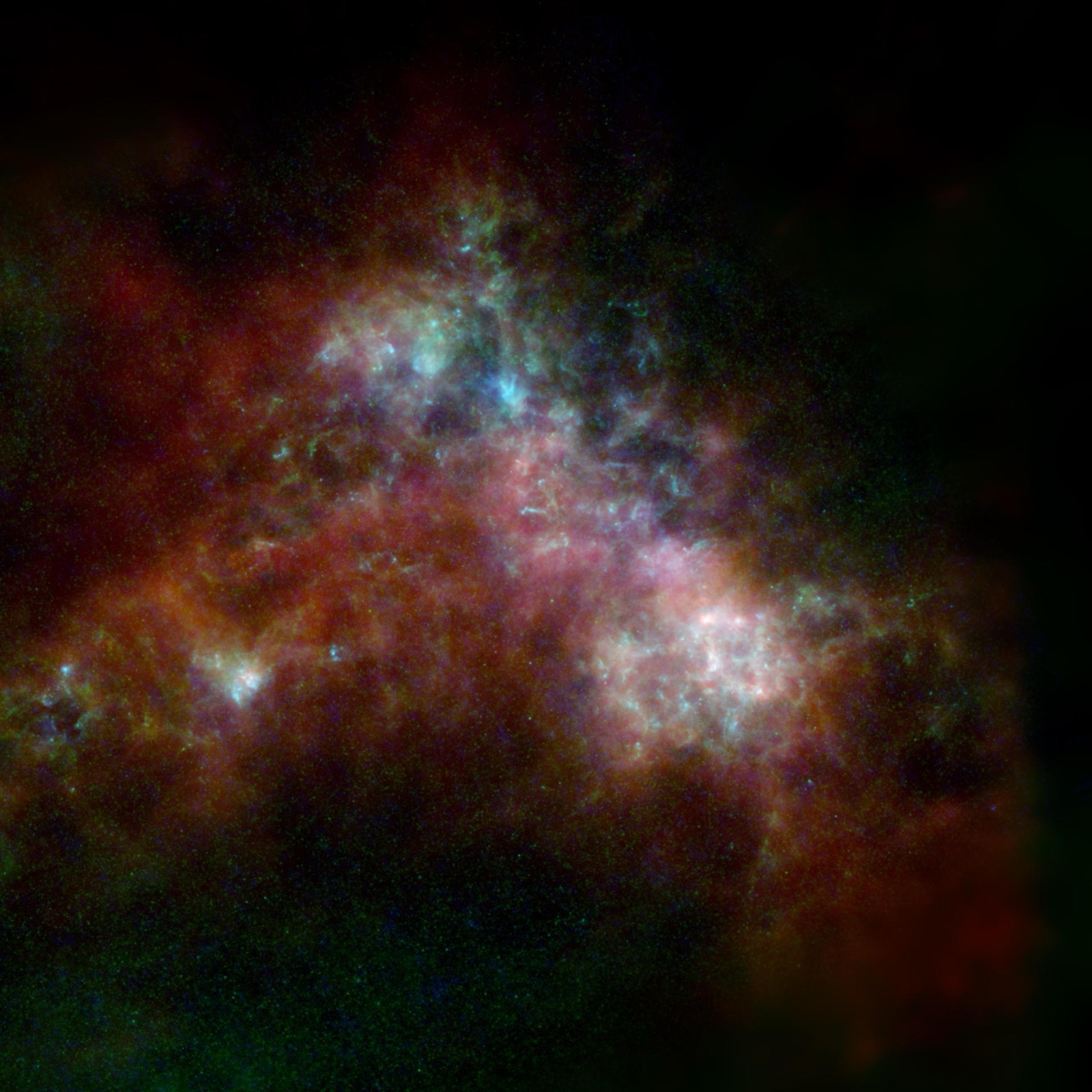
Most of the Small Magellanic Cloud falls within Tucana's boundaries, giving the constellation a claim on one of the Milky Way's nearest galactic neighbours. The SMC is a dwarf galaxy sitting 210,000 light-years away — close enough that it is visible to the naked eye as a detached luminous patch. Astronomers believe it probably began as a disk-shaped structure, but tidal forces from the far more massive Milky Way have distorted it into the irregular form seen today. Together with the Large Magellanic Cloud, it is embedded within the Magellanic Stream, a bridge of gas connecting the two satellite galaxies. Inside the SMC sits NGC 346, a vigorous star-forming region with an apparent magnitude of 10.3. Nested within NGC 346 is the triple-star system HD 5980, each of its three members ranking among the most luminous stars known — an extraordinary concentration of stellar power in an already remarkable location.
11 The Tucana Dwarf, almost outside the family Deeper
Near the southern reaches of the constellation lies the Tucana Dwarf galaxy, a dwarf spheroidal of type dE5 discovered in 1990. It is classified as an isolated member of the Local Group — the gravitationally bound family of galaxies that includes the Milky Way and Andromeda. Its distance from the Solar System is 870 kiloparsecs, equivalent to about 2,800,000 light-years. More tellingly, it sits roughly 1,100 kiloparsecs — around 3,600,000 light-years — from the Local Group's barycentre, the point around which the whole group's mass is balanced. That places it as the second most remote confirmed member galaxy of the Local Group, exceeded in isolation only by the Sagittarius Dwarf Irregular Galaxy. Its extreme position raises genuine questions about whether it is truly gravitationally bound to the group or merely passing through the neighbourhood.
12 When Hubble stared at Tucana for two weeks
In 1998, a patch of Tucana became the focus of one of the most ambitious observing programmes ever undertaken: a two-week continuous stare by the Hubble Space Telescope that produced the Hubble Deep Field South. Selecting the target area required unusual criteria. The field needed to lie at the poles of Hubble's orbit so the telescope could observe it without interruption as it circled Earth. The deciding factor that confirmed the final choice was the discovery of a quasar, designated QSO J2233-606, within the candidate field. The resulting deep image peered billions of light-years into the universe, revealing thousands of galaxies in various stages of formation and evolution — most of them far too faint and distant for any other instrument of that era to detect. A seemingly empty corner of Tucana turned out to conceal an almost incomprehensible depth of the cosmos.
13 Planets hiding in a faint constellation Deeper
Despite Tucana's modest stellar brightness, five star systems within its boundaries have been found to host planets, and four of those discoveries came from a single instrument: the High Accuracy Radial Velocity Planet Searcher, or HARPS, operating in Chile. HD 4308, with about 83 percent of the Sun's mass and lying 72 light-years away, hosts a super-Earth completing an orbit every roughly 15 days. HD 215497, an orange K3V star 142 light-years distant, has both a hot super-Earth orbiting every 3 days and a Saturn-sized planet with a period of around 567 days. HD 221287, of spectral type F7V at 173 light-years, hosts a planet more massive than Jupiter. HD 7199, 117 light-years away, has a planet carrying about 30 percent of Jupiter's mass with a 615-day orbital period. HD 219077 rounds out the group with a planet roughly ten times Jupiter's mass in a highly eccentric orbit — a configuration that raises questions about what, if anything, could survive alongside such a massive, erratic neighbour.