Scutum
“The Shield” · Southern · best around August evenings
Real star positions and magnitudes (HYG database via D3-Celestial, BSD-3). Lines are the conventional stick figure; north is up.
The story
Hevelius's shield of King Sobieski — the only constellation honoring a then-living person's deed (the 1683 relief of Vienna). Tiny, but its Milky Way patch, the Scutum Star Cloud, is the brightest of all; the Wild Duck cluster flies within it.
How to find it
The bright Milky Way knot between Altair and the Teapot.
✦ What lives inside it
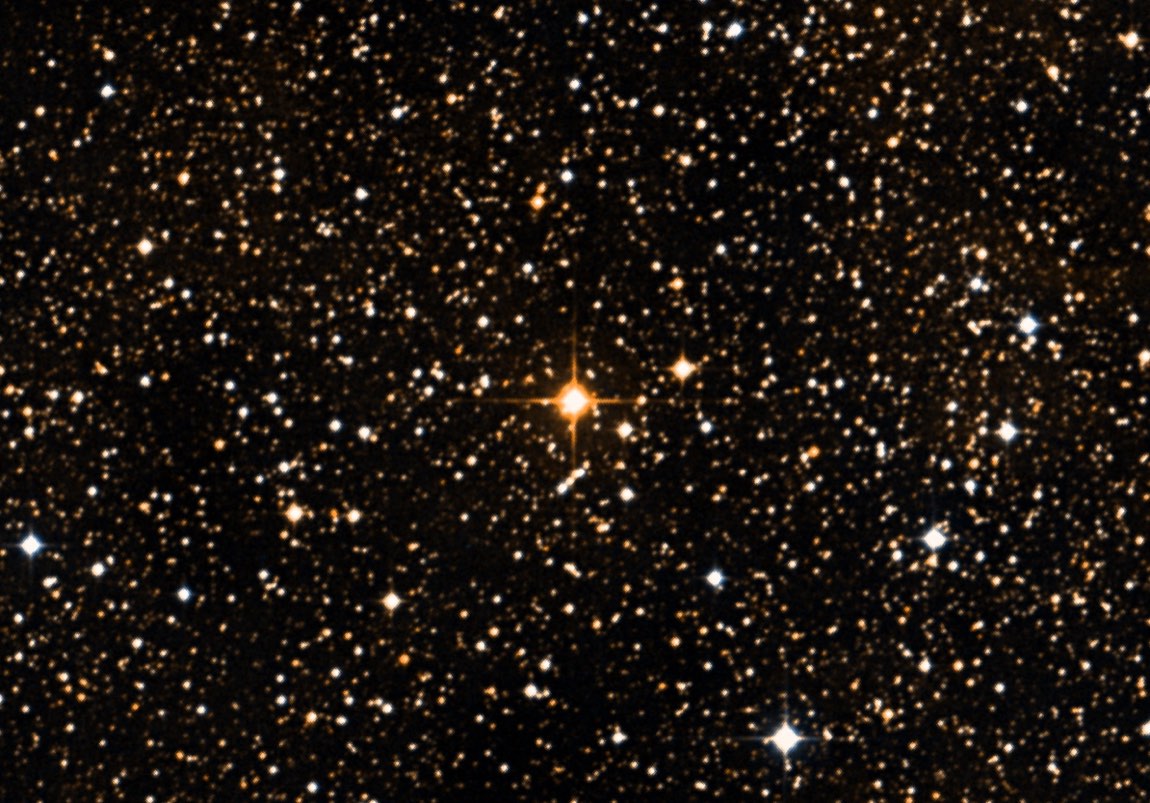
- Wild Duck Cluster (M11)
- Scutum Star Cloud
The deep dive
Researched for the Atlas from Wikipedia — Scutum (constellation) (3,562 characters read) · updated Sep 20, 2026
01 A Shield Raised for a King
When Johannes Hevelius introduced Scutum to the sky in 1684, he was doing something rare in the history of constellation-making: celebrating a living political event. The full original name, Scutum Sobiescianum, translates as the Shield of Sobieski, a direct tribute to Polish King John III Sobieski, whose forces had led the Christian coalition to victory at the Battle of Vienna just one year earlier, in 1683. Hevelius, himself Polish, was clearly proud of the moment. The stars he gathered into this figure had previously belonged to the neighboring constellation Aquila — five of them were catalogued simply as 1, 6, 2, 3, and 9 Aquilae before Hevelius drew his new boundary. Over the following centuries the political dedication faded from common use and the name was shortened to the plain Latin word for shield, Scutum. The International Astronomical Union formally adopted the constellation in 1922, assigning it the official abbreviation Sct and fixing its boundaries within a defined quadrilateral of sky.
02 Where East Meets West in the Stars
One of the more striking coincidences in cultural astronomy involves Scutum's stars and their independent meaning in Chinese sky-lore. While Hevelius was drawing a military shield over this patch of sky in 17th-century Europe, Chinese astronomers had already incorporated the same stars into a larger asterism called Tien Pien, meaning the Heavenly Casque, or Helmet. A casque is a battle helmet, so both traditions, separated by thousands of miles and entirely independent of each other, looked at the same faint grouping and saw military protective gear. Neither culture saw a swan or a hunter here — both saw armor. This kind of convergence is uncommon enough to be worth noting, and it suggests that the modest diamond shape of Scutum's brightest stars genuinely does carry a visual quality that reads as something hard-edged and defensive to the human eye, regardless of cultural background.
03 Pinning Down Its Patch of Sky
Scutum sits just south of the celestial equator, nestled between Aquila to the north and Sagittarius to the south, in one of the richest corridors of the Milky Way. Its formal boundaries in the equatorial coordinate system run in right ascension from 18 hours 21.6 minutes to 18 hours 59.3 minutes, and in declination from −3.83 degrees to −15.94 degrees. That narrow strip of right ascension — less than 38 minutes of sky time wide — makes Scutum one of the more compact constellations on the celestial sphere, and its four brightest stars form a narrow diamond that spans only a few degrees. Despite its small footprint, the constellation punches well above its weight in terms of interesting objects, because it lies squarely in front of one of the densest regions of the galactic disk, giving observers a deep line of sight through star-forming territory.
04 Modest Brightness, Remarkable Stars
By any measure of naked-eye impressiveness, Scutum is subdued. Its brightest star, Alpha Scuti, is a K-type giant shining at magnitude 3.85 — visible under good skies but easily overlooked in a rich Milky Way field. Beta Scuti follows at magnitude 4.22, and Delta Scuti at 4.72. What makes these stars interesting lies beneath their unremarkable appearance. Beta Scuti is a binary system whose primary star carries a solar-like spectral type yet burns 1,270 times brighter than the Sun — a reminder that spectral type and luminosity are not the same thing. Delta Scuti, the star formerly catalogued as 6 Aquilae, is a bluish-white giant with an unusual distinction: it is currently heading toward our solar system. Calculations indicate that within 1.3 million years it will pass within roughly 10 light-years of Earth, at which point it would appear far brighter than Sirius does today.
05 Giants Hidden in a Small Constellation Deeper
Scutum is home to some of the most physically enormous stars known anywhere in the galaxy. UY Scuti, a red supergiant, carries a radius exceeding 900 times that of the Sun, placing it consistently among the largest stars yet measured — a sphere so vast that if placed at the center of our solar system it would engulf the orbit of Jupiter. Even that colossus is outclassed within the same constellation: RSGC1-F01 is a red supergiant with a radius exceeding 1,450 times the Sun's, making it one of the most extreme examples of stellar inflation known. These monsters do not stand alone. Scutum hosts several clusters built almost entirely of supergiant stars, including RSGC1, Stephenson 2, and RSGC3. Their existence in one small corner of sky reflects the region's position near a zone of intense star formation along the Milky Way's inner arms, where massive stars formed and evolved rapidly.
06 The Wild Duck Cluster Up Close
Messier 11, the Wild Duck Cluster, earned its common name from the British admiral and astronomer William Henry Smyth, who in 1844 described its appearance through an eyepiece as resembling a flock of wild ducks in flight. The metaphor has stuck for nearly two centuries. The cluster lies 6,200 light-years from Earth and stretches roughly 20 light-years in diameter, packing approximately 3,000 stars into that volume — a density that makes it one of the richest open clusters in the sky. Its age is estimated at around 220 million years, though some studies push the figure older. Estimates of the cluster's total mass range widely, from 3,700 to 11,000 solar masses, and that uncertainty reflects ongoing difficulty in accounting for faint low-mass members and stars that have already evolved away from the main sequence. For visual observers, M11 rewards even a small telescope, resolving into a striking spray of faint points surrounding a brighter central condensation.
07 A Globular and a Nebula, Close Neighbors Deeper
In the eastern portion of Scutum, two very different classes of deep-sky object happen to sit unusually close together on the sky. The globular cluster NGC 6712 and the planetary nebula IC 1295 are separated by only 24 arcminutes — less than the apparent diameter of the full Moon. That proximity is a line-of-sight coincidence rather than a physical association; globular clusters and planetary nebulae belong to entirely different stages and populations of stellar evolution. NGC 6712 is a ball of ancient stars bound together by gravity, while IC 1295 is the glowing expelled shell of a single dying star. Finding both in the same low-power telescopic field offers an efficient contrast between cosmic time scales: the globular contains stars whose ages may approach the age of the universe itself, while the planetary nebula represents the final gasps of a star that lived and died in a fraction of that span.
08 Pioneer 11's Long Farewell
Long after its mission ended, the space probe Pioneer 11 continues to drift outward from the solar system, and its direction of travel points toward the constellation Scutum. The journey ahead is almost incomprehensibly long. Even at the speed Pioneer 11 was traveling, it will not come anywhere near the closest star in that patch of sky for over a million years — and by that point, its batteries will have been dead for most of that interval, its instruments silent, its signal gone. It will simply continue as a piece of inert metal moving through interstellar space. The trajectory toward Scutum is notable mainly because it connects the very human act of building and launching a spacecraft to the vast, indifferent timescales of stellar distances. Scutum is not a destination; it is simply the direction that physics and the geometry of Pioneer 11's final flyby happened to aim it.
09 Why This Region Overflows With Clusters Deeper
The abundance of star clusters in Scutum — open clusters including M11 and M26, supergiant clusters like RSGC1 and Stephenson 2, plus the globular NGC 6712 — is not a coincidence of chance alignment. Scutum sits along a line of sight that cuts deep into the galactic plane toward the inner Milky Way, intersecting a region where the density of stars, gas, and dust is high enough to have sustained vigorous star formation over billions of years. Open clusters like M11 represent relatively recent episodes of that formation, while the supergiant clusters represent extreme, more recent bursts in which dozens of very massive stars formed nearly simultaneously. The globular cluster NGC 6712, by contrast, is a relic of the galaxy's early history, not formed in the disk but captured or retained in this viewing direction. For observers, all of this means that even a modest telescope aimed at Scutum can sample several distinct chapters of galactic history within a single eyepiece session.