Eridanus
“The River” · Southern · best around December evenings
Real star positions and magnitudes (HYG database via D3-Celestial, BSD-3). Lines are the conventional stick figure; north is up.
The story
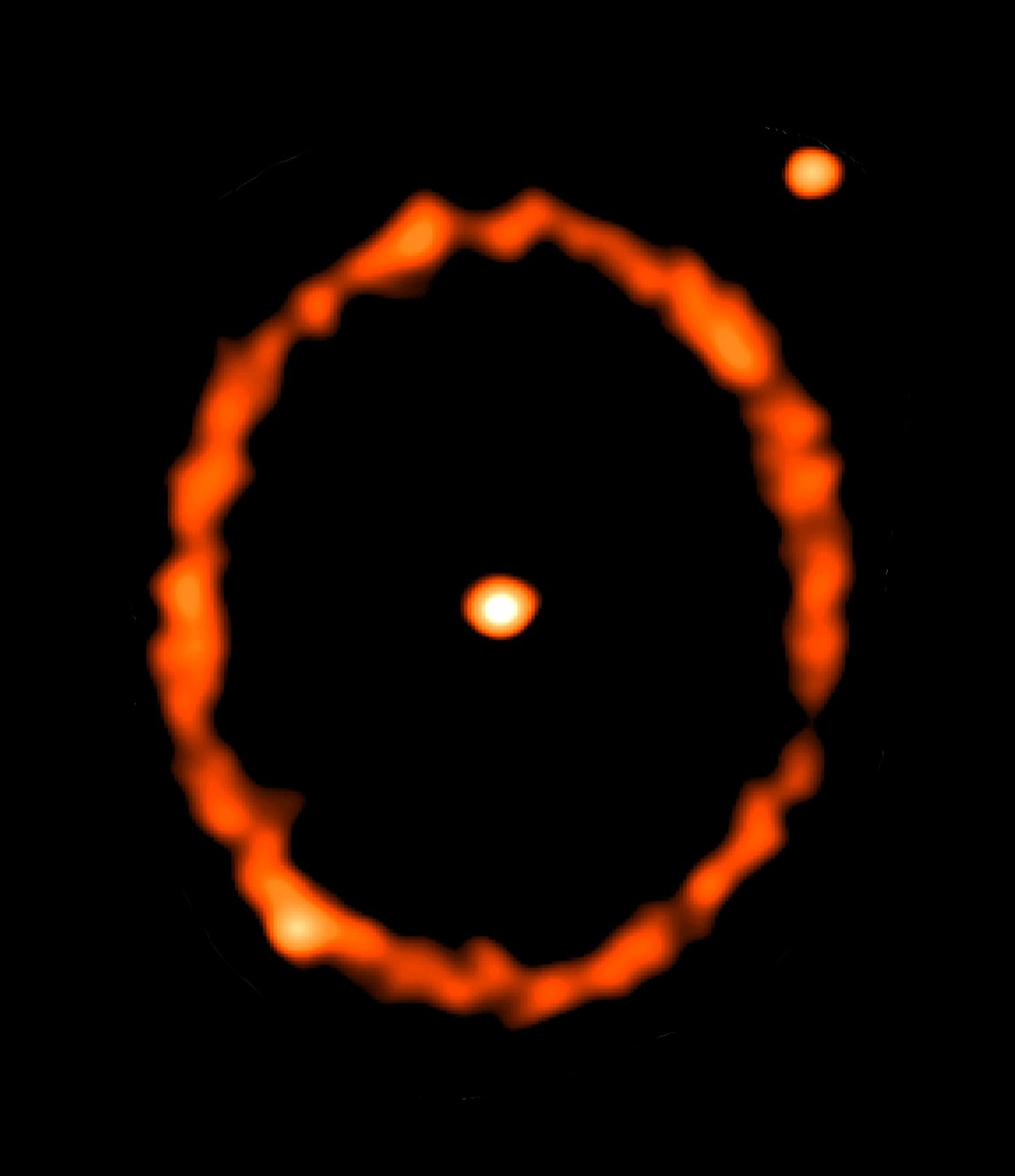
The celestial river, winding from Orion's foot deep into southern skies — the sky's sixth-largest constellation, ending at brilliant Achernar, 'river's end', the flattest bright star known (spinning so fast it is 35% wider than tall). Along its banks: Epsilon Eridani, one of the nearest sun-like stars with a planet.
How to find it
Start at Rigel and follow the faint stream south and west.
✦ What lives inside it
- Witch Head Nebula
The deep dive
Researched for the Atlas from Wikipedia — Eridanus (constellation) (6,938 characters read) · updated Sep 20, 2026
01 A river written in ancient Babylon
Long before Greek astronomers formalized the sky, the stars of Eridanus were already read as a river. One theory traces the constellation's name to the Babylonian "Star of Eridu" — written MUL.NUN.KI — named for Eridu, one of the oldest cities in the extreme south of Babylonia. Eridu sat in the marshy lowlands and was held sacred to Enki-Ea, the god who ruled the Abyss, a mythological conception of the freshwater reservoir believed to lie beneath the entire surface of the Earth. That watery underworld theology made a riverine constellation feel entirely natural: the stars overhead mirrored the sacred waters below. When the Greeks inherited and reshaped the figure, they kept its identity as a flowing river but grafted new stories onto it. The Babylonian origin reminds us that Eridanus is not simply a Greek invention but the final stage of a much older tradition of reading water into a long, winding chain of stars stretching deep into the southern sky.
02 Phaethon's fatal ride and the river of souls
The most dramatic myth attached to Eridanus concerns Phaethon, the mortal son of the sun god Helios. Phaethon persuaded his father to let him drive the solar chariot across the sky, but he lacked the strength to control the horses. The chariot veered wildly, scorching both Earth and heaven alike. Zeus, unwilling to allow the destruction to continue, struck Phaethon dead with a thunderbolt and hurled his burning body to Earth. The constellation was said to trace the ruinous path the chariot carved through the sky. In later tradition the river took on a still more solemn meaning: it became a path of souls. The geographic complexity deepens because the ancient Greeks also called the Po River in northern Italy "Eridanos," and the Roman poet Ovid placed Phaethon's fiery death specifically in the Po — where the river's waters extinguished his burning body. A minor river in Athens carried the same name. Celestial myth, Italian geography, and Athenian topography all braided together under a single river name.
03 The flattest star known: Achernar's wild spin Deeper
Achernar, designated Alpha Eridani and marking the southern tip of the river, is among the most physically peculiar stars in the sky. At magnitude 0.5 it is one of the brightest stars visible from Earth, a blue-white main-sequence star sitting 144 light-years away. Its traditional Arabic name translates directly as "the river's end," which is precisely its position in the constellation. What makes Achernar scientifically remarkable is its shape: observations show that its equatorial radius is about 50 percent larger than its polar radius. In practical terms, if you could view it from the side, it would look noticeably squashed — more like a spinning top than a sphere. This dramatic oblateness is caused by the star rotating at an extremely high speed. Centrifugal effects push material outward at the equator, stretching it far beyond what a slowly rotating star would show. The distortion is so pronounced that Achernar holds a place among the flattest stars ever measured, making it a landmark case study in how rapid rotation reshapes stellar structure.
04 40 Eridani: three stars, one white dwarf Deeper
At only 16 light-years from Earth, the triple system 40 Eridani is one of the nearest stellar groupings in the sky and one of the most instructive. Its primary is an orange main-sequence star of magnitude 4.4, bright enough to spot without optical aid under good skies. The real scientific treasure lies in the secondary: a white dwarf of magnitude 9.5 that is described as the most easily visible white dwarf in the sky — far more accessible than the famous companion of Sirius, which is swamped by its brilliant host. White dwarfs are the exposed cores of stars that have shed their outer layers and are slowly cooling; 40 Eridani's white dwarf offers a rare chance to study one with modest equipment. Completing the system is a red dwarf of magnitude 11 that orbits the white dwarf on a 250-year period. The three stars together span a wide range of stellar life stages: a middle-aged orange dwarf, a stellar remnant, and a dim red dwarf — making the 40 Eridani system a compact natural laboratory for stellar evolution at a distance small enough for detailed observation.
05 Epsilon Eridani: our nearest planetary neighbor
At just 10.5 light-years from Earth, Epsilon Eridani — formally named Ran — is one of the closest stars to the Sun and one of the most studied. It is an orange-hued main-sequence star of magnitude 3.7, making it visible to the naked eye despite its modest luminosity. Its significance to planetary science comes from its confirmed extrasolar planet, a world with an approximate mass of one Jupiter mass that completes an orbit every 7 years. That orbital period places the planet at a distance comparable to Jupiter's position in our own solar system. Epsilon Eridani's proximity means it has been a persistent target for searches aimed at understanding whether nearby stars routinely host planetary systems. The star is younger and somewhat less massive than the Sun, so its system offers a window into what our own solar neighborhood might have looked like in an earlier epoch. Its combination of closeness, naked-eye visibility, and confirmed giant planet makes Ran arguably the most personally relevant star in the entire constellation for anyone curious about worlds beyond our own.
06 The Eridanus Supervoid and the cold spot mystery Deeper
In the direction of Eridanus lies one of the largest known structures in the observable universe: the Eridanus Supervoid, discovered as of 2007. Spanning roughly one billion light-years in diameter — a distance so vast that the entire observable universe is only about 93 billion light-years across — it is the second largest known void, exceeded only by the Giant Void in Canes Venatici. A supervoid is a region of space conspicuously emptier of galaxies than the cosmic average. Researchers linked this void to a puzzling "cold spot" in the cosmic microwave background, the faint afterglow of the Big Bang that permeates all of space. By correlating that cold patch with an absence of radio galaxies in data from the National Radio Astronomy Observatory's Very Large Array Sky Survey, astronomers connected a feature on the largest map of the universe to a genuine absence of matter. The explanation remains unsettled: one speculative idea holds that the void could result from quantum entanglement between our universe and another. That hypothesis is far from established, but it illustrates how the cold spot has pushed theorists toward some of the most ambitious ideas in modern cosmology.
07 NGC 1300 and its spiral within a spiral Deeper
NGC 1300, a grand design barred spiral galaxy in Eridanus, sits approximately 61 million light-years away — with an uncertainty of plus or minus 8 million light-years. It is oriented nearly face-on toward Earth, giving observers a clean view of its structure. What sets NGC 1300 apart from ordinary barred spirals is an unusual feature at its very center. Inside the large-scale bar that crosses the galaxy's nucleus, there exists a second, distinct grand design spiral structure measuring 3,300 light-years in diameter. This spiral-within-a-spiral is tightly wound, sitting nested at the heart of the larger system. It represents a kind of recursive architecture — the same type of pattern that organizes the galaxy as a whole repeated at a much smaller scale in the core. Eridanus also hosts NGC 1232, NGC 1234, and NGC 1291, but NGC 1300 is the showpiece galaxy of the constellation partly because the Hubble Space Telescope has produced iconic images of it, and partly because its nested spiral structure poses genuine questions about how bars and central structures in galaxies form and sustain themselves over time.
08 IC 2118: the Witch Head's borrowed light
In the far northeastern corner of Eridanus, close to the boundary with Orion, lies IC 2118, a faint reflection nebula popularly known as the Witch Head Nebula. It does not generate its own light; instead it shines by scattering light borrowed from the nearby supergiant star Rigel in Orion. Astronomers believe it may be an ancient supernova remnant or simply a gas cloud that happens to be positioned at the right distance and angle to catch Rigel's powerful illumination. Reflection nebulae typically appear bluish because fine dust particles scatter shorter blue wavelengths more efficiently than red ones — the same principle that makes Earth's daytime sky blue. The nebula is faint enough that even under dark skies it requires patience and a wide field of view to appreciate, but its ghostly appearance and its debt to one of the night sky's most brilliant stars make it one of the more evocative objects the constellation offers. It also serves as a reminder that the northeastern corner of Eridanus blends physically and visually with the Orion Molecular Cloud Complex, one of the great star-forming regions in the solar neighborhood.
09 The Ganges on Shiva's head: Indian sky lore
In Indian astronomical tradition, the stars corresponding to Eridanus are also read as a river — but a very specific and sacred one. The constellation is called Srotaswini in Sanskrit, from the word srótas meaning the course of a river or stream. In this tradition the river is identified as the Ganges, and its placement in the sky is deeply tied to Hindu iconography. Dakshinamoorthy, also known as Nataraja, is a form of the god Shiva, and the constellation Orion represents his figure. The stars of Eridanus flow from near the head of that Orion-Shiva figure, depicting the Ganges as it descends from Shiva's head — a well-known image in Hindu religious art, where Shiva is shown catching the powerful sacred river in his matted hair to cushion its fall to Earth. The parallel with Greek tradition is striking: both cultures saw a river beginning near or connected to a major human or heroic figure in the sky. That two independent traditions arrived at broadly similar imagery speaks to how naturally the long, winding arc of Eridanus's stars suggests flowing water to pattern-seeking human minds.
10 Chinese astronomy and the White Tiger's edge
Chinese astronomical tradition divided the sky into regions anchored by four symbolic animals, and the northern portions of Eridanus fall within the domain of the White Tiger of the West, known in Chinese as 西方白虎. However, the constellation extends so far into the southern sky that its more southerly stars were entirely invisible from historical Chinese observing locations. Those unseen southern stars presented a classification problem that was eventually solved by the astronomer Xu Guangqi, who placed them among a special category called the Southern Asterisms — 近南極星區 in Chinese — drawing on knowledge derived from western star charts rather than indigenous observation. This practical accommodation reflects the broader challenge that deep southern constellations like Eridanus posed for astronomical traditions rooted in the Northern Hemisphere. The constellation is simply too long and too south to belong fully to any single regional sky culture. Its treatment in Chinese astronomy thus illustrates both the limits of horizon-bound observation and the eventual exchange of knowledge that allowed different traditions to fill in each other's blind spots.
11 Meteor showers from an unnamed visitor
Eridanus hosts two meteor showers, one of which poses an intriguing mystery about its origins. The Nu Eridanids are a recently discovered shower that radiates from the constellation between August 30 and September 12 each year. What makes the Nu Eridanids unusual is that their parent body — the object whose debris trail Earth passes through — has not been identified. It is classified as an Oort cloud object, meaning it likely originates in the vast reservoir of icy bodies that surrounds the solar system at enormous distances, but no specific comet or asteroid has been matched to the shower. The second shower, the Omicron Eridanids, peaks between November 1 and 10. Meteor showers in general occur when Earth crosses a stream of debris left by a comet or, in some cases, an asteroid along its orbit. The unidentified parent of the Nu Eridanids is a reminder that the inventory of significant solar system objects contributing debris to the inner solar system is not yet complete — something is out there that we have not yet directly seen.
12 Six largest: Eridanus in the constellation hierarchy
Eridanus ranks as the sixth largest of the 88 modern constellations by area, a fact that is easy to appreciate once you trace its full extent across the sky. It begins near the foot of Orion in the north — indeed, Beta Eridani carries the name Cursa, meaning "the footstool," reflecting its position just south of Orion's foot — and winds all the way south to Achernar near the south celestial pole. That enormous north-to-south reach means the full constellation is circumpolar from no single mid-latitude location; observers in the Northern Hemisphere see its northern portions while its southern end, including the brilliant Achernar, is only accessible from the Southern Hemisphere and tropical latitudes. Ancient sky charts, including Johann Bayer's influential Uranometria, consistently depicted Eridanus as a meandering river flowing past Cetus and Fornax into the deep southern sky. The stars of the modern constellation Fornax were themselves once considered part of Eridanus, suggesting the river originally claimed even more of the sky before later astronomers trimmed its boundaries.