Dorado
“The Dolphinfish” · Southern · best around January evenings
Real star positions and magnitudes (HYG database via D3-Celestial, BSD-3). Lines are the conventional stick figure; north is up.
The story
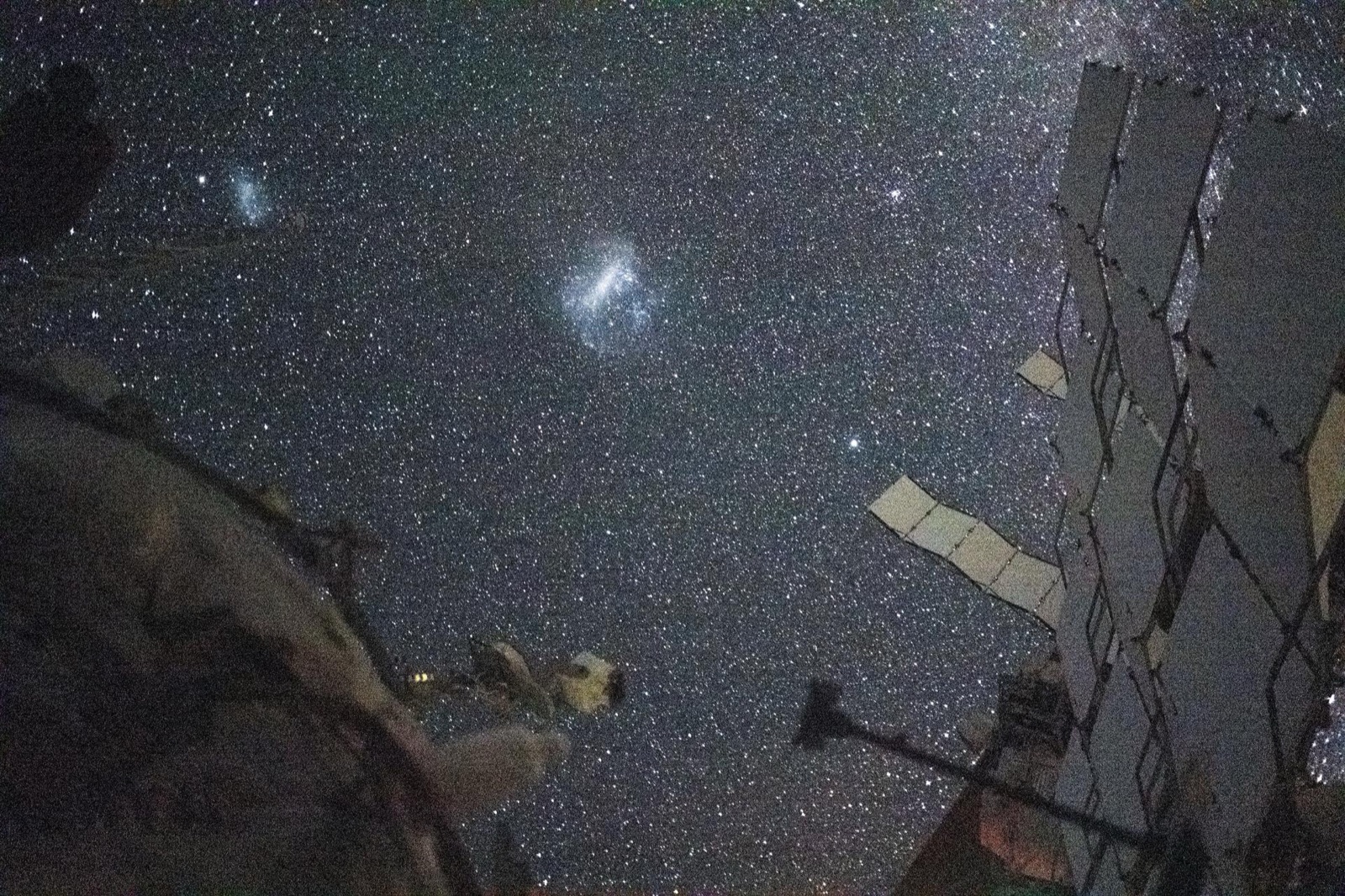
A Dutch navigators' constellation carrying the southern sky's crown jewel: most of the Large Magellanic Cloud, including the Tarantula Nebula, lies within Dorado.
How to find it
Between Canopus and the pole; the Magellanic glow marks it.
✦ What lives inside it
The deep dive
Researched for the Atlas from Wikipedia — Dorado (7,308 characters read) · updated Sep 20, 2026
01 A Spanish name in a Latin sky
Almost every constellation name in the modern sky is Latin or Greek, but Dorado breaks that rule — it is a Spanish word meaning "golden," referring to the mahi-mahi fish, Coryphaena hippurus, whose skin blazes with iridescent gold when freshly caught. Because the International Astronomical Union follows Latin grammatical conventions, astronomers give the constellation the genitive form Doradus when labeling its stars, treating the name as if it were a feminine Greek proper noun ending in -ō, the same pattern used for Io, Callisto, and the ship Argo. The alternative name Xiphias, meaning swordfish in Greek, appeared in print for the first time in Johannes Kepler's 1627 edition of Tycho Brahe's star list, the Rudolphine Tables. Both images — a golden dolphinfish and a silver swordfish — circulated among celestial cartographers for decades, but Dorado ultimately won out and was formally adopted by the IAU. The constellation has also been loosely called "the goldfish" in popular literature, since dorados are famously gold-colored.
02 Born from a Dutch voyage to the Indies
Dorado owes its existence to two Dutch navigators: Pieter Dirkszoon Keyser and Frederick de Houtman, who systematically observed the southern skies during late-sixteenth-century voyages to the East Indies. Their positional measurements were handed to the cartographer Petrus Plancius, who used them to define twelve new southern constellations, Dorado among them. The figure made its first public appearance on a 35-centimetre-diameter celestial globe published in Amsterdam in 1597 or 1598, produced by Plancius together with the engraver Jodocus Hondius. It then entered the permanent record of celestial atlases when Johann Bayer included it in his landmark Uranometria of 1603. Nicolas Louis de Lacaille later refined the constellation's stellar inventory, assigning Bayer designations — Alpha through Pi — to fifteen stars in 1756, though he omitted Iota, Omicron, and Xi, and curiously labeled two stars as Eta and Pi. Mu Doradus was eventually dropped from catalogues altogether because of its dimness.
03 The pole the Sun traces each year Deeper
Dorado holds a geometric distinction that most constellation guides overlook: the South Ecliptic Pole lies within its boundaries, close to the figure's head. The ecliptic pole is the point on the sky that sits exactly 90 degrees from the plane of Earth's orbit, meaning it is the direction the Sun never approaches — the axis around which the entire ecliptic tilts. Because the ecliptic pole is fixed relative to the distant stars, it does not precess the way the celestial poles do; it anchors the solar system's geometry against the stellar background. The seventeenth-century astronomer Philipp von Zesen, also known as Caesius, recognized the significance of this location and gave it the name "Polus Doradinalis," the Doradine Pole. Having both the South Ecliptic Pole and most of the Large Magellanic Cloud packed into a single, relatively compact constellation makes Dorado one of the most cosmologically eventful patches of the southern sky.
04 Alpha, Beta, and a shape-shifting variable
The brightest star in Dorado is Alpha Doradus, a blue-white star of magnitude 3.3 sitting 176 light-years from Earth. Far more scientifically famous, however, is Beta Doradus, a yellow-tinged supergiant and a classic Cepheid variable. Its brightness pulses between a minimum magnitude of 4.1 and a maximum of 3.5 over a remarkably steady period of 9 days and 20 hours — a rhythmic heartbeat caused by the star physically expanding and contracting. At 1,040 light-years away, Beta Doradus is distant enough that its light takes roughly a millennium to reach us, yet bright enough to be seen with the naked eye throughout its cycle. Cepheids like Beta Doradus are critical to astronomy because their period of pulsation is tightly linked to their true luminosity, making them precise distance-measuring tools across millions of light-years. Gamma Doradus, another variable in the constellation, is important enough to serve as the prototype of an entire class of pulsating stars named after it.
05 The star with the widest face in the sky Deeper
Among the strangest residents of Dorado is R Doradus, a variable star with a magnitude of 5.73 that holds a remarkable record: it has the largest known apparent angular size of any star other than the Sun. That means if you could photograph it with sufficient resolution, its disk would spread wider across the sky than any other stellar point of light we can resolve. Even more extreme is WOH G64, a binary system embedded in the Large Magellanic Cloud containing what is currently identified as the largest known star with a well-defined radius — an almost incomprehensible 1,540 ± 77 solar radii. To put that in scale, if WOH G64 replaced our Sun, its surface would engulf every planet out past Jupiter. Then there is S Doradus itself, a hypergiant in the Large Magellanic Cloud with a magnitude of 9.721 that serves as the prototype of the entire S Doradus class of luminous blue variable stars, which undergo dramatic, unpredictable eruptions that temporarily make them among the brightest objects in their host galaxies.
06 A star fleeing the galaxy at full speed Deeper
Dorado is also home to HE 0437-5439, a hypervelocity star — an object moving so fast it is escaping the gravitational grip of the Milky Way and Magellanic Cloud system entirely. Hypervelocity stars are thought to be flung outward when a binary pair of stars strays too close to a massive black hole, with one star captured and the other slung away at hundreds of kilometers per second. HE 0437-5439's trajectory traces back toward the Milky Way or Large Magellanic Cloud, consistent with that violent origin story. Meanwhile, the constellation also harbors SNR 0509-67.5, the remnant of a Type Ia supernova that detonated roughly 400 years ago and was described in the article as unusually energetic even by supernova standards. The expanding shell of debris from that ancient explosion is still visible as a glowing ring today, a fossil record of one of the most powerful thermonuclear events the universe produces.
07 The supernova that changed astrophysics
On February 23, 1987, a star in the Large Magellanic Cloud — and therefore in the direction of Dorado — exploded as Supernova 1987A. It was the closest supernova observed since 1604, making it the nearest such event since before the invention of the telescope and the first supernova detectable with modern instruments at close enough range to study in extraordinary detail. Neutrino detectors on Earth registered a burst of particles from the collapse hours before the visible light arrived, directly confirming theories about how stellar cores implode. SN 1987A was the first supernova of the year 1987 and rapidly became one of the most intensively studied objects in the history of astronomy. Its remnant continues to brighten as the expanding shock wave slams into surrounding material, and astronomers still debate whether a neutron star or black hole lurks at its center — a question unresolved at the time the article was written.
08 The Tarantula: a nebula beyond comparison
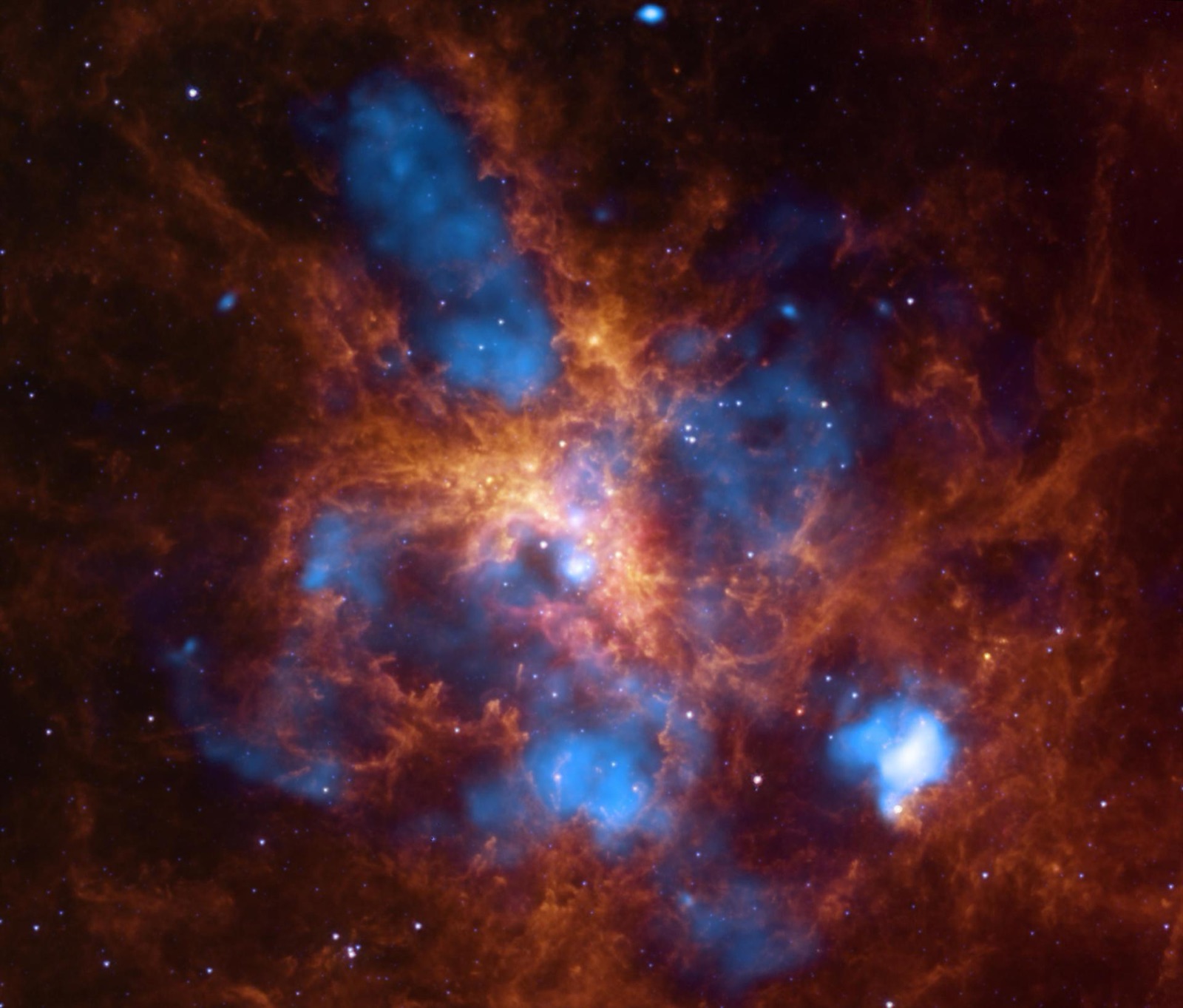
If the Tarantula Nebula sat at the distance of the Orion Nebula, it would cast shadows on Earth at night. Formally designated 30 Doradus, it is visible to the naked eye as what looks like a slightly out-of-focus star, even though it lies 179,000 light-years away inside the Large Magellanic Cloud. At 1,000 light-years in diameter it is larger than any nebula in the Milky Way, and its extraordinary brightness comes from the open star cluster NGC 2070 that illuminates it from within. At the very heart of NGC 2070 sits R136, a dense cluster of supergiant stars that pour out torrents of ultraviolet radiation, ionizing the surrounding gas and sculpting the spidery filaments that give the nebula its arachnid name. This single structure spans a volume that would swallow hundreds of Orion Nebulae and continues actively forming new stars at a furious rate.
09 Ghost Head, Seagull, and a superbubble
Beyond the Tarantula, Dorado shelters a gallery of visually striking nebulae, each with its own personality. NGC 2080, called the Ghost Head Nebula, is an emission nebula 50 light-years wide whose two bright white patches — labeled A1 and A2 — are active star-forming regions. The western patch, A1, contains one massive newly formed star; the eastern patch, A2, hides several stars behind dust. Color reveals chemistry: the western portion glows green from doubly ionized oxygen, the southern portion burns red from hydrogen-alpha emission, and the center blends yellow from both. NGC 2032, nicknamed the Seagull Nebula, is a nebula complex that clusters four NGC designations — NGC 2029, NGC 2032, NGC 2035, and NGC 2040 — in close proximity. Perhaps most dramatic in scale is N44, a superbubble 1,000 light-years across carved by 40 hot central stars. Nested inside N44 is the smaller N44F, about 35 light-years in diameter, shaped by a single ferociously hot star driving stellar winds at 7 million kilometers per hour, with dust columns inside that may be hiding newborn stars.
10 An Earth-like world found by a new telescope
In early 2020, astronomers announced the discovery of TOI-700 d, an exoplanet orbiting the star TOI-700 in Dorado. Its significance is considerable: TOI-700 d was the first potentially Earth-like exoplanet found by NASA's Transiting Exoplanet Survey Satellite, known as TESS. The planet sits in what researchers consider a potentially habitable orbital zone around its host star, making it one of the more closely watched worlds outside our solar system. Its discovery demonstrated that TESS, which scans the sky by watching for tiny dips in starlight caused by a planet crossing in front of its star, could find not just hot giants but small rocky candidates in gentle orbits. Dorado's position in the sky — already distinguished by the Large Magellanic Cloud, multiple prototype variable stars, and a historic supernova — thus added a genuinely Earth-scale discovery to its scientific résumé within the first decades of twenty-first-century astronomy.
11 How Chinese astronomers mapped these stars Deeper
Long before European navigators charted the far southern sky, East Asian astronomical traditions had their own frameworks for organizing the heavens, though the deep south presented challenges for observers in China. Within the system formalized by the scholar Xu Guangqi, the stars now belonging to Dorado were grouped into two of the Southern Asterisms — a set of constellations defined specifically for stars near the southern celestial pole that fell outside the classical Chinese system. The stars of Dorado were assigned to two groups: the White Patches Attached, known in Chinese as 夾白 (Jiābái), and the Goldfish, known as 金魚 (Jīnyú). The Goldfish asterism is particularly evocative given the parallel with the Western naming tradition — both cultures independently reached for an aquatic creature, though China chose the goldfish while Europe settled on the mahi-mahi or swordfish. This convergence speaks to how the bright, distinctive arrangement of these stars suggested a living, swimming form to very different sky-watching traditions.
12 Cluster-rich: the LMC's deep-sky treasury Deeper
The Large Magellanic Cloud, which the article describes as 25,000 light-years in diameter and located 179,000 light-years away, has been gravitationally deformed by its interactions with the Milky Way — and that turbulent history has triggered wave after wave of star formation, leaving Dorado littered with clusters and nebulae at a density unmatched by any equivalent area of sky. The constellation contains multiple globular clusters — NGC 1755, NGC 1850, NGC 1854, and NGC 2164 among them — alongside a profusion of open clusters including NGC 1761, NGC 1820, NGC 1869, NGC 1901, NGC 1910, NGC 1978, NGC 2002, and NGC 2027. Several bright nebulae punctuate the list: NGC 1763 is associated with three type-B stars, NGC 2014 is a red emission nebula, and NGC 2020 is an HII region surrounding a Wolf-Rayet star. The face-on spiral galaxy NGC 1566, unrelated to the LMC, gives its name to the NGC 1566 Group. The emission nebula N180B and the four interlinked NGC objects near NGC 1936 — including NGC 1929, NGC 1934, and NGC 1935 — round out a field so rich that even modest binoculars begin to reveal structure.