Canis Major
“The Great Dog” · Southern · best around February evenings
Real star positions and magnitudes (HYG database via D3-Celestial, BSD-3). Lines are the conventional stick figure; north is up.
The story
Orion's larger hunting dog, led by Sirius, the brightest star in our night sky — the 'Dog Star' whose dawn rising marked the Nile flood and gave us the 'dog days' of summer. The whole constellation glitters: it holds several of the most luminous stars known, which look modest only because Sirius sits so much closer.
How to find it
Winter: Orion's Belt points down-left straight at Sirius — you cannot miss the sky's brightest star.
✦ What lives inside it
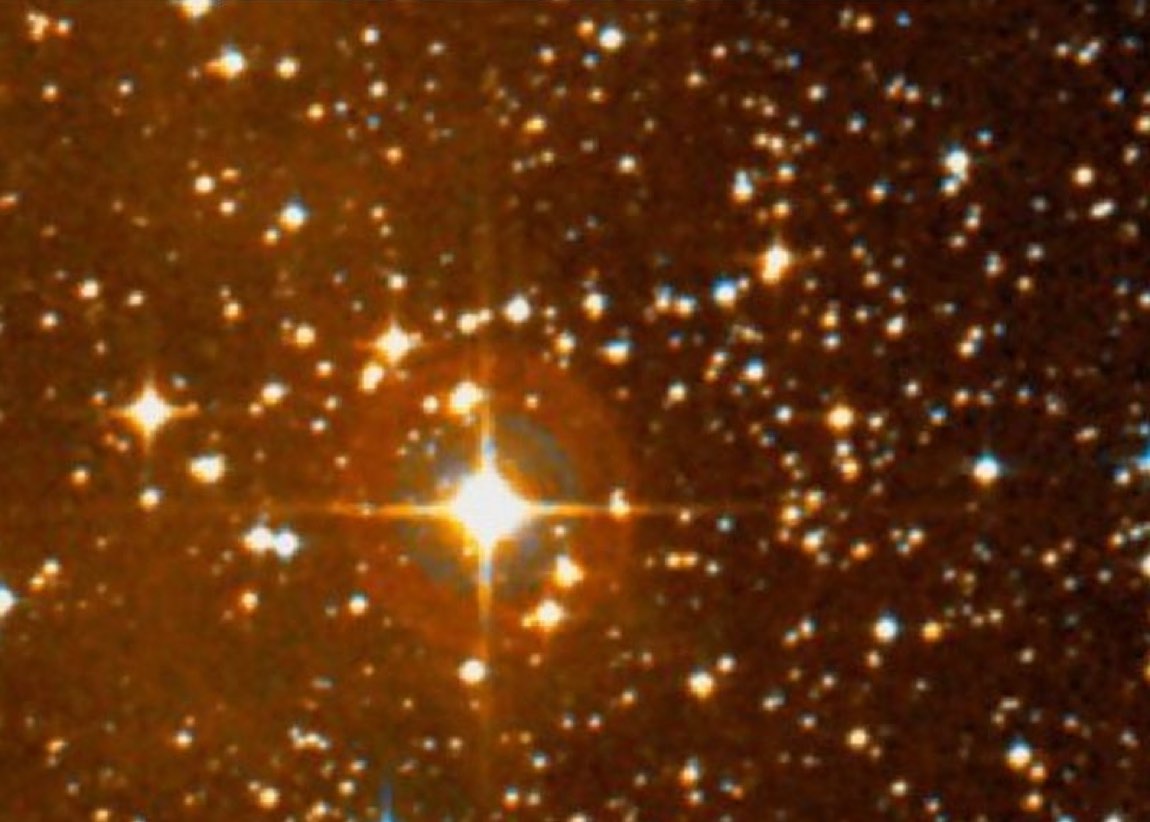
- M41 cluster
The deep dive
Researched for the Atlas from Wikipedia — Canis Major (22,981 characters read) · updated Sep 20, 2026
01 Why Sirius blazes above every other star
Sirius earns its rank as the brightest star in the night sky through a fortunate combination of nearness and genuine power. At just 8.6 light-years away it is one of the closest stars to Earth, and its apparent magnitude of −1.46 is the product of both that proximity and real intrinsic brilliance. Its name comes from the Greek word for "scorching" or "searing," which feels appropriate on any clear winter night. What many observers do not realize is that Sirius is actually a binary system: its companion, Sirius B, is a white dwarf glowing at magnitude 8.4 — roughly 10,000 times fainter than Sirius A as seen from Earth. The two stars complete one orbit around each other every 50 years. Their closest approach last occurred in 1993, and between 2020 and 2025 they reach their greatest angular separation, making it somewhat easier to split them in a telescope. The ancient Egyptians tied their entire calendar to this single star, watching for its annual predawn rising as the signal for the Nile flood season.
02 Supergiants that dwarf our imagination Deeper
Beyond Sirius, Canis Major is stacked with colossal supergiant stars that are bright only because they are intrinsically enormous, not because they are nearby. Wezen (Delta Canis Majoris) is a yellow-white supergiant of spectral type F8Iab sitting about 1,605 light-years away. It is 17 times as massive as the Sun and radiates 50,000 times as much energy; its diameter is 200 times the Sun's, meaning that if Wezen replaced the Sun it would reach all the way to Earth's orbit. At only around 10 million years old, Wezen has already exhausted hydrogen fusion in its core. Its outer envelope is beginning to expand and cool, and within the next 100,000 years it will swell into a red supergiant, fusing progressively heavier elements until an iron core triggers a supernova collapse. Aludra (Eta Canis Majoris) is a blue-white supergiant 1,120 light-years away with a luminosity 176,000 times the Sun's and a diameter roughly 80 times larger. It is classified as an Alpha Cygni variable, pulsing in brightness from magnitude 2.38 to 2.48 over a cycle of just 4.7 days. These two stars alone illustrate how the constellation's apparent brightness conceals radically different physical realities hiding behind similar magnitudes.
03 Adhara and the invisible ultraviolet flood Deeper
Epsilon Canis Majoris, known as Adhara, looks modest to the unaided eye at magnitude 1.5, but it hides a remarkable distinction: it is the brightest source of extreme ultraviolet radiation in the entire night sky. Located about 404 light-years away, this blue-white supergiant of spectral type B2Iab pours out energy at wavelengths completely blocked by Earth's atmosphere, which is why its dominance in this band went unrecognized until the space age. The star's traditional name means "the virgins," originally applied collectively to the group of stars that includes Adhara, Wezen, Aludra, and Omicron2 — Arabic astronomers called them Al Adzari — before the name was transferred to Epsilon alone. Adhara also has a binary companion at magnitude 7.4. Looking back in time, the star held an even more spectacular past role: roughly 4.7 million years ago it shone at an apparent magnitude of −3.99, which would have made it the single brightest star in the sky by a wide margin, outshining everything then visible. Mirzam (Beta Canis Majoris) similarly peaked at −3.65 about 4.42 million years ago, when our distant ancestors were just beginning to walk upright in Africa.
04 VY Canis Majoris: a star of almost absurd scale
Tucked into Canis Major at a distance of approximately 3,800 light-years is VY Canis Majoris, a red hypergiant that represents one of the most extreme objects the galaxy has to offer. Its radius is around 1,420 times that of the Sun — if placed at the center of the Solar System it would engulf every planet out beyond Jupiter. Despite this staggering size, its current mass is estimated at only about 17 ± 8 solar masses, because it has shed enormous quantities of gas and dust from an original mass believed to have been 25 to 32 solar masses. That expelled material has formed a surrounding red reflection nebula, sculpted by the star's ferocious stellar winds. The star's luminosity is roughly 270,000 times that of the Sun. VY CMa is not stable; it is shedding mass at a prodigious rate, and its ultimate fate is expected to be a supernova or possibly a direct collapse into a black hole. The uncertainty in its mass estimate — a full range of 8 solar masses — honestly reflects how difficult it is to measure the properties of such an extreme and heavily shrouded object at this distance.
05 A neutron star smaller than a city
At the opposite extreme from VY Canis Majoris sits RX J0720.4-3125, a neutron star within the constellation's borders with a radius of around just 5 kilometers — roughly the size of a mid-sized city. It is exceedingly faint, with an apparent magnitude of 26.6, placing it far beyond any amateur telescope. What makes this object scientifically intriguing is its spectrum and surface temperature, which appear to be mysteriously changing over a period of several years. The nature of these changes is not fully understood, but one hypothesis is that they were triggered by the star's absorption of an accretion disk — leftover material that gradually spiraled onto the neutron star and altered its behavior. This kind of gradual evolution in an isolated neutron star is unusual and not yet well explained by existing models. RX J0720.4-3125 therefore represents one of the genuine open questions sitting inside the boundaries of this otherwise well-studied constellation: a tiny, dense remnant quietly presenting puzzles that current physics has not yet fully resolved.
06 The Mesopotamian bow and arrow behind the dog
Long before Greek astronomers shaped Canis Major into a hunting dog, Babylonian sky-watchers around 1100 BC saw a completely different picture in the same stars. In the Three Stars Each tablets, the southern stars of Canis Major, together with part of what is now Puppis, were drawn as a great bow named BAN, while Sirius was the arrow named KAK.SI.SA2 — the arrow aimed toward Orion. The later Babylonian compendium MUL.APIN associated the arrow with the warrior god Ninurta and the bow with Ishtar, daughter of Enlil. Ninurta was himself linked to the chief deity Marduk, who in Babylonian mythology slew the ocean goddess Tiamat using a great bow. This war-and-weapon imagery was completely swept away when the Ancient Greeks substituted their own tradition of a loyal hunting dog. The Chinese astronomical tradition preserved a different version of the same basic idea: Sirius was called Tiānláng, the Celestial Wolf, representing invasion and plunder, while a separate asterism called Húshǐ — the celestial Bow and Arrow — was mapped onto Delta, Epsilon, Eta, and Kappa Canis Majoris together with Delta Velorum.
07 Indigenous skies: Australian and Pacific traditions
Multiple Indigenous peoples of Australia and the Pacific brought their own detailed knowledge to these stars. The Boorong people of Victoria identified Sigma Canis Majoris as Unurgunite — a name now officially recognized by the International Astronomical Union — while the flanking stars Delta and Epsilon represented his two wives. In their story, the Moon (Mityan, meaning "native cat") attempted to lure away the farther wife, Epsilon, but Unurgunite attacked him, and the Moon has been wandering the sky restlessly ever since. The Tharumba people of the Shoalhaven River read three stars of Canis Major as Wunbula the Bat and his two wives; when the women try to bury him while he hunts a wombat underground, he spears them and all three are set permanently in the sky as the constellation Munowra. In Polynesia, Māori communities recognized a large constellation called Te Huinga-o-Rehua, meaning "the Assembly of Rehua," encompassing both Canis Major and Canis Minor with surrounding stars. They called Sirius both Rehua and Takarua, though Rehua was a name shared with other prominent stars across different Māori groups. The Tuamotu people named the figure Muihanga-hetika-o-Takurua, "the abiding assemblage of Takarua."
08 Young star clusters and very old ones Deeper
Canis Major hosts open clusters spanning an extraordinary range of ages. At one extreme sits NGC 2362, a compact gathering of about 60 stars, 5,200 light-years away, centered visually on Tau Canis Majoris. Its members are only a few million years old — essentially newborn by astronomical standards — and when observed through binoculars the fainter stars appear huddled tightly around the brilliant Tau. At the other extreme is Caroline's Cluster, NGC 2360, discovered by Caroline Herschel and located 3,700 light-years away with a combined magnitude of 7.2 and a physical diameter of around 15 light-years. Careful study of its stellar population has dated it to approximately 2.2 billion years old, making it one of the more ancient open clusters visible in this region of sky. The showpiece Messier object M41, sitting just 4 degrees south of Sirius, lands in between: its most luminous members have already evolved off the main sequence into giants, and its 2,300-light-year distance makes it a genuine binocular object at combined magnitude 4.5. M41 covers the same apparent area as the full Moon, though in reality it spans about 25 light-years across, and it contains a visually appealing mix of blue, yellow, and orange stars.
09 Thor's Helmet and the Wolf-Rayet winds that made it Deeper
One of the more visually dramatic deep-sky objects in Canis Major is NGC 2359, a relatively bright emission nebula with an approximate magnitude of 10, located 10,000 light-years from Earth. Its popular name is Thor's Helmet, though it is also sometimes called the Duck Nebula. The sculpted, bubble-like shape of the nebula is not random: it has been blown and shaped by the powerful stellar winds of HD 56925, an unstable Wolf–Rayet star embedded at its center. Wolf–Rayet stars are among the most extreme stars known, shedding mass at enormous rates and generating fast outflows that carve complex structures into surrounding gas. Another Wolf–Rayet star appears among Canis Major's variable stars: EZ Canis Majoris, of spectral type WN4, which fluctuates between magnitudes 6.71 and 6.95 over a period of 3.766 days. The cause of its variability is not fully understood but is thought to be connected to the interaction between its stellar wind and its rotation. Together these two Wolf–Rayet objects remind observers that the constellation's inner life involves some of the most energetically violent processes in the galaxy.
10 The controversial Canis Major Dwarf Galaxy Deeper
In 2003 astronomers announced an apparent overdensity of stars in the direction of Canis Major and proposed it was the Canis Major Dwarf, which they argued would be the closest satellite galaxy to Earth. The claim generated immediate scientific controversy that has not been fully resolved. Skeptics pointed out that investigation of the region yielded only ten RR Lyrae variable stars — a number consistent with the known populations of the Milky Way's own halo and thick disk rather than with a separate dwarf spheroidal galaxy. Supporters of the extragalactic interpretation pointed to NGC 2298, a globular cluster in neighboring Puppis that appears to be associated with the proposed dwarf system. This cluster is extremely metal-poor, a chemical signature that argues it did not originate from the Milky Way's thick disk and instead has extragalactic roots. The debate essentially hinges on whether the stellar overdensity represents a disrupted infalling galaxy or simply an uneven sampling of the Milky Way's own spiral arm and disk populations seen from our particular vantage point. The question remains open, making this region of sky one of the more actively debated patches of the southern winter sky.
11 Two galaxies slowly colliding 125 million light-years away
Well beyond the Milky Way itself, Canis Major contains a striking example of galactic interaction. NGC 2207 and IC 2163 are a pair of face-on spiral galaxies located 125 million light-years from Earth. About 40 million years ago they underwent a close passage, and tidal forces from that encounter have already distorted both their shapes. Currently they are moving apart, but the smaller IC 2163 is gravitationally bound and will eventually be absorbed into NGC 2207. As the two galaxies continue to interact, their gas and dust clouds are being churned, triggering waves of star formation. The interaction has also been extremely productive for supernova hunters: NGC 2207 alone has hosted four observed supernovae — SN 1975a (type Ia) in 1975, SN 1999ec (type Ib) in 1999, SN 2003H (type Ib) in 2003, and SN 2013ai (type II) in 2013. That is an unusually rich supernova record for a single galaxy observed over just a few decades, and it reflects the heightened rate of massive star formation that galaxy mergers tend to drive.
12 Planets hiding in the dog's lesser-known stars
Canis Major is home to at least seven star systems confirmed to harbor planets, several of which tell surprisingly nuanced stories about planetary architecture. HD 45364 is a star 107 light-years distant, slightly smaller and cooler than the Sun (spectral type G8V), with two planets discovered in 2008. The two worlds orbit with periods of 228 and 342 days and share a 3:2 orbital resonance — the same mathematical relationship that governs Neptune and Pluto in our own Solar System — which acts to stabilize the pair gravitationally. HD 47186 hosts a "Hot Neptune" inner planet completing its orbit in just four days, while its outer companion follows an eccentric 3.7-year orbit with a mass similar to Saturn's. Nu2 Canis Majoris, an aging orange giant only 64 light-years away, is orbited by a planet 2.6 times as massive as Jupiter over a 763-day period — a glimpse of what the Solar System's own giant planets may look like once the Sun expands into its red giant phase. HD 47536 presents a similar picture of a planetary system circling an aging giant star, offering a preview of the Solar System's eventual fate.
13 Labeling a constellation: centuries of cartographic revision Deeper
The stars of Canis Major acquired their current names and designations through a long, sometimes messy process of revision by European astronomers. German cartographer Johann Bayer applied Greek letters Alpha through Omicron in the early 17th century, assigning three adjacent stars the shared designation Nu and creating two pairs labeled Xi and Omicron. His compatriot Johann Elert Bode later added Sigma, Tau, and Omega, while French astronomer Nicolas Louis de Lacaille appended lettered stars a through k — none of which survived into common use. English astronomer John Flamsteed numbered 31 stars, but Lacaille subsequently moved 3 Canis Majoris into the neighboring constellation Columba as Delta Columbae, since Flamsteed had not recognized Columba as a distinct figure. Flamsteed labeled two stars as Kappa1 and Kappa2, but later cartographers Francis Baily and John Bevis dropped the fainter Kappa1, leaving Kappa2 as the sole Kappa. The official three-letter abbreviation CMa was adopted by the International Astronomical Union in 1922, and the constellation's formal boundaries — a quadrilateral defined in the equatorial coordinate system spanning right ascensions 06h 12.5m to 07h 27.5m and declinations −11.03° to −33.25° — were set by Belgian astronomer Eugène Delporte in 1930.