Aquarius ☉ Zodiac
“The Water Bearer” · Both (straddles the celestial equator) · best around October evenings
Real star positions and magnitudes (HYG database via D3-Celestial, BSD-3). Lines are the conventional stick figure; north is up.
The story
A youth pouring water from a jar — part of the ancient 'Sea' region of watery constellations. Faint but historic: within it lie the Helix Nebula (the nearest bright planetary nebula, a dying star's eye staring back) and the radiant of May's Eta Aquariid meteors, dust of Halley's Comet. The TRAPPIST-1 seven-planet system hides here too.
How to find it
Autumn: between Pegasus and Fomalhaut, in a star-poor region — dark skies help.
✦ What lives inside it
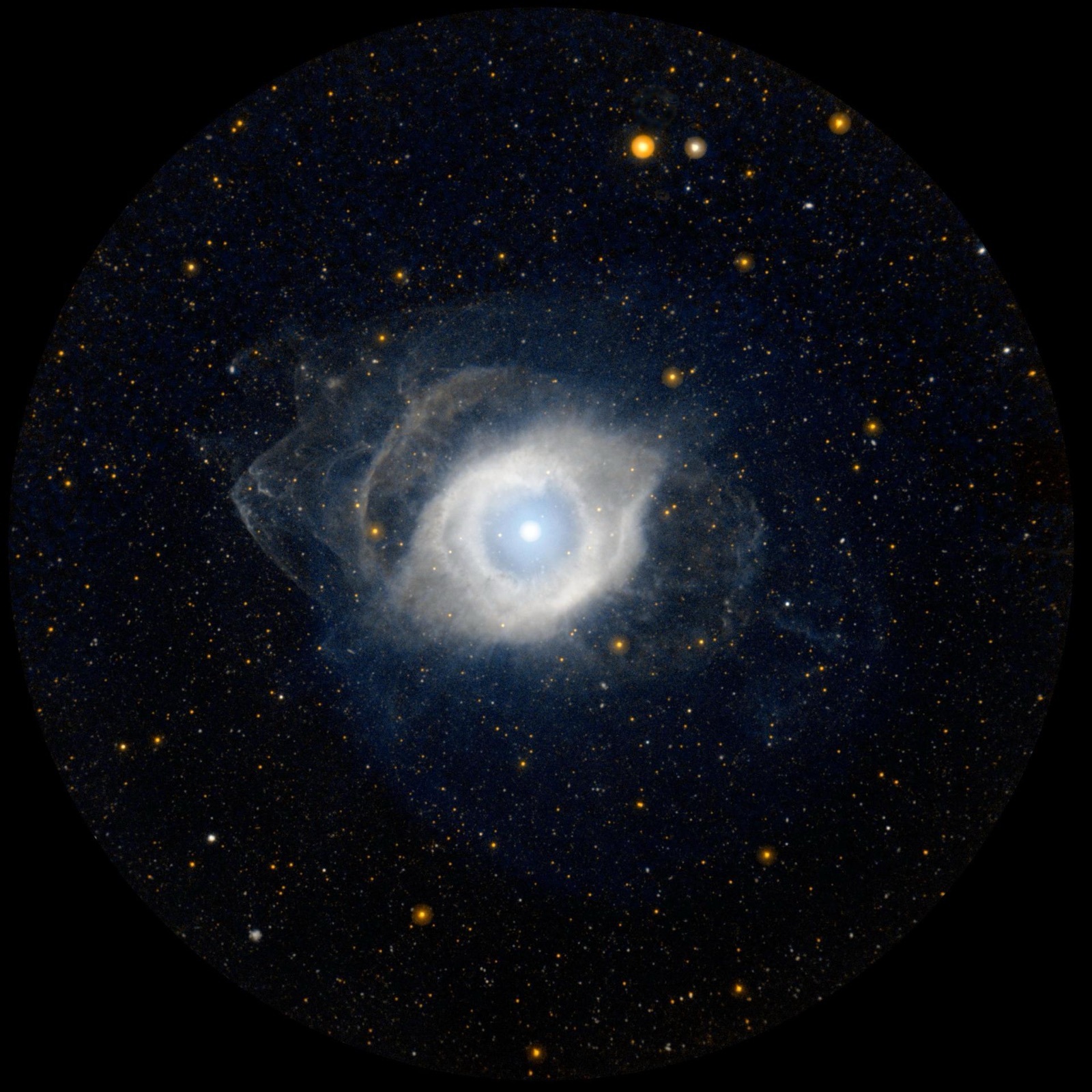
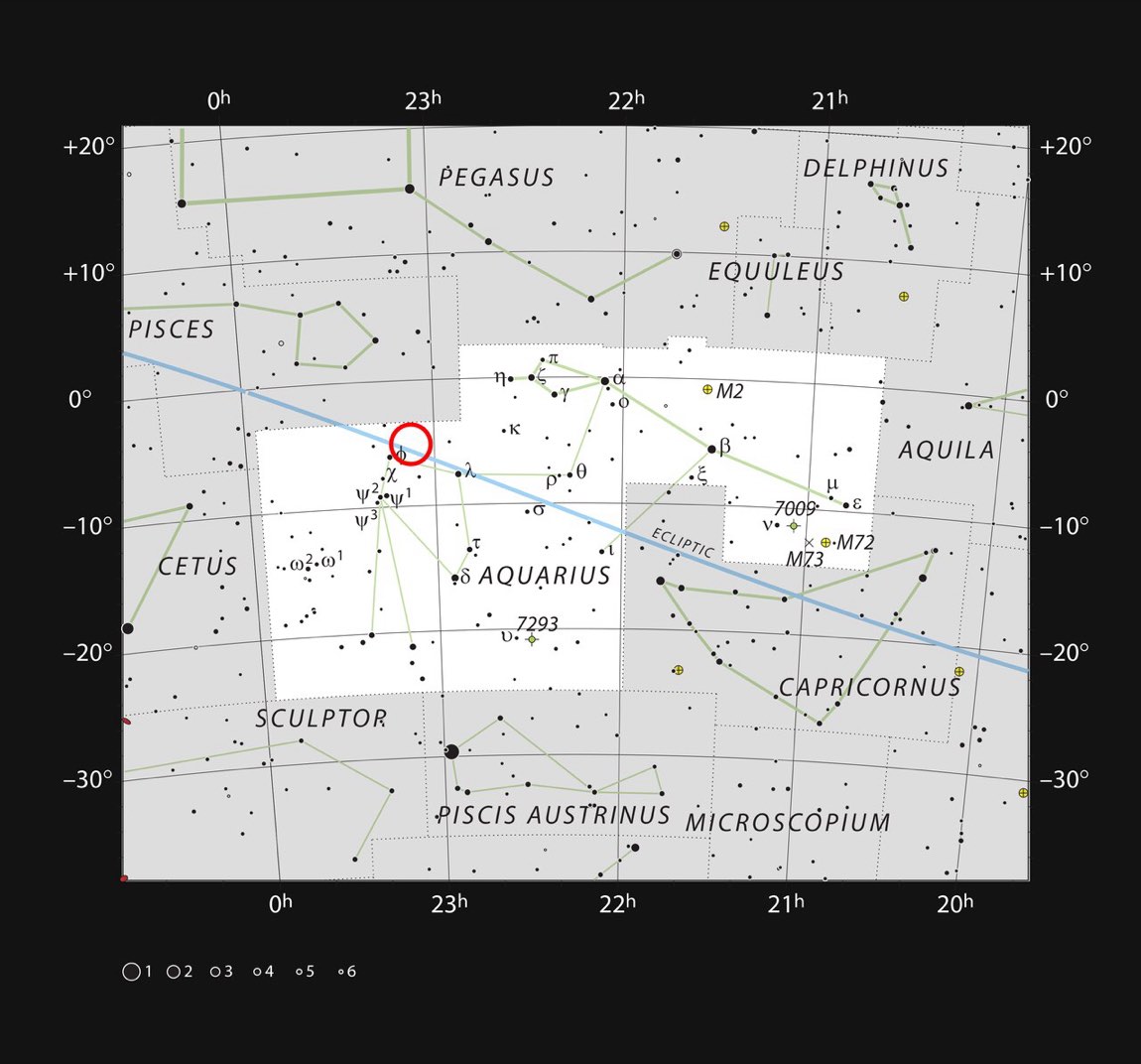
- Eta Aquariid meteor radiant
- M2 globular
The deep dive
Researched for the Atlas from Wikipedia — Aquarius (constellation) (16,879 characters read) · updated Sep 20, 2026
01 A sky full of water neighbors
Aquarius does not stand alone. It sits within a sprawling region of the sky that ancient observers called the Sea, a territory crowded with constellations bearing watery identities: Cetus the whale, Pisces the fish, Eridanus the river, and Piscis Austrinus, into which Aquarius famously pours its stream. This clustering was no accident of imagination. The region rises in the northern autumn sky, a season many ancient Mediterranean cultures associated with rains and flooding. Ptolemy's first-century Almagest captured the Western image precisely: a water-bearer tipping a vase whose stream flows across more than twenty stars before terminating at the bright star Fomalhaut, now formally assigned to Piscis Austrinus. That river of stars effectively stitches two constellations into a single story, and even today tracing it across a dark sky on an autumn night gives a vivid sense of motion and flow that flat star maps rarely convey.
02 Babylon's great god and a winter solstice Deeper
Long before Greek mythology attached Ganymede or Deucalion to these stars, the Babylonians identified the constellation as GU.LA, meaning 'The Great One,' and saw in it the god Ea himself. Cylinder seals and entitlement stones from the second millennium BCE already show the familiar image of an overflowing vase. More striking is the astronomical precision behind the myth: in the Early Bronze Age, the winter solstice actually fell inside Aquarius, making it the constellation that marked the year's shortest day. In Old Babylonian astronomy, Ea ruled the southernmost quarter of the Sun's path, called the 'Way of Ea,' covering the 45 days on either side of the winter solstice. The Babylonians also linked Aquarius to the destructive floods they regularly suffered, giving the constellation a negative character very different from the Egyptian association, where Aquarius pouring his jar into the Nile signaled the beginning of spring and the life-giving annual inundation.
03 Three myths, one constellation
Greek tradition could not settle on a single hero for Aquarius, offering at least three candidates. The most famous is Ganymede, son of the Trojan king Tros and said to be so beautiful that Zeus sent an eagle — represented by neighboring Aquila — to carry him to Olympus to serve as cup-bearer to the gods. Some versions of the myth say the eagle was Zeus himself in disguise; one tradition instead credits the goddess Eos with the abduction. A second candidate is Deucalion, son of Prometheus, who built a ship with his wife Pyrrha to survive a great flood, sailing for nine days before grounding on Mount Parnassus — a Greek story clearly parallel to the Babylonian flood associations already embedded in the constellation's history. The third candidate, less commonly cited, is Cecrops I, a king of Athens remembered for offering water rather than wine as a sacrifice to the gods. That detail alone makes the water-carrier symbolism literal rather than mythological.
04 China's army in the stars Deeper
Chinese astronomers built an entirely different world inside Aquarius. The stars of the water stream flowing from the Water Jar asterism were read as the 'Army of Yu-Lin,' or Yulinjun, meaning 'feathers and forests' — a poetic reference to light-footed soldiers from the empire's northern frontier. This celestial army was the most star-rich of any Chinese constellation, numbering 45 stars, the great majority lying within the modern boundaries of Aquarius. The army needed protection, so a defensive wall called Leibizhen was built from twelve stars including Iota, Lambda, Phi, and Sigma Aquarii. Separate groupings depicted axes used as weapons and for executions, imperial mausoleums marked by collinear stars, and even emotional abstractions: two pairs of stars were named Ku, meaning 'crying,' and Qi, meaning 'weeping,' clustered together in the same region. The Water Jar asterism itself was read as a tomb called Fenmu, giving the constellation's most recognizable shape a funerary meaning utterly unlike anything in the Western tradition.
05 Two yellow giants growing old together
Aquarius is famously short on brilliant stars, but its two brightest — Alpha and Beta Aquarii — share a remarkable parallel biography. Both are luminous yellow supergiants, spectral types G0Ib and G2Ib respectively, and both were once hot blue-white B-class main-sequence stars between five and nine times the Sun's mass. Having exhausted their core hydrogen, they have since cooled, swollen, and brightened enormously. Beta Aquarii, known as Sadalsuud, is the constellation's champion at apparent magnitude 2.91; it has ballooned to roughly 50 times the Sun's diameter and shines about 2,200 times as brightly, lying 540 plus or minus 20 light-years away. Alpha Aquarii, Sadalmelik, reaches magnitude 2.94 and is 3,000 times as luminous as the Sun at a distance of 520 plus or minus 20 light-years. Both stars are also moving through space perpendicular to the plane of the Milky Way — an unusual trajectory that sets them apart from most disk stars around them.
06 The Y-shaped asterism and its fainter members
The most recognizable feature within Aquarius's boundaries is not a single star but a small pattern: the Water Jar, a Y-shaped asterism formed by Gamma, Pi, Eta, and Zeta Aquarii. Some modern observers call it the 'Steering Wheel.' Zeta Aquarii, the central star of the Y, is itself a visual double: two white stars of spectral type F2 that orbit each other over a period of 760 years, currently drifting farther apart. Together they shine at magnitude 3.6. Gamma Aquarii, Sadachbia, is a white A0V star sitting 164 plus or minus 9 light-years away, about 2.5 times the Sun's mass and double its radius, glowing at magnitude 3.85. The name Sadachbia derives from Arabic for 'lucky stars of the tents.' Further out in the constellation, Pi Aquarii is a striking outlier of spectral type B0, carrying the constellation's most extreme absolute magnitude at negative 4.1, yet appearing only at magnitude 4.66 because of its distance.
07 A red dwarf's landmark planetary system Deeper
Among the twelve exoplanet systems identified within Aquarius as of 2013, one earned a permanent place in the history of planet-hunting. Gliese 876, a red dwarf star just 15 light-years from Earth, was the first red dwarf ever found to host a planetary system. It harbors four planets whose orbital periods range from just 2 days to 124 days. One of those planets is terrestrial, with a mass 6.6 times that of Earth — making it one of the earlier confirmed rocky worlds outside the solar system. The system stands in contrast to the multiple hot-Jupiter and gas-giant planets found around other Aquarius stars. For instance, 91 Aquarii b is an orange giant's companion with a mass 2.9 times Jupiter's, while Gliese 849 b, orbiting another red dwarf, was the first confirmed long-period Jupiter-like planet around that class of star, taking 1,852 days to complete one orbit at a mass of 0.99 times Jupiter's.
08 TRAPPIST-1 and the search for life
In February 2017, NASA announced that the ultracool dwarf star TRAPPIST-1, located within the boundaries of Aquarius, hosts seven Earth-sized planets. Of those seven worlds, as many as three may lie within the habitable zone — the range of distances where liquid water could exist on a planetary surface. The discovery was immediately recognized by astronomers as a significant step toward finding life beyond Earth, partly because ultracool dwarf stars are extraordinarily common in the galaxy, meaning a planetary architecture like TRAPPIST-1's could be widespread. The system is described in the article as a milestone precisely because it offered multiple potentially habitable targets orbiting a single nearby star. Aquarius, a constellation associated with water and floods across cultures separated by thousands of miles and thousands of years, turns out to contain one of the most water-relevant star systems yet found.
09 The closest planetary nebula in the sky
NGC 7293, the Helix Nebula, is the nearest planetary nebula to Earth, sitting just 650 light-years away. Its proximity makes it also the largest planetary nebula visible from Earth, sprawling across 0.25 square degrees of sky — roughly half the apparent area of the full Moon. Despite that impressive angular size, its light is spread so thinly that it can only be seen as a very faint object, though its integrated magnitude of 6.0 is technically within binocular range under excellent dark skies. It stands in sharp contrast to the Saturn Nebula, NGC 7009, also in Aquarius, which at 3,000 light-years is far more distant and physically compact. Lord Rosse, the nineteenth-century astronomer, named the Saturn Nebula for the faint protrusions on either side of its 8th-magnitude disk that mimic the appearance of Saturn's rings in a telescope. Its central star registers at magnitude 11.3, reachable with moderate amateur instruments.
10 Two globular clusters at very different depths Deeper
Aquarius holds two Messier globular clusters that illustrate well how distance affects what we can observe. Messier 2, catalogued also as NGC 7089, is a rich concentration at magnitude 6.5, theoretically visible to sharp naked eyes under dark skies, but requiring a 100 mm aperture telescope before any of its individual stars can be resolved. It lies approximately 37,000 light-years from Earth. Messier 72, NGC 6981, is smaller and fainter at 9th magnitude and considerably more remote at roughly 56,000 light-years — nearly half again as far as M2. Completing the Messier trio is M73, NGC 6994, whose nature proved controversial: originally catalogued as a sparsely populated open cluster, modern analysis found that its six main stars are not gravitationally associated, reclassifying it as a mere asterism. The galactic plane avoids Aquarius, which is why the constellation's deep-sky catalog skews toward extragalactic objects and planetary nebulae rather than the dense star clusters and nebulae that crowd the Milky Way's band.
11 Halley's Comet lights up May skies
Every May, Earth passes through a trail of debris shed by Halley's Comet, and the resulting meteor shower radiates from a point in Aquarius. The Eta Aquariids peak between May 5 and 6, producing approximately 35 meteors per hour, making it the strongest of Aquarius's three major showers. The shower has a long recorded history: Chinese astronomers first documented it in the year 401. Activity begins around April 21 and can persist until May 12, with a bonus period of frequent fireballs between roughly May 9 and 11 following the main peak. The meteors themselves tend to show yellow trails. In contrast, the Delta Aquariids — a double-radiant shower peaking in late July and early August — lacks a confirmed parent body and splits its meteors between a southern radiant inside Aquarius, producing about 20 per hour at peak, and a secondary northern radiant in the northern circlet of Pisces at about 10 per hour. The Iota Aquariids, peaking August 6, offer a modest 8 meteors per hour.
12 When the Sun is actually in Aquarius
There is a persistent mismatch between astrological Aquarius and astronomical Aquarius, and it is worth understanding clearly. As of 2002, the Sun physically moves through the constellation's boundaries from February 16 to March 12 — meaning anyone born under the constellation in the astronomical sense is a Pisces by the tropical astrological calendar. Tropical astrology, anchored to the solstices and equinoxes, places the Sun in the sign of Aquarius from January 20 to February 19. Sidereal astrology, which attempts to track actual stellar positions, gives dates of February 15 to March 14. The gap between the tropical sign and the real constellation results from the precession of Earth's rotation axis — the same slow wobble that moved the winter solstice out of Aquarius after the Early Bronze Age. The related concept of the 'Age of Aquarius,' popularized in 1960s counterculture, refers to which constellation sits at the vernal equinox point; the article notes that the precise start date of that age remains a topic of significant debate.
13 Atoms-for-Peace and a colliding galaxy Deeper
Not every object in Aquarius fits the tidy categories of globular cluster or planetary nebula. NGC 7252 is a galaxy wreckage: the tangled result of a collision between two large galaxies, nicknamed the Atoms-for-Peace galaxy for its visual resemblance to a cartoon atom. It is a reminder that on cosmological timescales, galaxies are not fixed points of light but dynamic, colliding structures. More accessibly interesting for active amateur astronomers is NGC 7727, a spiral galaxy of type S with an integrated magnitude of 10.7 and dimensions of 3 by 3 arcseconds. The article specifically notes its appeal to observers who wish to discover or monitor supernovae — spiral galaxies with active star formation are the favored hunting grounds for the stellar explosions that amateur supernova patrollers scan repeatedly, comparing current images against archival baselines to catch the sudden brightening that signals a massive star's death.