Andromeda
“The Chained Princess” · Northern · best around November evenings
Real star positions and magnitudes (HYG database via D3-Celestial, BSD-3). Lines are the conventional stick figure; north is up.
The story
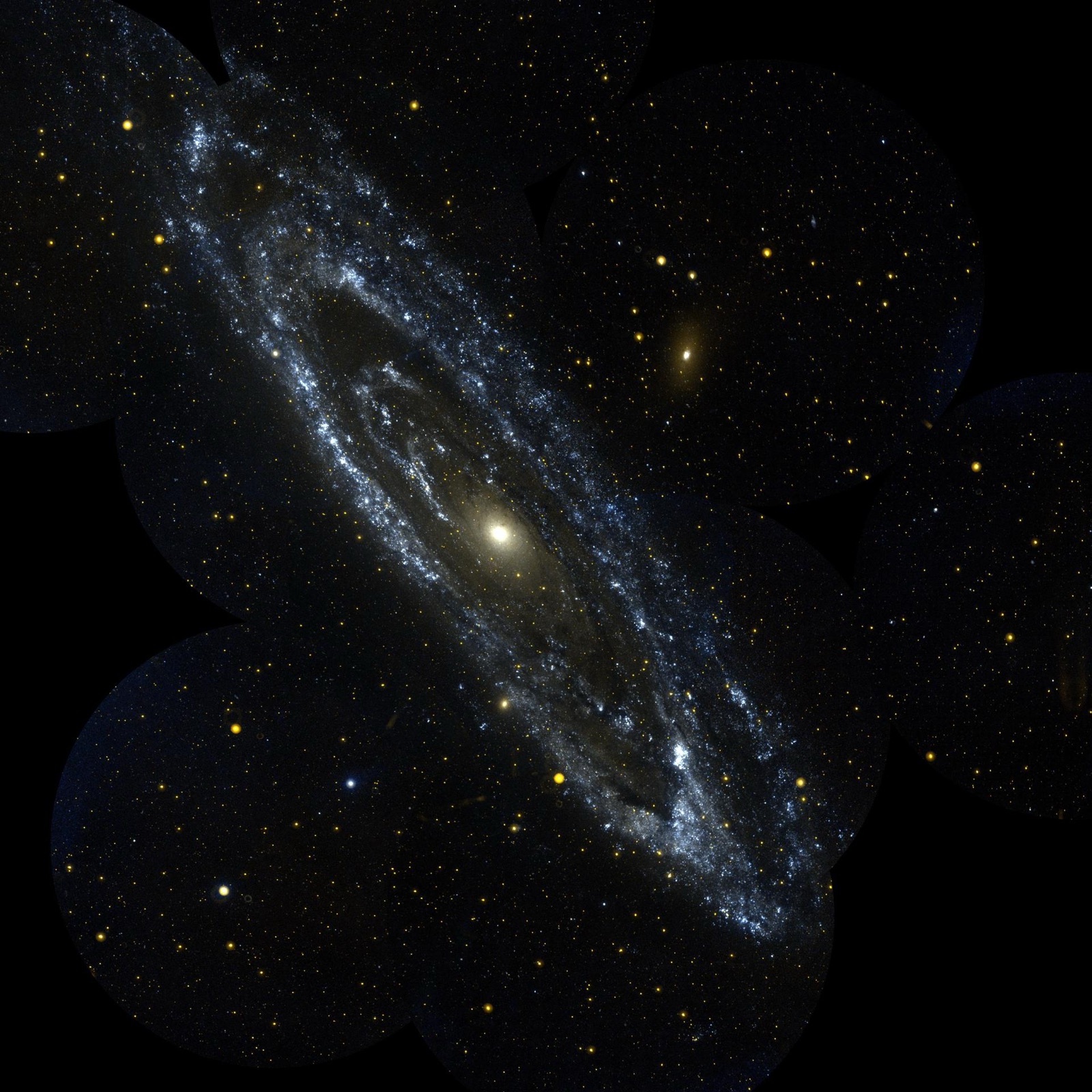
The princess chained to a rock for her mother Cassiopeia's boasting, rescued by Perseus — her stars stream out from a corner of the Great Square of Pegasus. Above her second star hangs the Andromeda Galaxy, our giant neighbor and the farthest thing human eyes can see unaided: light 2.5 million years old.
How to find it
Autumn evenings: from the Great Square's northeast corner, hop two stars along the chain, then two faint stars toward Cassiopeia — the elongated smudge is the galaxy.
✦ What lives inside it
- The Blue Snowball Nebula
The deep dive
Researched for the Atlas from Wikipedia — Andromeda (constellation) (19,358 characters read) · updated Sep 20, 2026
01 A constellation born from four traditions
Long before Greek storytellers fixed Andromeda's myth in stone, her stars were already meaningful. In Babylonian astronomy, the stars that now compose Pisces and the middle of Andromeda formed a single figure representing a fertility goddess, sometimes named Anunitum or the Lady of the Heavens. Arab astronomers kept Ptolemy's constellation but layered a second figure on top of it — a large fish called al-Hut, whose body swept through many of Andromeda's stars and into Pisces. The fish's nose rested on a hazy patch the Arabs could see with the naked eye: what we now call the Andromeda Galaxy. In Hindu tradition, the figure is Antarmada, depicted chained to a rock just as in the Greek account, and scholars cite the near-identical names as evidence that Greek and Indian astrological traditions were closely linked. Even the Marshall Islands had their say, folding Andromeda's bright stars into the body of a porpoise, with Cassiopeia as its tail and Aries as its head. Few constellations carry this many independent cultural fingerprints.
02 What the myth actually says
The Greek myth behind Andromeda is more elaborate than a simple rescue story. Cassiopeia, queen of Aethiopia, boasted that her daughter was more beautiful than the Nereids — sea nymphs of legendary beauty. The offended nymphs petitioned Poseidon, who sent the sea monster Cetus to ravage Aethiopia. Cepheus, Andromeda's father and king, consulted the Oracle of Ammon and was told the only remedy was to sacrifice his own daughter. Chained to a seaside rock, Andromeda was saved by Perseus, though the method varies by source: one version has Perseus using the severed head of Medusa to turn Cetus to stone; the Roman poet Ovid, in his Metamorphoses, has Perseus kill the monster with a diamond sword. After the wedding, the myth says the couple had nine children together — seven sons and two daughters — and went on to found Mycenae and its Perseid dynasty. When Andromeda died, the goddess Athena honored her by placing her image in the sky, neighbored permanently by her mother, father, rescuer, and the retreating monster.
03 Chinese skies carved the stars differently Deeper
Traditional Chinese astronomy divided Andromeda's stars among four separate constellations, each carrying its own astrological weight. Nine stars from Andromeda, joined by seven from Pisces, formed an elliptical figure called Kui, representing either the foot of a walking person or a wild boar. Gamma Andromedae and its neighbors became Tian Dajiangjun, Heaven's Great General — an image of military honor that doubled as an astrological symbol of distinction. Alpha Andromedae paired with Gamma Pegasi to form Bi, the Wall, representing both the eastern wall of the imperial palace and the emperor's personal library. The northern arc of Andromeda's stars formed Tianjiu, a stable for changing horses, while the constellation's far western edge merged with most of Lacerta to become Tengshe, a flying snake. This fragmented view — four constellations where Greece saw one woman — reflects how differently ancient cultures organized the same photons into meaning, carving out administrative, military, and mythological roles from stars that Greek eyes had already assigned to a chained princess.
04 The name on the star that belongs to two figures
Alpheratz, the brightest star in Andromeda at magnitude 2.1, sits at a genuine astronomical crossroads. For centuries it was formally shared between Andromeda and Pegasus, co-designated Delta Pegasi, because it completes the Great Square of Pegasus alongside Markab, Scheat, and Algenib. That double citizenship ended when the International Astronomical Union settled boundaries, but the star's very name preserves an older identity. Alpheratz and its alternate form Sirrah both derive from the Arabic phrase surrat al-faras, meaning the navel of the horse — a reference to Pegasus, not to Andromeda at all. So the star that marks Andromeda's head in Western depictions was named for a horse's belly by Arab astronomers who thought of it as part of an entirely different figure. The star is an A0p-class binary 97 light-years from Earth, with a combined luminosity of 96 times that of the Sun. Its apparent magnitude of 2.1 makes it the anchor point from which most observers star-hop into the rest of the constellation.
05 Almach: a color contrast worth the wait
Gamma Andromedae, known as Almach, presents one of the most celebrated color contrasts in the night sky. At magnitude 2.14 it is the third-brightest star in the constellation, sitting at the southern tip 358 light-years away, but its real appeal emerges in a telescope. The system splits into a warm yellow-orange primary of magnitude 2.3 and a blue-green companion of magnitude 5, separated by 9.7 arcseconds — a gap wide enough for a small telescope to resolve cleanly. William Herschel, observing the pair, wrote that the striking color difference suggested the idea of a sun and its planet, with the contrast of unequal sizes adding to the impression. The blue-green secondary is itself a double star, with a companion of magnitude 6.3 orbiting it with a period of 61 years, making Almach a triple system in total. The name comes from the Arabic phrase meaning the earth-kid, an oblique reference to an animal said to help lions locate prey — a poetic mismatch for a star that today most people simply call beautiful.
06 Ross 248: the nearest star you've never heard of Deeper
Tucked into Andromeda at a distance of just 10.3 light-years is Ross 248, also catalogued as HH Andromedae. It is the ninth-closest star to Earth, yet it never appears on popular lists of famous nearby stars because it is a dim M6-class red dwarf — a BY Draconis variable — far below naked-eye visibility. Its proximity makes it scientifically significant: at that range, even modest future spacecraft would reach it within conceivable mission timescales. For comparison, the nearest star system to Earth, Alpha Centauri, sits at about 4.2 light-years; Ross 248 at 10.3 light-years is roughly 2.5 times farther but still within the Sun's immediate stellar neighborhood. Andromeda is not usually thought of as a constellation crowded with nearby stars, so Ross 248 is a genuine surprise hidden in plain sight — a red dwarf variable star less than 11 light-years from our own solar system, visible only to those with a moderate telescope and a precise finder chart.
07 Upsilon Andromedae and its four planets Deeper
The binary star Upsilon Andromedae, catalogued as Titawin and sitting 44 light-years from Earth at magnitude 4.1, hosts one of the better-studied multi-planet systems outside our own. The primary star is an F-type dwarf, its companion an M-type dwarf. Four confirmed planets orbit the primary, with masses of 0.96, 14.57, 10.19, and 1.06 times the mass of Jupiter — a range that includes objects from near-Jupiter size to more than fourteen Jupiter masses, which puts the most massive companion near the boundary often discussed in planetary science between a large planet and a brown dwarf. The variety of masses in a single planetary system makes Upsilon Andromedae a useful case study for understanding how giant planets form and migrate. Meanwhile, 14 Andromedae — the star Veritate, 251 light-years away — hosts planet 14 Andromedae b, discovered in 2008. That planet has a mass of 4.3 times Jupiter, orbits at 0.83 astronomical units from its parent giant star every 186 days, and circles a star with 2.2 solar masses and a radius 11 times the Sun's.
08 The galaxy that proved the universe was vast
Before 1923, astronomers genuinely debated whether the Andromeda Nebula was a swirling cloud inside our own galaxy or something enormously farther away. Edwin Hubble settled the argument using the 100-inch Hooker Telescope at Mount Wilson Observatory in California. Searching for novae in M31, he found Cepheid variable stars instead — objects whose pulsation period reveals their true brightness, making them reliable distance markers. The distance he calculated was far greater than the known diameter of the Milky Way, forcing the conclusion that M31 was an entirely separate galaxy, an island universe in its own right. Hubble originally placed M31 at 900,000 light-years; Ernst Öpik's independent estimate in 1925 put it closer to 1.5 million light-years. Modern measurements set the distance at approximately 2.2 million light-years, with estimates ranging up to 2.5 million light-years. The galaxy is roughly 200,000 light-years in diameter — twice the width of the Milky Way — and despite that staggering distance, it registers at magnitude 3.5 and spans 192.4 by 62.2 arcminutes on the sky, larger than six full moons laid end to end.
09 M31's first recorded sighting and its companions Deeper
The Andromeda Galaxy's soft glow was visible to the naked eye throughout human history, yet no written record of it survives until AD 964, when the Arab astronomer al-Sufi described it as a little cloud in his Book of Fixed Stars. Telescopic observation followed shortly after the telescope's invention: Simon Marius turned one on M31 in 1612. The galaxy's two principal companions were discovered much later and by different observers. M32, the compact elliptical galaxy that appears superimposed on M31's disk just 0.5 degrees south of its core, was found in 1749 by French astronomer Guillaume Le Gentil. It has since been measured to lie actually closer to Earth than M31 itself. M110, the larger but lower-surface-brightness elliptical companion 1 degree northwest of M31's core, is classified either as a dwarf spheroidal or a generic elliptical galaxy. Together, M31, M32, and M110 are the most prominent members of a satellite family totaling 15 galaxies; nine of those satellites appear to lie in a common plane, a geometric arrangement that has led astronomers to suggest they share a single origin event.
10 A planetary nebula called the Blue Snowball
About 3 degrees southwest of Iota Andromedae, at a distance of roughly 4,000 light-years, floats NGC 7662 — nicknamed the Blue Snowball Nebula. The name is straightforwardly descriptive: in a telescope it appears as a small, round, distinctly blue-green disk at overall magnitude 9.2. Push the magnification higher and the structure becomes richer: the disk takes on a slightly elliptical shape, brightens toward the edges and grows darker at the center in the manner of a hollow shell, and at the very heart sits the central star responsible for the nebula's glow, clocking in at magnitude 13.2 — faint enough to require a moderately large telescope to detect. The nebula measures 20 by 130 arcseconds across, making it compact by planetary nebula standards. Its combination of distinctive color, obvious roundness, and relatively bright magnitude makes it one of the more rewarding planetary nebulae for amateur observers working through a list of Caldwell objects, where it appears as Caldwell 22.
11 The Andromedids: a ghost of a shattered comet
Every November, Andromeda serves as the radiant point for the Andromedid meteor shower, but any observer expecting a spectacle will be disappointed by modern rates of fewer than 2 meteors per hour at peak. The shower's reputation rests on its past, not its present. The storms of 1872 and 1885 produced an estimated peak rate of 2 meteors per second — a zenithal hourly rate of 10,000 — dramatic enough that a Chinese astronomer of the era compared the meteors to falling rain. Astronomers have long associated the Andromedids with Biela's Comet, a body that broke apart in the 19th century, though that connection is debated. The meteors are characteristic: unusually slow, sometimes red, and diffuse enough that they appear to drift in from neighboring constellations as well as from Andromeda itself. A modest outburst on December 3–5, 2011, reached a zenithal hourly rate of 50 and was linked specifically to material ejected by Comet Biela during its close solar pass in 1649, not to debris from the comet's 1846 disintegration. Researchers who studied the 2011 event predicted further outbursts in 2018, 2023, and 2036.
12 Boundaries, abbreviations, and a king's lost honor Deeper
Andromeda's administrative history is more eventful than most constellations'. In 1787, German astronomer Johann Bode attempted to carve a new constellation from several Andromeda stars and most of Lacerta's stars, naming it Honores Friderici — also called Friedrichs Ehre — in honor of King Frederick II of Prussia. The figure fell out of use quickly and was never formally adopted. The star now called 51 Andromedae, or Nembus, had a similarly complicated journey: Johann Bayer assigned it to Perseus as Upsilon Persei, and only later did the International Astronomical Union move it to Andromeda. The IAU standardized the constellation's three-letter abbreviation as And in 1922. Eight years later, in 1930, Belgian astronomer Eugène Delporte formally drew Andromeda's official borders as a 36-segment polygon. Those boundaries place the constellation between right ascensions 22h 57.5m and 2h 39.3m and between declinations 53.19° and 21.68°. The entire enclosure covers 722 square degrees — more than 1,400 times the area of the full Moon, and 55 percent of the area of Hydra, the largest constellation.
13 NGC 891 and the deep field beside Almach Deeper
Just east of Almach lies one of the finest edge-on galaxies accessible to amateur telescopes: NGC 891, listed as Caldwell 23. Discovered by William and Caroline Herschel in August 1783, it is a barred spiral galaxy tilted so precisely toward our line of sight that its disk appears as a narrow sliver, 13.5 by 2.8 arcminutes across, with a prominent dark dust lane running straight down the middle — a detail that became a textbook example of galactic dust structure. NGC 891 sits at approximately 30 million light-years, a distance derived from its redshift of 0.002, making it more than thirteen times farther than the Andromeda Galaxy. Its overall magnitude of 9.9 sounds accessible, but a surface brightness of 14.6 spreads that light so thinly across the sky that the galaxy is genuinely challenging. Dark, transparent skies and a telescope of at least 6 inches are typically needed to see the dust lane clearly. Despite the difficulty, NGC 891 rewards the effort — few sights in the autumn sky illustrate the structure of a spiral galaxy so directly.