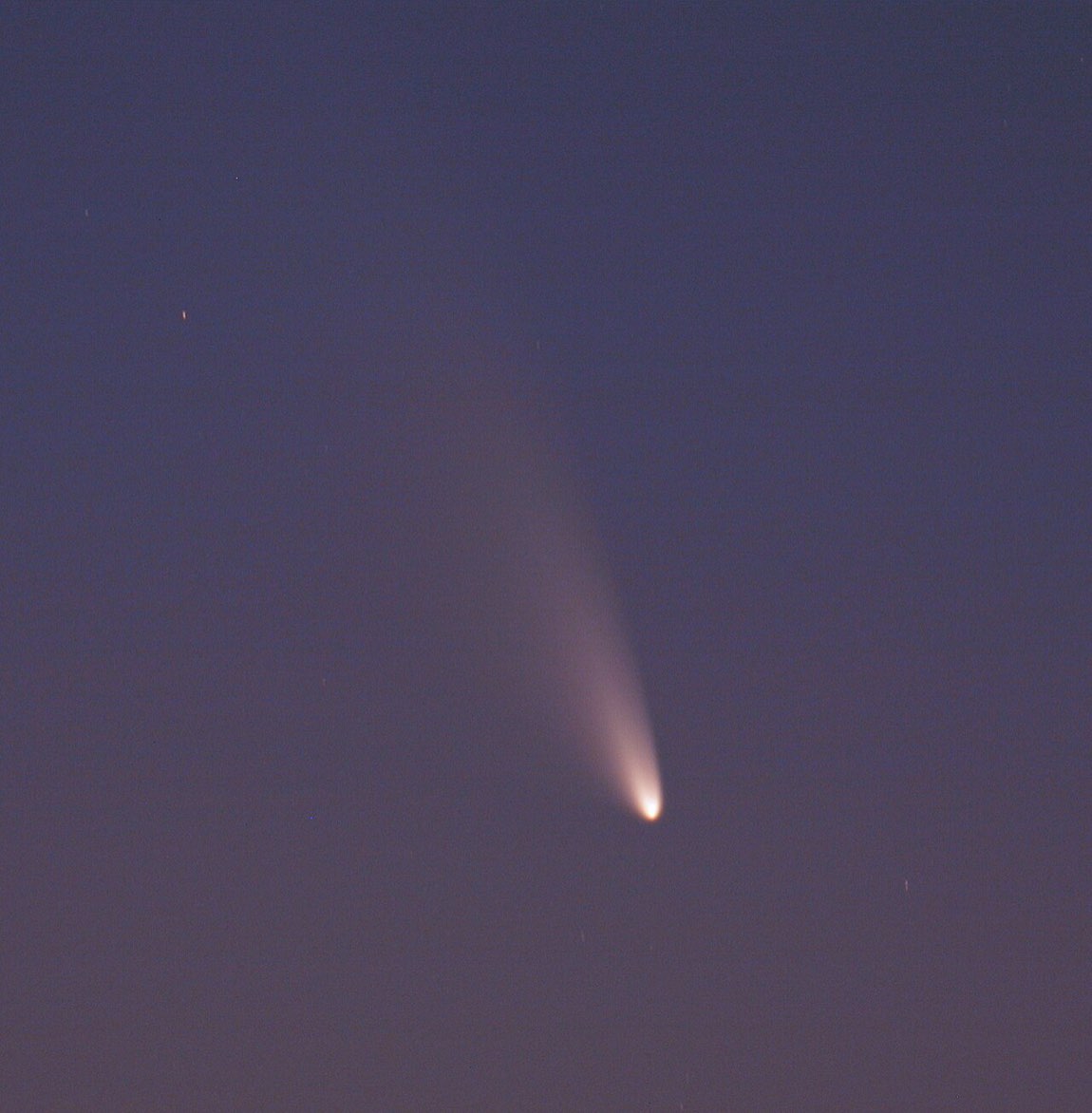
 Photograph · Astronomy Education Services/Gingin Observatory on NASA website · Public domain
Comet · Deep guide
Comet PANSTARRS (C/2011 L4)
Also called: C/2011 L4 · Comet Pan-STARRS
A naked-eye twilight comet of March 2013, found by the Pan-STARRS survey telescope in Hawaii.
What is it?
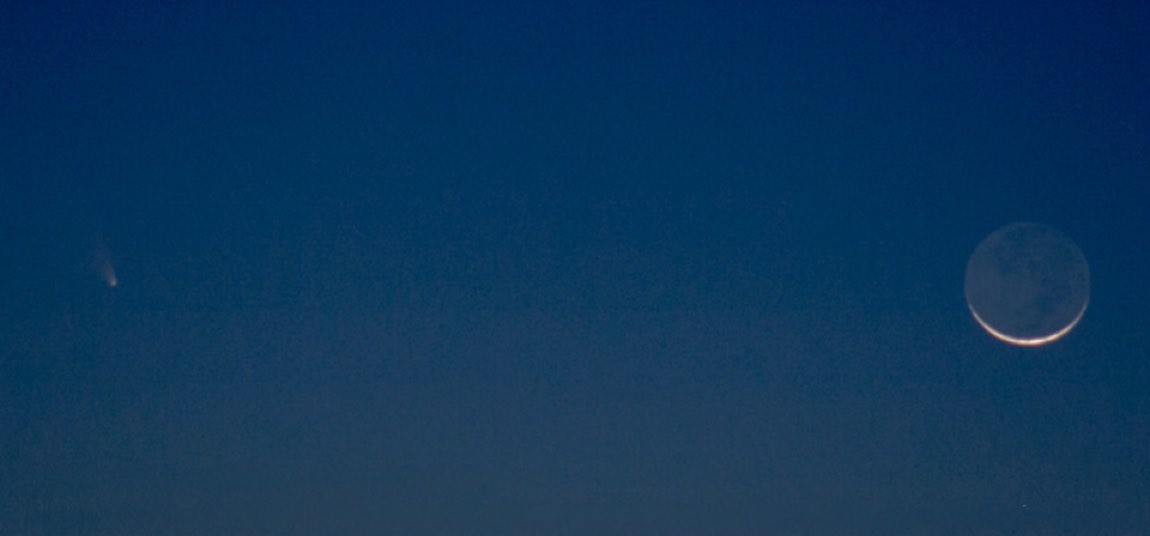
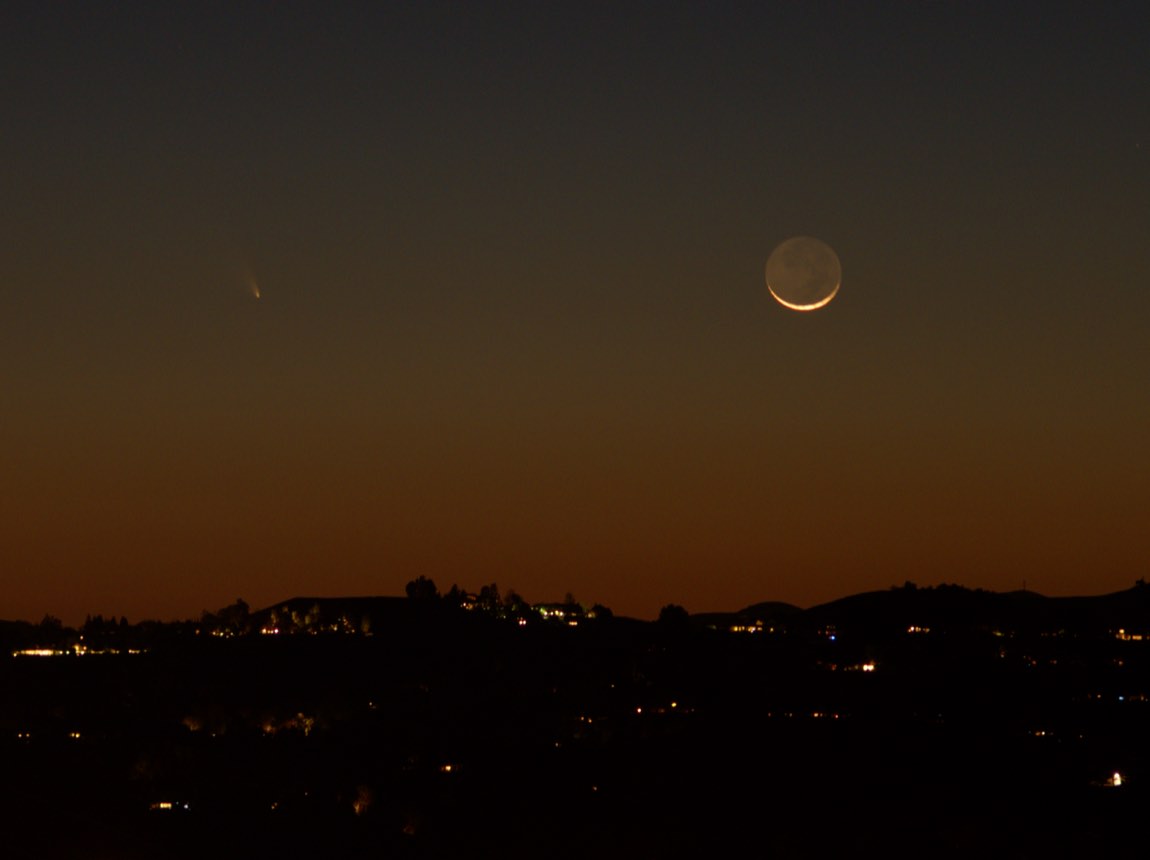
C/2011 L4 was discovered in June 2011 by the Pan-STARRS telescope near the summit of Haleakalā on Maui. It was a long-period comet arriving from the outer Solar System. It became visible to the naked eye in February 2013 and reached perihelion on 10 March 2013. Its peak brightness of about magnitude +1 fell short of early predictions, and it sat low in evening twilight, but many people spotted it near the thin crescent Moon.
The deep dive
Researched for the Atlas from Wikipedia — C/2011 L4 (PanSTARRS) (3,719 characters read) · updated Nov 14, 2026
01 A Telescope Network That Found It First
Comet PANSTARRS was discovered in June 2011 by the Pan-STARRS telescope, an instrument perched near the summit of Haleakalā on the island of Maui, Hawaii. When first detected, the comet was still a distant 7.9 AU from the Sun — roughly the distance to Saturn — and glowed at a faint apparent magnitude of 19, far beyond unaided human vision. For comparison, the faintest stars a sharp-eyed person can see on a perfect night reach about magnitude 6. Pan-STARRS is designed to sweep the sky systematically for exactly these kinds of faint, slow-moving objects, and the comet's detection nearly two years before its closest approach gave astronomers an unusually long runway to track and study it. The name C/2011 L4 encodes the discovery circumstances: "C" means non-periodic, "2011" is the year, "L" marks the half-month of discovery, and "4" identifies it as the fourth object found in that period.
02 How Brightness Predictions Went Wrong
Few aspects of C/2011 L4's story are more instructive than the serial collapse of its brightness forecasts. Early estimates confidently predicted a peak of around apparent magnitude 0 — roughly matching brilliant stars like Vega or Alpha Centauri A. By October 2012, one estimate pushed the prediction to magnitude −4, comparable to Venus and bright enough to cast faint shadows. Then reality intervened. A noticeable brightening slowdown appeared in January 2013, pulling the forecast back to magnitude +1. February brought a further slowdown, nudging estimates to around +2. A detailed secular light-curve study identified a specific "slowdown event" that occurred when the comet was 3.6 AU — about 540 million kilometers — from the Sun and shining at magnitude 5.6, after which outgassing became less efficient than expected. That study predicted a perihelion magnitude of only +3.5, noting that Comet Halley at the same distance would reach magnitude −1.0. In the end, most observers measured an actual peak near +1, landing between the optimistic and pessimistic extremes.
03 A "Baby Comet" Visiting for the First Time Deeper
The same secular light-curve study that diagnosed the slowdown event reached a striking conclusion: C/2011 L4 is very young and belongs to the class known as "baby comets," defined as those with a photometric age of fewer than four comet years. A comet year is measured in units of its own orbital period, so a photometric age this low implies the nucleus has experienced very few close passes near the Sun. First-time or near-first-time visitors behave differently from veteran comets because their outermost layers still retain the most volatile ices, which can produce dramatic but short-lived outbursts of activity before a less reactive crust forms. This youthfulness is consistent with the comet's origin: C/2011 L4 likely traveled inward over millions of years from the Oort cloud, the vast reservoir of icy bodies that surrounds the solar system at enormous distances, before making what may be its first or one of its earliest close approaches to the Sun.
04 The Coma: A Temporary Atmosphere 120,000 km Wide
As a comet warms on its inbound journey, solar heat vaporizes surface and near-surface ices, releasing gas and fine dust particles that form a fuzzy, gravitationally unbound envelope called the coma. For C/2011 L4, observers estimated the coma diameter at approximately 120,000 kilometers — about 75,000 miles — in October 2012, when the comet was still more than a year from its closest solar approach. To put that in perspective, 120,000 km is roughly 9.4 times the diameter of Earth, making a temporary feature that exists only because of solar heating far larger than any solid body in the inner solar system. The coma is not a stable structure; it continuously streams away from the nucleus and is replenished by fresh sublimation. Observers in mid-March 2013 were advised to use binoculars about 40 minutes after sunset, when the sky was dark enough to reveal the comet's diffuse glow above the western horizon.
 ⤢
05 Three Estimates for the Nucleus Size Deeper
Pinning down the true size of a comet's solid nucleus is surprisingly difficult, and C/2011 L4 illustrates why different methods give different answers. Dust and gas production rates, which scale with the active surface area releasing volatiles, suggest a nucleus diameter of roughly 1 kilometer — about 0.62 miles. A second approach uses the absolute nuclear magnitude combined with an assumed geometric albedo of 0.04, a typical value for dark, carbon-rich comet surfaces; this method yields a diameter of over 2.4 km, or about 1.5 miles. A third technique, based on the coma's magnitude decay function, estimates an effective radius of 2.317 ± 0.190 km. The spread between estimates — from roughly 1 km to nearly 5 km in diameter — reflects genuine uncertainty about how much of the nucleus surface was active, what its true reflectivity was, and how the coma's brightness was separated from the nucleus signal in the data.
06 Spinning Once Every Five Hours
Rotation periods for comet nuclei are notoriously hard to measure because the constant jets of gas and dust obscure and confuse the light curve. For C/2011 L4, astronomers found a window of opportunity between July and August 2013, after perihelion, when the comet entered a brief, less active state. With the coma relatively quiet, light-curve measurements could isolate brightness variations caused by the rotating nucleus itself. The result: C/2011 L4 spins once every five hours. Among solar system objects, that qualifies as a fast rotator. For comparison, Earth takes 24 hours; many asteroids rotate in the range of 4 to 12 hours. A fast rotation can affect how jets of escaping gas distribute themselves across the nucleus surface and can influence whether a loosely bound body might shed material along its equator, though no specific fragmentation events are reported for this comet.
07 Orbital Path: Millions of Years in Transit
C/2011 L4 carries the "C" designation because it is a non-periodic comet — one whose orbit does not regularly return to the inner solar system on a human-relevant timescale. The comet is thought to have originated in the Oort cloud and to have spent millions of years on its long fall inward toward the Sun. After swinging past perihelion in March 2013, it began the outbound leg of an enormous ellipse. The post-perihelion orbital period, calculated for the epoch of 2050 and accounting for gravitational nudges from the planets, is estimated to be roughly 107,000 years. That means anyone who missed the 2013 show would need to wait more than a thousand human lifetimes — or about five times as long as recorded human history — before the comet returned. Its trajectory offers no second chance on any civilizational timescale.
08 The Possibility of a Sodium Tail Deeper
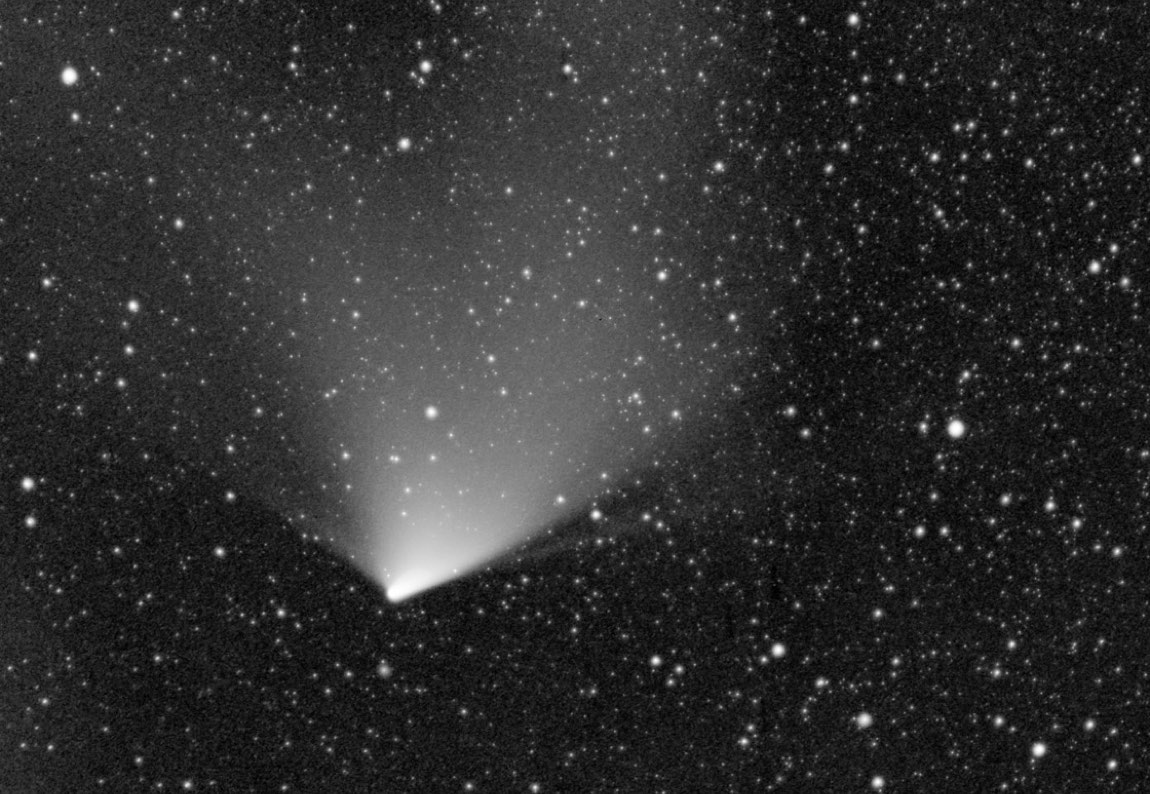
Most comets display two well-known tails: a dust tail, which curves gently away from the Sun following the comet's orbital path, and a plasma or ion tail, which points almost perfectly straight away from the Sun driven by the solar wind. A third, rarer feature is a sodium tail — a stream of neutral sodium atoms accelerated by radiation pressure. Comet Hale–Bopp, one of the brightest comets of the twentieth century, famously displayed such a sodium tail in 1997, and the article notes that C/2011 L4 may have had one as well. Sodium tails require specific observation geometries and specialized filters to detect, so their presence or absence is not always confirmed definitively. If confirmed, a sodium tail would indicate that sodium-bearing minerals or ices near the nucleus surface were being energetically processed during the comet's perihelion passage.
 ⤢
09 Star Encounters That Helped Track the Comet
As C/2011 L4 moved north through the sky in the spring of 2013, its path carried it past a succession of moderately bright stars that served as useful reference points for observers. On the nights of March 17 and 18, the comet appeared near Algenib — also known as Gamma Pegasi — a star shining at magnitude 2.8 that provided a convenient anchor for estimating the comet's own brightness and position. By April 22, the comet had drifted to the vicinity of Beta Cassiopeiae, and by May 12 through 14, it was near Gamma Cephei, continuing its northward track until May 28. These close passes near known stars were not mere curiosities; they were essential for the photometry, because the comet's low altitude over the horizon near twilight made accurate brightness estimates difficult, requiring corrections for differential atmospheric extinction — the extra dimming that affects objects at different heights above the horizon by different amounts.
10 From Magnitude 19 to Naked-Eye Visibility
The observational arc of C/2011 L4 from discovery to perihelion spans one of the more dramatic brightness climbs recorded for a modern comet. When found in June 2011, it sat at magnitude 19 — roughly 160,000 times fainter than the dimmest star a human eye can perceive without aid. By early May 2012, it had reached magnitude 13.5, within range of a large amateur telescope under dark skies. The first naked-eye sighting came on February 7, 2013, at approximately magnitude 6. The comet then passed closest to Earth on March 5, 2013, at a distance of 1.09 AU, before reaching perihelion just five days later on March 10. That five-day separation between Earth closest-approach and perihelion is a reminder that "closest to Earth" and "closest to the Sun" are different events for most comets, whose orbits are not centered on Earth. The entire naked-eye visibility window was brief and demanded clear western horizons after sunset.
11 Why Observing Conditions Were So Challenging Deeper
Even at its best, C/2011 L4 was not an easy naked-eye spectacle, and the article is candid about why. The comet's perihelion placed it very close to the Sun in the sky, meaning it rose and set nearly with the Sun, leaving only a narrow window — about 40 minutes after sunset in mid-March 2013 — when the sky was dark enough to pick it out yet the comet still sat above the horizon. Its low altitude introduced significant atmospheric extinction, the dimming and reddening of light that increases steeply as objects approach the horizon. This also created an asymmetry in the available reference stars for photometry, since stars at different elevations are dimmed by different amounts. The combined effect is that brightness estimates from that period carry meaningful uncertainties, and observers across different locations and sky conditions arrived at figures spanning a noticeable range, centered roughly on magnitude +1 but not tightly constrained.
 ⤢