 Photograph · self-made · Public domain
Comet · Deep guide
Comet Machholz 1 (96P/Machholz)
Also called: 96P/Machholz · Machholz 1
An oddball comet that dives inside Mercury's orbit and has an unusual chemical make-up.
What is it?
96P/Machholz was found by amateur astronomer Donald Machholz with binoculars in California in May 1986. Its stretched, steeply tilted orbit carries it to about 0.12 AU from the Sun, closer than any other regular numbered short-period comet apart from tiny SOHO comets. In 2007 it was found to be poor in carbon and cyanogen, a chemistry so rare that some scientists suggest it may have formed outside our Solar System. It is linked to the Marsden and Kracht sungrazer groups and the daytime Arietid meteors.
The deep dive
Researched for the Atlas from Wikipedia — 96P/Machholz (5,891 characters read) · updated Nov 14, 2026
01 A Discovery Made by Eye and Binoculars
Donald Machholz found this comet on 12 May 1986 from Loma Prieta peak in central California, using nothing more than a pair of 130 mm (5.1 in) binoculars. That aperture is modest even by amateur standards, which speaks to how bright the comet was at the moment of discovery. Machholz was a dedicated visual comet hunter — a practice that was already giving way to automated sky surveys in the 1980s — and his find came through patient, systematic sweeping of the sky. The comet was soon confirmed and assigned the periodic designation 96P, the 'P' signifying a proven short-period orbit. Just weeks after discovery, on 6 June 1986, it passed 0.404 AU (60.4 million km) from Earth, giving observers a close-up view early in its recorded history. The comet has since been watched at every return, but the story of its detection remains a reminder that individual observers with simple equipment can still find objects that reshape scientific understanding.
02 An Orbit Unlike Any Other Numbered Comet
96P/Machholz holds a remarkable orbital record: among all numbered and regularly tracked short-period comets, only the small SOHO-discovered fragments come closer to the Sun. Its perihelion distance for 2028 is just 0.116 AU (17.4 million km), far inside the orbit of Mercury. At that closest point it hurtles past the Sun at 122 km/s — roughly 440,000 km/h, or about 360 times faster than a commercial airliner. The 5.29-year orbital period is relatively short, yet the orbit is both highly elongated and steeply tilted, a combination that is essentially unique among known short-period comets. Most short-period comets have either high eccentricity or high inclination, but rarely both together. The Tisserand parameter with respect to Jupiter is only 1.94, just below the threshold of 2 that defines the Jupiter-family classification, though orbital calculations show it exceeded that threshold roughly 2500 years ago. The comet is currently locked in a 9:4 orbital resonance with Jupiter, meaning it completes nine orbits in roughly the same time Jupiter completes four.
03 How the Perihelion Is Slowly Creeping Inward Deeper
96P/Machholz is not on a fixed orbital track — its closest approach to the Sun is gradually tightening over centuries. Between 1897 and 2102, perihelion distance is calculated to drop from 0.17 AU (25 million km) all the way down to 0.09 AU (13 million km). The year 2081 will mark the first time the comet dips below 0.1 AU, placing it even deeper inside Mercury's orbital zone. This drift matters enormously for the comet's long-term survival, because each closer pass subjects the nucleus to more intense solar heating. Looking even further ahead, the calculations become highly speculative: by 2235, the uncertainty in the comet's position alone exceeds 1 billion km, equivalent to 6.7 AU — wider than the gap between Jupiter and Saturn. That uncertainty arises partly from nongravitational forces, the subtle rocket-like push that outgassing jets exert on the nucleus, which are difficult to model reliably across long timescales. The comet may eventually be ejected from the Solar System altogether.
04 The Parent of Two Sungrazer Families
96P/Machholz is identified as the parent body of both the Kracht and Marsden sungrazer families — two distinct groups of small Sun-approaching comets discovered primarily through SOHO imagery. The orbital connection means that at some point in the past, the nucleus shed material, or broke apart in ways that sent fragments onto their own but dynamically related paths. The orbit also corresponds to the Arietids, one of the strongest daytime meteor showers observable from Earth. This web of related objects — a main comet, two comet families, and a meteor shower — makes 96P/Machholz one of the most consequential single bodies for understanding how cometary material disperses through the inner Solar System. The 2007 perihelion passage itself appears to have produced at least one confirmed offspring: the comet SOHO 2333 is believed to be a fragment that calved off during that return and was identified five years later by Indian amateur Prafull Sharma, who became the third Indian to discover a comet via public SOHO data.
 ⤢
05 Six SOHO Encounters and What They Revealed
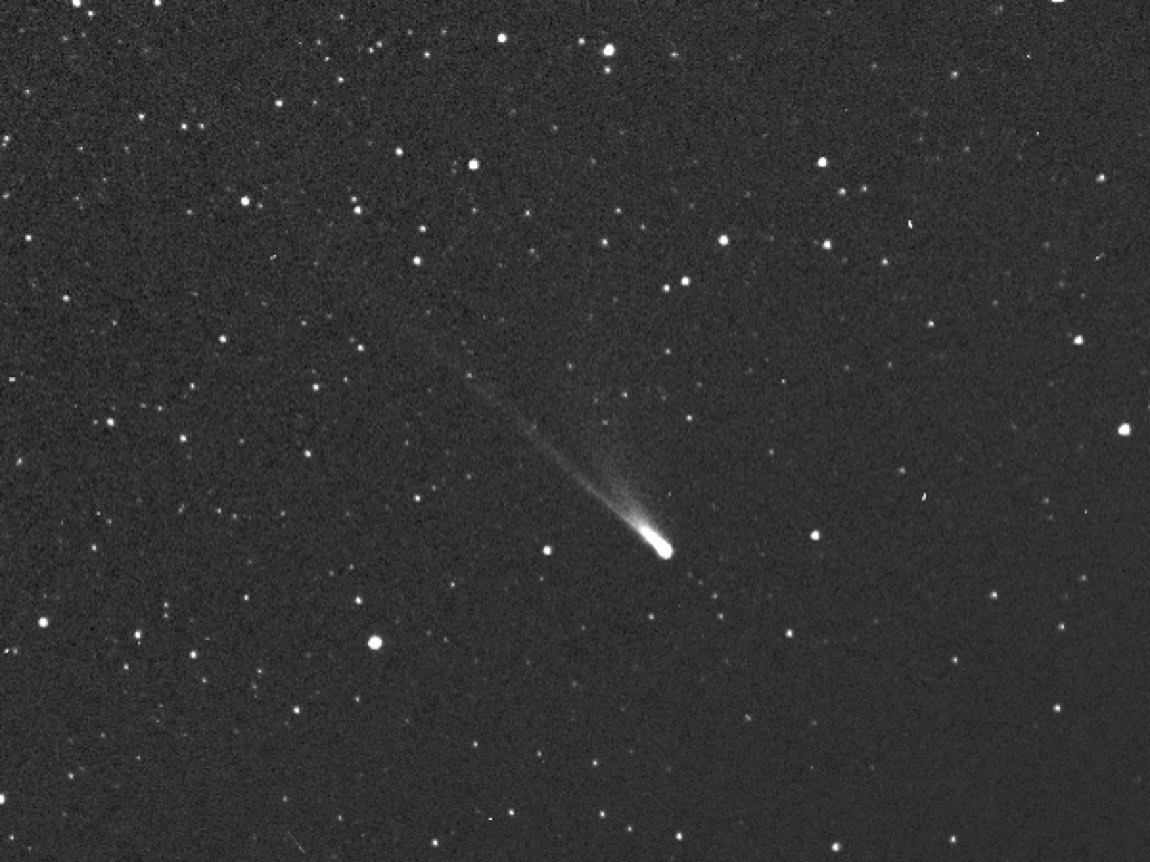
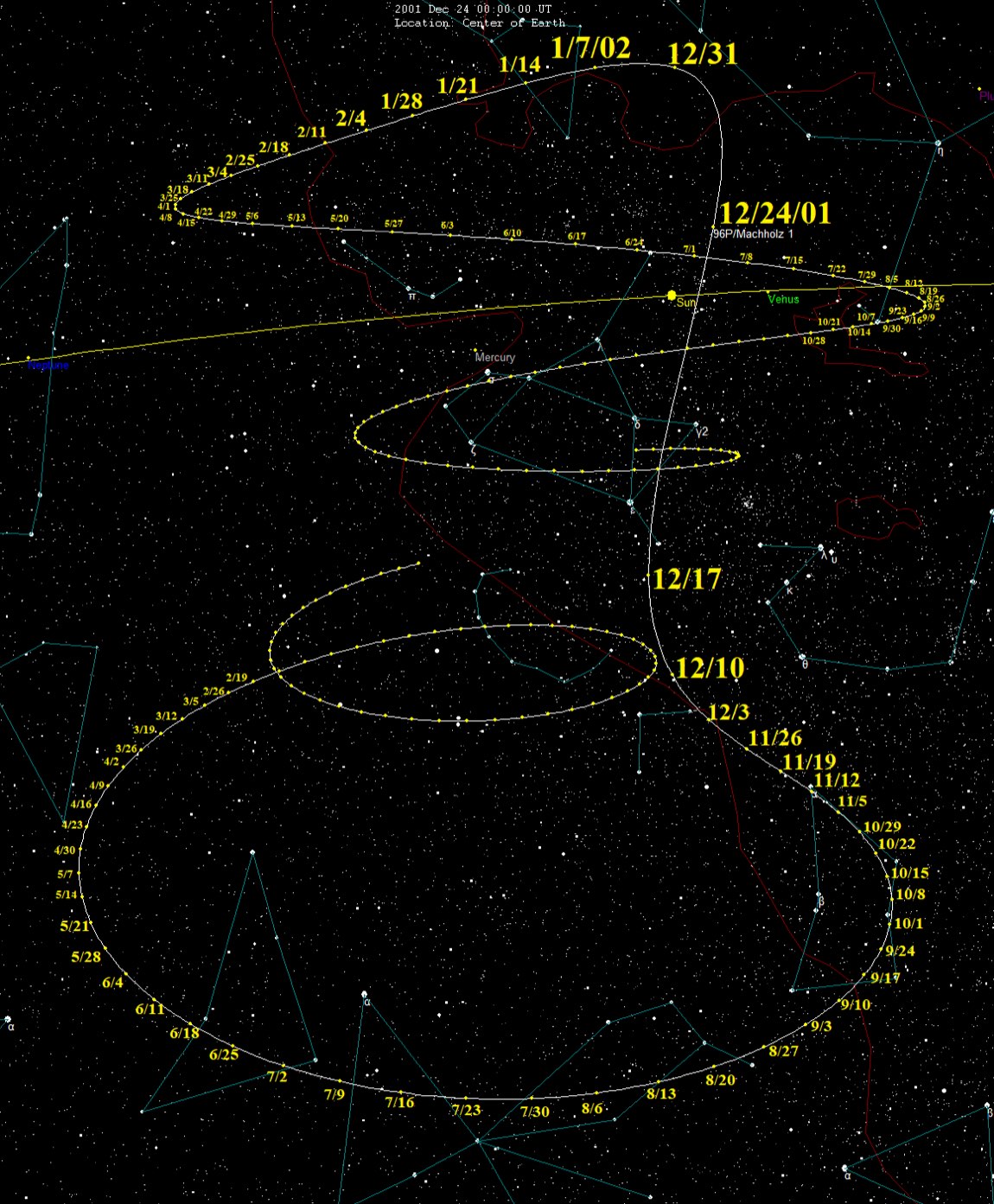
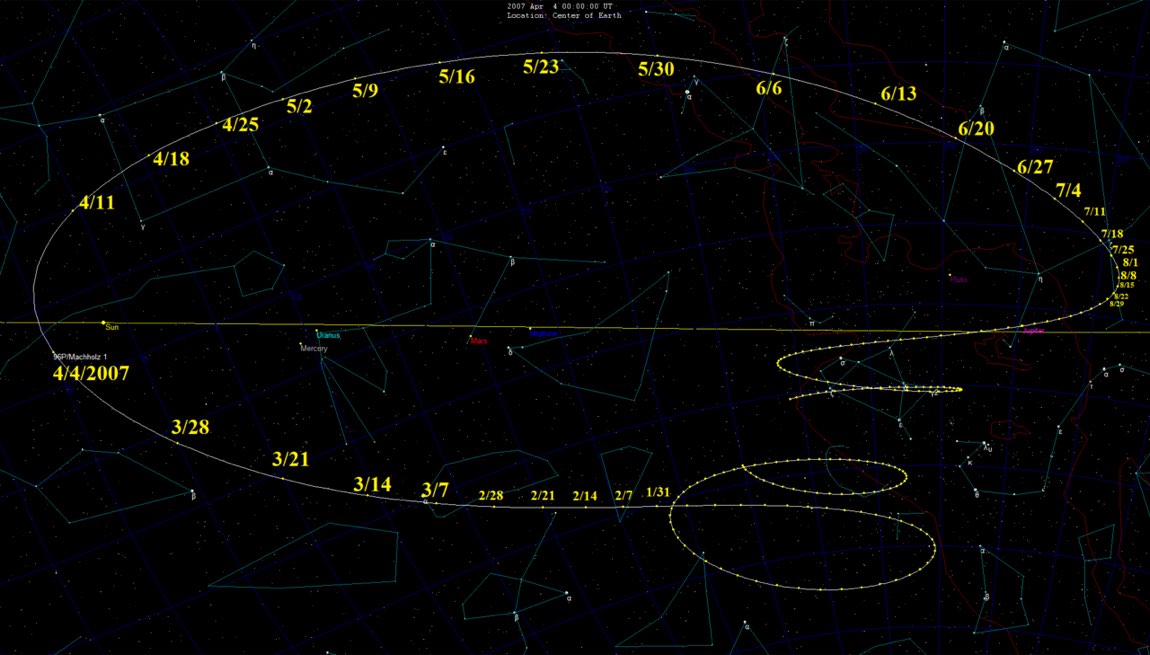
Because 96P/Machholz passes so close to the Sun, ground-based telescopes cannot safely observe it near perihelion — the Sun's glare makes that impossible. Instead, the Solar and Heliospheric Observatory (SOHO) has become the primary instrument of record, capturing the comet in its LASCO coronagraph fields during apparitions in 1996, 2002, 2007, 2012, 2017, and 2023 — six passages in total. During the 2001/2002 passage the comet brightened dramatically to magnitude −2, making it a spectacular sight in SOHO data. By contrast, the 2007 and 2012 returns peaked around magnitude +2. At the 2007 apparition it appeared in LASCO C3 from April 2 to 6, peaking on April 4; the coma was physically smaller than the Sun in volume, yet strong forward scattering of sunlight made it look considerably brighter than its size alone would suggest. After the January 31, 2023 perihelion, the comet was recovered on February 4 in the morning sky at about magnitude 7, just 2 degrees above the horizon — a final, faint farewell before retreating into the outer Solar System.
06 Fragmentation: A Comet Shedding Pieces Deeper
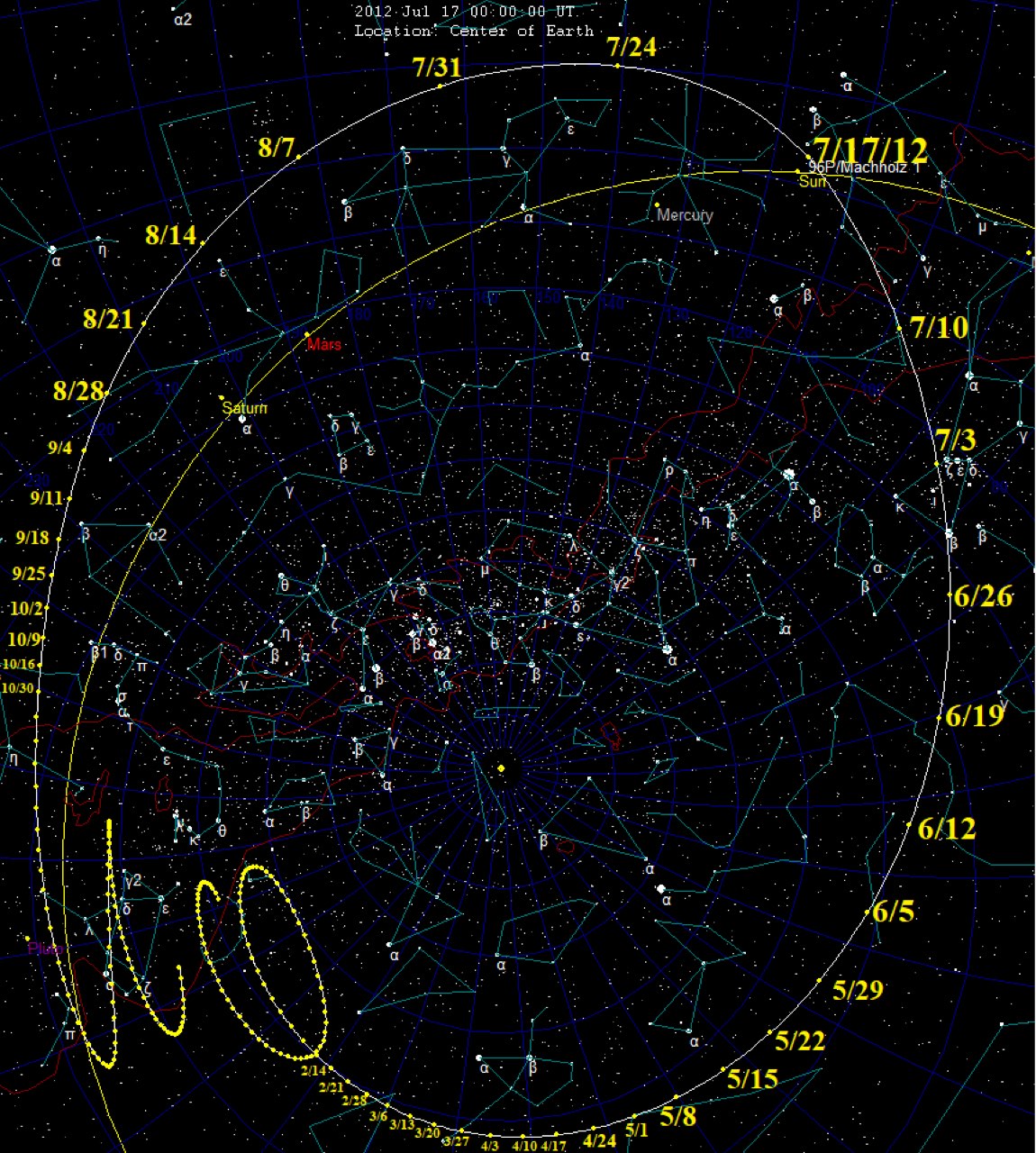
Direct evidence that 96P/Machholz is actively breaking apart has come from multiple SOHO observation campaigns. During the 2012 perihelion window, between July 12 and 17, two small faint fragments were detected in SOHO C2 images. These fragments were running five hours ahead of the main nucleus along the orbit, suggesting they had detached earlier and drifted slightly faster. Scientists concluded they most likely fragmented from the comet during the 2007 perihelion passage, not the 2012 one, meaning the pieces traveled independently for about five years before being spotted. The separately catalogued comet SOHO 2333 is also believed to be a fragment produced at the 2007 perihelion, identified through archival image analysis in August 2012. Together, these detections paint a picture of a nucleus under severe stress each time it rounds the Sun. With perihelion distances set to decrease further over coming centuries, the rate and scale of fragmentation events may well increase, potentially feeding additional material into the Kracht and Marsden families.
07 A Chemical Composition Almost Unique in the Solar System
What makes 96P/Machholz scientifically extraordinary is not just its orbit but its chemistry. During its 2007 apparition, researchers from the Lowell Observatory comet composition long-term observing program took spectra of its coma and compared the results with measurements from roughly 150 other comets. The comet was found to be severely depleted in both carbon-chain molecules and cyanogen. On average, those 150 other comets contained 72 times more cyanogen than 96P/Machholz — a staggering difference. Only two other comets have ever shown similar depletion in both categories: C/1988 Y1 (Yanaka) and C/2025 K1 (ATLAS), though both travel on substantially different orbits. Such a small club of chemical oddballs across the entire known comet population underscores how genuinely unusual 96P/Machholz is, and the composition has fueled vigorous debate about where and how this comet formed.
08 Three Theories for a Chemical Oddity Deeper
Scientists have proposed three distinct hypotheses to explain why 96P/Machholz is so depleted in carbon and cyanogen, and none has been definitively ruled out. The most dramatic idea is that it is an interstellar interloper — a comet that formed around another star and was captured by the Sun's gravity. If it condensed from a chemically different protoplanetary disk, its molecular inventory could differ fundamentally from Solar System comets. A second hypothesis is that it formed in an unusually cold region of the Solar System, cold enough that most carbon became locked into less volatile molecules rather than the carbon-chain species we normally detect. The third hypothesis points to the comet's extreme orbital history: its repeated close passages to the Sun may have baked away most of its cyanogen over millions of years, leaving a depleted surface layer exposed to spectroscopic analysis. Each hypothesis has some supporting logic, but distinguishing between them would require either direct sampling of the nucleus or more detailed compositional mapping than current instruments allow. The question remains genuinely open.
 ⤢
09 The Orbital Resonance Keeping It in Check — For Now Deeper
96P/Machholz is currently in a 9:4 mean-motion resonance with Jupiter, meaning it completes nine orbits around the Sun in approximately the same time Jupiter completes four. Such resonances can act as gravitational corrals, nudging a small body repeatedly in similar orbital phases and either stabilizing or gradually destabilizing its path. Historical orbital integrations suggest that the comet's Tisserand parameter with respect to Jupiter — a quantity used to classify comet types — was greater than 2 about 2500 years ago, which would have placed it formally in the Jupiter-family category. Today it sits at 1.94, just below that boundary. The resonance, combined with Jupiter's enormous gravitational influence, is likely responsible for shaping the comet's unusual combination of high eccentricity and high inclination over time. The same dynamics make long-term predictions unreliable: the article notes that by 2235, positional uncertainty exceeds 1 billion km, and the possibility of eventual ejection from the Solar System cannot be excluded.
10 When and Where to Watch It Next
96P/Machholz will not make another close pass by Earth until 2028, when it will approach to 0.3197 AU (47.83 million km) — somewhat closer than the 0.404 AU flyby recorded in 1986. The next perihelion is calculated to occur around 12 May 2028, based on observations collected through October 2022. Near perihelion, the comet will again pass through SOHO's coronagraph field of view, making space-based monitoring the primary means of detailed observation since the comet will be too close to the Sun for safe ground-based viewing. Its perihelion distance for that return is listed as 0.116 AU. Observers hoping for a naked-eye spectacle from the ground should watch for pre- and post-perihelion windows, similar to the February 4, 2023 recovery when the comet appeared at about magnitude 7, two degrees above the morning horizon. Its brightness behavior has ranged dramatically between returns — from magnitude −2 in 2001/2002 to magnitude +2 in 2007 and 2012 — so predictions carry genuine uncertainty.
11 The Nucleus: Small, Scarred, and Slowly Shrinking
The nucleus of 96P/Machholz has an estimated diameter of around 6.4 km (4.0 mi) — roughly the width of Manhattan Island. For a comet that passes closer to the Sun than any other numbered periodic comet, that is a relatively modest size, and the question of how much longer the nucleus can survive its repeated solar infernos is scientifically interesting. At perihelion in 2017, for example, the comet passed just 0.12395 AU (18,543,000 km) from the Sun. The confirmed detachment of fragments during and after the 2007 perihelion demonstrates that the nucleus is actively losing mass in chunks, not just through sublimation. As perihelion distance continues to decrease through the next century — dropping from 0.116 AU toward a projected 0.09 AU by 2102 — the thermal stress on the nucleus will intensify. Whether 96P/Machholz will survive intact through these passages, or gradually disintegrate into the stream of Kracht and Marsden sungrazers it has already begun spawning, is one of the genuinely open questions surrounding this comet.
 ⤢