 Photograph · Umptanum · CC BY-SA 3.0
Black Hole · Deep guide
GW150914
The first gravitational-wave detection: two black holes heard colliding.
What is it?
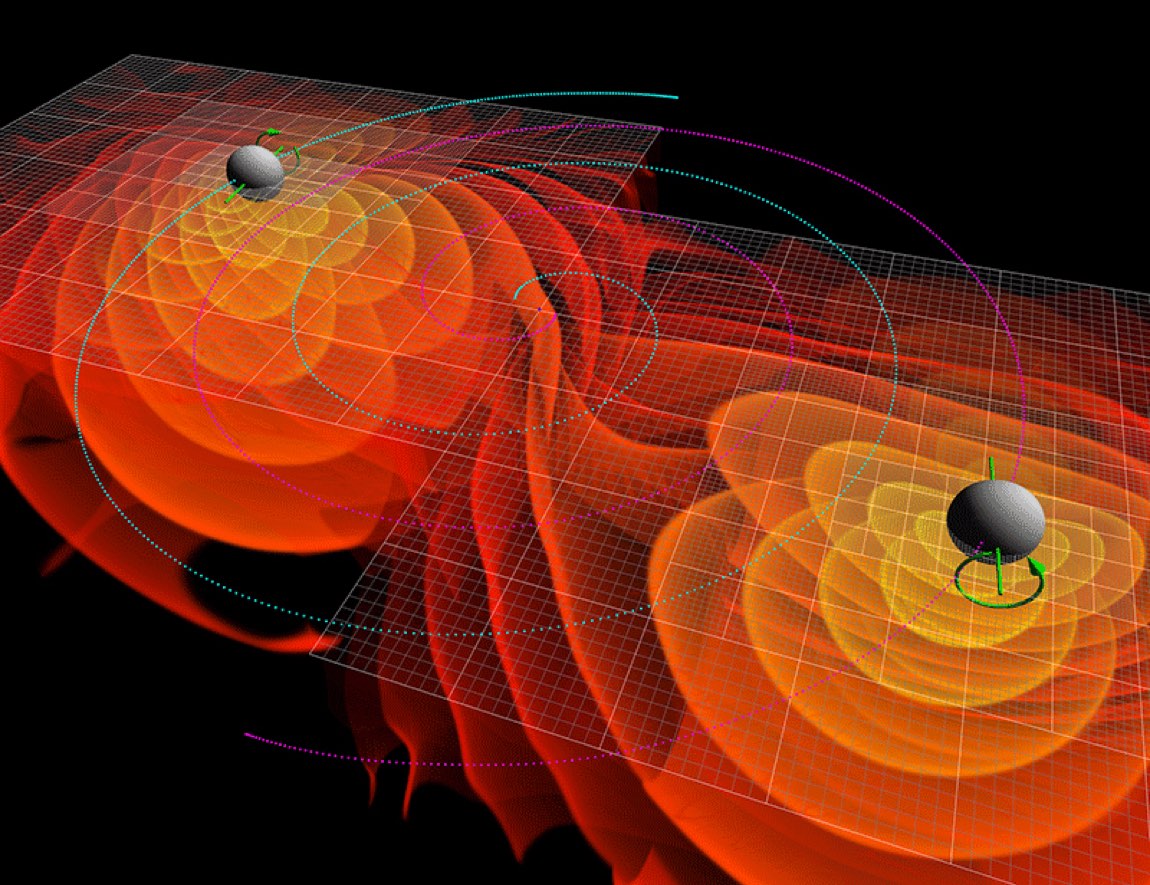
On September 14, 2015, the LIGO detectors twitched by less than a proton's width: two black holes of 36 and 29 solar masses, 1.3 billion light-years away, had spiraled together and merged. Three Suns' worth of mass vanished into pure gravitational radiation in a fifth of a second — briefly out-powering all the starlight in the observable universe. It confirmed Einstein's century-old prediction and opened an entirely new sense for astronomy.
The deep dive
Researched for the Atlas from Wikipedia — First observation of gravitational waves (28,046 characters read) · updated Sep 20, 2026
01 A signal smaller than a proton
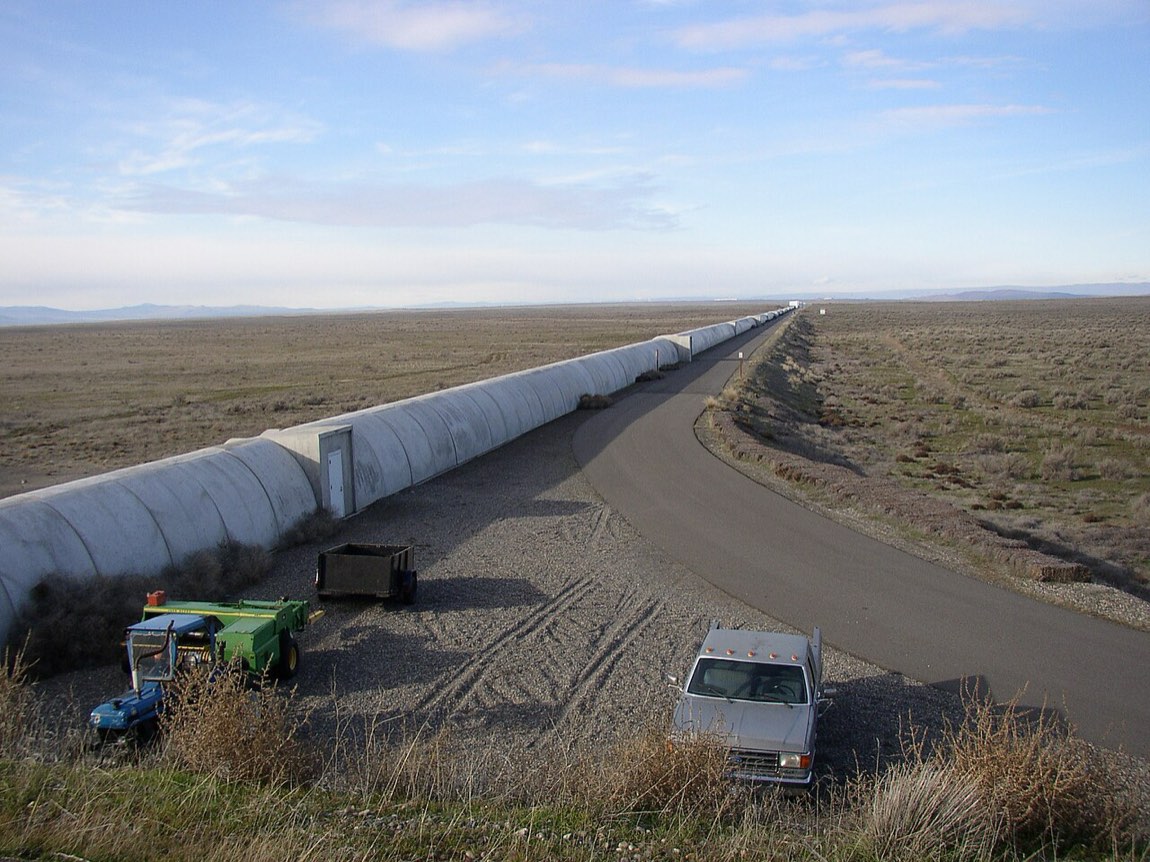
When GW150914 arrived at Earth, it had been travelling for more than a billion years and had stretched and squeezed spacetime by an almost incomprehensible amount. The ripple changed the effective length of LIGO's 1,120 km light-path by a thousandth of the width of a single proton — a shift proportionally equivalent to changing the distance to the nearest star outside the Solar System by the width of one human hair. Albert Einstein himself doubted any instrument could ever be sensitive enough to register such a disturbance. The fact that LIGO succeeded came down to laser interferometry, a technique suggested in the 1960s and refined over decades. A laser beam is split, sent down two perpendicular arms each about 4 km long, and then recombined. A passing gravitational wave alters the travel time along each arm by different amounts, producing an interference pattern — a "beat" — that reveals the distortion. Even then, two widely separated detectors are needed, because local vibrations can mimic a signal at one site but will not appear coherently at the other, 3,002 km away.
02 How LIGO was built and upgraded Deeper
The Laser Interferometer Gravitational-Wave Observatory was formally founded in 1992. It operates two detectors in unison: the LIGO Livingston Observatory in Livingston, Louisiana, and the LIGO Hanford Observatory on the Department of Energy's Hanford Site near Richland, Washington. Initial operations ran from 2002 to 2010 without detecting any statistically significant gravitational wave events. The detectors were then shut down for a multi-year overhaul, replaced by far more capable "Advanced LIGO" versions, representing roughly a tenfold improvement in sensitivity. In February 2015, the upgraded detectors entered engineering mode — fully operational but undergoing final testing before the formal science run, which was scheduled to begin on 18 September 2015. GW150914 arrived on 14 September 2015, just three days before that planned start date, while the instruments were still in engineering mode. Researchers had also routinely introduced "blind injections" of fake signals to test their analysis pipelines; only four people knew when these occurred, a safeguard that made the real detection all the more startling when it was confirmed as genuine.
03 The final 20 milliseconds of a billion-year journey
The detectable chirp signal lasted just over 0.2 seconds, sweeping upward through roughly 8 cycles as the gravitational wave frequency rose from 35 Hz to 250 Hz — a range squarely within human hearing, described by many physicists as resembling a bird's chirp. During the final 20 milliseconds of the merger, the radiated power peaked at about 3.6×10⁴⁹ watts, a figure 50 times greater than the combined light output of every star in the observable universe simultaneously. Over the full 0.2-second detectable signal, the orbiting speed of the two black holes climbed from 30 percent to 60 percent of the speed of light, while their orbital separation shrank to just 350 km — roughly the straight-line distance from New York to Boston — at the moment of merger. The wave peaks registered at the Livingston detector seven milliseconds before they reached Hanford, a delay consistent with the light-travel time between the two sites and confirming that the waves propagated at the speed of light.
04 Why these objects had to be black holes Deeper
The masses and orbital dynamics encoded in GW150914 allowed researchers to rule out almost every other candidate. The pre-merger objects had masses of 35 and 30 times the Sun's mass in the source frame — far above the accepted maximum mass for a stable neutron star, which sits at a conservative upper limit of 3 solar masses. The highest observed neutron star mass is only 2 solar masses, so a neutron star pair could not account for the signal unless exotic alternatives such as boson stars are invoked. A black hole-neutron star pair would have merged at a lower orbital frequency than was observed. The clinching argument was geometric: any other known class of objects with these masses would be physically larger than the 350 km separation at merger, meaning they would have touched and merged before reaching the observed orbital frequency. Only black holes are compact enough to orbit that close and fast while remaining distinct. After the merger, the decaying "ringdown" waveform matched predictions for a single rotating Kerr black hole settling into its final state.
05 The merged black hole and its spin Deeper
When the two black holes coalesced, they did not simply add their masses together. The resulting object has a mass of 62 solar masses, while the two progenitors together totalled 65 solar masses. The missing 3.0 ± 0.5 solar masses — equivalent to roughly 5.3×10⁴⁷ joules of energy — was radiated away as gravitational waves in those final fractions of a second. The planet Earth received about 36 billion joules from that burst, of which only a small fraction was absorbed. The post-merger black hole is a rotating Kerr black hole with a spin parameter of 0.68 (with an uncertainty of about +0.05/−0.06), meaning it possesses approximately two-thirds of the maximum possible angular momentum for an object of its mass. The inferred mass and spin of the merged black hole are consistent with predictions derived from the two pre-merger masses, passing the first observational test of general relativity in what physicists call the very strong-field regime — conditions far more extreme than any binary pulsar or Solar System test had previously reached.
06 Tracing the progenitor stars back in time
The black holes themselves were not the beginning of this story. The two stars that eventually collapsed to form them were probably born around 2 billion years after the Big Bang, with masses estimated between 40 and 100 times the mass of the Sun. The fact that both resulting black holes were more massive than any stellar-mass black hole previously inferred from X-ray binary observations carries an important clue about those ancestral stars. Massive stars shed enormous amounts of material through stellar winds, and strong winds would have stripped away too much mass for such heavy black holes to form. This implies the progenitor stars must have had relatively weak winds — which in turn means they were metal-poor, containing less than about half the proportion of elements heavier than hydrogen and helium found in the Sun. The black holes then spent billions of years slowly spiralling toward each other, losing orbital energy primarily through gravitational wave emission, before their cataclysmic final merger.
07 Locating the event on the sky Deeper
With only two detectors operating, pinpointing GW150914's origin precisely was impossible. Gravitational wave interferometers are essentially all-sky monitors — they cannot focus like a telescope. The 6.9 millisecond time delay between Livingston and Hanford, combined with amplitude and phase comparisons between the two detectors, constrained the source to an arc across the Southern Celestial Hemisphere, in the approximate direction of the Magellanic Clouds, though far more distant. The 50 percent credible region covered 150 square degrees of sky; the 90 percent region spread across 610 square degrees — a patch comparable in area to the entire constellation of Orion, which spans 594 square degrees. The Virgo detector near Pisa, Italy, was offline for an upgrade at the time; had it been operating, it would likely have been sensitive enough to detect the signal, which would have dramatically tightened the source localization through triangulation.
08 The gamma-ray mystery and what it means Deeper
Black hole binary mergers are not expected to produce gamma-ray bursts because stellar-mass black hole pairs should carry little surrounding matter. Yet the Fermi Gamma-ray Space Telescope's Gamma-Ray Burst Monitor reported a weak gamma-ray signal above 50 keV, beginning 0.4 seconds after the LIGO detection, with a positional uncertainty that overlapped the LIGO sky region. Fermi's team estimated the probability of a chance coincidence at just 0.22 percent. However, the INTEGRAL space telescope's all-sky instrument found that any gamma-ray or hard X-ray emission from GW150914 was less than one millionth of the energy emitted as gravitational waves — a limit that, had the Fermi signal been genuinely astrophysical, should have produced a 15-sigma detection in INTEGRAL. A subsequent independent analysis concluded the Fermi data showed no clear gamma-ray burst, attributing the signal to background or an Earth albedo transient. The original Fermi team contested this rebuttal. The question remains unresolved, with theorist Avi Loeb proposing a specific stellar-collapse mechanism to explain both the gravitational wave event and a delayed gamma-ray burst.
09 Bounding the mass of the graviton Deeper
General relativity predicts that gravitational waves travel at exactly the speed of light, which requires the hypothetical force-carrying particle for gravity — the graviton — to be completely massless, just as the photon is massless and electromagnetism has infinite range. If the graviton had any mass at all, gravitational waves would travel slightly below light speed, and lower-frequency components would lag behind higher-frequency ones, dispersing the waveform in a detectable way. No such dispersion was observed in GW150914. Analysis of the inspiral signal tightened the upper limit on the graviton mass to 2.1×10⁻⁵⁸ kg, corresponding to 1.2×10⁻²² eV/c², and implies a graviton Compton wavelength greater than 10¹³ km — roughly one light-year. Using the lowest observed signal frequency of 35 Hz, this constrains how close the gravitational wave speed can be to the speed of light: the upper limit on the quantity (1 − vg/c) is approximately 4×10⁻¹⁹, an extraordinarily tight bound.
10 Indirect detection: the pulsar that came first
Gravitational waves were not entirely unknown before 2015 — they had just never been directly felt. The first strong indirect evidence arrived in 1974 when Russell Hulse and Joseph Taylor discovered the double neutron star system PSR B1913+16, in which one star is a pulsar emitting radio pulses at precise, metronomic intervals. By tracking those pulses over years, they showed that the two stars were slowly spiralling toward each other, losing orbital energy at a rate that matched the theoretical predictions for gravitational wave emission with remarkable precision. This work earned them the Nobel Prize in Physics in 1993. Further observations of PSR B1913+16 and the double pulsar system PSR J0737-3039 continued to agree with general relativity to high precision. That indirect evidence was compelling, but it was not the same as feeling a gravitational wave ripple through an instrument on Earth — something that took another four decades of technological development to achieve.
11 What the discovery unlocked for astronomy
Before GW150914, virtually everything known about the universe came from electromagnetic radiation — light, radio waves, X-rays, gamma rays — and from particle streams such as cosmic rays and neutrinos. Each of these messengers has limitations: light can be blocked or absorbed by dust and gas, exotic compact objects may emit no radiation at all, and much of what shapes cosmic history happens in darkness. Gravitational waves pass through all of that unimpeded. They also carry information about events that produce no light: two black holes merging silently in the void between galaxies, for instance. Perhaps most profoundly, the very early universe is opaque to electromagnetic radiation because matter was ionised and photons scattered constantly off free electrons. Gravitational waves from that era would not face that barrier, offering a potential window onto cosmic history before the universe became transparent — an observational frontier entirely inaccessible before the discovery of GW150914.
12 Refining the rate of black hole mergers Deeper
Before GW150914, theorists had estimates for how often binary black hole mergers might occur, but those estimates spanned a wide and uncertain range. The detection immediately ruled out the most pessimistic theoretical models, which predicted merger rates below 1 event per cubic gigaparsec per year. Statistical analysis of the signal and surrounding data revised the previous upper limit rate of around 140 events per cubic gigaparsec per year down to 17 events per cubic gigaparsec per year, with an uncertainty range of +39/−13. A 2016 model predicted that when LIGO reaches its full design sensitivity after planned upgrades, it could detect roughly 1,000 black hole mergers per year. Those same upgrades are expected to double the signal-to-noise ratio and expand the detectable volume of space by a factor of ten. The addition of Advanced Virgo, KAGRA, and a possible third LIGO detector in India will further sharpen the ability to localise sources and extract precise physical parameters from detected signals.
13 Who announced it and who was honoured
The discovery was announced on 11 February 2016 at a news conference in Washington, D.C. David Reitze, LIGO's executive director, delivered the public announcement alongside a panel including Gabriela González, Rainer Weiss, Kip Thorne, and France A. Córdova, the director of the National Science Foundation. Barry Barish simultaneously delivered the first scientific presentation to a research audience. The initial paper appeared in Physical Review Letters during the news conference itself. Recognition followed quickly: in May 2016 the full collaboration — with Ronald Drever, Kip Thorne, and Rainer Weiss singled out — received the Special Breakthrough Prize in Fundamental Physics. Drever, Thorne, and Weiss also shared the 2016 Shaw Prize in Astronomy and the 2016 Kavli Prize in Astrophysics, while Barish received the 2016 Enrico Fermi Prize. Gabriela González and the LIGO team received the 2017 Bruno Rossi Prize. The capstone came when the 2017 Nobel Prize in Physics was awarded to Rainer Weiss, Barry Barish, and Kip Thorne for their decisive contributions to LIGO and the observation of gravitational waves.
 ⤢
⤢