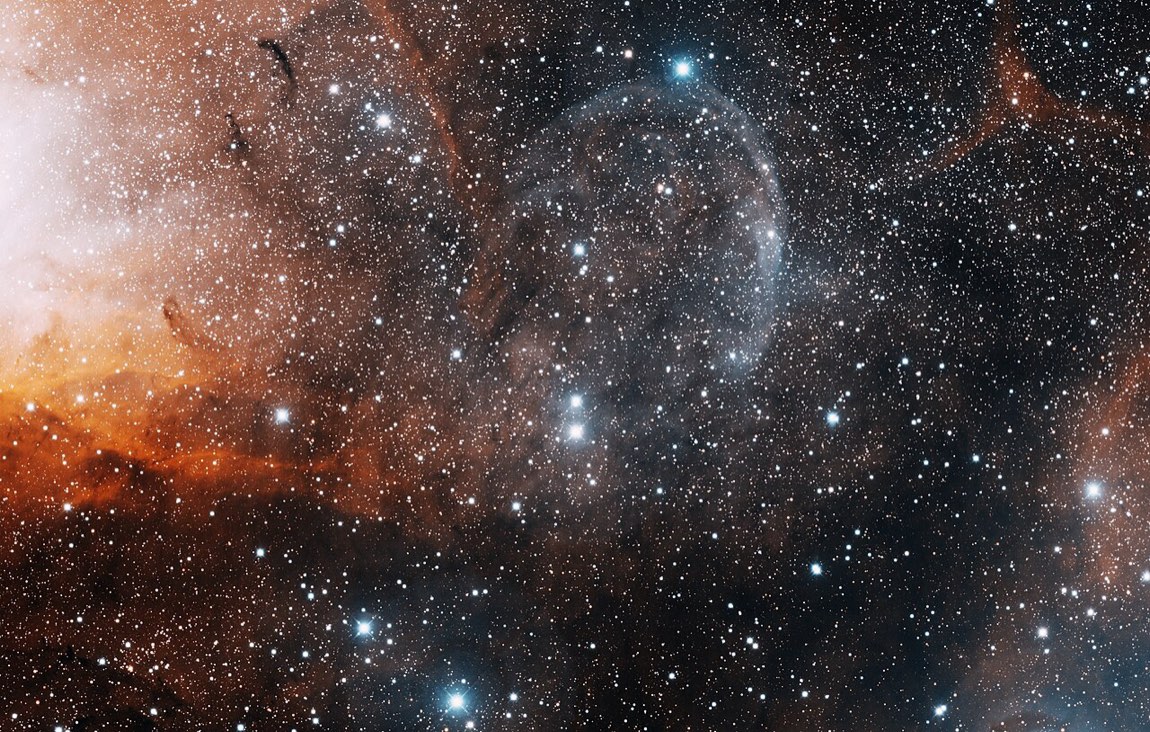
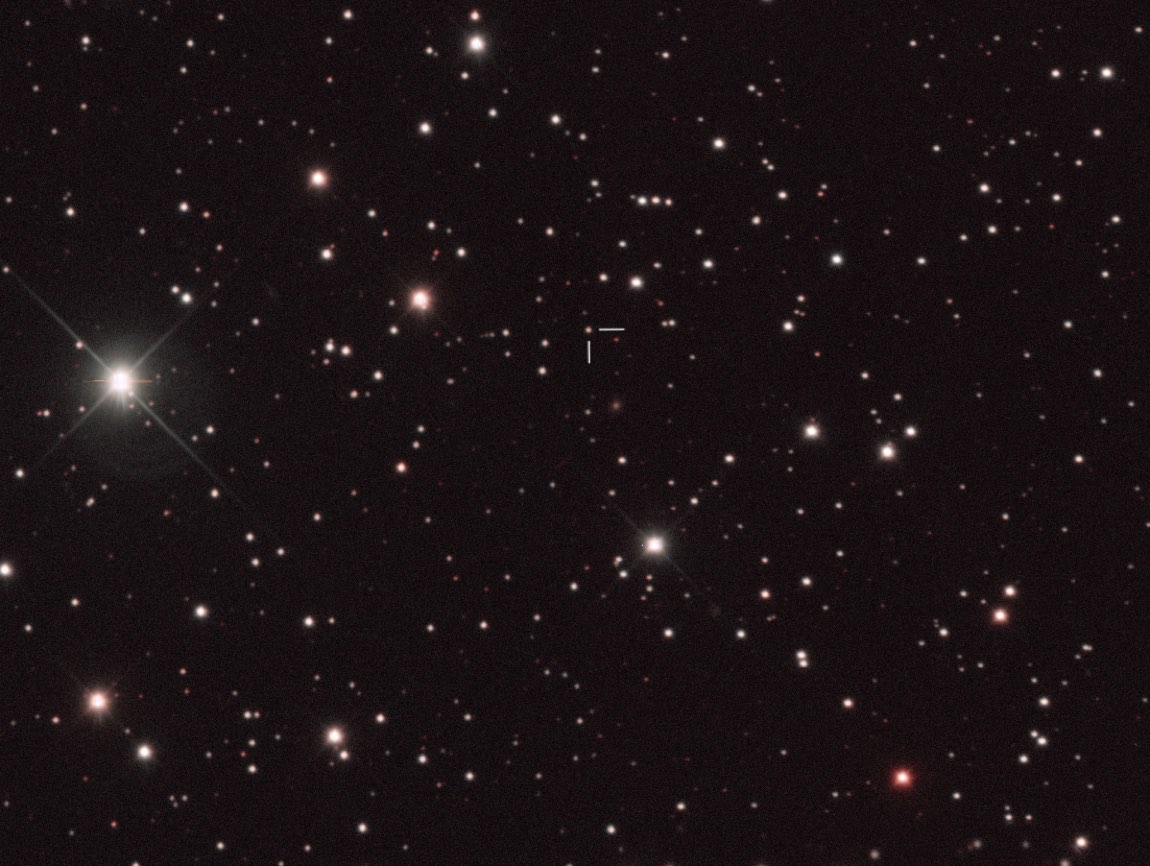
 Photograph · Sloan Digital Sky Survey · CC BY 4.0
Black Hole · Deep guide
A0620-00 (V616 Mon)
A quiet monster with a captive star, and for decades the nearest known black hole.
What is it?
A0620-00, about 3,300 light-years away in Monoceros, announced itself in 1975 with an X-ray outburst that briefly made it the brightest X-ray source in the sky; it has dozed ever since. It is a ~6.6-solar-mass black hole slowly nibbling a small orange star that whips around it every 7.75 hours — long the closest black hole known, and still the classic example of a dormant X-ray nova.
The deep dive
Researched for the Atlas from Wikipedia — A0620-00 (2,007 characters read) · updated Sep 20, 2026
01 Two X-Ray Outbursts Across Six Decades
A0620-00 has flared dramatically twice in recorded history, and both events revealed something extraordinary. The first outburst occurred in 1917, long before astronomers had any framework for understanding X-ray binaries or black holes. The second eruption came in 1975 and was captured by the Ariel 5 satellite, which was designed specifically to survey the X-ray sky. During that 1975 event, A0620-00 became the brightest X-ray point source in the entire sky — outshining everything else detectable at those wavelengths. Its apparent visual magnitude also surged to 11.2, bright enough to see with a modest pair of binoculars under dark skies, a dramatic contrast to its usual faint slumber at magnitude 18.3. That difference of roughly seven magnitudes corresponds to a brightness increase of over six hundred times. Because of this pattern — long dormancy punctuated by violent X-ray flares — the system has been reclassified as an X-ray nova, a category defined by exactly this kind of recurrent, energetic eruption driven by instabilities in the accretion disk surrounding the compact object.
02 How We Knew the Dark Object Was a Black Hole Deeper
For years after its 1975 outburst, A0620-00 was known to harbor something compact and massive, but confirmation took time. The black hole nature of the system was not formally determined until 1986, more than a decade after the Ariel 5 detection. The key evidence came from careful measurement of the orbital dynamics of the visible K-type companion star. By tracking how the companion's light shifts in wavelength as it swings toward and away from Earth during each orbit, astronomers can calculate the mass function of the system — essentially a lower bound on the unseen object's mass. The result pointed to a mass of about 6 solar masses for the dark companion. That figure is decisive because neutron stars, the densest known stable form of matter, cannot exceed roughly 2 to 3 solar masses before gravity overwhelms all known forms of pressure support. An object of 6 solar masses that emits no detectable light of its own leaves only one credible explanation: a stellar-mass black hole. This mass-based argument remains the primary tool astronomers use to confirm black hole candidates in binary systems throughout the galaxy.
03 An Ellipsoidal Star Stretched by Gravity
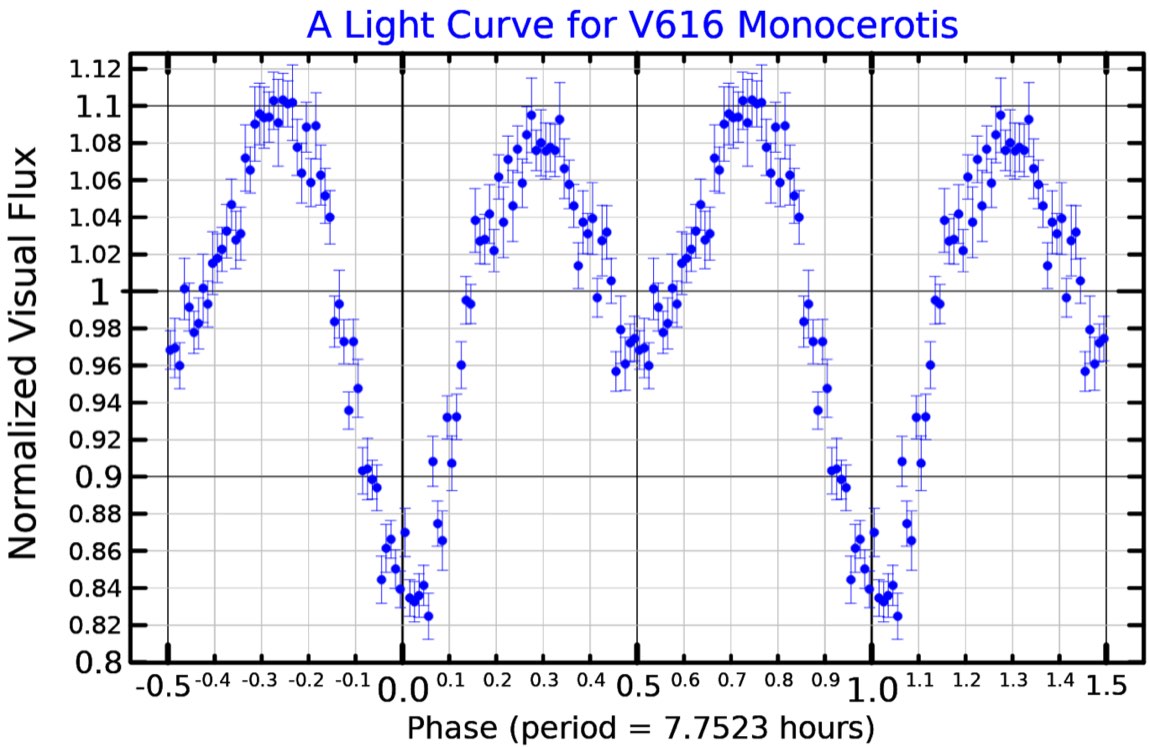
The K-type main-sequence star in A0620-00 is not a simple sphere. The black hole's intense gravitational pull has distorted it into an ellipsoidal shape — something like a stretched egg — because gravity tugs more strongly on the near side of the star than the far side. This tidal distortion has a direct observational consequence: as the two objects orbit each other every 7.75 hours, the amount of the K-type star's surface area visible from Earth changes continuously. When the star is seen end-on, less glowing surface faces us; when it rotates so its broader flank is presented, more surface is visible. This causes the system's apparent brightness to rise and fall in a regular pattern tied precisely to the orbital period. Astronomers can exploit this brightness variation, called ellipsoidal modulation, to extract information about the star's size, the inclination of the orbit, and even the mass of the unseen black hole — turning a gravitational distortion into a precision measurement tool. The accretion disk also contributes visible light and X-rays, adding complexity to the light curve.
04 An Accretion Disk Glowing in X-Rays
Between its two known outbursts and in its current quiet state, A0620-00 is not entirely dark. The black hole continuously pulls material from its K-type companion into an accretion disk — a flattened, spiraling structure of gas and dust that surrounds the black hole. As material in the disk falls inward, it compresses and heats to extreme temperatures, emitting significant amounts of both visible light and X-rays. This steady low-level emission is what keeps the system detectable even outside of major eruptions. The accretion disk's physics are central to understanding X-ray novae as a class: during quiescence, matter accumulates in the disk slowly; when enough builds up and reaches a critical temperature and density, the disk becomes thermally unstable and rapidly dumps material toward the black hole, triggering the bright X-ray outbursts that define these systems. The 1975 event, spectacular enough to make A0620-00 the sky's brightest X-ray source, is thought to represent exactly this kind of runaway disk instability reaching its peak.
05 One of the Nearest Black Holes to Earth
At a distance of roughly 3,300 light-years, or about 1,000 parsecs, A0620-00 sits remarkably close to the Solar System on a galactic scale. The Milky Way is roughly 100,000 light-years across, so this black hole lies well within our immediate cosmic neighborhood. The article notes it is closer than GRO J1655-40, another well-known black hole binary, making A0620-00 one of the nearest confirmed black holes known. That proximity is scientifically valuable: closer systems appear brighter and their orbital motions are easier to measure precisely, which is why A0620-00 played such an important role in establishing black hole mass measurements as a field. Three thousand three hundred light-years is still an almost incomprehensible distance — roughly 31 quadrillion kilometers — but in galactic terms it is close enough that A0620-00 serves as a benchmark object for calibrating techniques used to identify black holes in more distant, harder-to-study systems across the galaxy and beyond.
06 A Faint System in the Unicorn Constellation
A0620-00 lies in the constellation Monoceros, the Unicorn, a faint and often overlooked constellation nestled between Orion, Gemini, and Canis Major. Its current apparent magnitude of 18.3 places it far beyond naked-eye or even casual binocular reach — only a telescope of substantial aperture, combined with sensitive detectors, can pick it out. That quiescent faintness makes the 1975 outburst all the more dramatic: the system brightened to magnitude 11.2, a difference of about 7 magnitudes, and was detectable with simple binoculars. The variable star designation V616 Monocerotis reflects this variability formally within the international variable star naming system. The original designation 1A 0620-00 — shortened to A0620-00 — comes from the Ariel 5 satellite survey that detected it in the X-ray band, with the numbers encoding its approximate sky coordinates in the right ascension and declination system used by astronomers to locate objects precisely.
07 The Stephen Hawking Memorial Broadcast
On 15 June 2018, the European Space Agency used its large radio antenna at Cebreros Station, located 77 kilometers west of Madrid, Spain, to transmit a signal toward A0620-00 in memory of Stephen Hawking, who had died on 14 March 2018. Hawking's family described the message as one of peace and hope. The signal travels at the speed of light and must cross 3,457 light-years, meaning it will not arrive until the year 5475. When it does, it will represent the first-ever intentional human communication directed at a known black hole. A0620-00 was selected precisely because, at the time of the broadcast, it was recognized as the closest known black hole to Earth — a fitting destination for a tribute to the physicist whose most celebrated work concerned the theoretical properties of black holes. The transmission is a poignant intersection of cutting-edge astrophysics and human remembrance, a message crossing millennia of cosmic distance to honor one of the twentieth century's most influential scientific minds.
08 A System Quiet for Over a Century at a Time Deeper
One of the most striking facts about A0620-00 is the sheer length of time between its two recorded outbursts: 1917 and 1975, a gap of 58 years. During those intervening decades, the system sat in deep quiescence, faint and unobtrusive at magnitude 18.3. This long recurrence timescale is characteristic of soft X-ray transients, the broader class to which X-ray novae belong. The rarity of outbursts reflects the slow, patient accumulation of transferred material in the accretion disk over years to decades. Because observations before the satellite era were limited, the 1917 event is known primarily from archival photographic plates, and it is entirely possible that additional outbursts occurred in the distant past without being recorded. Since the 1975 event, which is now nearly five decades ago, the system has not erupted again to our knowledge — though disk instability theory suggests it eventually will. Astronomers monitoring X-ray transients watch systems like A0620-00 partly because each outburst offers a time-limited window to measure black hole properties that are otherwise hidden behind quiescent faintness.
09 The Orbital Period: 7.75 Hours Deeper
The two objects in A0620-00 complete one full orbit around their common center of mass every 7.75 hours — shorter than a typical workday. This compact orbit places the K-type star very close to the black hole, close enough for tidal forces to distort the star into its ellipsoidal shape and for the black hole's gravity to steadily strip material from the companion's outer layers into the accretion disk. The orbital period is one of the most precisely measurable quantities in such a system, derived from the regular periodic variations in the light curve and the Doppler shifting of spectral lines from the companion star. Knowing the period is essential to computing the mass function that ultimately constrains the black hole's mass. A 7.75-hour period is short even among X-ray binaries, implying an orbital separation of only a few solar radii — a system so compact that if placed at the center of our Solar System, both objects would orbit well inside the orbit of Mercury, which itself takes 88 days to complete a single lap around the Sun.
 ⤢
⤢