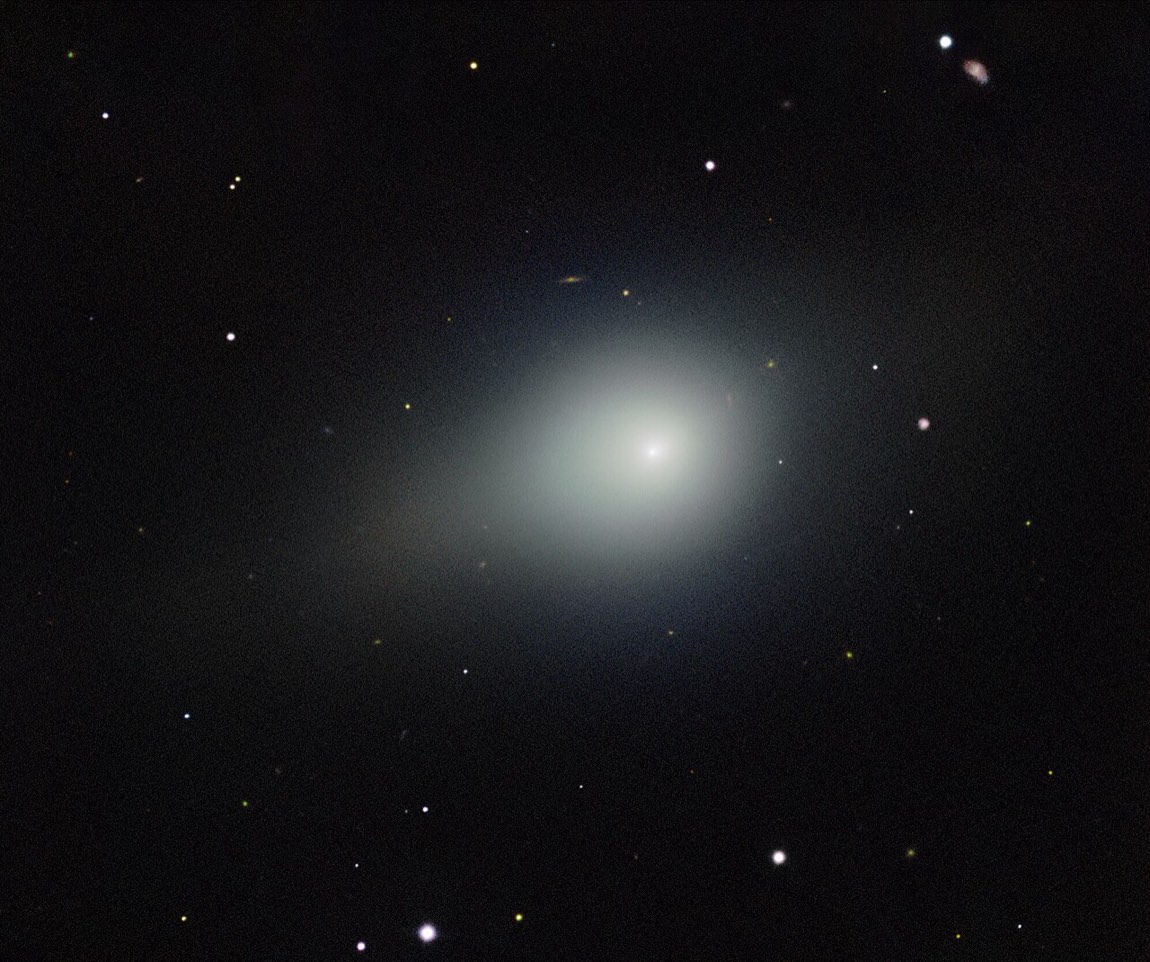
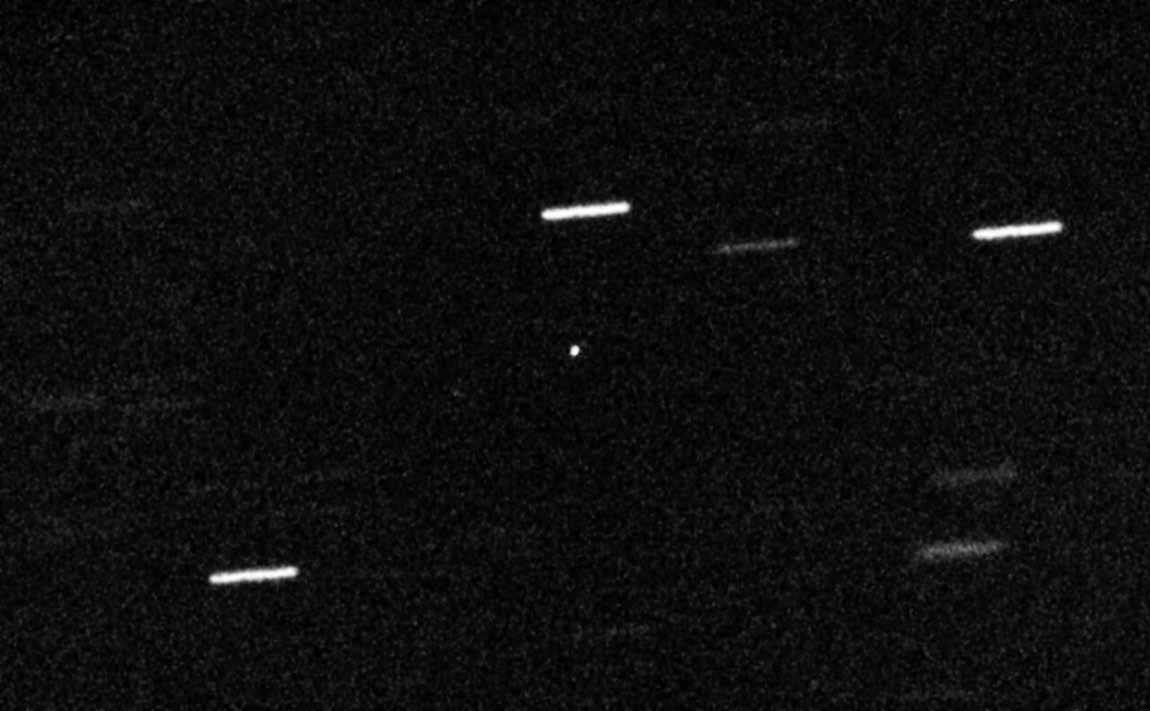
 Photograph · Alan Fitzsimmons ( Astrophysics Research Centre , Queen's University Belfast ), · Public domain
Asteroid · Deep guide
1I/ʻOumuamua
Also called: 1I/ʻOumuamua · Oumuamua · 1I/2017 U1 · A/2017 U1
The first known visitor from another star system — and its true nature is still debated.
What is it?
ʻOumuamua was spotted in October 2017 already speeding away from the Sun on a path too fast to be bound to our Solar System. It was the first confirmed interstellar object. It looked like a small, reddish, possibly very elongated body, roughly 100 m to a few hundred metres long. Puzzlingly, it showed no comet-like coma, yet it accelerated slightly as if pushed by escaping gas. Proposed explanations include a fragment of nitrogen ice or hydrogen escaping from water ice; it is catalogued here as an asteroid, but its nature is not settled.
The deep dive
Researched for the Atlas from Wikipedia — 1I/ʻOumuamua (25,833 characters read) · updated Nov 14, 2026
01 How Robert Weryk and Pan-STARRS Found It
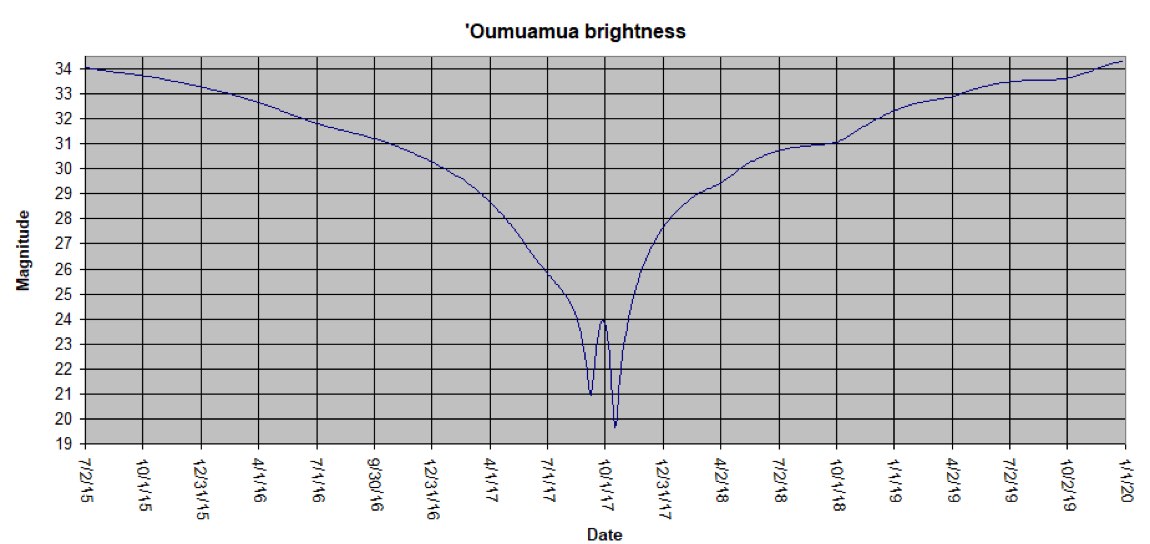
On 19 October 2017, Canadian physicist Robert Weryk was reviewing images from the Pan-STARRS telescope at Haleakalā Observatory, Hawaii, as part of the Spaceguard Survey — a program designed to find potentially hazardous near-Earth objects — when he noticed something moving far too fast to belong to the Solar System. The object had already swung around the Sun 40 days earlier, on 9 September, and was already 33 million km (about 21 million miles, or 0.22 AU) from Earth and racing away. That is roughly 85 times the Earth–Moon distance, and it was fading quickly. By the end of October it had dimmed to apparent magnitude 23, requiring the largest ground-based telescopes to detect at all. By mid-December 2017 it was simply too faint and fast-moving for even those instruments to follow. The entire usable observation window lasted only about 80 days. Weryk and his colleague Karen J. Meech led the team that published the initial findings in the journal Nature on 20 November 2017, with follow-up data gathered using the Canada–France–Hawaii Telescope, the Very Large Telescope, Gemini South, and Keck II, and later the space-based Hubble and Spitzer telescopes.
02 A Designation System Built on the Fly
Nothing quite like ʻOumuamua had ever been seen before, and the International Astronomical Union had to invent new rules as it went. The object was first announced as comet C/2017 U1 based purely on its wildly hyperbolic trajectory. Then, because it showed absolutely no cometary coma, it was demoted to asteroid A/2017 U1 — making it the first comet ever re-designated as an asteroid. Once its interstellar origin was confirmed, a brand-new designation class was created on the spot: "I" for interstellar object. ʻOumuamua became 1I, the founding member of an entirely new category in the catalog of the sky. The IAU had not yet codified rules for which objects qualify for I-numbers or what names they should carry, so those guidelines were written after the fact. The object can legitimately be called by four different names: 1I; 1I/2017 U1; 1I/ʻOumuamua; or 1I/2017 U1 (ʻOumuamua). The name ʻOumuamua was chosen by the Pan-STARRS team in consultation with Kaʻiu Kimura and Larry Kimura of the University of Hawaiʻi at Hilo. It comes from Hawaiian, combining ʻou ("reach out for") and mua (reduplicated for emphasis: "first, in advance of"), loosely translating as "first distant messenger." The opening character is not an apostrophe but a Hawaiian ʻokina, representing a glottal stop.
03 An Orbital Path Unlike Anything Before It Deeper
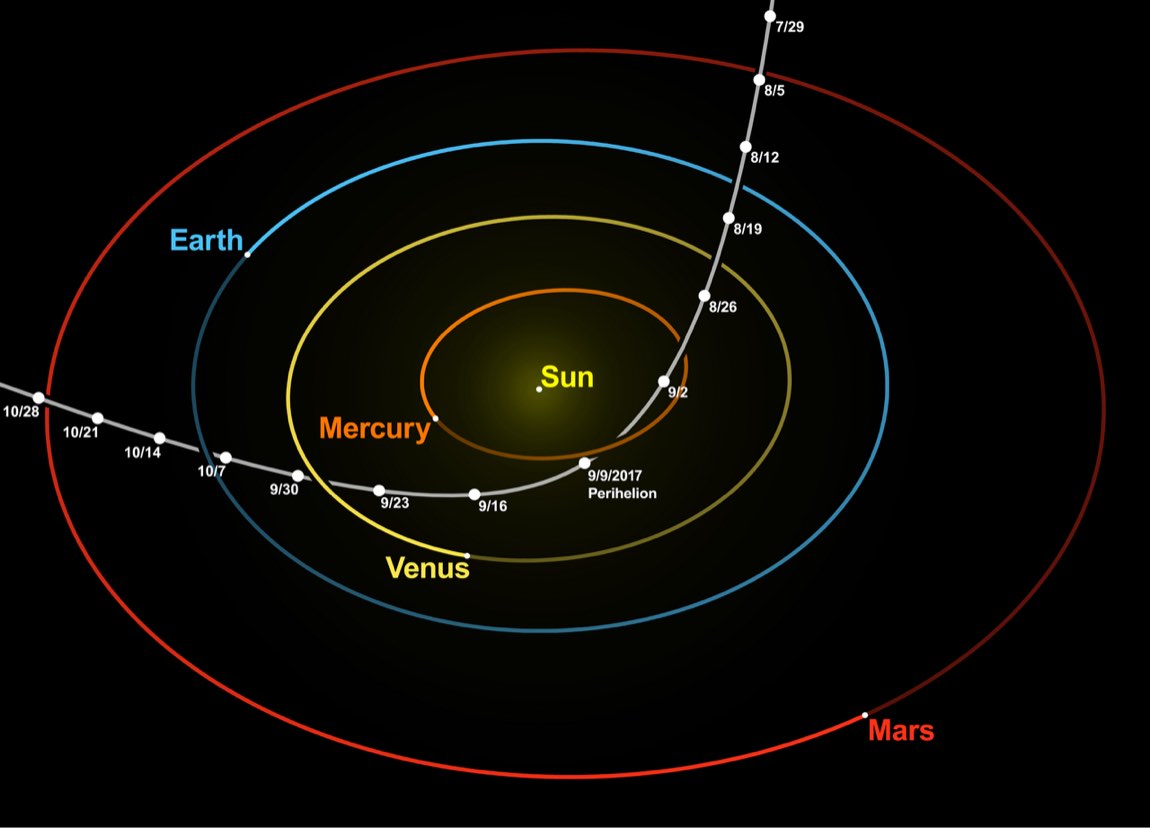
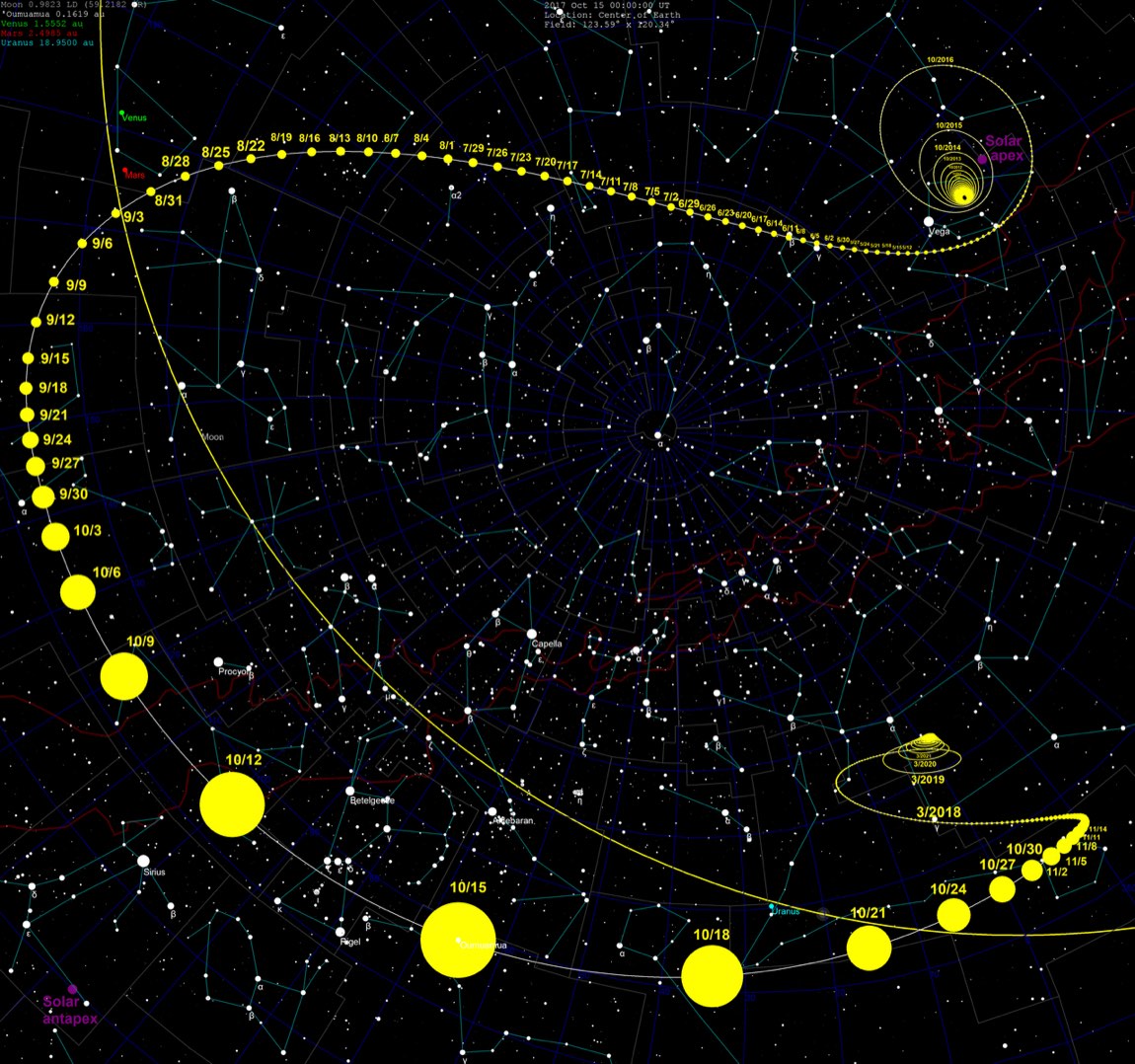
ʻOumuamua's orbit is defined by an eccentricity of 1.20 — the highest ever recorded for any solar-system object until the interstellar comet 2I/Borisov was discovered in August 2019. Any eccentricity above 1.0 means the object is traveling faster than the Sun's escape velocity and cannot be gravitationally captured. While minor planet C/1980 E1 previously held the record with an eccentricity just barely above 1.0 — achieved by a close encounter with Jupiter — ʻOumuamua's value is so extreme that no planet or even hypothetical undiscovered planet in the Solar System could have accelerated it to that trajectory. It entered from north of the ecliptic plane, diving in from roughly the direction of Vega in Lyra. At perihelion on 9 September 2017, it reached a maximum speed of 87.71 km/s (315,800 km/h; 196,200 mph), passing just 0.255 AU from the Sun — about 17% closer than Mercury's own closest approach. Its inbound direction was only 6° from the solar apex, the direction the Sun itself moves relative to nearby stars, which is precisely the most statistically probable direction for objects arriving from interstellar space. It swept past Earth on 14 October at a closest approach of approximately 0.16175 AU (about 24,197,000 km), crossed Mars's orbit on 1 November, Jupiter's in May 2018, Saturn's in January 2019, and Neptune's in 2022, departing toward the constellation Pegasus.
04 The Mysterious Extra Push
On 27 June 2018, astronomers reported something deeply puzzling: ʻOumuamua was not following the trajectory that gravity alone would predict. It was accelerating slightly more than it should, with the total velocity change near perihelion summing to about 17 meters per second. This so-called non-gravitational acceleration set off a cascade of competing explanations that continue to this day. The first instinct was cometary outgassing — volatile ices vaporizing in sunlight and acting as a tiny rocket — but no gas tail or coma was ever detected. Skeptics of the outgassing idea pointed out that an elongated, tumbling body driven by jets of escaping gas should have its spin rate disrupted rapidly, potentially tearing the object apart; yet ʻOumuamua's rotation appeared stable. Solar radiation pressure was proposed as an alternative, but that would require ʻOumuamua to be extraordinarily thin and low-density — almost sail-like. In March 2023, a new hypothesis emerged: that molecular hydrogen, built up inside a water-ice body by cosmic-ray bombardment over millions of years, was slowly leaking out. This "hydrogen-laden water ice" model is consistent with an origin as a comet-like interstellar body and would produce a hydrogen coma invisible to Earth-based telescopes, since the atmosphere blocks the relevant wavelengths.
 ⤢
05 Shape: Cigar, Pancake, or Something Else? Deeper
Even after extensive observation, nobody knows ʻOumuamua's true shape, because it appears as nothing more than a point source of light even in the most powerful telescopes. Everything inferred about its geometry comes from its light curve — the way its brightness fluctuates as it rotates and tumbles. The swings in brightness are dramatic: lightcurve amplitudes of 1.5 to 2.5 magnitudes have been reported, corresponding to a factor of roughly four to ten in reflected light. Those swings imply either a highly elongated cigar shape with a longest-to-shortest axis ratio of perhaps 5:1 or greater, or an extremely flat disc with a roughly 1:6 ratio. A 2019 analysis found the disc more probable, since a disc does not require any special viewing orientation to produce the observed range of brightnesses. If it is cigar-shaped and assuming an albedo of 10%, the estimated dimensions are approximately 100–1,000 m long and 35–167 m wide. Its albedo is unknown. ʻOumuamua is not rotating cleanly around a principal axis; instead it appears to be tumbling, a state that could persist for at least a billion years without damping. The tumbling was most likely triggered by a collision back in its home system. By 2021, some researchers proposed that if it is composed of nitrogen ice, the extreme shape could be a by-product of intense evaporation after entering the Solar System, and that it may have lost 92% of its mass in the month following perihelion.
06 Surface Chemistry: Tholins and Cosmic Rays
Although ʻOumuamua's interior composition remains deeply uncertain, its surface tells a clearer story — at least in outline. Spectra taken with the 4.2 m William Herschel Telescope and the 8.2 m Very Large Telescope show a featureless, uniformly red spectrum extending into near-infrared wavelengths, resembling D-type asteroids, Kuiper Belt objects, and comet nuclei. The redness is most likely caused by tholins, complex irradiated organic compounds that build up on the surfaces of icy bodies exposed to cosmic rays and ultraviolet radiation over millions of years. The presence of tholins is used by astronomers as a surface-age indicator — the redder, the longer the exposure. This irradiated mantle, potentially at least 0.5 m (1.6 ft) thick, may also be insulating whatever volatile ices might remain beneath the surface. The lack of any detectable coma when ʻOumuamua passed within 0.255 AU of the Sun limits any exposed surface ice to no more than a few square meters. Early spectral observations with the Hale Telescope on 25 October 2017 showed a reddish color similar to Trojan asteroids and comet nuclei, consistent with long-term cosmic ray processing. Its spectrum is featureless, meaning no specific minerals or molecules have been positively identified.
07 Where Did It Come From? A Galaxy of Theories Deeper
Tracing ʻOumuamua's origin is genuinely hard. Its velocity relative to the Sun when in interstellar space — 26.33 km/s — is very close to the local standard of rest, the mean motion of nearby stars in the Milky Way. That proximity is a clue and a complication: it means ʻOumuamua may have been wandering the galaxy for so long that it has circled the Milky Way multiple times, erasing any clear pointer to a birthplace. It appears to have come from roughly the direction of Vega in Lyra, but accounting for Vega's own proper motion, it would have taken 600,000 years to arrive from Vega, and Vega was not in that region of sky at the relevant time. The apparent origin direction does rule out the closest dozen stars. One study speculated that ʻOumuamua was ejected from one of the nearby young stellar associations — Carina or Columba, within about 100 parsecs — roughly 45 million years ago. A Gaia Data Release 2 study from August 2018 identified four stars, including HIP 3757 and HD 292249, that ʻOumuamua passed relatively close to in the past few million years at moderately low velocities. About 1.3 million years ago it may have passed within 0.16 parsecs (0.52 light-years) of the star TYC 4742-1027-1, potentially skimming through that system's Oort cloud at about 15 km/s, though its velocity is too high for that star to be its birth system.
08 Dark Comets: A New Class Born from One Object
ʻOumuamua's strangest property — accelerating without any visible gas or dust tail — was initially treated as unique to this one object. But by 2024, astronomers had identified 14 solar-system asteroids displaying the same unexplained non-gravitational acceleration without any detectable outgassing. This recognition elevated ʻOumuamua to founding member of a brand-new category of objects called "dark comets." The name captures the idea that these bodies may be driving themselves with outgassing that is somehow invisible: either the escaping material is in wavelengths difficult to detect, the coma is too thin to see against the sky background, or the volatile being released — perhaps hydrogen — is blocked by Earth's atmosphere. The existence of a whole class of such objects changes the picture significantly: ʻOumuamua's behavior no longer looks like a one-off anomaly or evidence of something exotic. Instead, it may represent a population of comet-like bodies whose activity has simply gone undetected in earlier surveys. This context also makes the technosignature hypothesis — the idea that the acceleration is evidence of an artificial solar sail — considerably less compelling, since the same effect now appears in many solar-system bodies for which artificial origin is not a plausible explanation.
 ⤢
09 Radio Silence: What SETI Searches Found
The idea of an interstellar visitor naturally prompted researchers to listen for any artificial signals it might be transmitting. The SETI Institute pointed its Allen Telescope Array at ʻOumuamua and detected no unusual radio emissions. More rigorous follow-up was conducted using the Breakthrough Listen hardware installed on the Green Bank Telescope in West Virginia. On 13 December 2017, that telescope observed ʻOumuamua for six hours across four bands of radio frequency. No signals were found. The sensitivity of the search was remarkable: given ʻOumuamua's proximity at the time of observation, astronomers were able to set upper limits on any putative radio transmitter at an effective isotropically radiated power of just 0.08 watts — roughly the power of a small LED bulb. Despite these null results, astronomer Avi Loeb of Harvard University, an adviser to the Breakthrough Listen project, cited the object's unusual elongated shape as a reason to continue the search. Loeb and his postdoctoral researcher Shmuel Bialy submitted a paper on 26 October 2018 formally exploring whether ʻOumuamua could be an artificial thin solar sail accelerated by solar radiation pressure. Most other scientists regard this hypothesis as unsupported by the available evidence, particularly because a tumbling solar sail would not be expected to accelerate consistently, and simpler natural explanations are available.
10 Could a Spacecraft Still Catch It?
By the time astronomers confirmed ʻOumuamua's interstellar nature, it was already sprinting away. Despite that, mission designers found reasons for optimism. The Initiative for Interstellar Studies launched Project Lyra specifically to assess whether a spacecraft could realistically intercept ʻOumuamua, exploring mission durations of 5 to 25 years and the corresponding velocity requirements. NASA's Space Launch System, already being studied for other interstellar precursor missions, was identified as capable of enabling a flyby at speeds around 63 km/s (39 mi/s). More advanced options involving solar sails, laser-electric propulsion, and laser sails based on Breakthrough Starshot technology were also examined. A key engineering challenge is the trade-off between speed and science: a spacecraft moving fast enough to catch ʻOumuamua would streak past it in a hypersonic flyby with minimal time to collect data. Decelerating enough to orbit or land on the object was described as "highly desirable, due to the minimal science return from a hyper-velocity encounter." Both the Lyra study team and researchers Seligman and Laughlin independently concluded that an encounter mission, while very challenging, would be feasible with near-term technology and would be scientifically valuable — a rare chance to analyze genuine interstellar material up close.
11 ʻOumuamua and the Interstellar Object Census
ʻOumuamua's discovery opened a new chapter in astronomy simply by proving that interstellar objects pass through the Solar System at all. The second confirmed interstellar visitor, 2I/Borisov, was found on 30 August 2019 arriving from the direction of Cassiopeia and reached perihelion on 8 December 2019 — it was clearly a comet, exhibiting a bright coma that ʻOumuamua conspicuously lacked. A third interstellar object, 3I/ATLAS, was discovered on 1 July 2025 and arrived with a hyperbolic excess velocity of 58 km/s, far faster than ʻOumuamua's 26.33 km/s. Proposed interstellar objects also include two meteors — CNEOS 2014-01-08 and CNEOS 2017-03-09 — which reportedly impacted Earth in 2014 and 2017 respectively, though these claims have been met with skepticism. The pace of discovery suggests that interstellar objects are more common than previously thought, and future wide-field sky surveys should find many more of them. ʻOumuamua was detected only because it happened to pass unusually close to Earth; most interstellar visitors likely slip through undetected. Each new discovery offers an independent sample of material from other stellar systems, making the growing census scientifically invaluable.
12 Open Questions Astronomers Are Still Debating Deeper
More than seven years after its discovery, ʻOumuamua refuses to be neatly classified. Its precise shape — cigar or disc — remains undetermined because it was never resolved as anything more than a point source of light. Its albedo is unknown. Its composition is contested: proposed candidates have included rocky metal-rich material, nitrogen ice from an exo-Pluto, hydrogen ice from a molecular cloud core, and water ice with trapped hydrogen released by cosmic-ray radiolysis. Each hypothesis explains some observations but struggles with others. The hydrogen iceberg idea, for instance, was shown to be inconsistent with the survival timescales for such objects in interstellar space. The planetary fragment origin produces cigar shapes, while the light curve more strongly supports a disc. Its home stellar system is unknown, its age unknown, and even the most specific proposals — ejection from the Carina or Columba stellar associations about 45 million years ago — remain speculative. The 2023 hydrogen-outgassing-from-water-ice model is currently among the most broadly consistent explanations for the non-gravitational acceleration, but it has not achieved consensus. What is now agreed is that ʻOumuamua, despite being observed for only about 80 days, has permanently changed how astronomers think about the material that drifts between the stars.
 ⤢