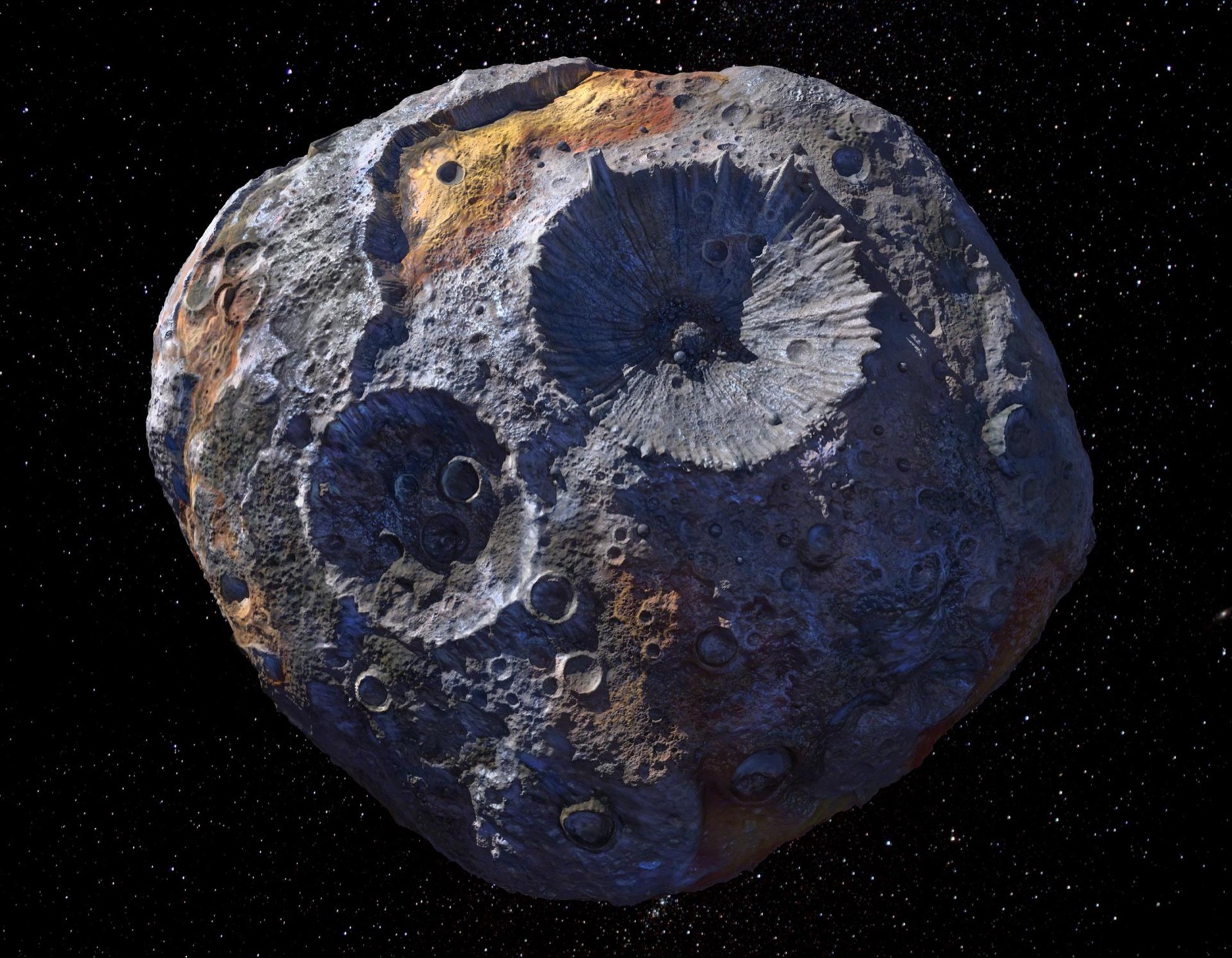
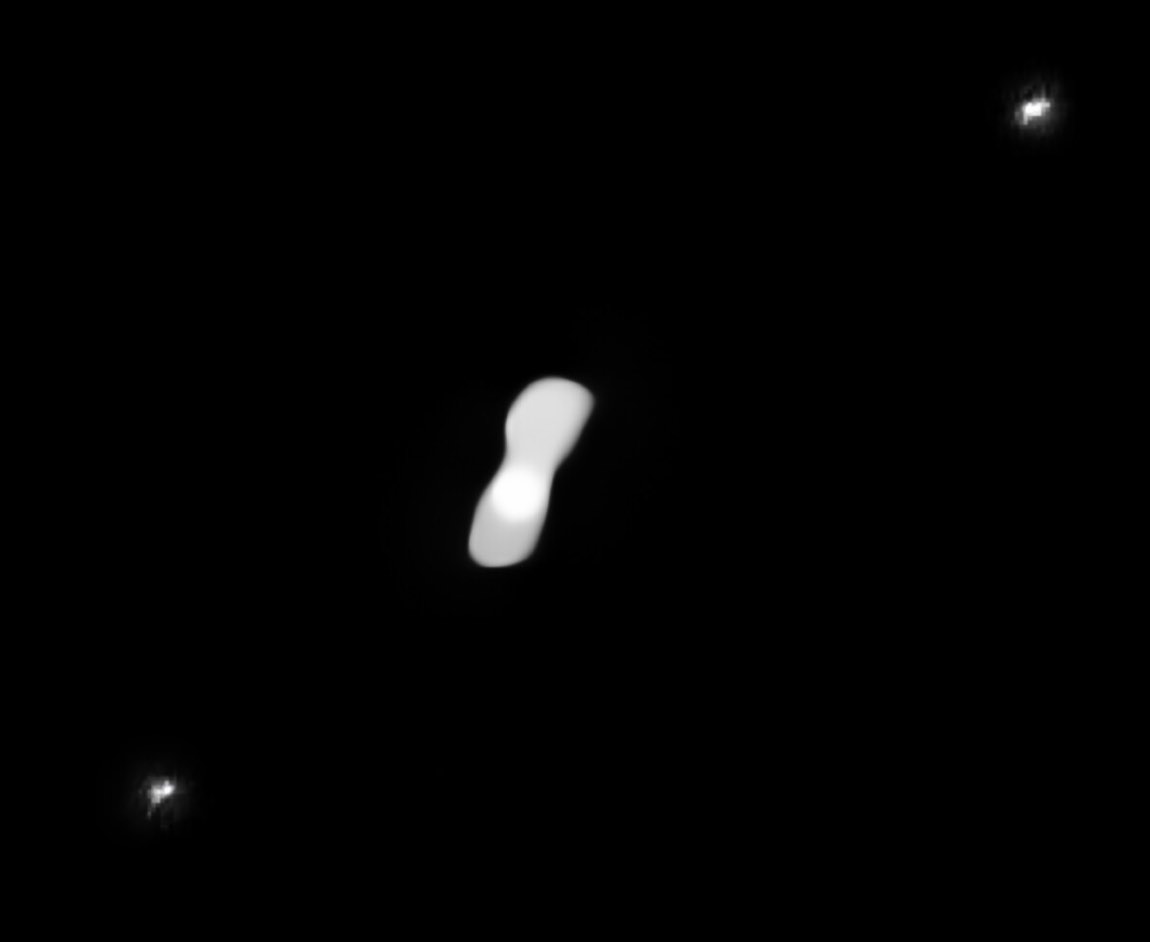
 Photograph · ESO/Vernazza, Marchis et al./MISTRAL algorithm (ONERA/CNRS) · CC BY 4.0
Asteroid · Deep guide
216 Kleopatra
Also called: 216 Kleopatra · (216) Kleopatra · A880 GB
A dog-bone-shaped metallic asteroid with two tiny moons.
What is it?
Kleopatra is a long, thin M-type asteroid about 270 km from end to end, shaped like a dog bone or dumbbell. Its M-type spectrum suggests it is rich in metal. Two small moons, discovered in 2008, orbit it and are named Alexhelios and Cleoselene after Cleopatra's twin children. It was found in 1880 by Johann Palisa at the naval observatory in Pola, now Pula in Croatia.
The deep dive
Researched for the Atlas from Wikipedia — 216 Kleopatra (4,006 characters read) · updated Nov 14, 2026
01 A bone-shaped world unlike any other
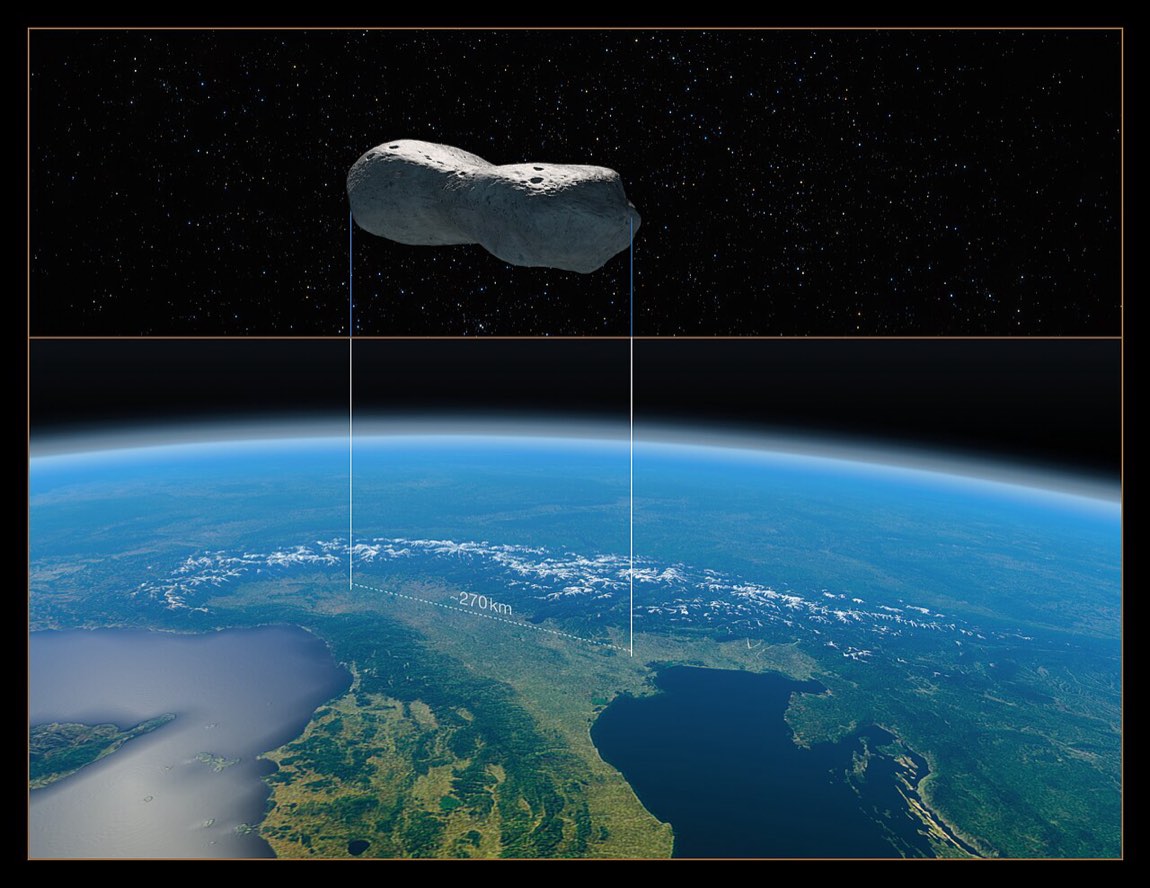
Most asteroids are lumpy but roughly rounded. Kleopatra is something else entirely. Its most recent shape model — built from radar delay-Doppler imaging, adaptive optics, and stellar occultation data combined — gives dimensions of 267 × 61 × 48 km. Picture a ham-bone or a dumbbell roughly the length of Ireland laid end to end, yet barely 48 km thick at its narrowest. The two bulging lobes are connected, not separate, making Kleopatra what astronomers call a contact binary: two distinct masses that touch and cling together. If the asteroid were spinning appreciably faster than it does today, gravity would lose its grip on that narrow neck and the lobes would drift apart into a true binary pair. It is an object perched right on the edge of its own structural stability, and that precariousness is part of what makes it scientifically compelling.
02 How the shape was gradually revealed Deeper
Pinning down Kleopatra's bizarre form took decades and several competing techniques. The first hint came on 19 January 1991, when stellar occultation observations from eight separate ground locations traced the asteroid's silhouette as it briefly blotted out a background star. Follow-up imaging with the ESO 3.6 m Telescope at La Silla suggested two distinct, similarly sized lobes — a genuinely double source. That interpretation was disputed when radar observations at the Arecibo Observatory showed the lobes were actually connected, more like a ham-bone than two separate objects. Those Arecibo radar results were striking enough to appear on the cover of Science Magazine. Later modelling pushed the picture further, suggesting an even more elongated body, and the most precise dimensions we have today come from combining radar delay-Doppler imaging with adaptive optics and stellar occultations — a triangulation of three independent methods that cross-check one another.
03 Two tiny moons and what they tell us
In September 2008, astronomer Franck Marchis and his collaborators announced a striking discovery: two small moons orbiting Kleopatra, spotted using the adaptive optics system on the Keck Observatory. A search for exactly such companions had been attempted back in 1988 using the UH88 telescope at the Maunakea Observatories, but found nothing. Twenty years of improved technology made the difference. The outer moon, Alexhelios, measures about 8.9 ± 1.6 km across and completes one orbit in 2.7 days. The inner moon, Cleoselene, is slightly smaller at 6.9 ± 1.6 km and orbits in just 1.8 days. Both were formally named in February 2011 after Cleopatra VII's twin children — Alexander Helios and Cleopatra Selene II — keeping the Egyptian royal family theme intact. Beyond the mythology, these moons are scientifically invaluable: their orbital periods give astronomers the lever they need to calculate Kleopatra's mass.
04 Weighing an asteroid by its moons Deeper
Because gravity governs how a moon orbits its parent body, the orbital periods and distances of Alexhelios and Cleoselene act as a natural scale for Kleopatra's mass. The calculation is not straightforward — Kleopatra's wildly irregular shape distorts the gravitational field around it, making orbital modelling a genuine challenge. The most recent adaptive-optics observations and modelling yield a mass of (2.97 ± 0.32) × 10¹⁸ kg, which is significantly lower than earlier estimates. Combined with the best available volume estimate for the asteroid, that mass implies a bulk density of 3.38 ± 0.50 g/cm³. For context, pure iron has a density around 7.9 g/cm³, so Kleopatra at 3.38 g/cm³ is far less dense than a solid metal body of its size should be. That gap is a clue that something more complicated is going on inside.
05 Metal-rich or rubble pile — an open debate Deeper
Kleopatra is classified as an M-type asteroid, a category long associated with metallic, iron-rich compositions. Its radar albedo — how brightly it reflects radar waves — does suggest a high metal content, but only in the southern hemisphere. Along the equator, the radar signature resembles the more common S- and C-class asteroids, which are rocky or carbonaceous rather than metallic. This inconsistency has forced researchers to reconsider the simple picture of Kleopatra as a solid metal world. The lower-than-expected bulk density points toward significant internal porosity. One hypothesis that reconciles the shape, density, and variable surface signature is that Kleopatra is a rubble-pile asteroid — a loosely bound collection of fragments held together by mutual gravity rather than solid rock — sitting in a dynamic equilibrium. If true, its dumbbell form becomes even more remarkable: an unconsolidated pile of rubble holding itself in one of the solar system's most extreme shapes.
 ⤢
06 A violent birth: the oblique impact theory
How does an asteroid end up looking like a ham-bone? One compelling hypothesis traces Kleopatra's origin to an oblique — that is, glancing rather than head-on — impact roughly 100 million years ago. The collision's geometry would have transferred angular momentum into the surviving body, spinning it up. As the rotation rate increased, the asteroid elongated, and material flung outward from the neck region eventually coalesced into the outer moon Alexhelios. Cleoselene may have split off later, perhaps around 10 million years ago, in a secondary event. The whole sequence — collision, spin-up, elongation, moon formation — is a chain of consequences from one ancient impact. This scenario is attractive because it explains three separate puzzles at once: the unusual shape, the rapid rotation, and the existence of two moons. It remains a hypothesis, however, and the uncertainties in timing and mechanism leave room for alternative explanations.
07 Orbital path through the asteroid belt
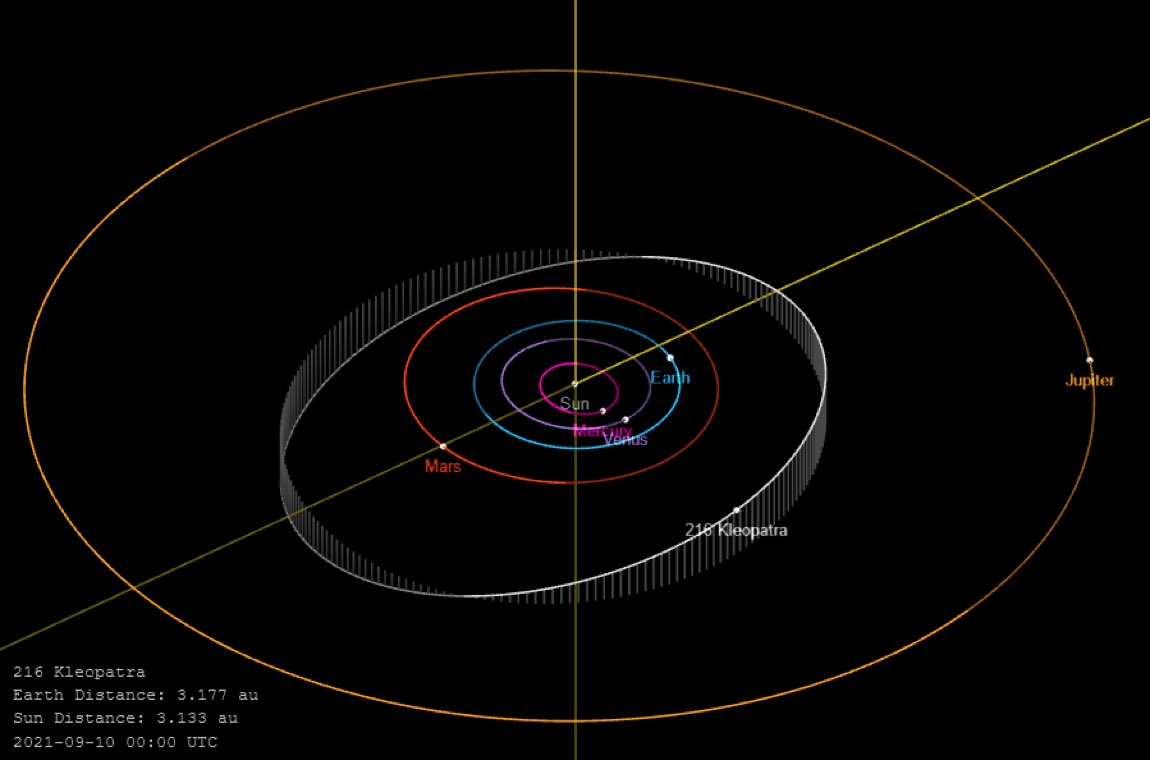
Kleopatra travels around the Sun on a path that places it solidly in the central asteroid belt, ranging between 2.1 and 3.5 AU from the Sun over the course of one orbit. Its semi-major axis sits at 2.79 AU, and a full trip around the Sun takes 4 years and 8 months — 1,706 days. The orbit is moderately elongated, with an eccentricity of 0.25, meaning the difference between its closest and farthest solar distances is substantial. It also tilts 13° relative to the ecliptic, the plane in which Earth orbits. Crucially, Kleopatra does not belong to any recognised asteroid family — those clusters of objects that share a common origin in a past collision. It is instead part of the main belt's background population, an independent traveller with its own distinct history rather than a fragment of some larger, shattered ancestor.
08 Discovery at the Austrian Naval Observatory
Johann Palisa spotted Kleopatra on 10 April 1880, working at the Austrian Naval Observatory in Pola — a city that now belongs to Croatia and is known today as Pula. Palisa was one of the most prolific visual asteroid discoverers in history, and Kleopatra was among the objects that cemented his reputation. The formal observation arc begins ten days after discovery, on 20 April 1880, with a confirmatory observation recorded at Leipzig Observatory. The asteroid was named after Cleopatra VII, the famous last active pharaoh of ancient Egypt, continuing the classical-world naming tradition common for main-belt asteroids of that era. The choice proved fitting in hindsight: when the two moons were named in 2011 after her twin children, Alexander Helios and Cleopatra Selene II, the asteroid acquired a small mythological family to match its physical one.
09 Size in context: how big is 120 km?
Kleopatra's mean volume-equivalent diameter is 120 ± 2 km — a figure that represents the diameter of a perfect sphere containing the same volume as the irregular asteroid. That is roughly the distance from London to Birmingham, or about one and a half times the length of Rhode Island. But mean diameter can be misleading for an object this elongated. The asteroid's longest dimension, 267 km, is more than twice the mean, while its shortest is just 48 km. So in its longest direction it stretches further than the entire state of New Hampshire, yet a cross-section through its narrowest point would fit inside a circle smaller than many metropolitan areas. Among main-belt asteroids Kleopatra is relatively large, but it is not in the same league as the dwarf planet Ceres at roughly 940 km across. Its size, combined with its shape and composition, is precisely what makes it an unusually informative object for understanding asteroid evolution.
10 Open questions still waiting for answers Deeper
Despite decades of observation, Kleopatra leaves several fundamental questions unresolved. The internal structure remains contested: is it a coherent metallic body, a porous rubble pile, or something in between? The uneven radar albedo — metallic in the south, more ordinary near the equator — lacks a fully accepted explanation. It is unclear whether this reflects a genuinely heterogeneous composition, differences in surface regolith grain size, or an observational artefact. The timing and mechanism of moon formation is also imprecise: the estimate that Cleoselene split off around 10 million years ago and Alexhelios perhaps 100 million years ago carries large uncertainties. How the moons have evolved dynamically since their formation — whether they have migrated significantly in their orbits, exchanged material, or been reshaped by tidal forces — has not been studied in detail. A dedicated spacecraft visit, which has not yet occurred, would be needed to answer many of these questions definitively.
 ⤢