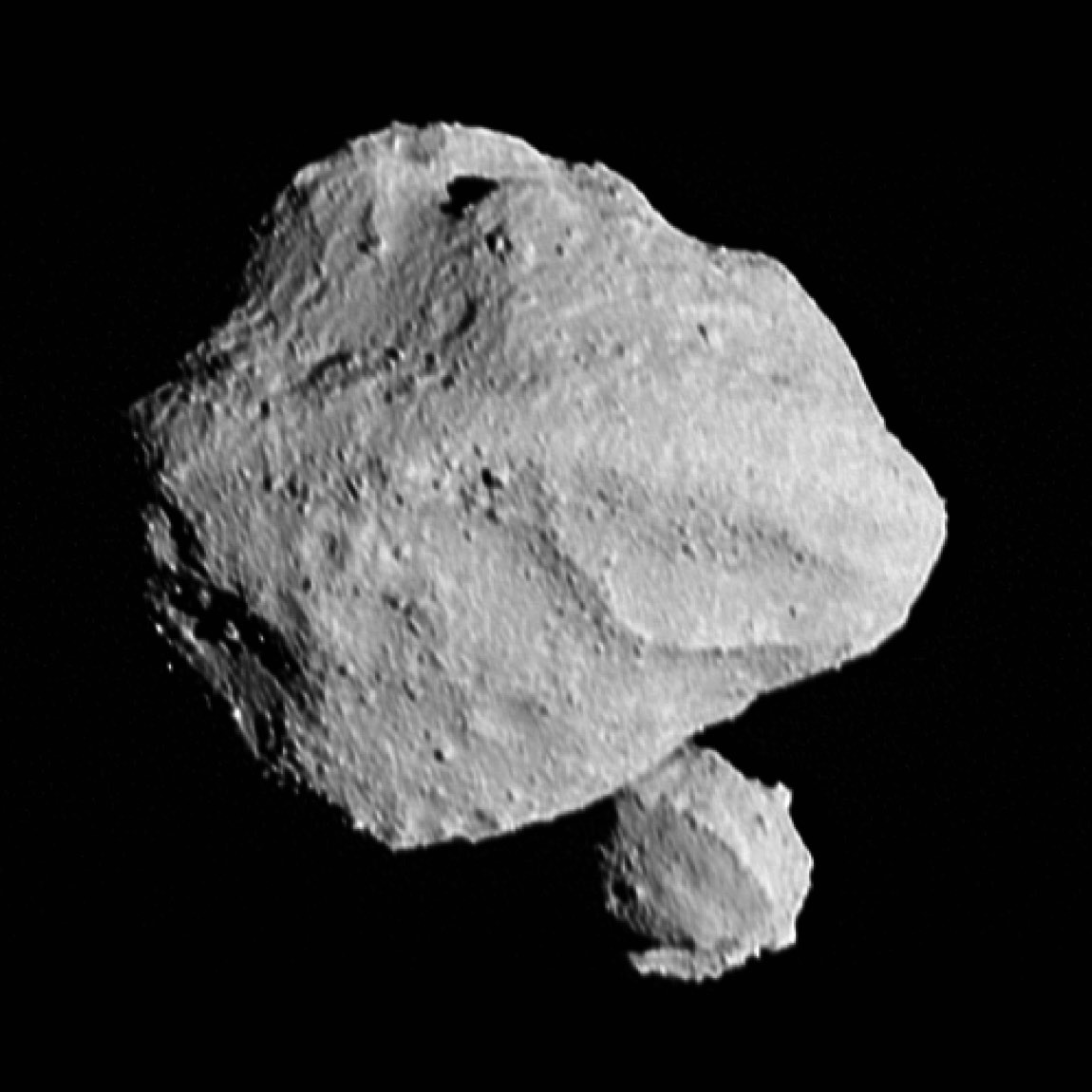
 Photograph · NASA/Goddard/SwRI/Johns Hopkins APL/NOIRLab · Public domain
Asteroid · Deep guide
152830 Dinkinesh
Also called: 152830 Dinkinesh · (152830) Dinkinesh · 1999 VD57
Lucy's first flyby target — which surprised everyone by having a contact-binary moon.
What is it?
Dinkinesh is a small main-belt asteroid about 740 m across. NASA's Lucy spacecraft flew past it on 1 November 2023 as a warm-up before its journey to Jupiter's Trojan asteroids. The flyby revealed a moon, Selam, about 220 m wide — and Selam itself turned out to be two lobes stuck together. The asteroid's name comes from the Ethiopian name for the famous 'Lucy' fossil.
The deep dive
Researched for the Atlas from Wikipedia — 152830 Dinkinesh (10,845 characters read) · updated Nov 14, 2026
01 Lost and Found: A Rocky Road to Discovery
Dinkinesh had an unusually tangled path to recognition. After its discovery on 4 November 1999 by the LINEAR survey at Socorro, New Mexico, observations continued only until 15 November 1999, after which the asteroid slipped through the cracks and went unrecognized for years. Spacewatch reobserved it in April 2004 but mistakenly bundled those sightings with an entirely unrelated asteroid, 2004 GZ43. Then in February 2007, Palomar Observatory's NEAT survey spotted it again as what seemed like yet another new object, earning it the provisional designation 2007 CB63. It was Gareth V. Williams, the associate director of the Minor Planet Center, who finally connected the dots on 2 March 2007, linking the 1999 and 2007 observations as the same body. That linkage unlocked a cascade of additional detections stretching from 2001 to 2007, plus pre-discovery LINEAR images from as far back as 15 October 1999 that were identified and published on 19 August 2007. All together, the observation arc extended to over seven years, dramatically tightening the orbital solution and earning Dinkinesh its permanent catalog number, 152830, on 2 April 2007.
02 What 'Dinkinesh' Actually Means
The name Dinkinesh comes from Amharic, the official language of Ethiopia, written ድንቅነሽ. It translates as 'you are wonderful,' constructed from two parts: 'Dinkʼi,' meaning 'wonderful,' and 'nesh,' the feminine second-person form of 'you are.' The asteroid shares its name with the Amharic name for the famous Lucy fossil, the 3.2-million-year-old Australopithecus afarensis skeleton discovered in Ethiopia, after which NASA's Lucy mission is itself named. When the asteroid was selected as a flyby target, it had no official name at all. The Lucy mission team proposed the name to the International Astronomical Union's Working Group for Small Bodies Nomenclature, which approved and publicly announced it on 6 February 2023 — less than nine months before the spacecraft would actually reach the asteroid. The naming theme extends to surface features: the IAU decreed that geological features on Dinkinesh and its moon should be named after words meaning 'wonderful,' 'marvelous,' or 'beautiful' in languages from around the world, a convention officially applied when the first approved feature names were announced on 20 December 2024.
03 An Orbit in the Inner Belt Deeper
Dinkinesh travels the inner main asteroid belt on a mildly elliptical path, completing one orbit around the Sun every 3.24 years at an average distance of 2.19 astronomical units — about 328 million kilometers. Its orbital eccentricity of 0.112 is modest but enough to swing it between 1.95 AU at perihelion and 2.44 AU at aphelion, a range of roughly 73 million kilometers. The orbit is inclined only 2.1° relative to the plane of the Solar System, making it nearly coplanar with Earth's orbit in comparison. Dinkinesh is also possibly a member of the Flora family, a large grouping of asteroids that share orbital characteristics with the parent body 8 Flora. Flora family members are generally thought to be fragments produced by past collisions, though membership for any individual object is probabilistic rather than confirmed. That inner-belt location is scientifically valuable: it places Dinkinesh in a different solar environment than the near-Earth asteroids like 65803 Didymos, whose binary system resembles Dinkinesh's in size and composition, allowing researchers to compare how distance from the Sun influences binary asteroid dynamics and surface evolution.
04 A Rubble Pile Wearing a Ridge
Close-up Lucy images revealed a Dinkinesh that is far from a simple rock. Its surface is littered with boulders and craters, and its outline is noticeably irregular rather than smooth — a sign, scientists interpret, that the asteroid is relatively old and has accumulated a long history of impacts. Most strikingly, Dinkinesh sports a prominent equatorial ridge officially named Fab Dorsum, and even a secondary ridge that branches off from it. Such equatorial ridges on asteroids are generally interpreted as evidence of past mass-shedding events, in which material migrates toward the equator and is eventually flung off as the asteroid spins up. Dinkinesh's overall shape strongly resembles two well-studied near-Earth asteroids, 101955 Bennu and 162173 Ryugu, both of which are confirmed rubble piles — loose aggregates of rock and dust held together only by gravity rather than solid rock. That physical resemblance leads scientists to suspect Dinkinesh likely shares a rubble-pile interior structure, though this remains an inference rather than a direct measurement. At approximately 790 meters across its equator, Dinkinesh is small enough that this loosely bound structure could explain how its moon, Selam, may have formed from material shed off its surface.
05 Reading the Rock: Spectral Fingerprints Deeper
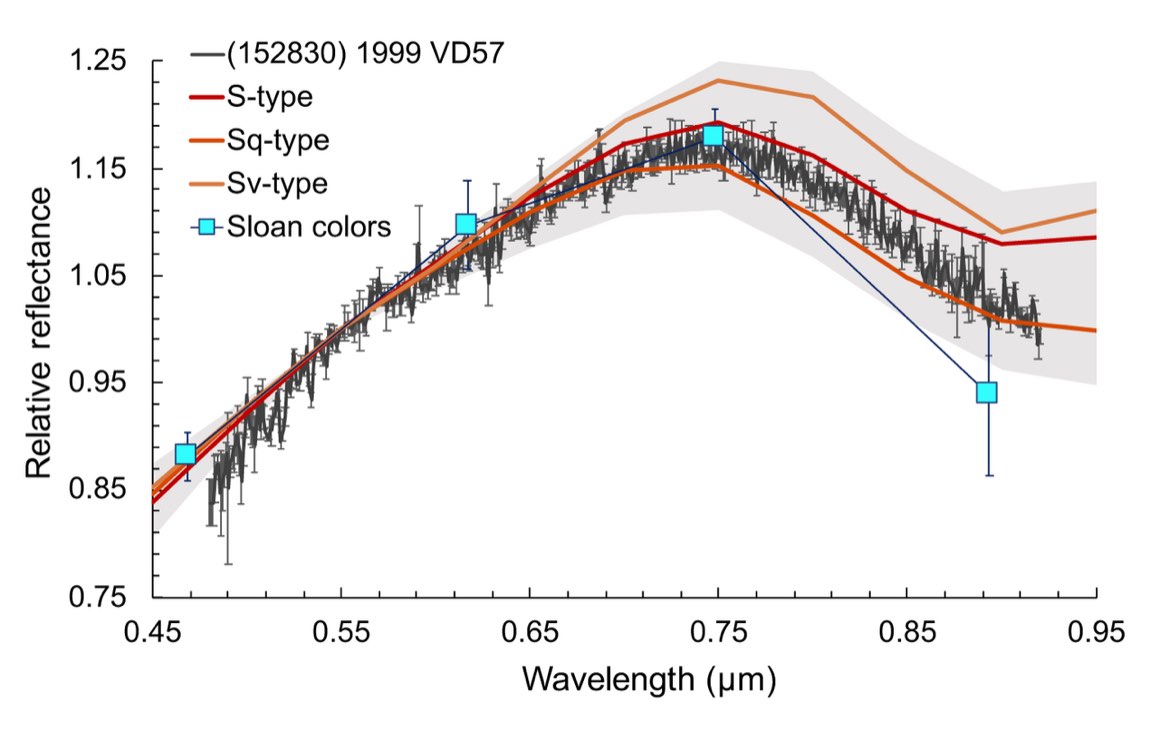
Before Lucy ever arrived, two independent research teams used ground-based telescopes in November and December 2022 to analyze sunlight reflected from Dinkinesh. Both agreed on the broad classification: Dinkinesh is an S-type asteroid, composed primarily of rocky silicates with small amounts of metal. The agreement ended there, however. Data from the 10-meter Keck I telescope on Mauna Kea, Hawaii pointed toward the Sq subclass, because the spectrum shows a pronounced 1-micrometer absorption band associated with the minerals olivine and pyroxene — a feature characteristic of Q-type asteroids. Meanwhile, data from the 8.1-meter Gemini South telescope at Cerro Pachón, Chile produced a shallower version of that same band, more consistent with a standard S-type classification. The two teams could not definitively resolve the discrepancy. It may stem from observational artifacts, but a more intriguing possibility is that it reflects real compositional variation across the asteroid's surface as it rotates into view. If the surface is uneven in composition, an uneven distribution of space-weathered material — likely deposited by impacts or shaped by surface topography — could explain the spectral difference. That question remained open even after the flyby.
06 The Light Curve That Hid a Secret Deeper
Ground-based observers trying to characterize Dinkinesh's rotation found something puzzling. Photometric observations with the 1.23-meter telescope at Calar Alto Observatory in Almería, Spain, running from November 2022 through February 2023, recorded Dinkinesh's brightness oscillating by 0.39 ± 0.02 magnitudes with a period of 52.67 hours. That period was far too long to match Dinkinesh's actual spin rate of one rotation every 3.7387 ± 0.0013 hours. The explanation, revealed only after the flyby, is that the 52.67-hour brightness cycle was not caused by Dinkinesh rotating at all. Instead, it was produced by the tidally locked orbital motion of Selam, whose elongated, two-lobed shape sweeps in and out of the line of sight and periodically blocks or reflects additional light. The discrepancy between the predicted and observed brightness variations in the weeks before the flyby was what gave the Lucy team the first hints that something unexpected was orbiting Dinkinesh. An earlier attempt to measure the light curve using the 0.8-meter IAC-80 telescope at Teide Observatory in Tenerife, Spain in November 2022 did not last long enough to reach conclusive findings, leaving the Calar Alto dataset as the primary pre-flyby photometric record.
 ⤢
07 Selam: A Moon Made of Two Pieces
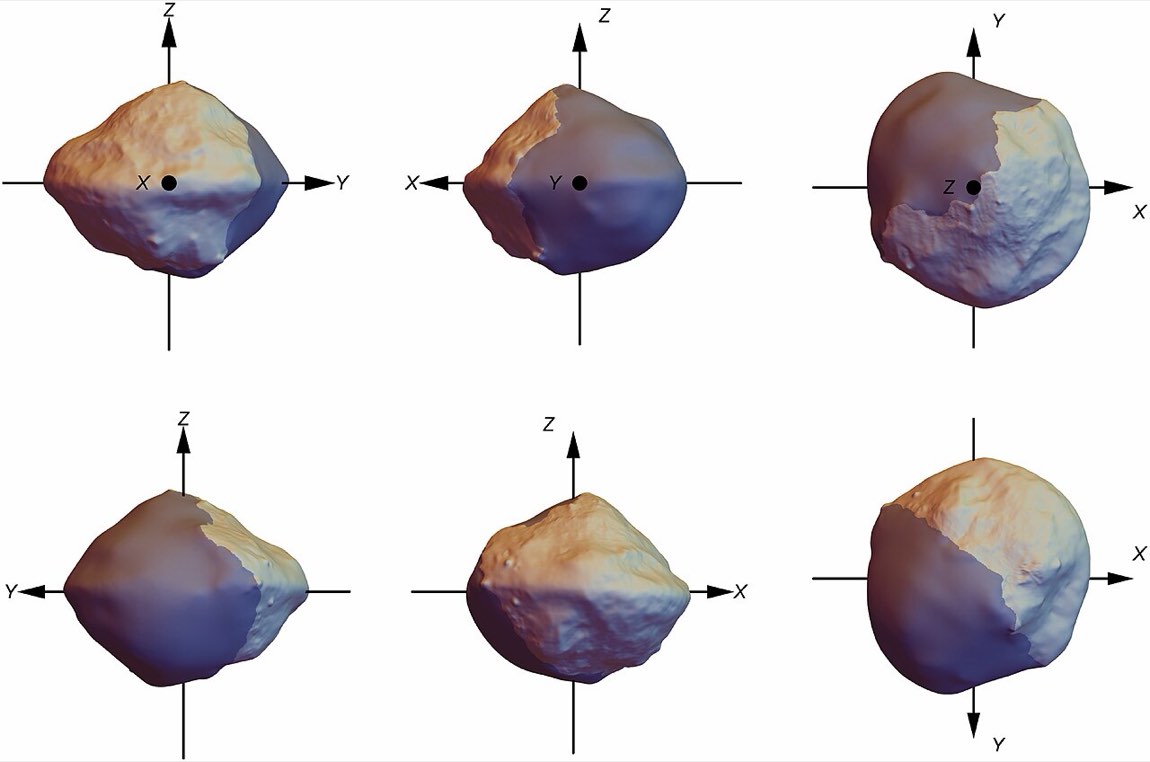
The biggest surprise of the Dinkinesh flyby was the discovery of its moon, Selam. Revealed in images taken as Lucy swept past, Selam turned out to be not just a satellite but a contact binary — two separate lobes, each roughly 220 meters (720 feet) in diameter, pressed together and joined at a neck. Contact binary asteroids are not unusual in the Solar System, but Selam holds a unique distinction: it is the first known contact binary that is itself a moon of another asteroid. Its name honors the fossil remains of a three-year-old female Australopithecus afarensis found at Dikika, Ethiopia — the same species as the Lucy fossil and the same species as the adult skeleton that gave the Lucy mission its name. Selam orbits Dinkinesh in a tidally locked state, always keeping the same face toward its host, much as Earth's Moon keeps the same face toward Earth. That locked orbit, combined with Selam's elongated two-lobed shape, is precisely what generated the 52.67-hour brightness oscillation that puzzled observers on the ground before the flyby. The formation process that produced a contact binary satellite around a small asteroid remains an open and actively discussed scientific question.
08 How Lucy Was Steered to Dinkinesh
Dinkinesh was not part of Lucy's original mission plan. The asteroid was initially overlooked as a flyby candidate simply because it was too small. The situation changed in August 2022 when Raphael Marschall, a mission collaborator from the Nice Observatory, combed through 500,000 asteroids to identify any that might pass close enough to Lucy's trajectory for a practical diversion. Dinkinesh made the cut. NASA and the Lucy science team announced the new flyby target on 25 January 2023, over a year after Lucy had launched in October 2021. Lucy's original path brought it within about 64,000 kilometers (40,000 miles) of Dinkinesh — close in astronomical terms but too far for detailed imaging. A series of planned trajectory correction maneuvers executed between May and September 2023 progressively bent Lucy's course, ultimately bringing it within just 425 kilometers (264 miles) of the asteroid on 1 November 2023. Lucy took its first resolved images of Dinkinesh on 3–5 September 2023, when the asteroid was still about 23 million kilometers (14 million miles) away. Because Dinkinesh is so small, surface detail only became visible on the actual day of the flyby.
09 What Lucy's Instruments Captured Deeper
At closest approach on 1 November 2023 at 16:54 UTC, Lucy was moving at 4.5 kilometers per second (2.8 miles per second) relative to Dinkinesh. Even at that high speed, its three main instruments collected a layered scientific dataset. The panchromatic L'LORRI imager captured images at a resolution of approximately 2 meters per pixel — fine enough to pick out individual large boulders on the surface. The L'Ralph color imager added context at 15 meters per pixel, providing color information across the visible spectrum. The L'TES spectrometer measured near-infrared spectra and thermal emission at 24 meters per pixel, giving a window into surface composition and temperature. After the flyby itself, L'LORRI kept watching Dinkinesh for four additional days to measure the asteroid's light curve at close range — something impossible to do accurately from Earth. The Dinkinesh encounter was explicitly designed as a dress rehearsal: Lucy's engineers used it to test the spacecraft's autonomous tracking system, which must lock onto a small fast-moving target with no real-time guidance from Earth, before that same system is called upon for Lucy's primary science objectives at the Jupiter Trojan asteroids.
10 The Smallest Main-Belt Asteroid Visited
With a diameter of roughly 790 meters across its equator, Dinkinesh holds the record as the smallest main-belt asteroid yet explored by a spacecraft. The distinction matters because asteroid size correlates with physical processes: small bodies lose heat faster, are more susceptible to radiation-driven spin changes, and can be disrupted by impacts that larger bodies would barely notice. Some smaller near-Earth asteroids have been visited — the article notes that explicitly — but none as small as Dinkinesh in the main belt. Dinkinesh also makes Dinkinesh and Selam only the second binary asteroid system in the main belt to be explored up close, following the discovery of 243 Ida's moon Dactyl by the Galileo spacecraft in 1993. Comparing Dinkinesh to Didymos, a near-Earth binary of similar size and composition that was deliberately impacted by NASA's DART mission, gives scientists a rare controlled comparison: two similar binary systems at different distances from the Sun, evolving under different levels of solar heating and radiation pressure. That comparison may help untangle how binary asteroid systems form and how long they survive.
11 Open Questions After the Flyby Deeper
Despite the richness of data returned by Lucy, Dinkinesh leaves several scientific questions unanswered. How did Selam form as a contact binary satellite? The leading framework for binary near-Earth asteroids involves rotational fission — a small asteroid spins up under the YORP thermal effect until it sheds mass that coalesces into a companion — but whether that process can produce a contact binary moon rather than a simple spheroidal one is not established. The spectral disagreement between the Keck I and Gemini South datasets also remains unresolved: does Dinkinesh's surface vary in composition from hemisphere to hemisphere, or were the differences instrumental? And the equatorial ridge, Fab Dorsum, with its branching secondary ridge, invites detailed modeling of the mass-shedding history that created it. Even Dinkinesh's Flora family membership is listed only as a possibility, not a confirmed relationship. Each of these threads represents ongoing research territory. The flyby data will continue to be analyzed for years, and Dinkinesh's role as a testbed for Lucy's instruments means its legacy extends well beyond its own scientific story — it set the stage for Lucy's encounters with the Jupiter Trojans, the mission's primary scientific prize.
 ⤢