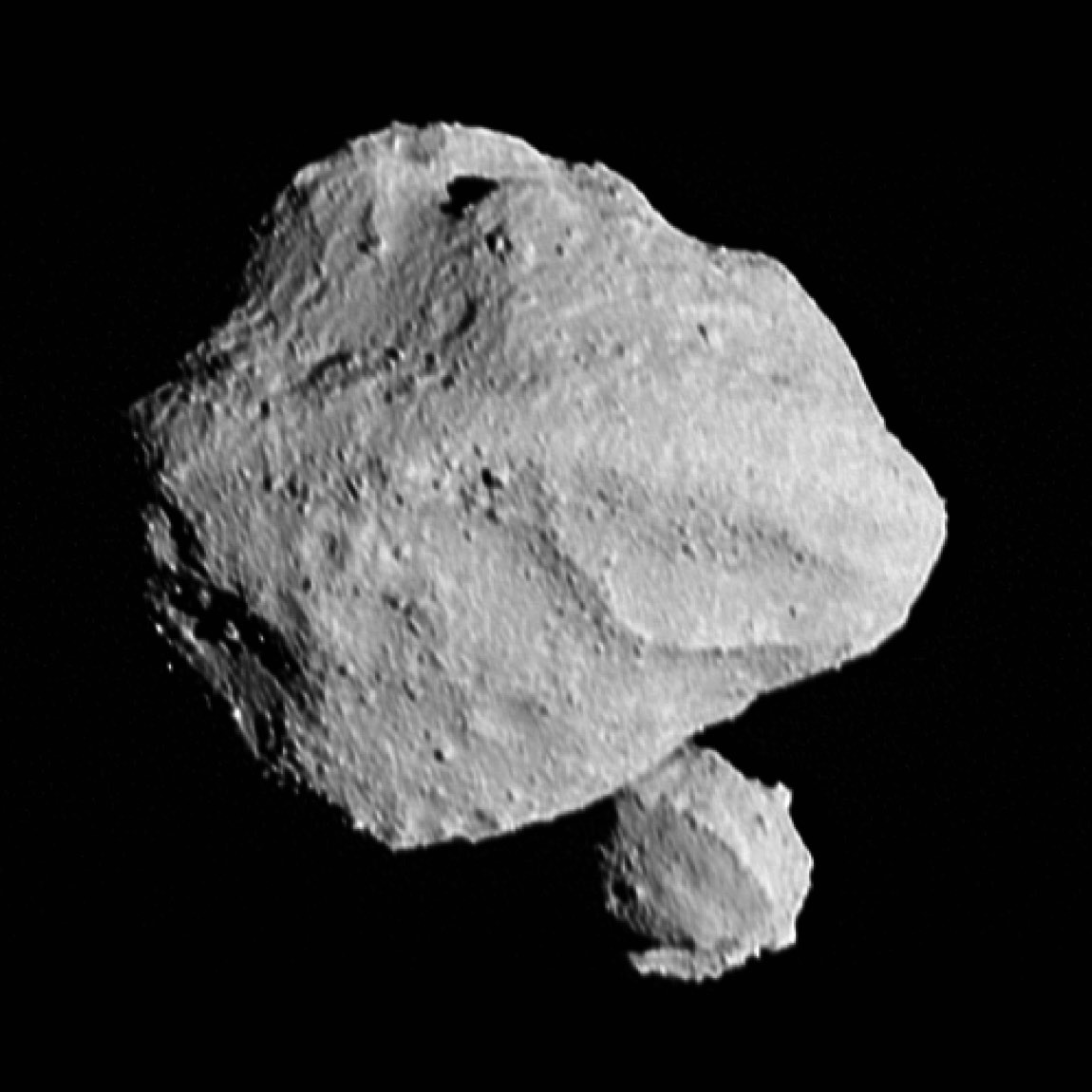
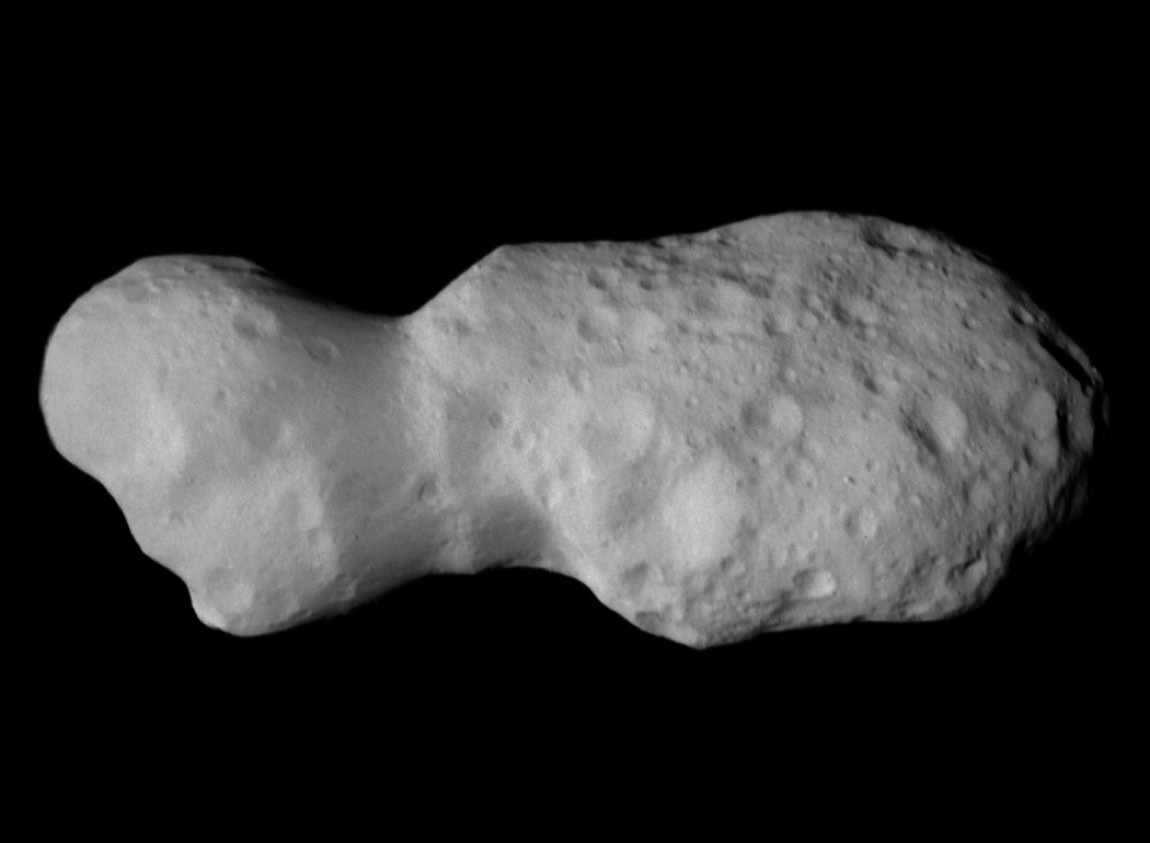
 Photograph · NASA · Public domain
Asteroid · Deep guide
52246 Donaldjohanson
Also called: 52246 Donaldjohanson · (52246) Donaldjohanson · 1981 EQ5
A wobbling, two-lobed asteroid that Lucy flew past in 2025, named after the man who found the Lucy fossil.
What is it?
Donaldjohanson is an elongated main-belt asteroid about 8.8 km long, made of two lobes joined by a narrow neck. NASA's Lucy spacecraft flew past it on 20 April 2025. Rather than spinning around one axis, it tumbles chaotically — slowly flipping end over end — a motion thought to be caused by the gentle push of sunlight. It is named after paleoanthropologist Donald Johanson, and many of its features carry the names of famous fossil sites.
The deep dive
Researched for the Atlas from Wikipedia — 52246 Donaldjohanson (16,710 characters read) · updated Nov 14, 2026
01 A Peanut Carved from a Catastrophe
Donaldjohanson did not begin life as a single body. The Erigone asteroid family — to which it belongs — is thought to have been born from a violent collision between an 80-kilometer-diameter parent asteroid and a 20-kilometer impactor sometime within the last 270 million years, most likely around 155 million years ago. That makes the Erigone family relatively young by solar system standards. Donaldjohanson itself is believed to have originated as two separate kilometer-scale fragments that were flung out of that destruction traveling alongside each other. Gravity gently drew them together over time until they made contact and merged into the elongated, peanut-shaped body we see today, a form astronomers call a contact binary. The crater record on the asteroid's surface independently confirms this timeline: the density of impact scars is consistent with a surface no older than the Erigone family's estimated age, providing a cross-check between orbital statistics and surface geology.
02 Two Lobes With Very Different Life Stories
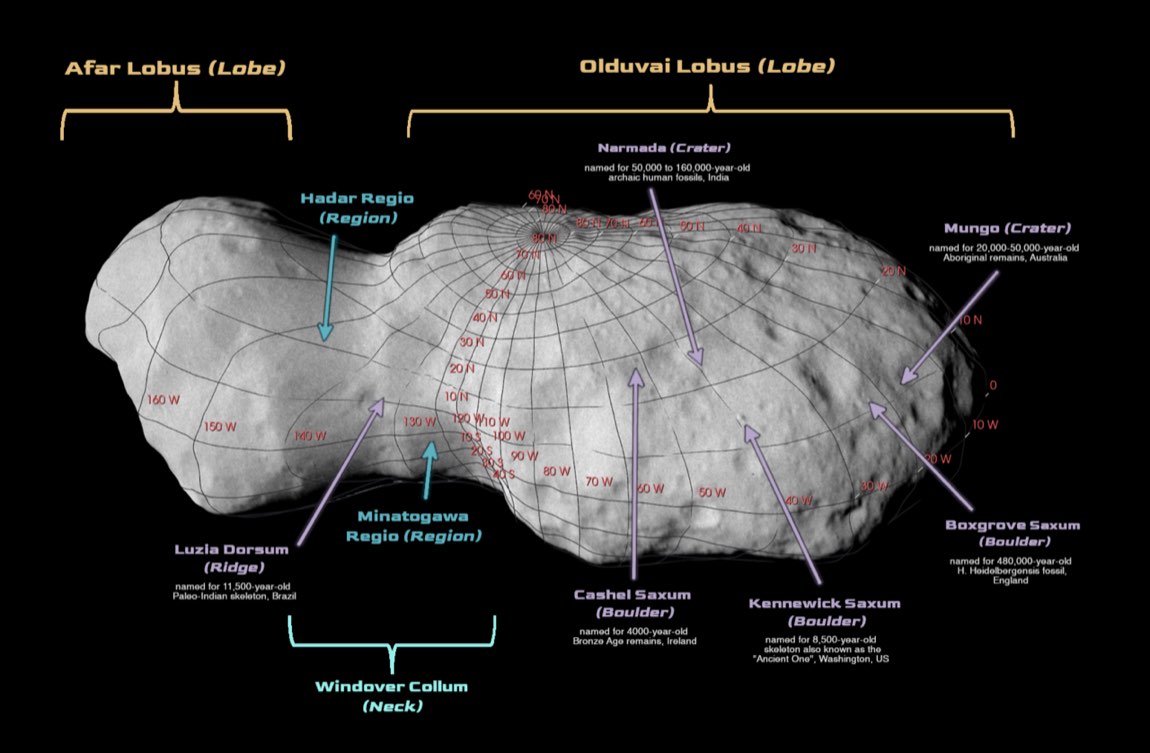
The asteroid's two lobes are named Afar Lobus and Olduvai Lobus, honoring famous paleoanthropological sites in Ethiopia and Tanzania respectively. Afar Lobus, the smaller of the two, stretches about 3.4 kilometers in length, while the larger Olduvai Lobus runs about 5.4 kilometers — long enough that the entire asteroid's center of mass sits inside Olduvai Lobus rather than in the neck between them. Both lobes are heavily battered by impact craters. The largest known crater on Afar Lobus is between 0.8 and 0.9 kilometers across, while Olduvai Lobus hosts a crater between 2 and 3 kilometers in diameter, roughly the width of a small city. Craters larger than 400 meters appear to have reached a saturation density, meaning new craters are simply overwriting old ones at a steady rate. Smaller craters, however, are noticeably scarce, suggesting they were wiped out within the last 40 million years, most likely when a large impact shook the surface and caused loose debris to flow across it like a slow avalanche.
03 The Smooth Neck That Rewrites Its Own History Deeper
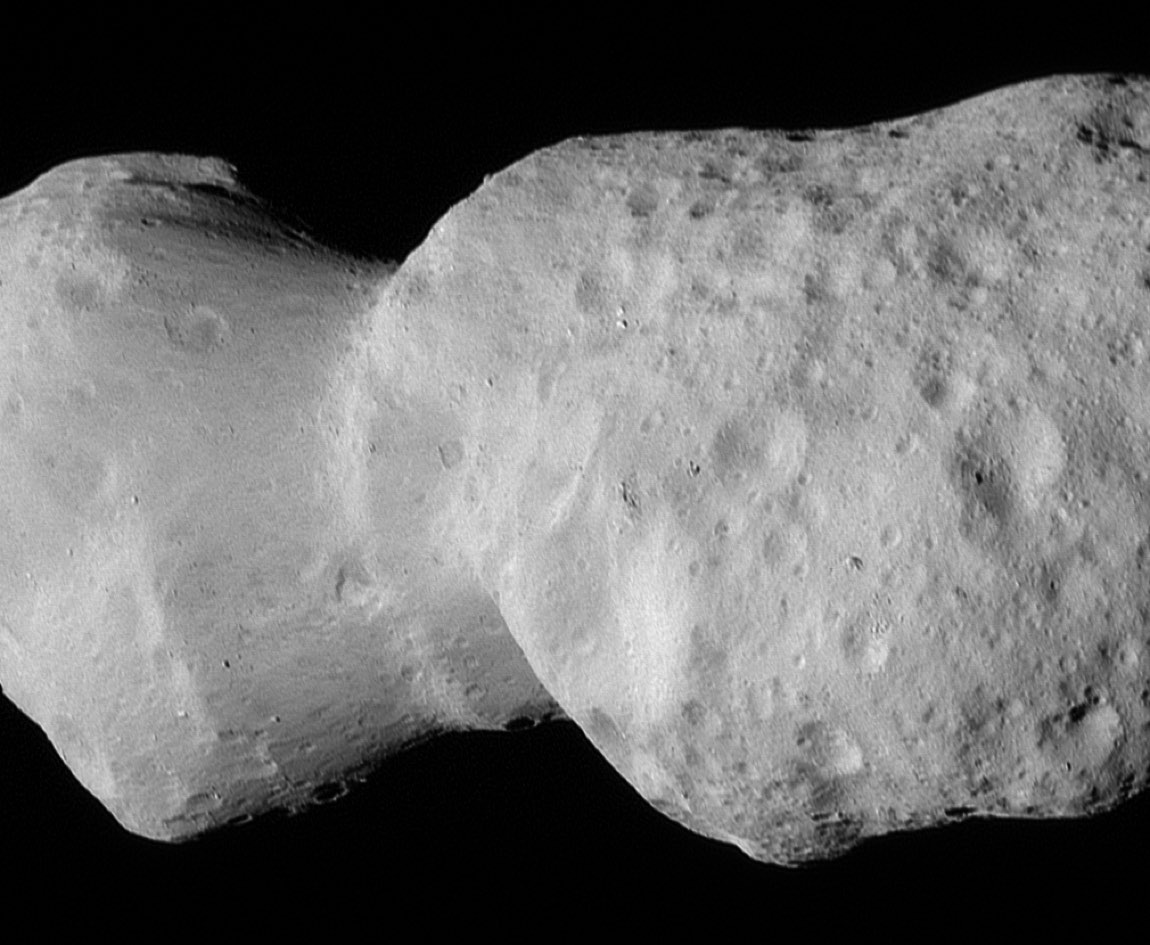
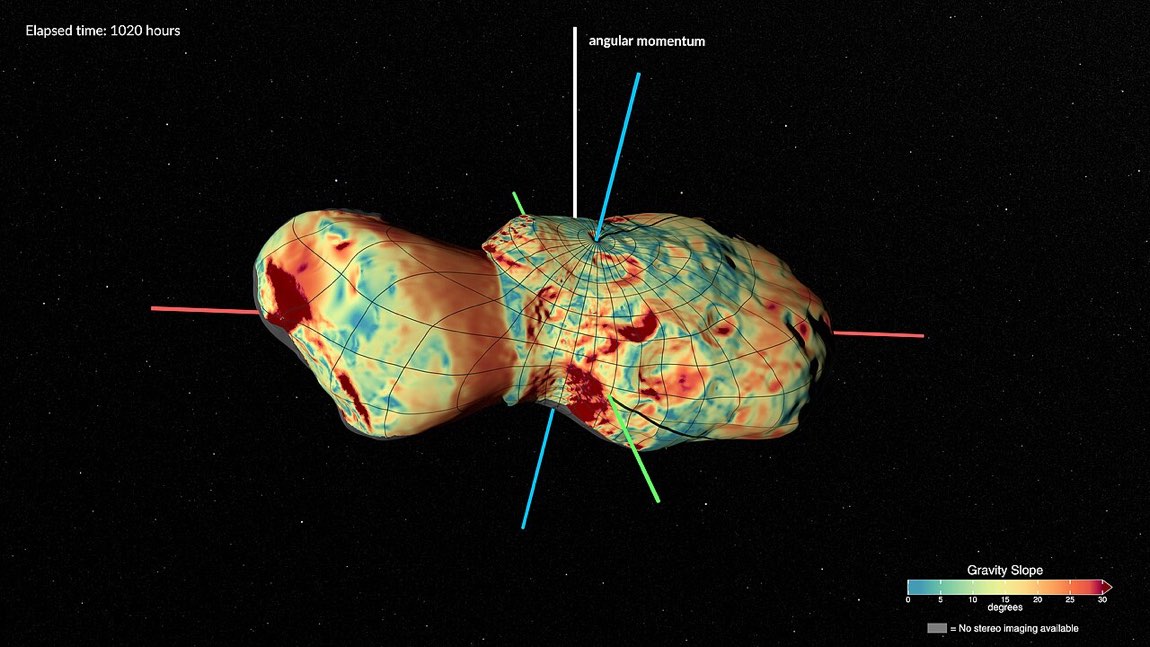
The neck connecting the two lobes — formally named Windover Collum after the Windover Archaeological Site in Florida — is strikingly different from the battered terrain of the lobes. It is divided by a ridge called Luzia Dorsum into two regions: Hadar Regio, on the Afar Lobus side, and Minatogawa Regio, on the Olduvai Lobus side. Because the center of mass sits inside Olduvai Lobus, gravity at Windover Collum pulls loose material downhill from Afar Lobus toward Olduvai Lobus. The neck's surface reflects this: Hadar Regio shows smooth terrain covered by degraded, often flat-floored craters, and the slope averages a steep 25 degrees relative to the local gravity direction. The Afar-facing side of Luzia Dorsum has a shallower slope of less than 10 degrees, indicating material has piled up there. All of these features point to the neck having been substantially resurfaced by landslides within the last 20 million years — geologically very recent — most likely triggered by large impacts elsewhere on the body. The Lucy team compared the overall shape to an hourglass or a pair of nested ice cream cones.
04 A Tumbling Wobble That Almost Never Repeats Deeper
Most asteroids spin cleanly around a single axis, like a top. Donaldjohanson does not. It exhibits what is called non-principal axis rotation, or tumbling, meaning its orientation changes chaotically and never exactly repeats itself. The motion involves multiple overlapping periods: the asteroid rolls around its long axis with a precession period of 637.0 hours (26.54 days), wobbles around its angular momentum vector with a yaw precession period of 180.7 hours (7.53 days), and rotates end-over-end with a primary period of 252.6 ± 0.4 hours — just over 10.5 days. Lucy also detected a secondary rotation period of 455.2 ± 0.9 hours (about 19 days). The short axis can stray as much as 40 degrees away from the angular momentum vector. Ground-based telescopes first flagged this strangeness in 2021 by detecting brightness variations of roughly 1 magnitude. The Lucy spacecraft confirmed the tumbling and refined all the periods by monitoring the asteroid's brightness for two months before its flyby.
 ⤢
05 How Sunlight Spun This Asteroid Nearly to a Stop
Donaldjohanson is thought to have started life spinning rapidly, with a rotation period somewhere between 5 and 10 hours — fast enough that centrifugal acceleration helped keep steep surface slopes stable. Over tens of millions of years, a process called the YORP effect gradually robbed it of that spin. The YORP effect works because an irregularly shaped asteroid absorbs sunlight and re-radiates it as infrared heat in a slightly asymmetric pattern, producing a tiny but persistent torque. For Donaldjohanson, that torque has been slowing the rotation rather than speeding it up. Simulations by the Lucy team suggest the period lengthened to about 10 hours within 20 to 60 million years of formation, at which point centrifugal forces weakened enough that steep slopes collapsed inward, sculpting the smooth neck terrain. The tumbling motion itself is believed to have begun roughly 120 to 130 million years after the asteroid formed. If nothing disturbs it — no major impacts, no changes in YORP — the asteroid is predicted to keep tumbling for approximately 20 billion years before settling onto a stable spin axis, far longer than the current age of the universe.
06 Clay Minerals That Remember Ancient Water Deeper
Lucy's spectrometers, combined with Earth-based telescopes, identified Donaldjohanson as a C-type asteroid with a geometric albedo of about 5% in visible light — dark enough that its surface reflects only about 1 in 20 photons that hit it, similar to fresh asphalt. The surface absorbs light preferentially at wavelengths of 0.7 and 2.8 micrometers, signatures of iron-rich phyllosilicate minerals, commonly called clays, most similar to those found in CM chondrite meteorites. These clays contain hydroxyl groups (−OH), chemical fingerprints that form when minerals interact with liquid water. The implication is that liquid water once percolated through the material now sitting on Donaldjohanson's surface — probably while it was still part of its parent asteroid before the Erigone family-forming collision. The water exposure appears to have been brief, because iron in clays tends to be replaced by other elements over prolonged contact with liquid water, and Donaldjohanson's iron-rich clays suggest that did not happen extensively. This sets it apart from C-type asteroids Bennu and Ryugu, whose iron-poor clays indicate they experienced longer or more intense aqueous alteration.
07 An Orbit That Drifts and Occasionally Goes Chaotic Deeper
Donaldjohanson follows an elliptical path around the Sun with a semi-major axis of 2.38 AU and an orbital period of 3.68 Earth years. Its distance from the Sun swings between 1.9 AU at perihelion and 2.8 AU at aphelion with each orbit. The orbital eccentricity is 0.19, though averaged over long timescales it rises to about 0.21. Despite sitting in the inner main belt far from powerful orbital resonances with Jupiter, the asteroid's relatively high eccentricity makes its orbit sensitive to small perturbations, giving it a Lyapunov time — a measure of predictability — of only about 12,000 years. Over 10 million years, models suggest its perihelion distance could drop as low as 1.727 AU, close enough for Mars to exert a weak gravitational influence. On longer timescales, N-body simulations find the orbit should remain stable for at least 1 billion years, but with the semi-major axis jittering by roughly 0.001 AU in a random walk. Additionally, the Yarkovsky effect — heat-driven recoil — is slowly nudging the orbit outward at a rate of 8.4×10⁻⁵ AU per million years.
08 Named Features Honor Deep Human History
The International Astronomical Union approved the first eleven formal feature names on Donaldjohanson on 27 August 2025, all chosen from the world of paleoanthropology to match the asteroid's connection to Donald Johanson and the Lucy fossil. The naming categories follow IAU conventions: boulders are called saxa (singular: saxum) and ridges are called dorsa (singular: dorsum). Three features — the boulder Boxgrove Saxum and the small craters Mungo and Narmada — were specifically chosen to define the asteroid's prime meridian because they were the smallest and most clearly visible features in Lucy's close-up images. Two larger boulders, Cashel Saxum and Kennewick Saxum, with diameters of 80 and 100 meters respectively (roughly the length of a football field each), have also received names. All the named boulders and craters cluster on Olduvai Lobus. The neck ridge Luzia Dorsum honors the Luzia Woman, an ancient human fossil from Brazil, and divides the neck into Hadar Regio and Minatogawa Regio, named for sites in Ethiopia and Japan.
 ⤢
09 Lucy's Fleeting 960-Kilometer Portrait Session
NASA's Lucy spacecraft made its closest approach to Donaldjohanson on 20 April 2025 at 17:51 UTC, skimming past at a distance of 960 kilometers — roughly the distance from New York to Chicago — while moving at a relative speed of 13.4 kilometers per second. At that pace, the entire close encounter was over in moments. Lucy's cameras captured images at resolutions of up to 5.2 meters per pixel, fine enough to resolve individual boulders tens of meters across. However, the spacecraft stopped taking pictures 40 seconds before its closest point to avoid pointing its instruments dangerously close to the Sun. As a result, only 40% of Donaldjohanson's surface has been imaged in useful detail. The first images of the asteroid were taken on 20 and 22 February 2025, when Lucy was still approximately 70 million kilometers away, and the spacecraft continued monitoring brightness over the two months prior to the encounter, which is what allowed scientists to fully characterize the complex tumbling rotation. This was also the first time in history that a spacecraft visited an asteroid named after a living person.
10 A Discovery Lost and Found Twice Over
The discovery history of Donaldjohanson is a small detective story in itself. Astronomer Schelte J. Bus found it on 2 March 1981 while scanning survey plates from the 1.2-meter U.K. Schmidt Telescope at Siding Spring Observatory in Australia, and the Minor Planet Center published the discovery in August 1982 under the provisional designation 1981 EQ5. Additional observations from February, March, and May 1981 were published over the following years, but then the asteroid dropped out of view entirely. In December 1998, the Lincoln Near-Earth Asteroid Research project in New Mexico spotted what it thought was a brand-new asteroid and logged it as 1998 YF26. It was not until February 1999 that astronomer Arno Gnädig cross-matched the two sets of observations and realized they described the same object. The asteroid received its permanent minor planet number, 52246, on 16 February 2003. Its name was publicly announced by the Minor Planet Center on 25 December 2015, nearly three months after NASA selected the Lucy mission for its Discovery Program — and almost six years before the spacecraft launched.
11 No Moons, No Comet Tail, No Companion
During its close encounter, Lucy searched systematically for any sign that Donaldjohanson harbors a small moon or displays cometary activity such as gas or dust emission. The spacecraft found neither. The Lucy team ruled out the existence of any moon larger than 15 meters in diameter anywhere within the asteroid's Hill sphere — the region of space where Donaldjohanson's gravity dominates over the Sun's — which extends roughly 700 kilometers from the asteroid's center. For context, 15 meters is about the length of a city bus, making this a remarkably sensitive upper limit. No dust jets, halos, or brightness enhancements consistent with outgassing were detected either, consistent with Donaldjohanson being an inert, rocky body rather than an active one. This simplicity actually makes the asteroid's physical record easier to interpret, since there are no ongoing processes complicating the geological and rotational history that scientists are trying to reconstruct.
12 An Estimated Mass Built on Assumptions Deeper
One of the fundamental gaps in what scientists know about Donaldjohanson is its mass. No spacecraft flew close enough for long enough to measure the gravitational tug on Lucy directly, so the mass has not been determined from observations. Instead, researchers estimated it by assuming the asteroid has a bulk density of 1.2 grams per cubic centimeter, similar to the well-studied carbonaceous asteroids Bennu and Ryugu. Combined with the measured volume of approximately 58 cubic kilometers, that density assumption yields an estimated mass of 7×10¹³ kilograms — roughly 70 trillion metric tons. The surface's cohesive strength tells a different story than those two reference asteroids, however: Donaldjohanson's surface is estimated to have a cohesive strength of up to 40,000 pascals, far higher than the less-than-100-pascal cohesive strengths measured for Bennu and Ryugu, which are loosely bound rubble piles. That difference suggests the interior structure or surface packing of Donaldjohanson may differ meaningfully from those bodies, which in turn means the assumed density could be off and the true mass remains genuinely uncertain.
 ⤢