 Photograph · NASA/Johns Hopkins APL · Public domain
Asteroid · Deep guide · orbits 65803 Didymos
Dimorphos
Also called: Didymos I · S/2003 (65803) 1 · Didymos B · Didymoon
The little moonlet that DART hit in 2022 — the first time humans changed a celestial body's orbit.
What is it?
Dimorphos is a 177-metre moon of the asteroid Didymos, probably a loose rubble pile built from debris Didymos shed while spinning fast. On 26 September 2022 NASA's DART spacecraft slammed into it on purpose. The impact shortened Dimorphos's orbit around Didymos by about half an hour and blasted out more than a million kilograms of debris, which formed a comet-like tail thousands of km long. It was the first real-world test of deflecting an asteroid.
The deep dive
Researched for the Atlas from Wikipedia — Dimorphos (9,423 characters read) · updated Nov 14, 2026
01 How Dimorphos Was Found in the Dark
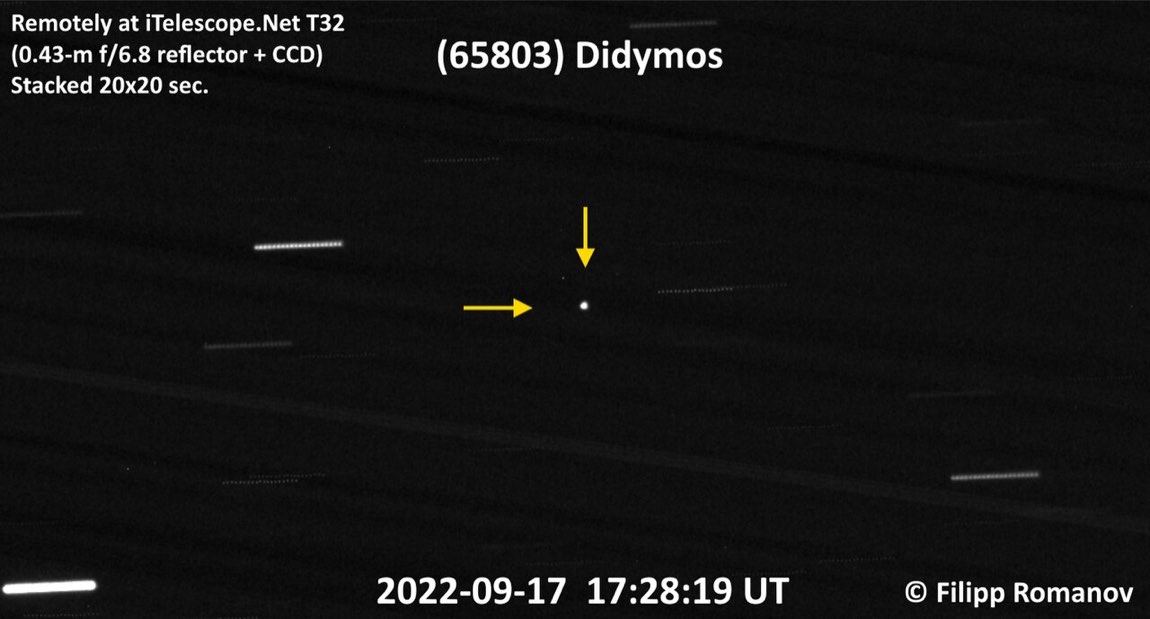
Dimorphos was not spotted by a telescope resolving two separate objects — it was inferred from shadows. On 20 November 2003, Petr Pravec and colleagues at the Ondřejov Observatory in the Czech Republic noticed that Didymos regularly dimmed in a periodic, rhythmic way. Those dips in brightness were caused by mutual eclipses and occultations: Dimorphos passing in front of or behind its parent body and briefly blocking or hiding reflected sunlight. Radar observations from the Arecibo observatory then confirmed the binary nature of the system by producing delay-Doppler images that showed two distinct objects. This indirect detection technique — hunting for the shadow of a moon rather than the moon itself — is the standard method for finding tiny satellites around small asteroids, because the satellites are simply too faint and too close to their hosts for conventional imaging from Earth. Without that telltale flicker in Didymos's light curve, Dimorphos might have remained unknown for years longer.
02 A Name That Predicted Its Own Future
Before the International Astronomical Union gave it an official name on 23 June 2020, the little moon was informally called Didymoon in official communications. The IAU's Working Group for Small Bodies Nomenclature replaced that nickname with Dimorphos, a Greek word meaning 'having two forms.' The name was proposed by Kleomenis Tsiganis, a planetary scientist at the Aristotle University of Thessaloniki who served on both the DART and Hera mission teams. The choice was deliberately forward-looking: the naming justification explicitly states that Dimorphos will become 'the first celestial body in cosmic history whose form was substantially changed as a result of human intervention.' That prediction proved accurate — the DART impact transformed its shape from an oblate spheroid to what researchers describe as a flat-topped oval, or triaxial ellipsoid. A moon named for having two forms has now literally lived up to its name.
03 Born from Its Parent's Spin Deeper
Dimorphos did not form alongside Didymos in the early solar system; it is geologically newborn by asteroid standards. Its surface age is less than 0.3 million years, strikingly young compared to Didymos's surface age of approximately 12.5 million years. The leading formation model, proposed by Madeira and colleagues in 2023, invokes the YORP effect — a subtle radiation torque that gradually spins up an asteroid over time. As YORP accelerated Didymos's rotation to a critical threshold, the parent body shed material from its equator, creating a ring that contained roughly 25 percent of Didymos's total mass. Within that ring, material outside the Roche limit — the distance beyond which tidal forces no longer prevent clumping — coalesced into moonlets. A fraction of the ring's mass assembled into Dimorphos; most of the remaining ring material eventually fell back onto Didymos. The result is a low-density rubble pile: a loosely bound collection of fragments rather than a solid, coherent rock.
04 What DART Actually Hit — and How Fast
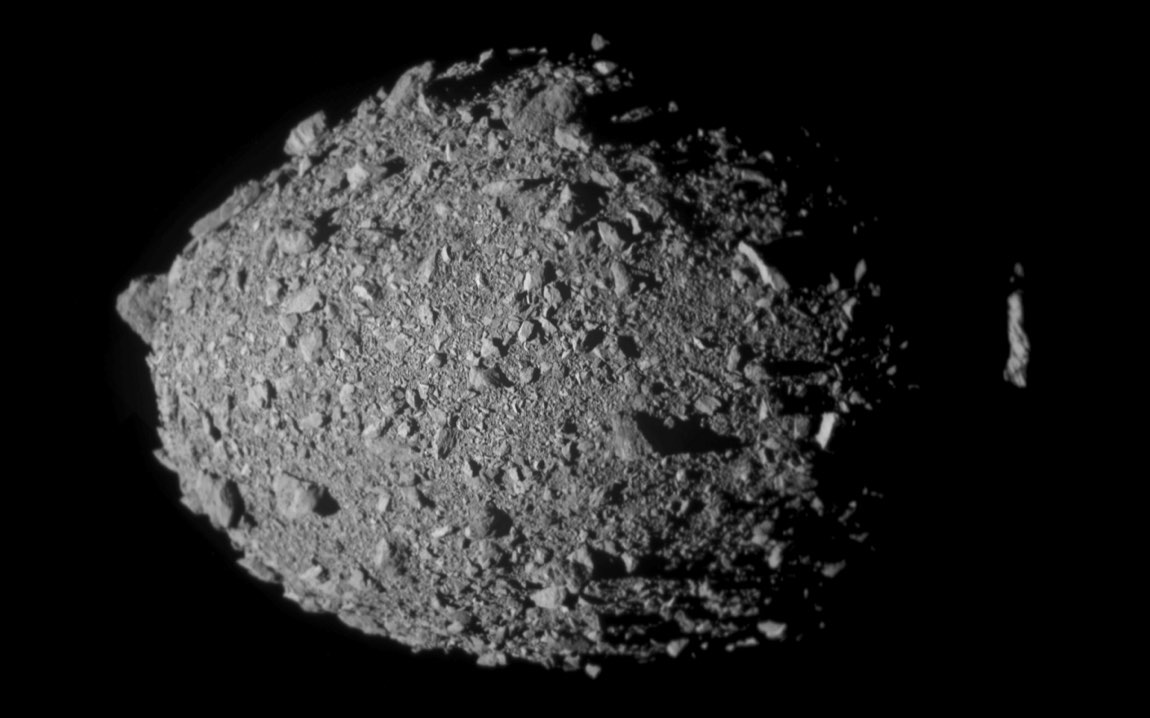
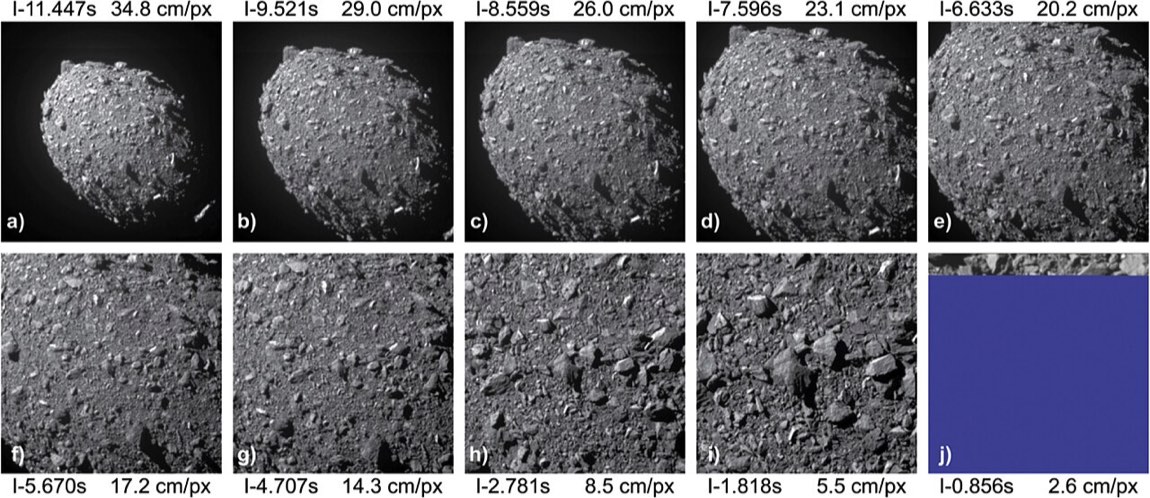
The DART spacecraft was launched on 24 November 2021 by NASA and the Johns Hopkins Applied Physics Laboratory. After a ten-month journey, it struck the center of Dimorphos on 26 September 2022, traveling at approximately 24,000 kilometers per hour — fast enough to cross the continental United States in about ten minutes. What the final images revealed before impact was an egg-shaped body blanketed with boulders, consistent with a rubble-pile interior. Fifteen days before the collision, DART released LICIACube, a small CubeSat built by the Italian Space Agency, which performed a close flyby and photographed both the impact flash and the expanding debris cloud. Observatories including the Hubble Space Telescope, the James Webb Space Telescope, and the Lucy spacecraft also captured the event from different vantage points, making it one of the most thoroughly documented asteroid impacts in history.
05 The Ejecta Multiplier: Why One Punch Hit Harder Deeper
The orbital change DART produced was significantly larger than the spacecraft's own momentum could explain, and that discrepancy is the scientifically crucial result. The impact caused an instantaneous slowing of Dimorphos's orbital speed of about 2.7 millimeters per second. More telling, the momentum transferred to the asteroid was amplified by a factor of 2.2 to 4.9 — the range depending on assumed mass — relative to what the spacecraft alone imparted. That amplification comes from ejecta recoil: when over 1 million kilograms of material was blasted off the surface and shot into space, the reaction pushed Dimorphos in the opposite direction, adding substantially to the deflection. This is analogous to a rocket exhaust effect, where the ejected mass acts as propellant. Understanding that multiplier is critical for planetary defense planning, because it means a relatively small impactor can punch far above its weight if it excavates enough material — provided the target's surface properties allow that kind of energetic ejection.
06 Thirty-Three Minutes That Changed Everything
Before DART arrived, Dimorphos completed one orbit around Didymos every 11.92 hours. The impact shortened that period by 33 plus or minus 1 minute — a figure confirmed through careful ground-based observations of brightness fluctuations in the Didymos system. While 33 minutes sounds modest, its significance lies in how small velocity changes accumulate over time. Researchers note that a velocity shift of just 2 centimeters per second builds up to a positional difference of roughly 6,500 kilometers — half Earth's diameter — in approximately 10 years. Earth's own diameter is around 13,000 kilometers, meaning that for a hypothetical Earth-threatening body on a collision course, even such a tiny nudge applied a decade in advance could shift its trajectory enough to miss our planet entirely. DART demonstrated this principle under real conditions for the first time.
 ⤢
07 A Moon Turned Active Asteroid Deeper
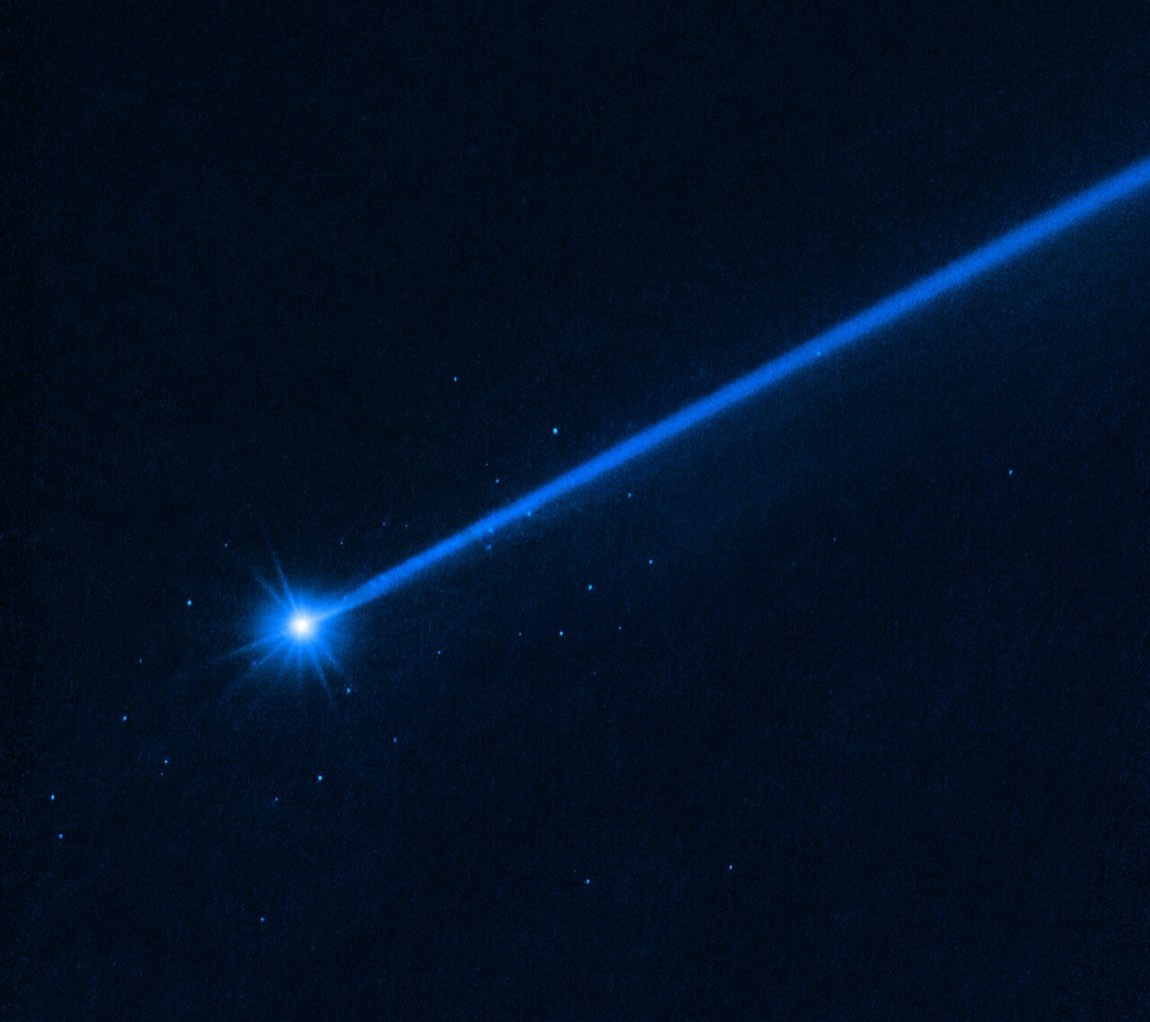
Scientists had long suspected that some active asteroids — bodies that sprout dust tails like comets — are created by impact events, but that hypothesis had never been tested under controlled, observable conditions. The DART impact changed that. By striking Dimorphos under precisely documented circumstances, researchers watched for the first time as an inactive body became an active asteroid in real time. The collision produced a dust plume that temporarily brightened the entire Didymos system and then stretched into a dust tail 10,000 kilometers long — roughly the distance from one side of Earth to the other — that persisted for several months. Observations from multiple spacecraft and telescopes documented the tail's development and evolution. Dimorphos lost approximately 1 million kilograms of material through this process. The event created an unprecedented natural laboratory for studying the physics of active asteroid formation under known initial conditions.
08 A Shape Transformed, a Rotation Destabilized Deeper
Post-impact analysis suggests DART did far more than nudge Dimorphos's orbit. Brightness fluctuations observed within the Didymos system indicate that the impact either significantly deformed Dimorphos into an ellipsoidal shape or sent it into a chaotically tumbling rotation — and possibly both. Its form shifted from a roughly symmetrical oblate spheroid to what researchers describe as a flat-topped oval or triaxial ellipsoid. The predicted impact crater is estimated to be several tens of meters in diameter, and global resurfacing is thought to have accompanied the shape change. If Dimorphos entered a tumbling state, it is no longer simply keeping one face locked toward Didymos; instead it wobbles unpredictably, subjecting its surface to irregular tidal forces from Didymos. Models suggest it will eventually return to a tidally locked, synchronous rotation state — but not for several decades. The Hera mission, which arrived at the Didymos system in 2026, was dispatched in part to measure the actual current state of Dimorphos's rotation and shape.
09 Synchronized Orbit and Lazy Spin
Before DART intervened, Dimorphos moved in a nearly equatorial, nearly circular orbit around Didymos, completing one loop every 11.9 hours. Its rotation period matched its orbital period exactly — a state called synchronous or tidally locked rotation — meaning the same hemisphere always faced Didymos, much as our Moon always shows the same face to Earth. Dimorphos's orbit is retrograde relative to the ecliptic plane, mirroring Didymos's own retrograde rotation. Even in its pre-impact state, the YORP effect was slowly braking Dimorphos's spin, with an estimated rotation-period doubling time of 86,000 years. Without the stabilizing tidal grip of Didymos, that YORP-driven spin-down would eventually become pronounced; with it, tidal forces continuously pulled the moon back into synchronous lock. The post-impact tumbling state disrupted that equilibrium, making Dimorphos a live experiment in tidal re-synchronization.
10 Size, Mass, and an Egyptian Comparison
Dimorphos spans approximately 170 meters in diameter — about the length of one and a half American football fields — against Didymos's 780-meter width. It has no confirmed mass, but assuming a density of 2.17 grams per cubic centimeter (similar to Didymos), estimates place its mass at roughly 5 times 10 to the ninth kilograms, or about 5.5 million tons. That is approximately the same mass as the Great Pyramid of Giza. Despite being small even by asteroid standards, Dimorphos is large enough to earn an official IAU name — it ranks among the smallest formally named celestial bodies, alongside 367943 Duende and 469219 Kamoʻoalewa. Its rubble-pile structure means that mass is spread through a loosely packed interior rather than solid rock, contributing to the low bulk density estimate.
11 Named Boulders and Craters on a Tiny World
Even on a body barely 170 meters across, the IAU has begun assigning formal names to surface features. Five boulders, designated as saxa, and six craters have received official names drawn from traditional drums across multiple world cultures. Each named feature is approximately 10 meters across or smaller — the size of a large room. This naming scheme reflects a broader IAU tradition of organizing the nomenclature of a body around a cultural theme, and the drum theme connects symbolically to the percussion of an impact event. Before DART arrived, the surface was described as covered in boulders with virtually no craters, suggesting a young surface that had not accumulated an impact record — consistent with the formation age of less than 0.3 million years inferred from other data. Post-impact, the landscape will have changed substantially, and Hera's observations were expected to document the new crater and any resurfacing.
12 Hera: The Follow-Up Investigation
DART answered the question of whether a kinetic impactor could change an asteroid's orbit; it left open the question of exactly what happened to Dimorphos afterward. To answer that, the European Space Agency launched three spacecraft as part of its Hera mission in 2024, targeting arrival at the Didymos system in November 2026. Hera's objectives include measuring the mass of Dimorphos directly for the first time, mapping the DART impact crater's size and depth, characterizing the current shape of Dimorphos, and determining whether the moon is tumbling chaotically or has re-established a stable rotation. Those measurements will allow scientists to refine the momentum transfer models that underpin planetary defense strategies. Hera's data, combined with DART's impact observations, will provide a complete before-and-after portrait of the first human-engineered alteration of a celestial body's orbit and form.
 ⤢