 Photograph · Филипп Романов (Filipp Romanov) · CC BY-SA 4.0
Asteroid · Deep guide
65803 Didymos
Also called: 65803 Didymos · (65803) Didymos · 1996 GT
The 'twin' asteroid whose small moon NASA deliberately rammed to test planetary defense.
What is it?
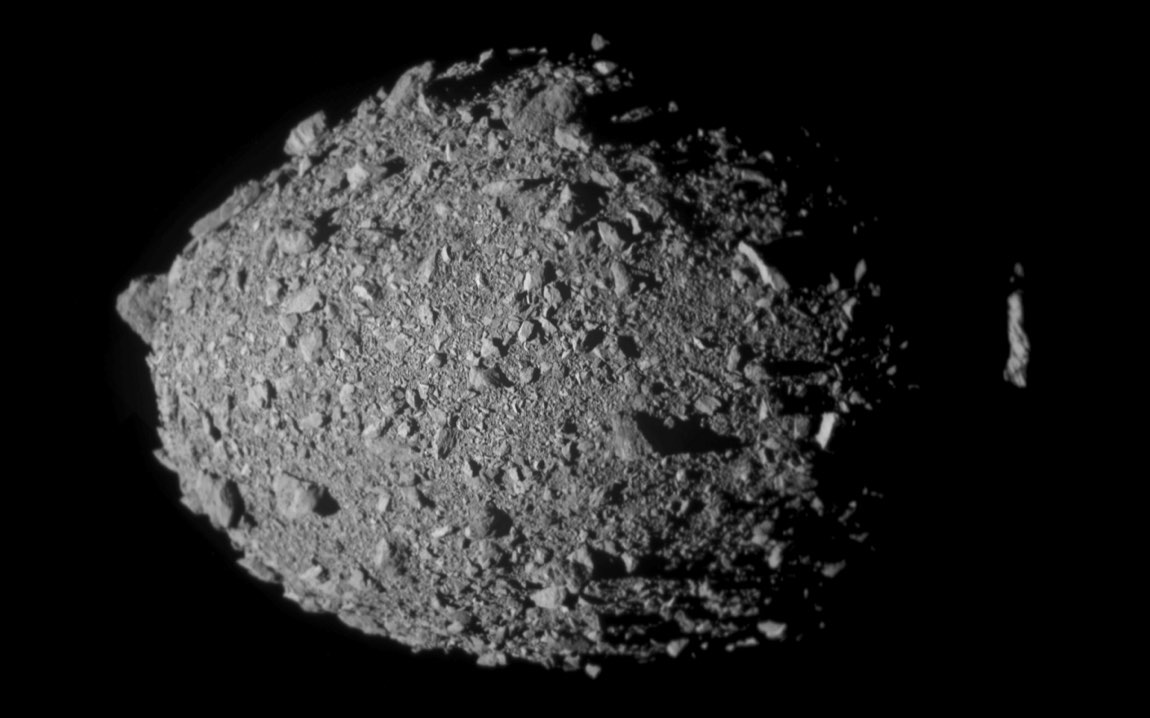
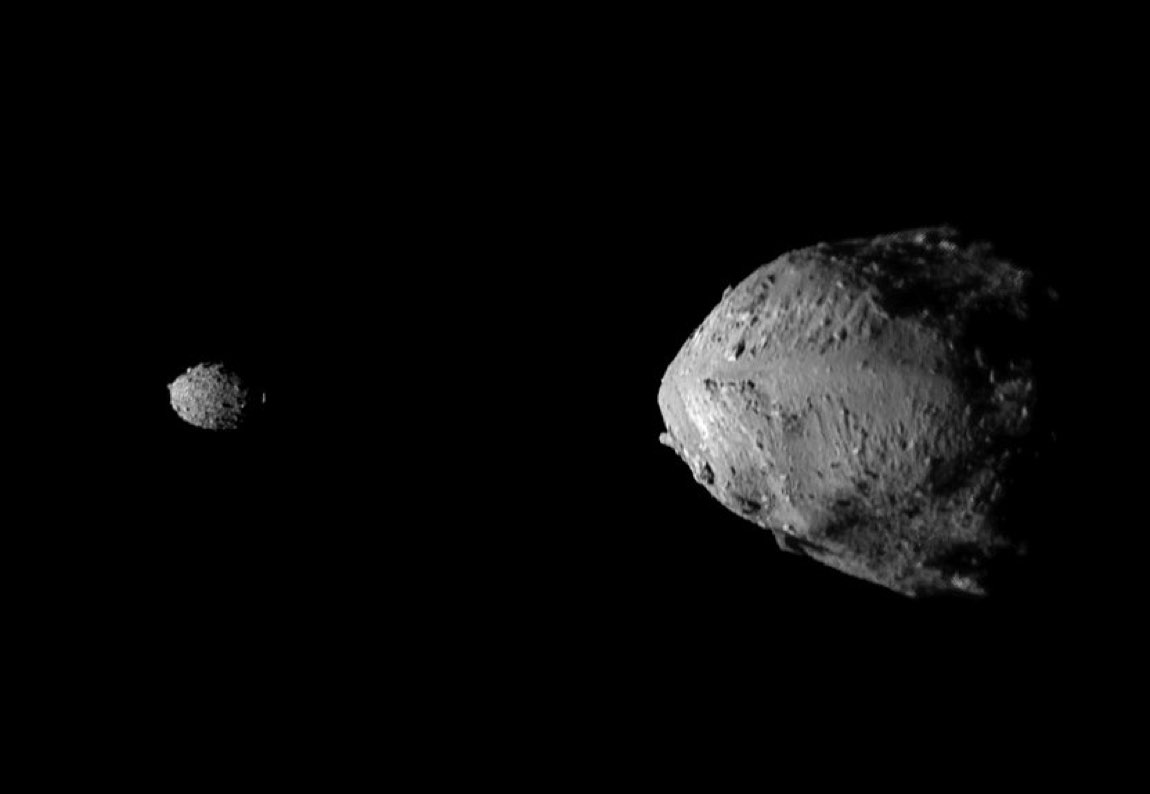
Didymos is a near-Earth asteroid about 765 m across with a 150-metre moon, Dimorphos — its name is Greek for 'twin'. In September 2022 NASA's DART spacecraft crashed into Dimorphos to see whether an impact could change an asteroid's path, and it did. Didymos itself spins quickly, once every 2.26 hours, which may have helped form its moon. The European Space Agency's Hera mission, launched in October 2024, arrived in November 2026 to survey the aftermath.
The deep dive
Researched for the Atlas from Wikipedia — 65803 Didymos (6,235 characters read) · updated Nov 14, 2026
01 A Twin by Discovery, Not by Choice
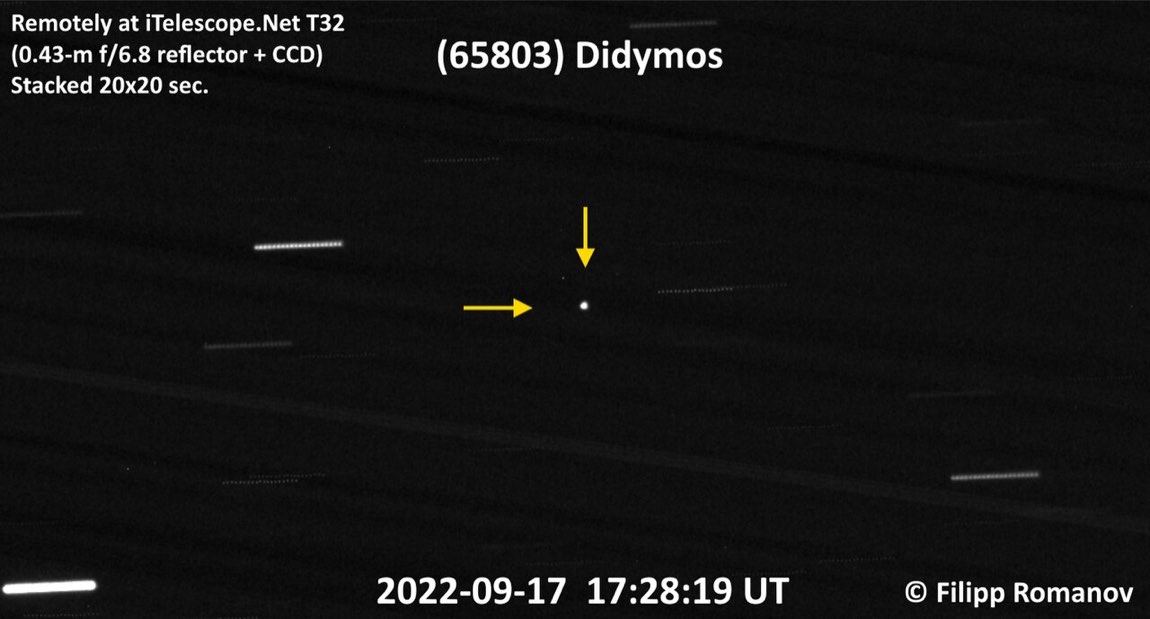
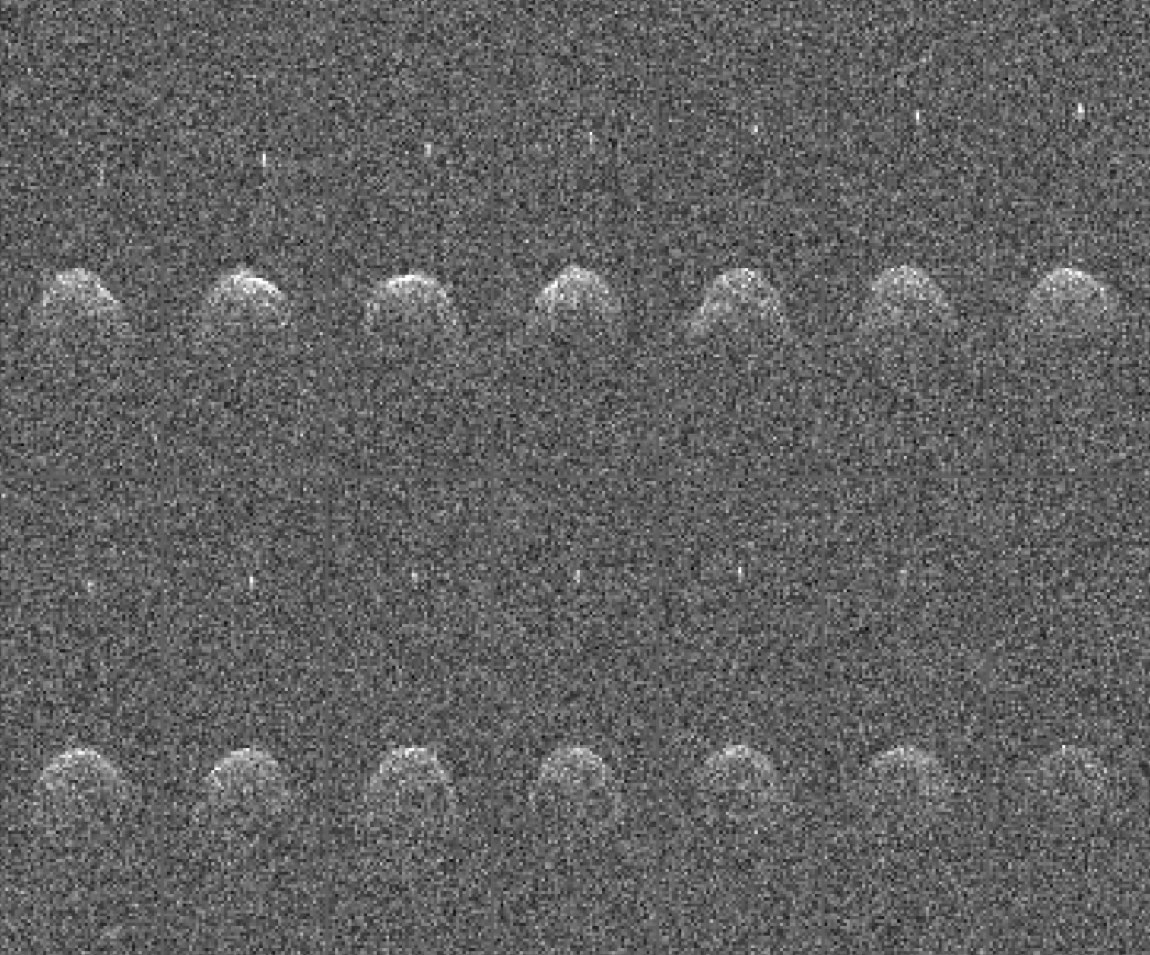
Didymos earned its name from pure happenstance. Joseph L. "Joe" Montani of the University of Arizona Lunar and Planetary Laboratory discovered the asteroid itself on 11 April 1996 using the Spacewatch survey's 0.9-meter telescope at Kitt Peak National Observatory in Arizona. For seven years it was simply a lone near-Earth rock on the catalogues. Then, in 2003, something unexpected emerged: hints of a companion buried in Goldstone delay-Doppler radar echoes. Those suspicions were confirmed through optical lightcurve analysis and Arecibo radar imaging on 23 November 2003. Only after binarity was established did Montani propose the name "Didymos" — Greek for "twin" — to the International Astronomical Union. The naming citation was formally published on 13 July 2004. It is a tidy piece of astronomical history: the object had to reveal its double nature before it could receive the name that describes it.
02 Shape Carved by Speed
Didymos spins fast — one full rotation every 2.26 hours — and its body shows it. Radar observations confirmed that the asteroid is oblate, meaning it bulges at its equator and is flattened at its poles, a direct consequence of centrifugal forces stretching loose surface material outward. Its brightness varies by only 0.08 magnitude as it rotates, which tells astronomers that the shape is nearly spheroidal rather than jagged or elongated. The mean diameter of the primary body is approximately 780 meters — roughly the length of eight American football fields end to end. In the SMASS classification system, Didymos sits at an unusual transitional boundary, initially classified as an Xk-type, blending the X-type and the rare K-type categories. Later visible and near-infrared spectroscopy revealed a silicate composition, also qualifying it as a stony S-type asteroid, so its spectral identity itself carries a kind of duality matching its binary nature.
03 Dimorphos: A Moon With Two Meanings
The moon of Didymos is roughly 160 meters in diameter — about the height of a 50-story building — compared to 780 meters for its parent, giving a diameter ratio of approximately 0.22. Before receiving its official name, it carried the ungainly provisional designation S/2003 (65803) 1 and was informally called "Didymoon" or "Didymos B." Its name, Dimorphos, comes from the Greek for "having two forms," proposed by planetary scientist Kleomenis Tsiganis of the Aristotle University of Thessaloniki in Greece. The name was chosen deliberately to reflect how Dimorphos's orbital parameters would be altered by the DART spacecraft's impact — though the article notes the actual change is only a very slight adjustment to its orbital parameters, not a dramatic transformation. Dimorphos moves in a mostly circular retrograde orbit around Didymos with an orbital period of 11.9 hours. Two boulders on the system have also been formally named — both named after traditional drums.
04 An Orbit That Brushes Earth and Mars Deeper
Didymos follows an elliptical path around the Sun ranging from 1.0 to 2.3 AU, completing one orbit every 770 days — just over two years and one month. Its orbital eccentricity of 0.38 is fairly pronounced, and its inclination is a modest 3 degrees relative to the ecliptic. The minimum possible distance between its orbit and Earth's is currently 0.04 AU, or 6.0 million km. In November 2003 it passed within 7.18 million km of Earth, and it will not come that close again until November 2123, when it is expected at 5.86 million km. Mars, too, falls within its gravitational neighborhood: in July 2144 Didymos will fly by Mars at 4.68 million km. Looking even further ahead, the Earth approach of October 2184 is projected at 8.6 million km, but carries an uncertainty region of roughly ±105 km — a reminder that long-baseline orbital predictions carry real limits, even for well-tracked objects.
 ⤢
05 One Third of Its Life in the Asteroid Belt Deeper
Because Didymos's orbit stretches as far as 2.3 AU from the Sun, it spends approximately one third of each orbit crossing the inner portions of the main asteroid belt — a region far more crowded with potential impactors than the space near Earth. This exposure has statistical consequences. Astronomers calculate that roughly every 73,000 to 84,000 years, a collision occurs involving energy comparable to the DART mission impact. Over Didymos's estimated median lifetime as a near-Earth asteroid — somewhere between 8 and 10 million years — it has probably been struck several tens of times by objects releasing that level of energy. Those accumulated impacts likely shaped its surface, potentially dislodging material, altering its spin, and contributing to the population of boulders observed on and around the system. This geological violence is not exceptional; it is simply what small bodies in the inner solar system endure across deep time.
06 From AIDA to DART: A Mission Reshaped
The idea of visiting Didymos did not spring up overnight. In the early 2010s, ESA and NASA jointly conceived the Asteroid Impact & Deflection Assessment mission, known as AIDA, with Dimorphos as its primary target. ESA eventually withdrew, and that version of the mission dissolved. NASA then independently redefined the concept, retaining the impactor element and calling it the Double Asteroid Redirection Test — DART. The mission was explicitly designed to answer one of planetary defense's most urgent questions: could a spacecraft deliberately collided with an asteroid actually shift its trajectory? Didymos was selected in part because of its accessibility; reaching it requires a delta-v of only 5.1 km/s, less than the 6.0 km/s needed to reach the Moon. DART launched on 24 November 2021 and struck Dimorphos on 26 September 2022, making it the first spacecraft ever to intentionally target an asteroid known to possess a minor-planet moon.
07 The Impact and What It Changed
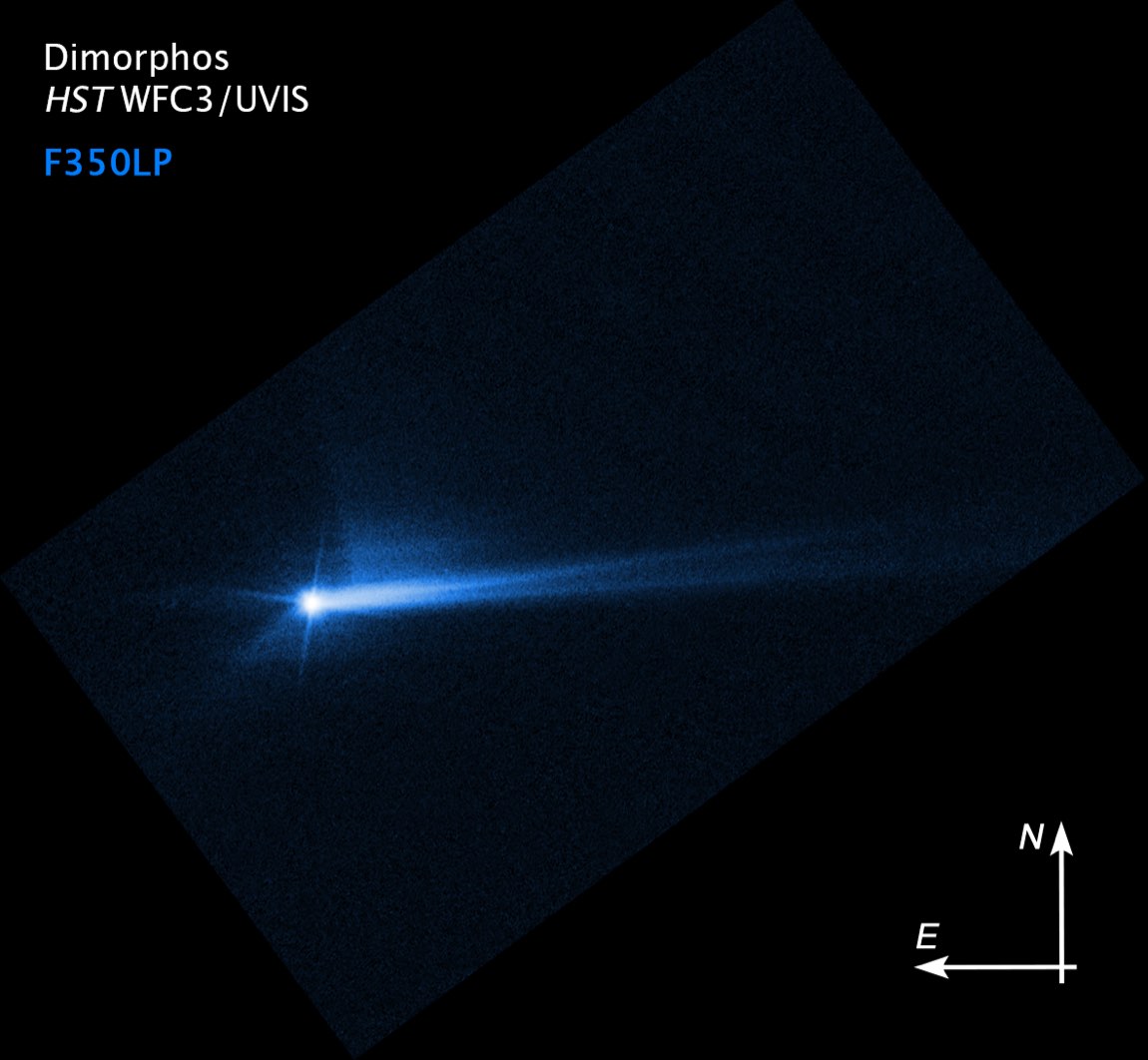
When DART struck Dimorphos, it was not alone in watching. The Italian Space Agency's LICIACube — a six-unit flyby CubeSat — had been released 15 days before impact specifically to observe both the asteroid and the collision event at close range. After two weeks of post-impact analysis, NASA announced a result that exceeded expectations: the collision shortened Dimorphos's orbital period around Didymos by 32 minutes, with an uncertainty of ±2 minutes. The minimum requirement for mission success had been set at 73 seconds of change; the informal benchmark for a strong result was 10 minutes. Achieving 32 minutes of change demonstrated that a kinetic impactor can be a genuinely effective planetary defense tool. The momentum transferred was far greater than the spacecraft's own momentum, suggesting that ejecta blasted from Dimorphos's surface amplified the push — a phenomenon called momentum enhancement.
08 Hera Arrives to Read the Aftermath
The DART impact answered one question but raised many more: exactly how large is the crater? How did the internal structure of Dimorphos respond to the collision? How did the orbit evolve in detail over the months following impact? ESA's Hera mission was designed to pursue those follow-up questions. Approved in November 2019 and launched in October 2024, Hera arrived at Didymos in November 2026. Its objectives include surveying the dynamical effects of the DART impact and directly measuring the characteristics of the crater DART left behind. Together, DART and Hera form a complementary two-act scientific investigation: DART delivered the experiment, and Hera reads the results in detail. The combination is intended to give scientists the high-resolution physical data needed to model future deflection missions with real confidence rather than extrapolation.
 ⤢
09 Why Reaching Didymos Is Easier Than the Moon Deeper
Among near-Earth asteroids of its size, Didymos stands out for how accessible it is to spacecraft. The delta-v required for a rendezvous — the total velocity change a spacecraft must execute — is only 5.1 km/s. For comparison, reaching the Moon from low Earth orbit requires approximately 6.0 km/s. This matters enormously for mission design: lower delta-v means smaller fuel loads, lower launch costs, or more payload capacity for scientific instruments. The accessibility stems from a combination of Didymos's orbital inclination of only 3 degrees from the ecliptic and an orbital period that brings it into relatively favorable launch windows. This made it the ideal proving ground for planetary defense technology — not just scientifically interesting, but practically reachable within the constraints of real spacecraft engineering budgets.
10 The Statistics of Being Hit Repeatedly Deeper
Because Didymos regularly crosses the inner main asteroid belt, it faces a collision probability that is meaningfully higher than asteroids that remain closer to Earth. Astronomers estimate a DART-energy-equivalent impact strikes Didymos every 73,000 to 84,000 years. Over its projected median lifetime as a near-Earth object — between 8 and 10 million years — this implies it has been struck several tens of times with that level of force. These are not catastrophic planet-shattering events; they are more like geological resets, capable of redistributing surface material, triggering landslides of loose regolith, altering spin states, and potentially even reshaping the relationship between Didymos and Dimorphos over time. The binary system we observe today is therefore not a pristine relic of solar system formation — it is the cumulative product of millions of years of impacts, gravitational nudges, and slow orbital evolution.
11 Open Questions After the Collision Deeper
Even with DART's success firmly established, significant scientific questions remain open. The exact size, depth, and morphology of the crater DART excavated in Dimorphos was not measurable by DART itself or by LICIACube at the resolution needed — that work falls to Hera. The internal structure of Dimorphos, whether it is a solid rock or a loosely bound rubble pile, was inferred but not directly confirmed before impact; Hera's measurements of the system's mass, density, and crater geometry will help constrain this. The degree to which ejecta momentum enhancement amplified the deflection beyond DART's own kinetic contribution also requires precise mass estimates that only close-range follow-up can provide. And the long-term dynamical evolution of the binary system following the impact — whether Dimorphos's orbit has remained stable or continues to evolve — remains an active area of investigation.
 ⤢