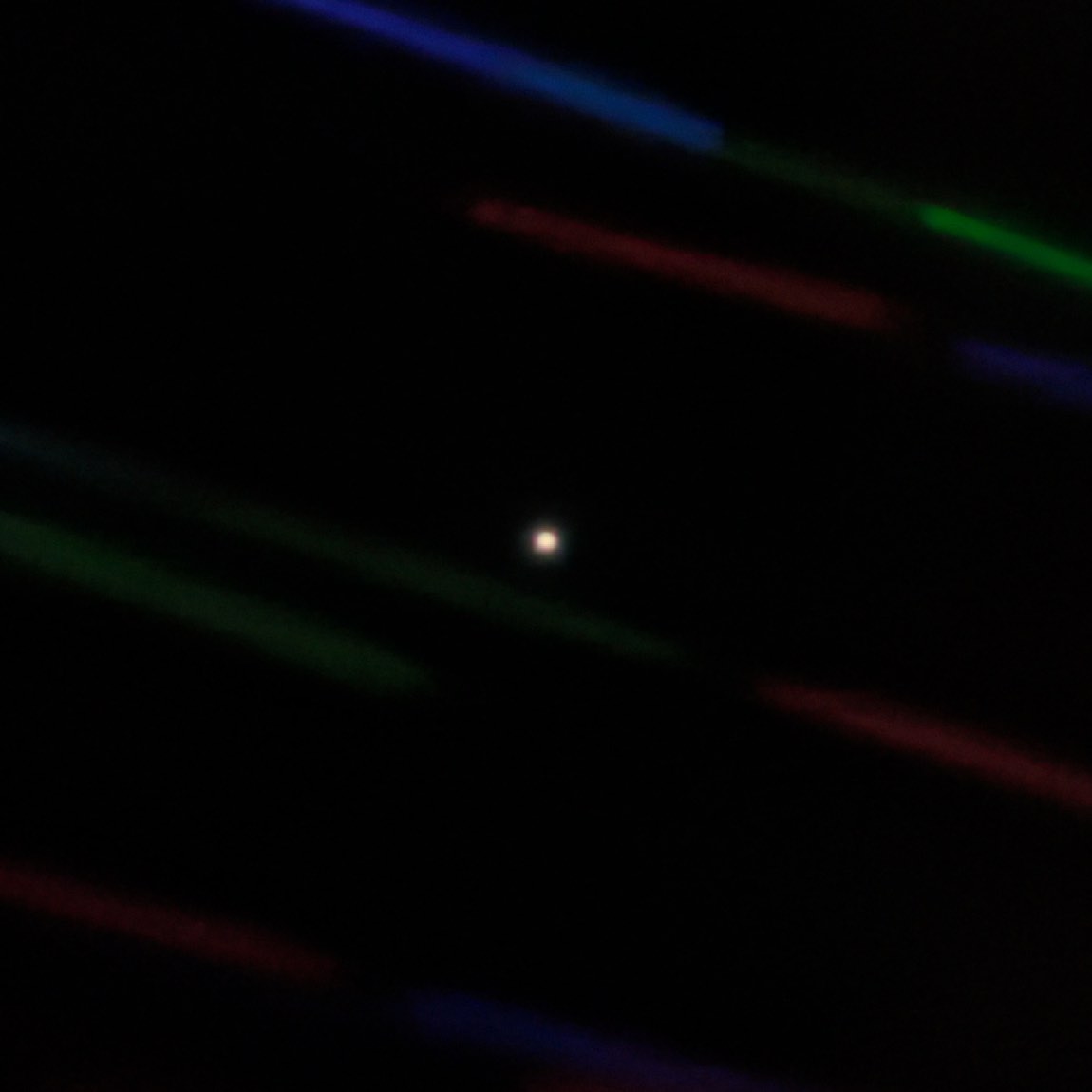
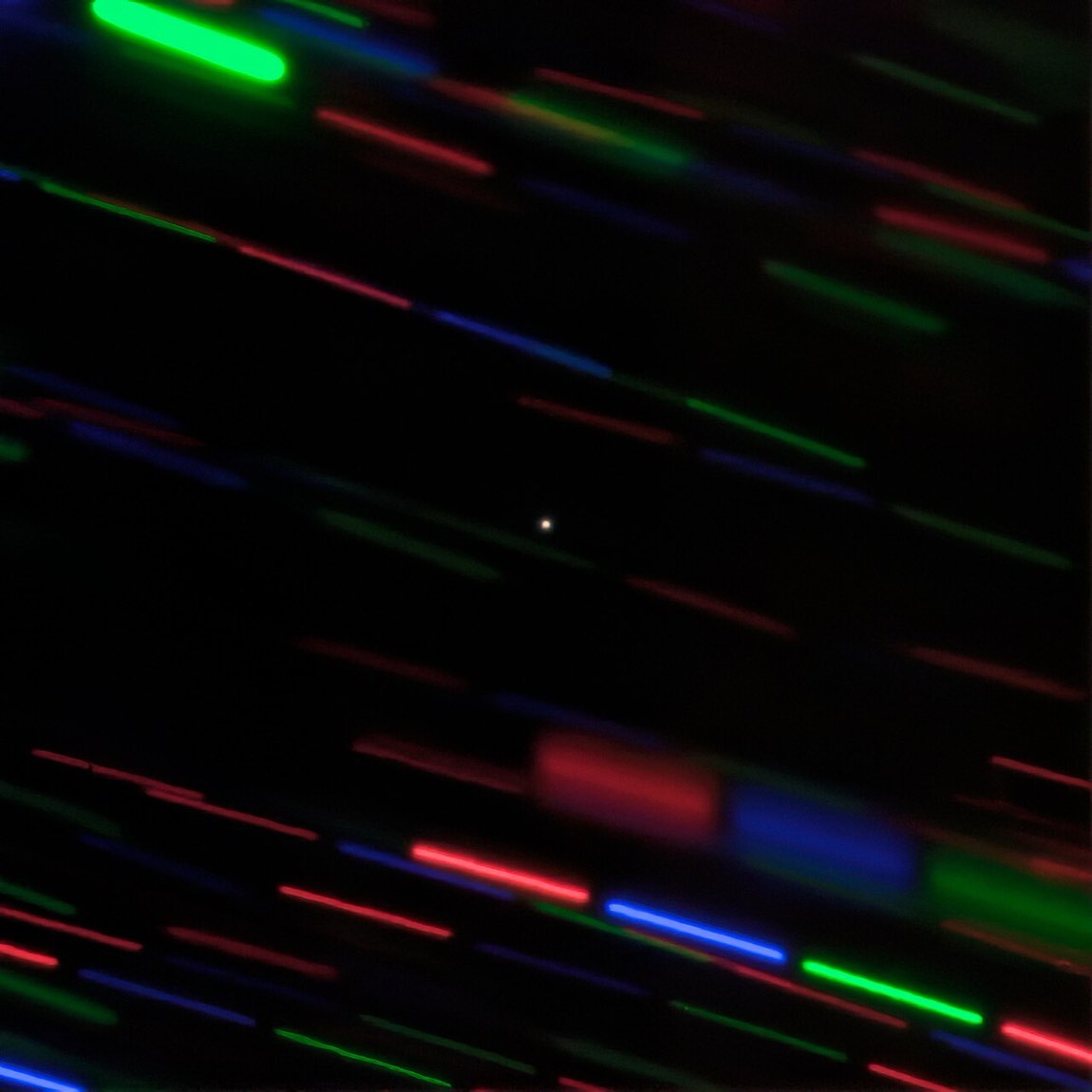
 Photograph · The international Gemini Observatory/NSF’s National Optical-Infrared Astronomy R · CC BY-SA 4.0
Asteroid · Deep guide
2020 CD3
Also called: 2020 CD3 · C26FED2
A car-sized 'minimoon' that circled Earth for a few years before escaping in 2020.
What is it?
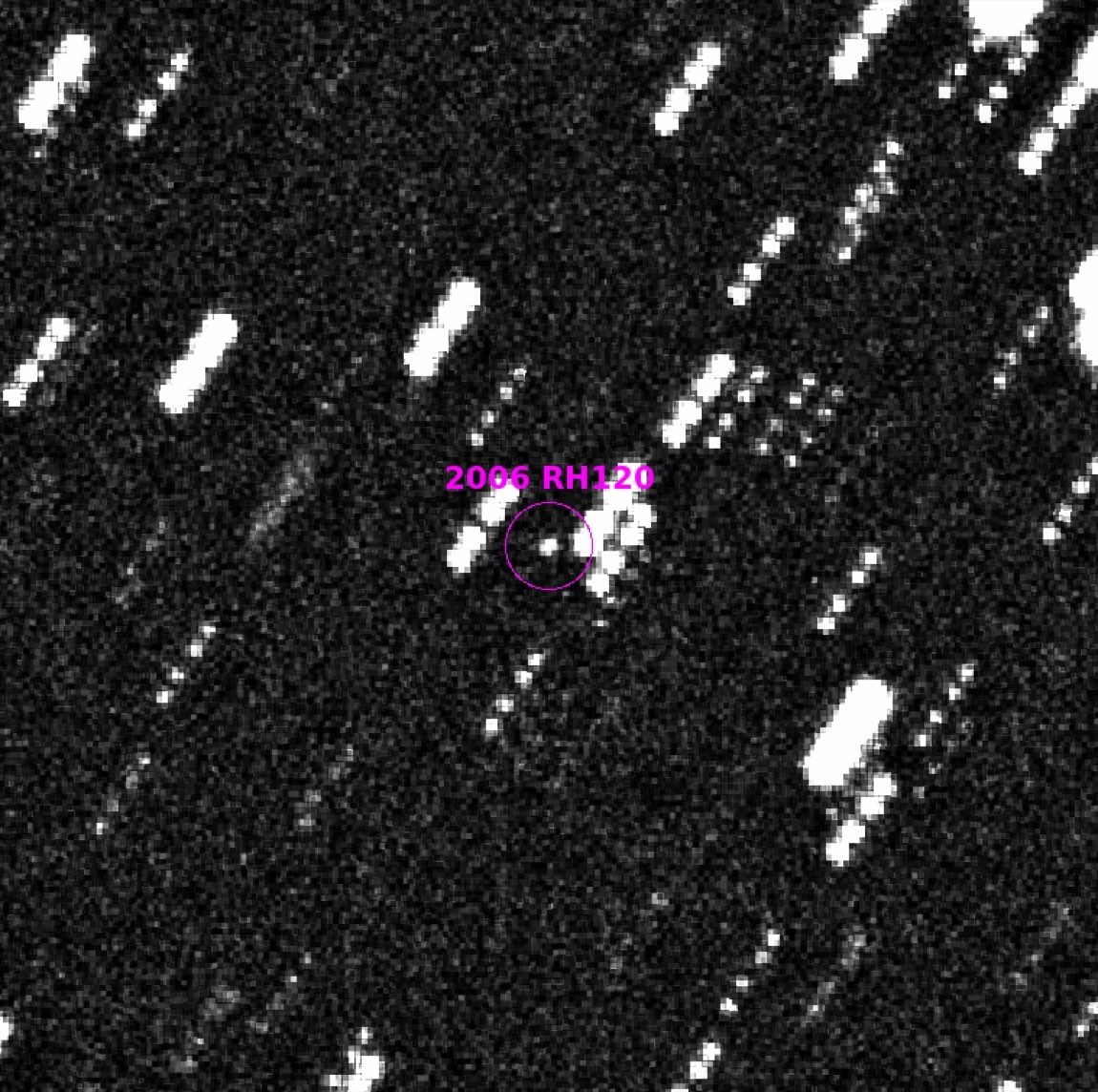
2020 CD3 is a tiny asteroid, only a few metres across, that normally orbits the Sun but was temporarily captured by Earth's gravity around 2016–2017. Astronomers at the Mount Lemmon Survey spotted it in February 2020 while it was looping around our planet. It escaped Earth's grip around May 2020 and returned to an orbit around the Sun. It was only the second temporary natural satellite of Earth found while still in orbit, after 2006 RH120.
The deep dive
Researched for the Atlas from Wikipedia — 2020 CD3 (8,710 characters read) · updated Nov 14, 2026
01 How astronomers spotted a car-sized rock in orbit
On 15 February 2020, Theodore Pruyne and Kacper Wierzchoś were scanning the sky from Mount Lemmon Observatory in Tucson, Arizona, as part of the Catalina Sky Survey — a programme dedicated to hunting near-Earth objects. What caught their attention was a faint, 20th-magnitude smudge moving through the constellation of Virgo. At the moment of detection, the object was only about 0.0019 AU, or roughly 280,000 km, from Earth — almost exactly the distance to the Moon. Its motion on the sky immediately hinted that it might be gravitationally bound to Earth rather than simply passing through. That suspicion triggered a cascade of follow-up observations from multiple observatories over the next six days, allowing the Minor Planet Center to calculate a preliminary orbit. The formal announcement came on 25 February 2020, in a Minor Planet Electronic Circular. Precovery images — older archival photographs in which the object can be found after the fact — push the detection record back to May 2018, giving researchers a slightly longer arc of data to work with.
02 Natural rock or dead spacecraft? Ruling out the artificial
Whenever a small object is found in Earth orbit, scientists must immediately ask an uncomfortable question: is this a natural asteroid, or a piece of human-made hardware — a defunct satellite or spent rocket booster — that has wandered back into a bound orbit? For 2020 CD3, analysts looked for signs of solar radiation pressure perturbing its path in the way it would affect a hollow, low-density artificial object. No such perturbations were detected. Investigators also searched catalogues of known artificial objects and found no match. The evidence therefore pointed strongly toward a dense, rocky body, consistent with a natural asteroid. However, at the time of the formal announcement the team was careful to state that an artificial origin had not been fully ruled out. The object was given the internal designation C26FED2 during this evaluation period before receiving the provisional designation 2020 CD3 from the Minor Planet Center. Its permanent minor planet number has still not been issued, because the observation arc spans only a couple of years and the object has not been seen at enough oppositions to meet the standard threshold.
03 Three years of chaotic loops around Earth Deeper
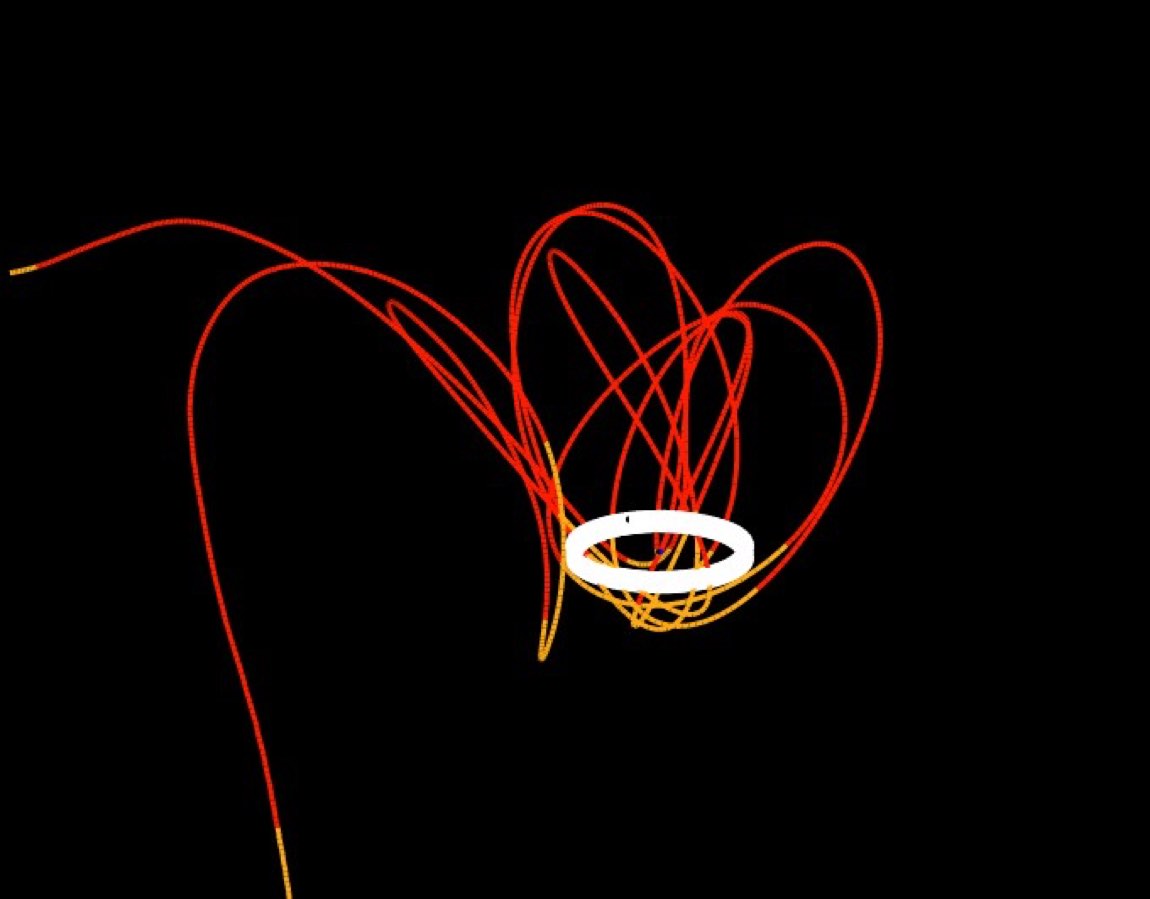
Once captured, 2020 CD3 did not settle into anything resembling a stable, circular orbit. Its geocentric path was highly variable and eccentric, with an orbital period that ranged anywhere from 70 to 90 days — meaning the length of a single loop around Earth was not even constant from one revolution to the next. The chaos has a clear culprit: the Moon. Repeated close encounters with the Moon transferred momentum in unpredictable ways, destabilising the orbit each time. On 15 September 2017, for instance, 2020 CD3 passed just 12,000 km from the Moon's surface. Between September 2017 and February 2020 alone it made 12 close approaches to Earth, never straying more than 0.0112 AU, or about 1.68 million km, from our planet during that span. The closest Earth approach on record occurred on 4 April 2019, when the asteroid came within 13,104 km — closer than many telecommunications satellites. This cumulative gravitational harassment by the Moon eventually built up enough momentum to eject 2020 CD3 from Earth's Hill sphere, and it returned to solar orbit on 7 May 2020.
04 What kind of asteroid is an Arjuna?
2020 CD3 belongs to a category called Arjuna asteroids — a subtype of Apollo asteroids, which are themselves a class of Earth-crossing objects with semi-major axes greater than 1 AU. What sets Arjunas apart is that their orbits are remarkably Earth-like: low eccentricity, low inclination, and orbital periods close to one year. This similarity in orbital geometry means their velocity relative to Earth is unusually small, which is precisely why objects like 2020 CD3 can drift close enough, slowly enough, to be gravitationally captured in the first place. Before its capture, 2020 CD3's heliocentric orbit was probably Earth-crossing, and simulations suggest it may have had either an Aten-type orbit — meaning its semi-major axis was less than 1 AU — or an Apollo-type orbit with a semi-major axis greater than 1 AU, with the Aten scenario considered slightly more likely. The Arjuna classification also makes such objects potential candidates for relatively low-energy spacecraft missions, since reaching them from Earth requires comparatively little propellant.
05 Size, mass, and the limits of what we know
Because 2020 CD3 was observed for only a brief window and is exceptionally small, its physical properties are known with considerable uncertainty. Its absolute magnitude has been measured at around 31.7, which places it firmly in the category of very small objects. Neither its rotation period nor its albedo — the fraction of sunlight it reflects — has been directly measured, simply because there were not enough observations to determine them. Without a known albedo, astronomers must make assumptions. If 2020 CD3 reflects light like a dark, carbonaceous C-type asteroid, its diameter works out to between 1.9 and 3.5 metres — roughly the size of a small car. Studies published in November 2020 narrowed that estimate further, suggesting a diameter of about 1 to 2 metres. The JPL Sentry risk table, adopting a 2-metre diameter, estimates its mass at 4,900 kg, or about 10,800 lb. That is roughly the mass of a large delivery truck, packed into a boulder you could almost reach around with your arms.
06 How common are temporary Earth moons? Deeper
2020 CD3 is only the second object ever discovered while actively in temporary orbit around Earth. The first was 2006 RH120, found in 2006 and also a small asteroid temporarily captured through the same gravitational mechanism. The rarity of confirmed in-situ detections does not mean temporary capture is a rare physical phenomenon — scientists believe it is actually quite common. The bottleneck is detection: these objects are small, faint, and their orbits are chaotic, making them difficult to spot before they escape. Theory suggests that larger objects, those over about 0.6 m in diameter, are less likely to be both captured and detected by modern telescopes. Other objects are suspected to have experienced temporary capture in the past, including the small near-Earth asteroid 1991 VG and the bolide designated DN160822 03, though these cases are not confirmed. The term "minimoon" used widely in media coverage reflects the category, not just the individual object. As survey telescopes grow more sensitive, astronomers expect to find more such transient companions sharing Earth's neighborhood for months or years at a time.
 ⤢
07 The Yarkovsky effect and a foggy past Deeper
Reconstructing exactly where 2020 CD3 was before mid-2017 turns out to be surprisingly difficult, and not just because of limited observations. For an object only a few metres across, the Yarkovsky effect — a subtle force caused by the asymmetric re-emission of absorbed sunlight as infrared radiation — is significant enough to measurably alter its trajectory over multi-year timescales. Combined with the chaotic nature of its geocentric orbit and the numerous close encounters with both Earth and the Moon, predictions of its trajectory before mid-2017 carry substantial uncertainty. The earliest precovery image dates to May 2018, which helps constrain the orbit somewhat, but earlier history remains murky. One illustrative example of this uncertainty: it is simply unknown whether 2020 CD3 came closer to Earth than the Moon on Christmas Day 2015. The Yarkovsky effect is a reminder that for very small bodies, thermal physics and orbital mechanics are inseparably intertwined, and that treating an asteroid purely as a point mass governed by gravity will eventually lead to predictions that diverge from reality.
08 Impact risk: listed first, threat level zero
JPL's Sentry automated impact monitoring system has assessed 2020 CD3 and reached an almost paradoxical conclusion: it is listed as the most likely object to impact Earth by cumulative probability, yet it carries a Torino Scale rating of 0, meaning it poses no meaningful threat. The cumulative impact probability stands at 2.5%, and the Palermo Scale rating is –5.20. The single highest-probability date is 9 September 2082, with an estimated impact probability of 0.85% and a Palermo Scale rating of –5.66. For context, Sentry's nominal orbit places the asteroid at 0.00251 AU — about 375,000 km — from Earth on 8 October 2082, which is 29 days after that virtual impactor date. Even if 2020 CD3 did strike Earth, the outcome would almost certainly be benign: at only a few metres in size, the asteroid would almost certainly fragment and disintegrate as it passed through the atmosphere, long before reaching the surface. The reason Sentry still bothers to track it is that the multi-decade orbital forecast for such a small body is genuinely sensitive to non-gravitational forces, particularly solar heating, so the probability estimates carry inherent uncertainty.
09 Future flybys and why 2044 won't repeat 2016
After escaping Earth's gravitational influence in May 2020, 2020 CD3 rejoined the general population of near-Earth asteroids on a solar orbit. It will swing past Earth again on 20 March 2044, but at a distance of 0.0245 AU — about 3.67 million km — which is comfortably outside Earth's Hill sphere. That approach geometry makes another temporary capture very unlikely. The subsequent notable encounter comes in August 2061, when the nominal distance grows to about 0.034 AU, or 5.1 million km. Beyond 2061, the uncertainty in predicted trajectories expands rapidly. By the time 2082 approaches, close encounters carry a 3-sigma timing uncertainty of plus or minus 7 days, illustrating how the combined effects of chaotic dynamics and non-gravitational forces like solar heating accumulate over decades into genuinely large prediction errors. The 2016–2020 capture was therefore a relatively rare alignment of circumstances: a low enough approach velocity, the right geometry, and enough time for Earth's gravity to reel the small asteroid in.
10 The survey that keeps finding Earth's fleeting visitors
The discovery of 2020 CD3 was not an accident but the product of a systematic, long-running programme. The Mount Lemmon Survey is a component of the broader Catalina Sky Survey, operated out of Tucson, Arizona, and specifically designed to find near-Earth objects. The survey repeatedly photographs large swaths of sky and compares images taken minutes apart, flagging anything that has moved. It was this methodical approach that turned up the faint, 20th-magnitude dot in Virgo that became 2020 CD3. The same infrastructure — the network of observatories contributing follow-up measurements, the Minor Planet Center's Near-Earth Object Confirmation Page, and the pipeline from preliminary detection to formal announcement — also identified 2006 RH120, the only other confirmed temporary Earth satellite found in situ. As detection technology improves and survey cadences increase, programmes like the Catalina Sky Survey are expected to become even more effective at catching small, fast-moving, faint objects before they slip back into interplanetary space undetected.
11 A name still waiting: how designation works
The string of characters in the name 2020 CD3 is not arbitrary — it encodes information about when the asteroid was found. The year 2020 is straightforward. The letters that follow indicate the half-month of discovery within that year and the sequential order of discoveries during that period. Before this provisional designation was assigned on 25 February 2020, the object carried the internal working label C26FED2, used by the discovery team during the confirmation process. For an asteroid to graduate from a provisional designation to a permanent minor planet number, it typically needs to be observed across multiple oppositions — points when Earth and the asteroid are on the same side of the Sun and observing conditions are best — so that a reliable, long-term orbit can be computed. Because 2020 CD3 has an observation arc of only a couple of years and has not been followed through enough oppositions, it has not yet received a permanent number. Its temporarily captured, chaotic orbit also makes it harder to link observations across different apparitions with confidence.
 ⤢