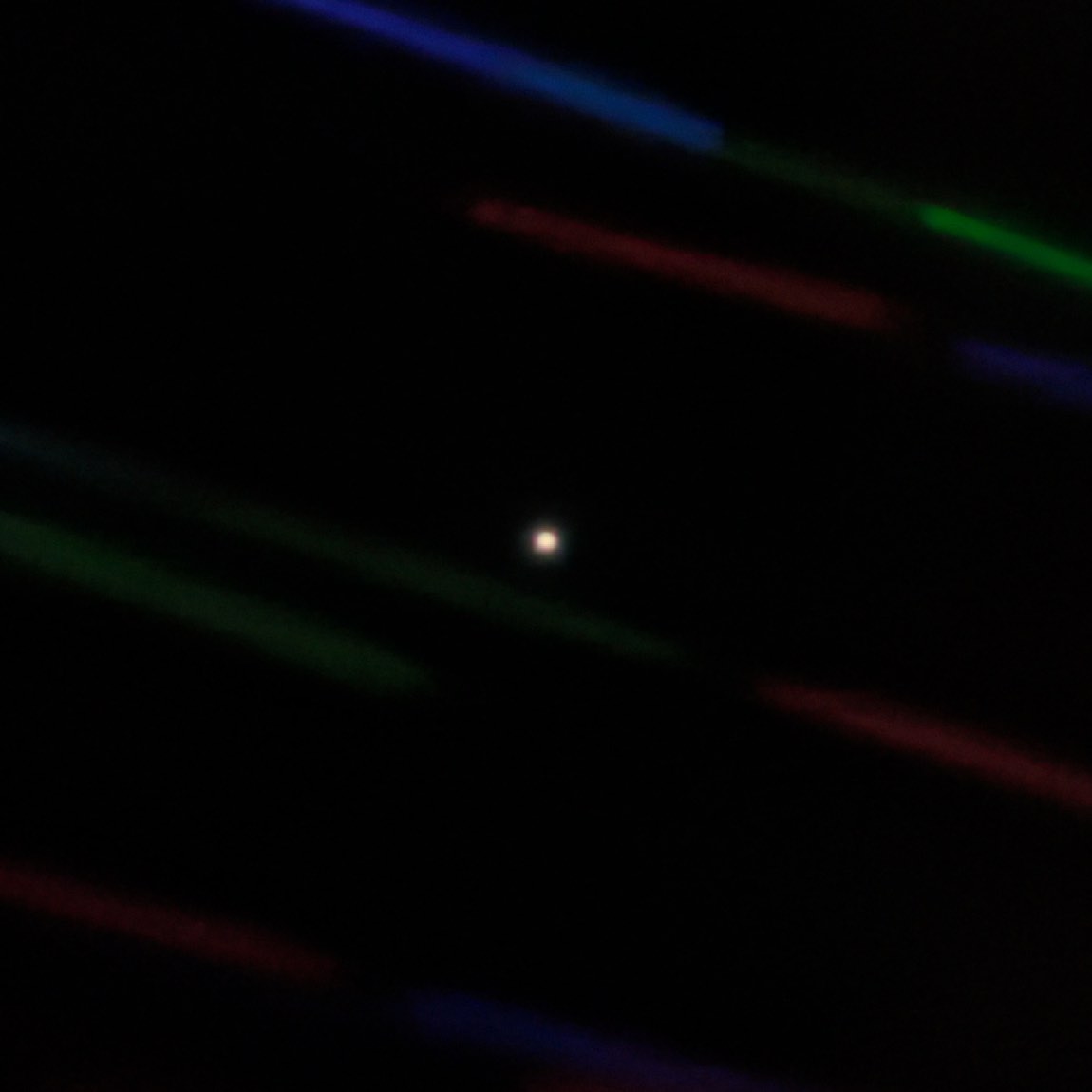
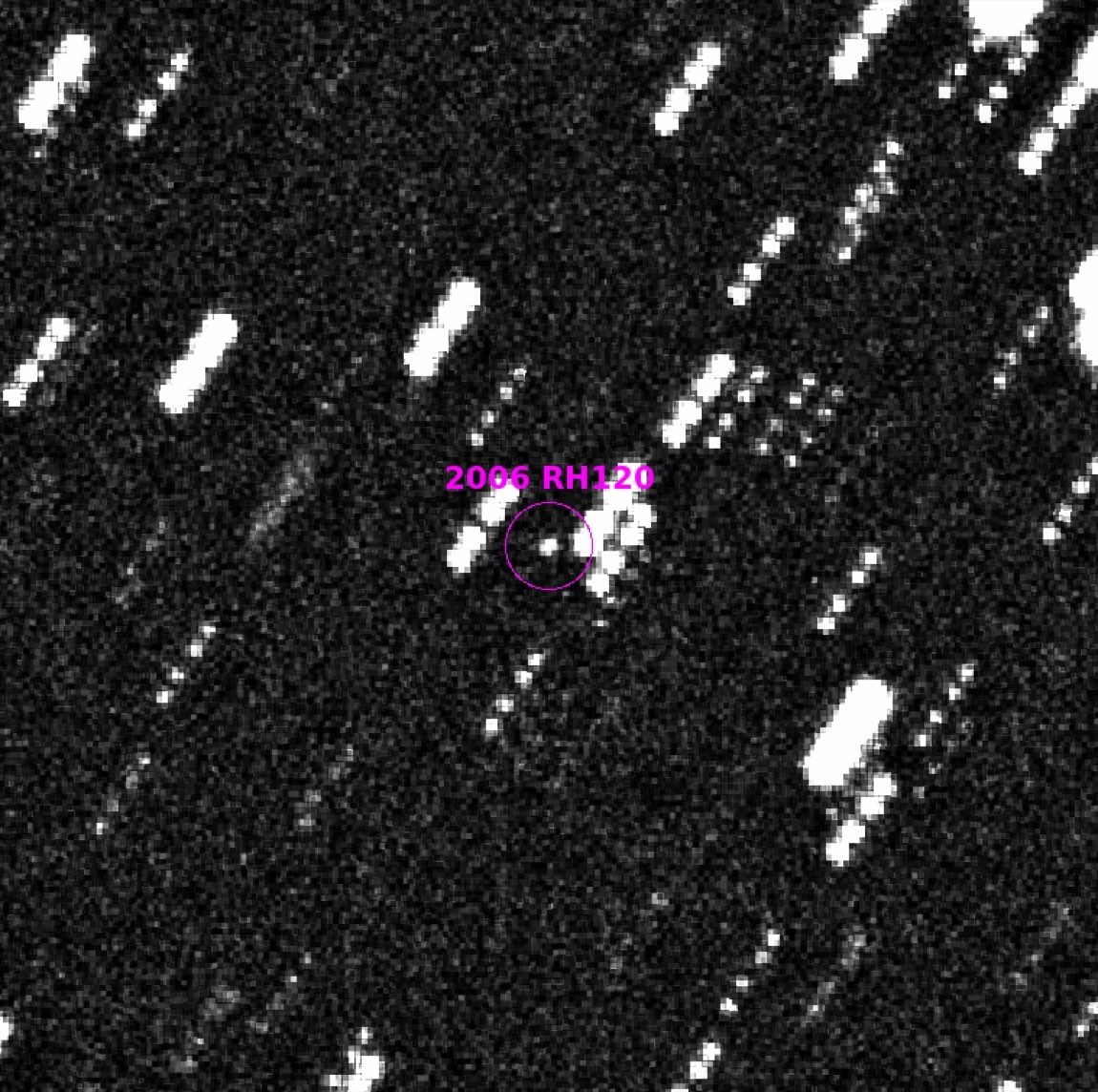
 Photograph · Data by Catalina Sky Survey; image editing by D. Rankin, Catalina Sky Survey · Public domain
Asteroid · Deep guide
2006 RH120
Also called: 2006 RH120 · 6R10DB9
A few-metre boulder that orbited Earth as a temporary second moon from 2006 to 2007.
What is it?
2006 RH120 is a tiny near-Earth asteroid only about 2–3 m across. Its Sun-centred orbit is so similar to Earth's that it comes close roughly every twenty years and can be pulled into a temporary orbit around our planet. From July 2006 to July 2007 it did exactly that, becoming the first natural temporary satellite of Earth discovered while in orbit. Before it received its official designation it was known by the survey code 6R10DB9.
The deep dive
Researched for the Atlas from Wikipedia — 2006 RH120 (5,676 characters read) · updated Nov 14, 2026
01 From rocket booster suspect to real asteroid
When 2006 RH120 was first spotted, astronomers were genuinely unsure whether they had found a natural rock or a piece of old space hardware. Its spectrum matched the white titanium-oxide paint used on Saturn V rockets, which immediately raised eyebrows. The concern was not far-fetched: J002E3 is currently thought to be the third-stage Saturn S-IVB booster from Apollo 12, and it had been found in an almost identical orbit. Another object, 6Q0B44E, discovered just a month before 2006 RH120, was also suspected to be artificial. The formal minor-planet designation was withheld during this period of uncertainty. What ultimately tipped the scales toward a natural origin were radar observations, which strongly suggest the object is a genuine asteroid rather than spent flight hardware. Paul Chodas at JPL's Solar System Dynamics Group added weight to this conclusion by noting that the solar-radiation pressure perturbing the object's motion is consistent with expectations for a rocky body, but not consistent with old flight hardware.
02 A possible dark comet hiding in plain sight Deeper
In 2023, 2006 RH120 was identified as a possible dark comet — a category that sits at an uncomfortable boundary between asteroid and comet. Dark comets are objects that look exactly like asteroids to the eye: no coma, no visible tail, nothing to suggest outgassing. Yet they exhibit comet-like acceleration that cannot be explained by gravity or standard radiation pressure alone. Researchers who study dark comets believe the extra push comes from outgassing on the sunlit side, where volatile ices or other materials quietly vent into space without producing the dramatic visual signature of a traditional comet. For 2006 RH120, this classification matters because it would mean the object carries volatile material, possibly hinting at an origin richer in ices than a plain rocky fragment. The dark comet hypothesis is still being evaluated, and the object's already ambiguous identity — first mistaken for a rocket booster, then confirmed as natural — makes pinning down its precise composition and behavior an active area of investigation.
03 Four laps around Earth in twelve months
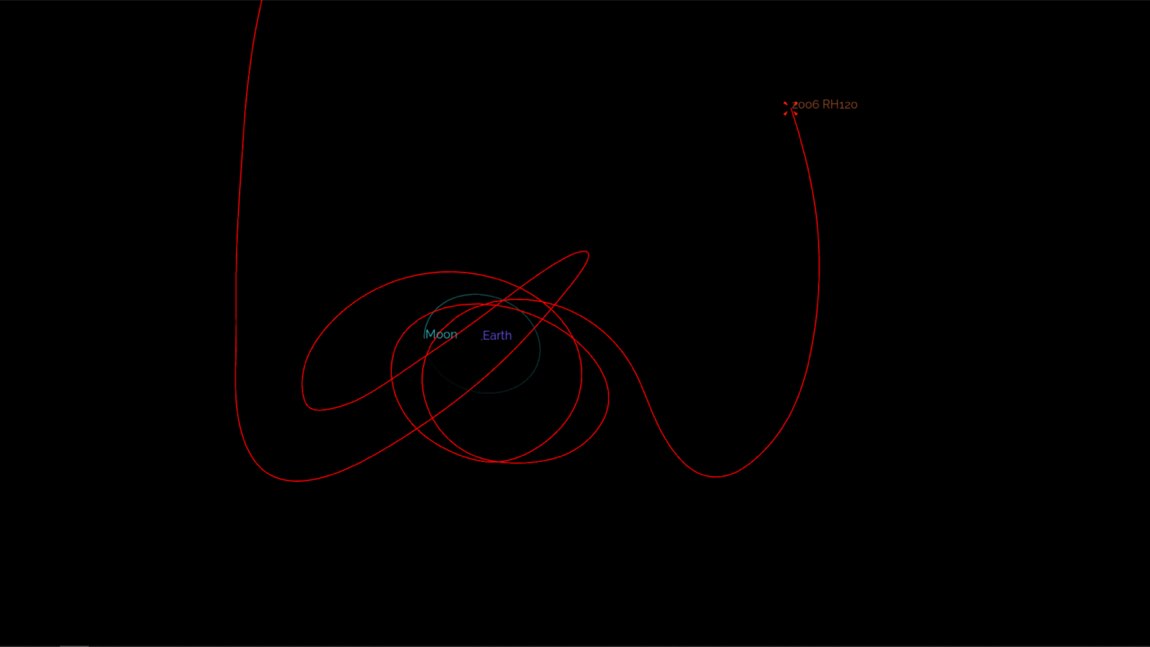
During its 2006–2007 visit, 2006 RH120 did not simply drift past Earth — it was temporarily captured and completed four separate orbits, each roughly three months long. Its closest approach to Earth during each orbit, called perigee, occurred on 11 September 2006, 3 January 2007, 25 March 2007, and 14 June 2007. Throughout the entire twelve-month capture, from July 2006 to July 2007, the asteroid never strayed more than 0.0116 AU, or 1.74 million km, from Earth. For context, the Moon sits about 0.00257 AU away, so the asteroid was always within roughly four and a half lunar distances at its farthest. The final perigee on 14 June 2007 brought it to just 0.72 lunar distances — closer than it had come during any other pass — at which point it dipped inside the Moon's orbit to a distance of 276,840 kilometres. That close approach gave Earth's gravity a last gravitational nudge that sent the asteroid on its way back into solar orbit.
04 How temporary satellite capture actually works Deeper
The mechanism that briefly turned 2006 RH120 into a natural Earth satellite is called temporary satellite capture, or TSC. Earth does not capture passing asteroids simply by pulling them closer; instead, TSC depends on an object entering the Hill sphere, the region of space where Earth's gravity dominates over the Sun's. While inside this zone, a small asteroid can follow a looping, chaotic path that keeps it gravitationally bound to Earth for months or even years before it inevitably escapes. The process is temporary by nature because these orbits are not stable — small perturbations from the Sun, Moon, and radiation pressure continuously nudge the trajectory until the object's geocentric orbital eccentricity exceeds 1 and it escapes back into solar orbit. For 2006 RH120, the geocentric eccentricity did not actually exceed 1 until 17 September 2007, even though it had already left the Hill sphere in June 2007. The asteroid makes close approaches to the Earth–Moon system roughly every twenty years, meaning TSC events like the 2006–2007 episode are expected to recur.
05 The asteroid's shifting orbital identities
2006 RH120 has worn several orbital labels over its observed history, reflecting just how dramatically its path changes depending on where it sits relative to Earth. While it was escaping Earth's Hill sphere in June 2007, it was classified as an Apollo-class asteroid — a category defined by orbits that cross Earth's orbital path. After fully separating, it settled into a different personality: an Amor-class asteroid, whose orbit lies completely outside Earth's orbit rather than crossing it. As of 2022, the object was 1.7 AU from Earth on the far side of the Sun, and it was not expected to come within 1 AU of Earth again until March 2025. This kind of orbital shape-shifting is unusual but not impossible for small bodies whose trajectories are sensitive to gravitational nudges from multiple sources. The same asteroid that briefly became Earth's smallest known natural satellite is, in its quiet periods, simply another small rock on the far side of the inner Solar System.
06 Solar radiation and the Yarkovsky effect Deeper
Because 2006 RH120 is only about 2 to 3 meters across, forces that would be completely negligible for a large asteroid become significant drivers of its motion. Solar radiation pressure — the gentle push of sunlight itself — is perturbing its orbit perceptibly, something analysts have confirmed through careful observation. Beyond that, JPL's orbital solution for the object explicitly accounts for non-gravitational forces, including the Yarkovsky effect, a subtle phenomenon where uneven heating of a rotating body causes it to emit slightly more thermal radiation from one side than the other, producing a tiny but cumulative thrust. Over years and decades, these forces can shift a small asteroid's orbit considerably. The JPL solution was built from a 281-day observation arc combined with radar observations, which is why it can confidently model the multi-decade motion of an object this small. Without accounting for these non-gravitational forces, any prediction about where 2006 RH120 will be in 2028 or 2044 would be significantly less reliable.
07 Its 2028 close passes explained
Around 18 August 2028, give or take three days, 2006 RH120 will pass Earth at a relative velocity of 136 m/s — roughly 300 mph, about the speed of a commercial aircraft. That is extraordinarily slow for an asteroid encounter. It will then swing past again around 9 October 2028, this time moving at 784 m/s, or 1,750 mph, as it accelerates toward a November 2028 perihelion passage, its closest point to the Sun. The contrast between these two passes illustrates how dramatically a small body's speed changes as it falls toward the Sun. For perspective, the article offers a sharp comparison: on 13 April 2029, the much more famous asteroid 99942 Apophis will pass Earth at a relative speed of 7.4 km/s, or about 17,000 mph — roughly ten times faster than 2006 RH120's October 2028 pass and nearly fifty times faster than its August 2028 pass. The slow 2028 approach makes 2006 RH120 exceptionally easy to reach from Earth.
08 A small impact risk in 2044
JPL's calculations give 2006 RH120 a 1-in-120 chance, or about 0.8%, of striking Earth on 8 February 2044. If that impact happened, it would release approximately 1.3 kilotons of energy — a figure the article puts into immediate perspective by noting that the Chelyabinsk meteor of 2013 released about 440 kilotons. In other words, a 2006 RH120 impact would be roughly 340 times less energetic than Chelyabinsk, making it a harmless event by any practical measure. The nominal JPL orbit actually has the asteroid passing 0.009 AU, or 1.3 million km, from Earth on 9 January 2044, thirty days before the date of the calculated virtual impactor. The uncertainty in these predictions is a direct consequence of the object's tiny size: solar radiation pressure and the Yarkovsky effect can shift a 2–3 meter rock's path enough over two decades to matter, which is why the orbit solution accounts explicitly for non-gravitational forces.
09 Radar at Goldstone and what it revealed Deeper
During the final perigee on 14 June 2007, astronomers at JPL Goldstone in California used radar to study 2006 RH120 on three separate dates: 12, 14, and 17 June 2007. These radar astrometry measurements served two important purposes. First, they provided precise positional data that sharpened the orbital solution considerably — radar gives range and range-rate measurements that optical observations alone cannot match. Second, and perhaps more consequentially, the radar observations were instrumental in arguing against the artificial-object hypothesis. The pattern of non-gravitational accelerations seen in the data matched what you would expect from sunlight pushing on a natural rocky body, not from the venting or pressure history of an old rocket stage. At the time of this last perigee pass, the asteroid had an apparent magnitude of 18.5 to 19.0, which is too faint to see with the naked eye but accessible to moderately large telescopes. The Goldstone data, combined with the full observation arc, underpins everything JPL has since calculated about its future trajectory.
10 A lunar ejecta origin hypothesis Deeper
Among the several hypotheses about where 2006 RH120 came from, one of the more intriguing is that it is a piece of the Moon itself — lunar rock ejected by an impact at some point in the past. The Moon has no atmosphere to slow incoming impactors, so collisions can and do blast surface material into space at speeds high enough to escape lunar gravity. Some of that material eventually ends up in Earth-crossing or Earth-approaching orbits. The orbit of 2006 RH120, with its near-Earth-period solar orbit of roughly 12 months and its propensity for temporary capture by Earth's gravity, is broadly consistent with this scenario. The article does not confirm this as the established origin; it is presented as one hypothesis. The dark comet identification in 2023 complicates the picture further, since a volatile-bearing object would be harder to reconcile with a simple lunar rock origin. The question of where exactly this tiny body formed remains genuinely open.
11 Naming delays and designation history
The road to giving 2006 RH120 an official designation was unusually long and tangled. When it was detected on 14 September 2006, it received the internal Catalina Sky Survey identification 6R10DB9. It was added to the Minor Planet Center's Near-Earth Object Confirmation Page the same day but was then removed with the explanation that it 'was not a minor planet' — reflecting the early uncertainty about whether it was a natural body, an artificial satellite, or something else entirely. It was not until 18 February 2008, more than a year after the object had already left Earth orbit, that it was formally assigned the designation 2006 RH120. Even the precovery observations — images from 11 September 2006, taken three days before the official discovery — were not published until 31 July 2026, almost twenty years after the fact. Eric Christensen made the original discovery using the 27-inch, or 690 mm, Schmidt camera of the Catalina Sky Survey in Arizona.
12 Why it matters for human spaceflight
2006 RH120 is listed as part of the Near-Earth Object Human Space Flight Accessible Targets Study, known as NHATS. This program identifies asteroids that spacecraft — and potentially humans — could realistically travel to with reasonable amounts of fuel and time. The 2028 close approach, with its remarkably slow relative velocity of just 136 m/s during the August pass, is precisely the kind of geometry that makes an asteroid accessible. For comparison, reaching the Moon from Earth requires changing velocity by thousands of meters per second. An asteroid drifting past at 136 m/s relative to Earth is, in orbital mechanics terms, almost within reach. 2006 RH120's small size means there would be nothing to land on in any conventional sense, but its accessibility makes it a candidate for a close flyby, sample collection, or technology demonstration mission. Its recurring approaches every twenty years also mean that a missed window is not necessarily a permanent loss.
 ⤢