 Photograph · NAIC-Arecibo/NSF · Public domain
Asteroid · Deep guide
2015 TB145
Also called: 2015 TB145 · Halloween asteroid · Great Pumpkin
The 'Halloween asteroid' — possibly a dead comet — that swept past Earth on 31 October 2015.
What is it?
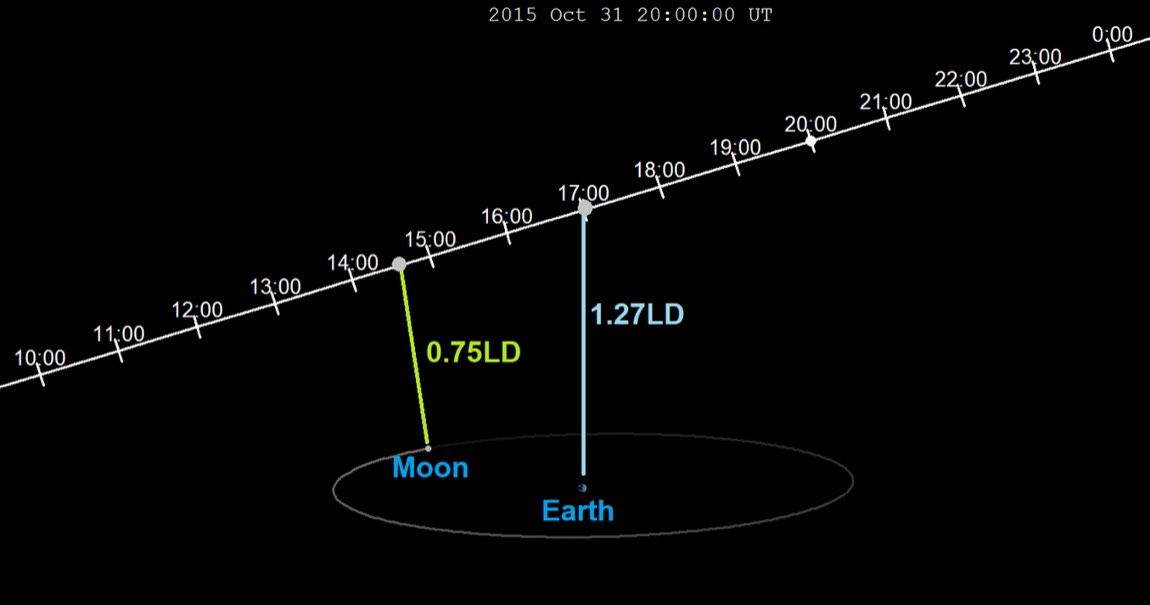
2015 TB145 is a near-Earth asteroid about 650 m across, discovered only three weeks before it passed Earth on Halloween 2015 at about 1.3 times the Moon's distance. Its timing earned it nicknames such as the 'Great Pumpkin'. Its steeply tilted, stretched orbit and dark surface suggest it may be an extinct comet that has lost its ice.
The deep dive
Researched for the Atlas from Wikipedia — 2015 TB145 (4,076 characters read) · updated Nov 14, 2026
01 Why the sky hid it for so long
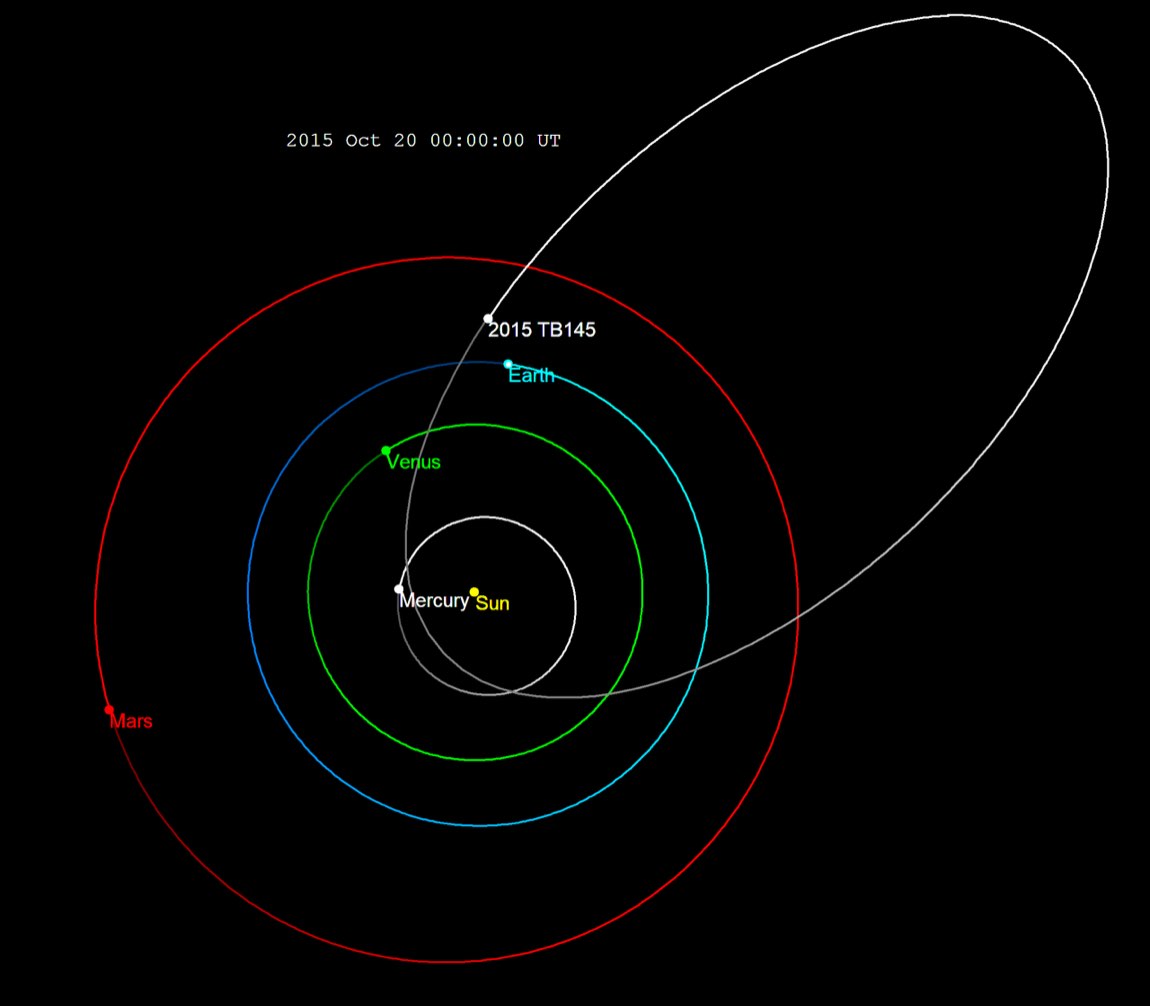
Despite being roughly 650 meters across — large enough to level a small country — 2015 TB145 went undetected until just three weeks before its closest approach to Earth. The reason lies in its unusual orbit. The asteroid spends most of its time beyond the orbit of Mars, far from the inner solar system where survey telescopes concentrate their gaze. Its large orbital inclination also keeps it well below the flat plane of the ecliptic, the band of sky where planets and most asteroids travel. Surveys naturally spend less time scanning those high-inclination regions. Only on 10 October 2015, when Pan-STARRS caught it at an apparent magnitude of 20 using its 1.8-meter Ritchey–Chrétien telescope, did astronomers finally register its existence. That left only three weeks of warning before its Halloween flyby — a sobering reminder of how orbital geometry can conceal even sizable objects until they are almost on our doorstep.
02 A skull carved in radar light
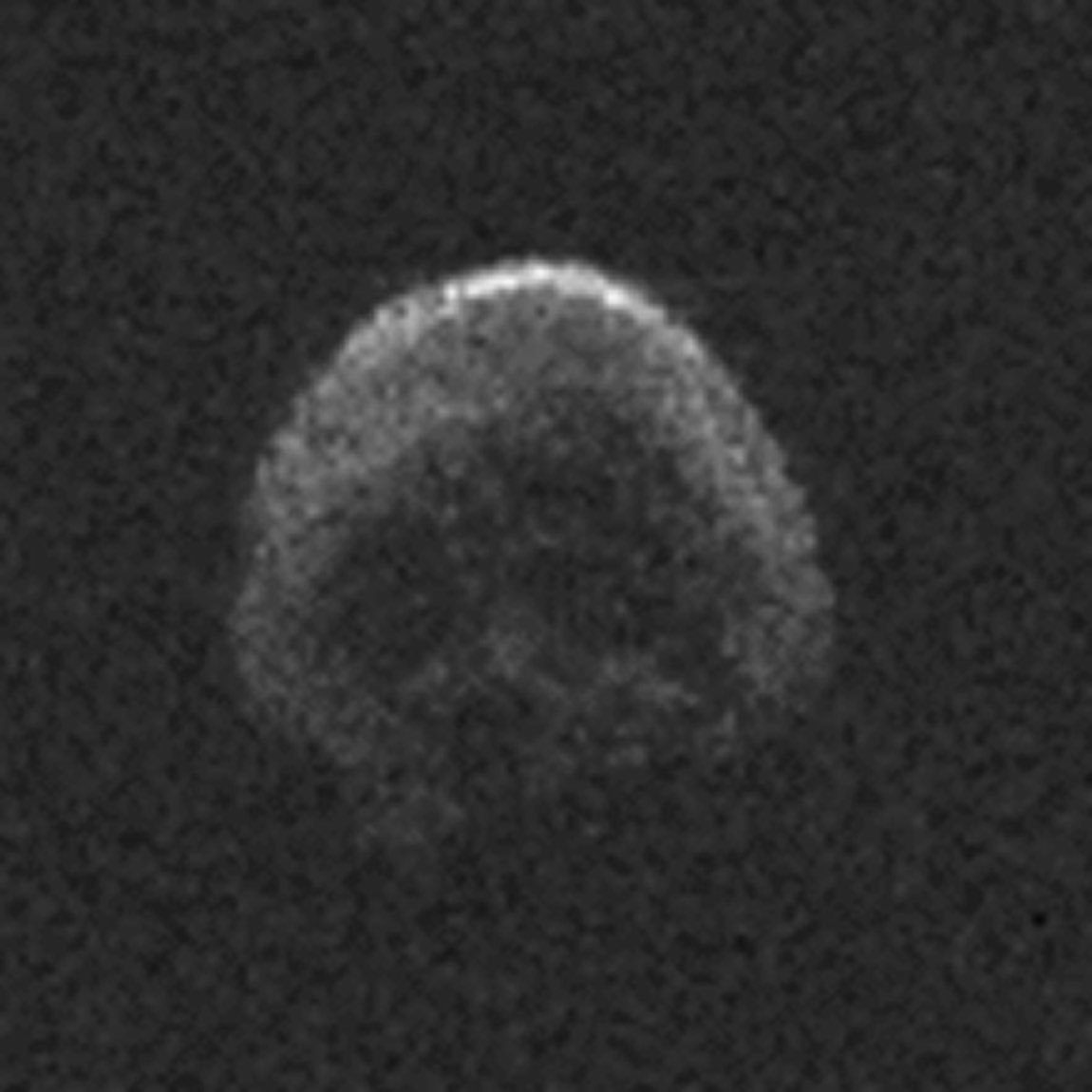
The 2015 flyby handed planetary scientists a rare gift: an unusually crisp radar portrait of a fast-moving near-Earth asteroid. Three major facilities were trained on 2015 TB145 during closest approach — the Goldstone Solar System Radar, the Green Bank Telescope, and the Arecibo Observatory. Together they captured images at resolutions as fine as 2 meters per pixel, meaning features roughly the size of a large SUV could be distinguished. Bistatic radar observations, in which Goldstone transmitted and Green Bank received, achieved 4 meters per pixel, while Arecibo images reached 7.5 meters per pixel. What emerged from that data was a striking skull-like surface morphology, complete with deep socket-like depressions and an overall rounded cranial shape. The imagery arrived just in time for Halloween, and the resemblance to a human skull was vivid enough to spawn one of the asteroid's most enduring nicknames: the Skull Asteroid.
03 Four nicknames and one animated beagle
Few asteroids have accumulated as many colorful nicknames as 2015 TB145. The press christened it the "Great Pumpkin" in a direct nod to the classic animated Halloween television special It's the Great Pumpkin, Charlie Brown, leaning into the coincidence that closest approach fell on 31 October. It also acquired the simpler alias "Spooky," the more descriptive "Halloween Asteroid," and finally the "Skull Asteroid" once radar imagery from Arecibo revealed its eerily skull-like surface. None of these are official designations — the asteroid's formal name remains the alphanumeric 2015 TB145, following standard minor-planet naming conventions — but the informal monikers reflect how public interest in planetary science can spike when astronomical events overlap with cultural moments. The skull appearance in particular generated widespread media coverage and helped communicate the capabilities of radar astronomy to a broad audience who might otherwise never encounter the subject.
04 How bright did it actually get?
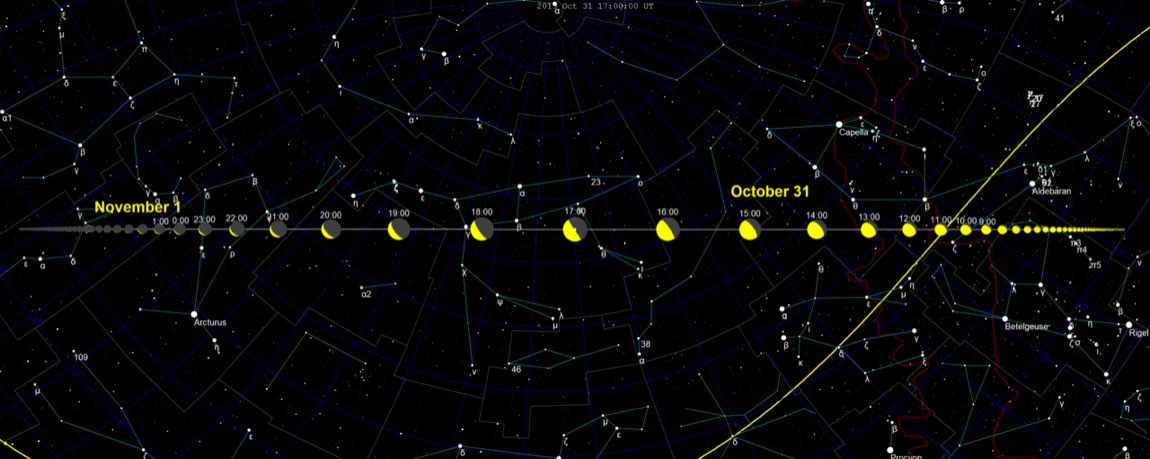
At closest approach on 31 October 2015, 2015 TB145 brightened to roughly apparent magnitude 10. That sounds impressive, but magnitude 10 is still about four times too faint for the unaided human eye to detect under ideal dark-sky conditions — the naked-eye limit sits near magnitude 6 to 6.5. Even for amateur astronomers with small telescopes, the asteroid was a challenging target. Two factors conspired against easy observation. First, an 80% waning gibbous Moon flooded the sky with glare during the critical window. Second, the asteroid was moving extraordinarily fast across the sky: at 11:00 UT it lay in the constellation Taurus, about 9 degrees from the Moon, sweeping along at 3.4 degrees per hour. By closest approach at 17:00 UT it had raced into Ursa Major, now 56 degrees from the Moon and accelerating to 14.7 degrees per hour. After that it faded rapidly and plunged too close to the Sun in the sky for further observation.
 ⤢
05 An ancient extinct comet in disguise? Deeper
The most scientifically provocative question surrounding 2015 TB145 is whether it is not an asteroid at all in the conventional sense, but rather an extinct comet — a body that once displayed a coma and tail but has exhausted its surface volatiles through repeated close passes around the Sun. Two lines of evidence support this hypothesis. First, the object has a high orbital inclination and high eccentricity, orbital characteristics far more typical of comets than of main-belt asteroids. Second, its albedo — the fraction of sunlight it reflects — is a mere 0.06. That is exceptionally dark, only slightly brighter than a typical active comet, which reflects between 0.03 and 0.05 of incoming sunlight. Dark surfaces on comets are attributed to the lag deposit of organic-rich material left behind as ice sublimates away over many solar orbits. Taken together, the orbital dynamics and surface darkness paint a picture consistent with a comet core that has simply run out of ice to drive activity.
06 Looking for a meteor shower that wasn't there Deeper
If 2015 TB145 really is an extinct comet, it may once have shed meteoroids along its orbital path — debris that could potentially produce a meteor shower when Earth crosses that stream. Orbital calculations by researchers Petrus Jenniskens and Jérémie Vaubaillon addressed this possibility directly. Their analysis concluded that no associated meteors were expected in 2015: any meteoroids that might exist were predicted to pass more than 0.0007 AU — about 100,000 kilometers — from Earth's orbit, far too distant for a shower. If such meteoroids ever did intersect Earth's path, their computed radiant point would appear near Northern Eridanus. To test the hypothesis observationally, the Cameras for Allsky Meteor Surveillance network, known as CAMS, monitored that region of sky during 2013 and 2014 and detected no activity whatsoever. The null result does not rule out a cometary origin, but it does confirm that any debris stream, if it exists, poses no current threat and produces no detectable shower.
07 Rediscovery after three years of silence
After its spectacular Halloween 2015 flyby, 2015 TB145 swung away from Earth and spent nearly three years beyond the range of practical observation. The recovery came on 7 October 2018, when astronomer L. Buzzi re-acquired the faint object at Schiaparelli Observatory, catalogued under observatory code 204. At that point it registered an apparent magnitude of 21, meaning it was glowing at roughly one-sixteenth the brightness of the faintest stars visible to the naked eye. The subsequent 2018 flyby, occurring on 11 November, was far less dramatic than the 2015 encounter: the asteroid passed approximately 0.267 AU from Earth — about 39,900,000 kilometers, or roughly a quarter of the average distance between Earth and the Sun. At that range, detailed radar characterization was not feasible, and the event attracted comparatively little public attention, illustrating how dramatically flyby distance shapes both scientific opportunity and public interest.
08 Its place in the near-Earth asteroid census Deeper
The 2015 flyby of 2015 TB145 offered a useful benchmark for assessing how often Earth receives close visits from large asteroids. At the time, the last close approach by an object with an absolute magnitude brighter than 20 had been asteroid 612901, designated 2004 XP14, which passed at 1.1 lunar distances on 3 July 2006 — nearly a decade earlier. Looking ahead, the next object of comparable size known to pass this close is asteroid 137108, designated 1999 AN10, which is predicted to pass about 1 lunar distance from Earth on 7 August 2027. The rarity of such events underscores a broader census challenge: astronomers estimate that roughly 2,400 near-Earth asteroids between 300 and 500 meters in diameter exist, yet only about 1,100 of them had been discovered as of that time. That means nearly half the population of potentially hazardous, city-to-region-killer-class asteroids remained uncharted — hidden, like 2015 TB145 itself, until they happen into a telescope's field of view.
 ⤢
09 The long gap between its Earth visits
The orbital history of 2015 TB145 reveals just how infrequently it ventures close to Earth. Before the 2015 encounter, the last time the asteroid passed within 0.064 AU — approximately 9,600,000 kilometers — of our planet was 29 October 1923, nearly 92 years earlier. The next time it will come that close again is not until 1 November 2088, another 73 years after the 2015 flyby. Its orbital path keeps it far from Earth for most of its journey. The 2015 close approach at 0.00325 AU — just 486,000 kilometers, barely more than the distance to the Moon — was therefore an exceptionally rare alignment of timing and geometry. Knowing that such encounters happen only once per human lifetime for a given asteroid reinforces why the brief windows they open for high-resolution radar imaging are so scientifically precious: researchers get one good look, and then the object retreats for generations.
10 How Pan-STARRS cornered a dark, fast mover Deeper
The discovery instrument for 2015 TB145 was the Pan-STARRS telescope, operating from Haleakalā Observatory in Hawaii. On 10 October 2015, it detected the asteroid at an apparent magnitude of 20 using its 1.8-meter Ritchey–Chrétien telescope, a design known for wide-field imaging with low optical aberrations — a good match for the sky-scanning demands of asteroid surveys. At magnitude 20, the object was about 100 times too faint for the naked eye. The detection came just 21 days before closest approach, an uncomfortably short warning window for an object of this size. The late discovery is directly attributable to the asteroid's orbital habits: its high inclination keeps it off the ecliptic plane where surveys are densest, and its time beyond Mars keeps it faint and distant most of the time. The episode became a case study in how sky-survey geometry and asteroid orbital properties together determine whether a potentially hazardous object is spotted well in advance or only at the last moment.
11 Open questions the skull left behind Deeper
Even after extensive radar observation, 2015 TB145 leaves significant scientific questions unanswered. Its cometary or asteroidal origin remains unconfirmed: the low albedo of 0.06 and eccentric, high-inclination orbit are suggestive but not conclusive. Without spectroscopic measurements confirming or ruling out cometary surface chemistry, the debate stays open. The skull-like surface morphology seen in radar images invites questions about its formation: are those deep depressions impact craters, sublimation pits left by ancient outgassing, or simply topographic coincidence? The asteroid's interior structure — whether it is a solid rock, a rubble pile loosely held together by gravity, or something in between — has not been determined. Its rotation period was measured, but the precise shape model that would fully constrain its dimensions and pole orientation requires additional observations. The next comparable close approach does not come until 2088, so astronomers must work with the data already in hand, running simulations and comparisons against other well-characterized near-Earth objects to fill the gaps.
 ⤢