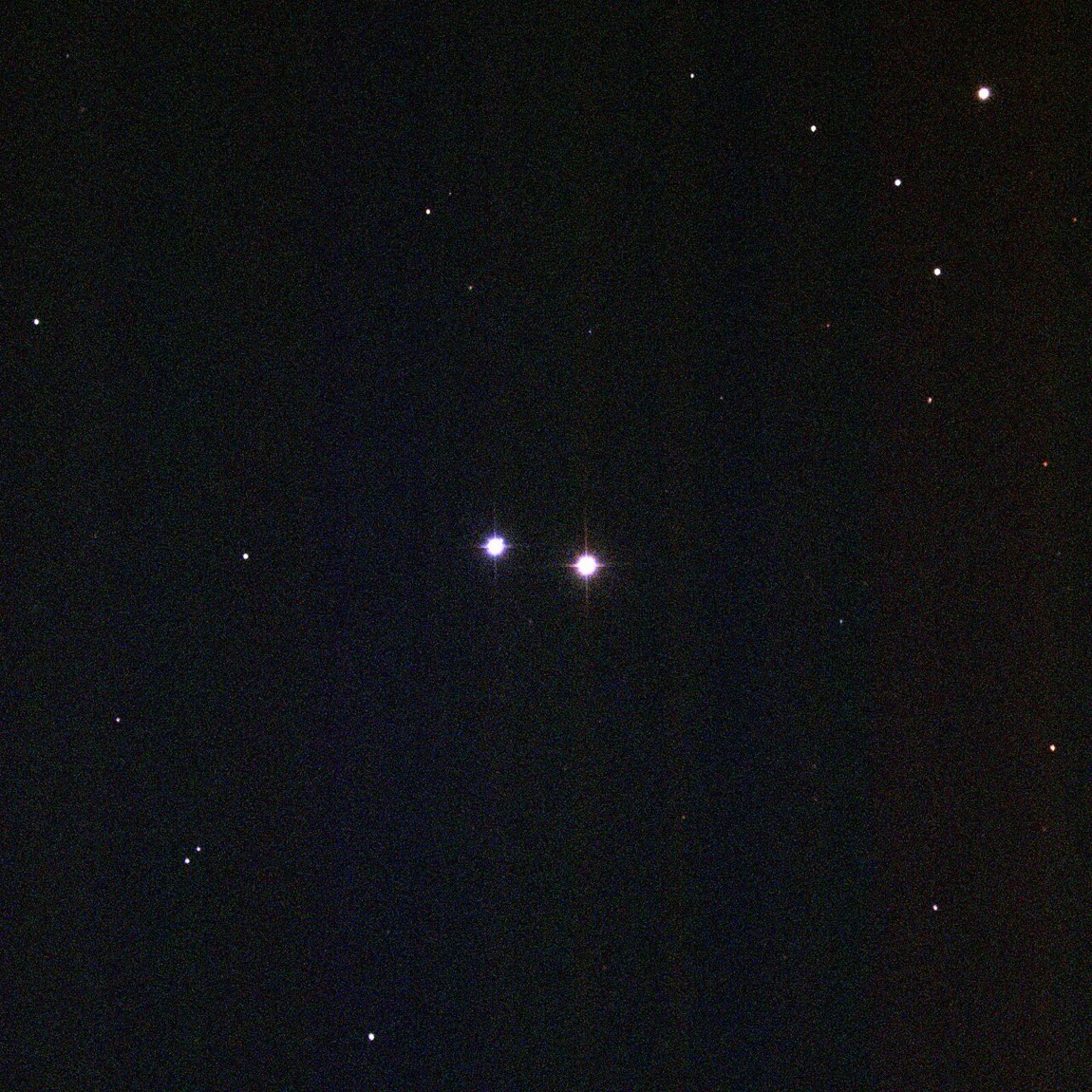
 Photograph · NOIRLab/ NSF /AURA · CC BY 4.0
Star · Deep guide
Messier 40 (Winnecke 4)
Also called: M40 · Winnecke 4 · WNC 4
Messier's famous mistake: two unrelated stars that only look like a pair.
What is it?
Messier 40 is not a nebula or cluster but two stars in Ursa Major that happen to line up. In 1764 Charles Messier searched for a nebula reported by Johannes Hevelius, found only this pair, and catalogued it anyway. Friedrich Winnecke recorded it again in 1863 as Winnecke 4. Gaia measurements show the stars are not companions: one is about 1,013 light-years away and the other about 470. The astronomer Robert Burnham called it one of the few real mistakes in the Messier catalogue.
The deep dive
Researched for the Atlas from Wikipedia — Winnecke 4 (2,027 characters read) · updated Nov 15, 2026
01 A Cataloguing Mistake 260 Years in the Making
Messier 40 holds the unusual distinction of being widely regarded as one of the most embarrassing entries in Charles Messier's otherwise celebrated catalog. When Messier swept this region of Ursa Major in 1764, he was chasing a nebula that Johannes Hevelius had reported decades earlier. Finding no nebula whatsoever, Messier logged the double star he did find rather than leave the field blank. Robert Burnham later called M40 "one of the few real mistakes in the Messier catalog," arguing that Messier had no business including it when what he observed was plainly just a double star and nothing else. The blunder is compounded by the fact that Hevelius, working with the naked eye, had almost certainly been looking at a completely different pair of stars — 74 and 75 Ursae Majoris — roughly one degree to the east, whose combined faintness and 22-arcminute separation could make them look like a single fuzzy smudge without a telescope. Messier's decision to log a 9th-to-10th magnitude pair that is far too faint for any naked-eye observer as the equivalent of that report remains puzzling to historians of astronomy.
02 Hevelius, 74 UMa, and the Original Confusion Deeper
Understanding why Messier went hunting in this corner of Ursa Major requires tracing the error back to Johannes Hevelius, the 17th-century Polish astronomer who compiled some of the last major naked-eye stellar catalogs before telescopes became standard. Hevelius appears to have noted 74 and 75 Ursae Majoris — a pair of 5th-to-6th magnitude stars separated by 22 arcminutes — and recorded them in a way that later readers interpreted as a nebula report. Without a telescope, two stars close enough together and dim enough individually might genuinely blur into what looks like a single unresolved, cloud-like point of light. Messier, armed with a telescope and presumably expecting to resolve that smudge into a crisp nebula, instead found nothing nebulous in that region at all. It is not fully clear why he then pivoted to Winnecke 4 specifically, since that object is far too faint to be detected by the unaided eye under any conditions. One charitable interpretation is that Messier was deliberately documenting the field to formally correct Hevelius's error for future observers, essentially placing a marker saying "there is no nebula here."
03 Rediscovery and the Winnecke Catalogue
Nearly a century after Messier logged the pair, German astronomer Friedrich August Theodor Winnecke independently came across the same two stars in 1863 and recorded them in his dedicated survey of double stars. The system entered the literature a second time as number 4 in the Winnecke Catalogue of Double Stars — which is why the object carries the designation WNC 4 alongside its more famous Messier label. This kind of double-discovery is not unusual in the history of double-star astronomy, where observers working independently with modest telescopes would often stumble upon the same close pairs. What is unusual is that Winnecke's rediscovery effectively gave the object a second, more appropriate scientific home: a catalog specifically designed for double stars, rather than a list of nebulae and star clusters where it had always been a misfit. The dual naming convention has persisted into the modern era, and both designations appear in professional databases today.
04 An Optical Double, Not a True Binary
For much of its catalogued history, it was at least conceivable that the two stars of Winnecke 4 were gravitationally bound to each other — a genuine binary pair orbiting a common center of mass. That picture changed decisively in the early 2000s. Data gathered by astronomer Brian Skiff in 2001 and independently analyzed by Richard L. Nugent in 2002 strongly indicated that the two stars are simply a line-of-sight coincidence, an "optical double" where two unrelated stars happen to fall along nearly the same direction from Earth. The definitive confirmation came from the European Space Agency's Gaia satellite, which measured precise parallax distances to both stars. The brighter-appearing component, HD 238107, sits at 311 ± 1 parsec — about 1,013 ± 4 light-years from Earth. Its apparent neighbor, HD 238108, is only 144.2 ± 0.3 parsecs away, or 470 ± 1 light-years. The "A" star that looks brighter is actually more than twice as far away as the star that appears fainter beside it — a striking illustration of how appearances in the flat sky can deceive.
05 Gaia's Precision and What the Numbers Mean Deeper
The Gaia satellite's parallax measurements transformed Winnecke 4 from an ambiguous curiosity into a cleanly settled case. Parallax works by measuring the tiny apparent shift of a star against background objects as Earth moves from one side of its orbit to the other — a shift that is larger for nearby stars and smaller for distant ones. For HD 238107, Gaia returned a distance of 311 ± 1 parsec (1,013 ± 4 light-years), while HD 238108 came in at 144.2 ± 0.3 parsecs (470 ± 1 light-year). The uncertainties on both measurements are remarkably small, well under one percent, leaving essentially no room for doubt: these two stars are separated by roughly 543 light-years of empty space along the line of sight, with no physical relationship between them. For comparison, 543 light-years is about five times the distance from Earth to the nearer of the two stars themselves. The separation between the two stars as seen on the sky — measured at 51.7 arcseconds in 1991, up from their 1764 value — reflects only the slow drift of two completely independent stars moving through the galaxy on their own separate paths.
06 A Hidden Binary Inside the "Nearer" Star Deeper
The story of Winnecke 4 gains another layer when you look more carefully at HD 238108, the nearer of the two line-of-sight stars at 470 light-years. That star is itself a genuine gravitationally bound binary system. Just 5 arcseconds away from HD 238108 sits an 18th-magnitude companion — so faint that it is roughly 1,000 times dimmer than what the human eye can detect without aid — which Gaia's data identifies as a white dwarf. The white dwarf's parallax distance is 146.8 ± 2.3 parsecs (479 ± 8 light-years), consistent within the measurement uncertainties with HD 238108's own distance of 144.2 ± 0.3 parsecs, confirming that these two objects genuinely share the same location in space. So the object catalogued as a double star by Messier, later confirmed to be a mere optical double, actually contains a real double star hidden within it — just not the double anyone was originally looking at. The white dwarf companion went entirely unrecognized until modern high-precision astrometry made it detectable.
07 How the Apparent Separation Has Changed Over Time
Because the two stars of Winnecke 4 are not gravitationally linked, each is moving through space on its own trajectory set by the dynamics of the Milky Way rather than by any mutual gravitational pull. This means their apparent separation on the sky changes over time, and observations spanning more than two centuries confirm exactly that trend. When Messier first noted the pair in 1764 he would have recorded one angular separation; by 1991, careful measurement placed that gap at 51.7 arcseconds — a figure that represents an increase from the 18th-century value. An arcsecond is 1/3600 of a degree, so 51.7 arcseconds is a gap easily resolved by even a small backyard telescope but invisible to the unaided eye. The gradual widening of the apparent gap is a natural consequence of the two stars' independent proper motions carrying them in slightly different directions across the sky over decades and centuries. If you could watch this pair over thousands of years, the two points of light would continue to drift apart until they no longer appear especially close to each other at all.
08 How to Find and Observe Winnecke 4
Winnecke 4 sits in Ursa Major, the Great Bear, one of the most recognizable constellations in the northern sky and a region that remains above the horizon all night for observers at mid-northern latitudes throughout the year. The pair lies in a northerly zone of the constellation. Because both stars are in the 9th-to-10th magnitude range, they are entirely invisible to the naked eye — Messier himself noted that his catalogued pair is far fainter than the threshold for unaided vision even under ideal dark-sky conditions. A small telescope will reveal the double easily, with the two stars sitting 51.7 arcseconds apart as of 1991. That gap is wide enough that practically any telescope capable of showing 10th-magnitude objects will split the pair cleanly. Observers who enjoy working through the full Messier catalog — a popular amateur astronomy challenge — sometimes react with wry amusement when they reach M40 and find, instead of a nebula or cluster, simply two faint stars. It is frequently described as the most anticlimactic object on the entire Messier list.
09 Why Messier's Error Has Scientific Value
It might seem that an entry which is simply two unrelated background stars has no scientific value, but Winnecke 4 has contributed in a small but genuine way to the study of stellar distances and proper motions. Because Messier recorded the pair in 1764 and Winnecke rediscovered it in 1863, astronomers have over two centuries of observational baseline to work with when measuring how the apparent separation between the two stars has changed. Long baselines are valuable in astronomy because slow angular motions that would be imperceptible over a human lifetime become measurable over generational timescales. The more recent work by Brian Skiff in 2001 and Richard Nugent in 2002, combined with Gaia's parallax data, turned this peculiar catalog entry into a clean case study for demonstrating the difference between optical doubles and true binaries. The discovery of the 18th-magnitude white dwarf companion to HD 238108 — found only because precise distance measurements flagged it as physically associated — adds yet another scientific footnote to what began as a cataloguing mistake.
10 The Wider Question of Messier Catalog Errors Deeper
Messier 40 is not entirely alone in raising questions about the coherence of the Messier catalog. Burnham's pointed criticism — calling M40 "one of the few real mistakes" — implies that the catalog is otherwise remarkably accurate, which it largely is for its era and purpose. Messier compiled his list specifically to help comet hunters avoid being distracted by fuzzy sky objects that might be mistaken for new comets. Under that criterion, a double star like Winnecke 4 genuinely does not belong, since a double star looks nothing like a comet. Hevelius's vague report gave Messier a reason to point his telescope at this region, but the decision to log a pair of 9th-to-10th magnitude stars in a catalog of potential comet-mimics is difficult to defend even on generous interpretations. The incident is a useful reminder that scientific catalogs are products of human decisions made under uncertainty, and that even meticulous observers working at the frontier of knowledge leave behind entries that later generations must reconcile with improved data and understanding.